
table of contents
You can't fix what you don't measure. This simple truth is the foundation of a stronger revenue cycle.
Optimizing your practice's financial health isn't about making drastic, overnight changes. It's a continuous process of refinement, and it all starts with a clear-eyed assessment of where you stand right now. Too many practices are unknowingly bleeding cash from small, hidden leaks in their everyday workflows.
Think of it as a diagnostic exam for your business. You wouldn't prescribe treatment without understanding the symptoms, and the same logic applies to your revenue cycle. Before you can solve the problems, you have to find them first.
Your Starting Point For A Stronger Revenue Cycle
A comprehensive internal audit is the only way to move from vague feelings of inefficiency to concrete, actionable data. It's how you create a targeted improvement plan that actually works.
Pinpointing The Exact Friction Points
The goal here is to pinpoint exactly where revenue is getting stuck. You need to walk through the entire financial journey of a patient, from the first phone call to the final payment.
This means putting a magnifying glass over several key areas:
- Patient Registration and Scheduling: Are front-desk staff consistently grabbing complete, accurate demographic and insurance info? Even a typo in a policy number can trigger an immediate rejection.
- Insurance Verification: How solid is your eligibility and benefits verification process? Is it happening before every visit, or does it get skipped when things get hectic?
- Charge Capture and Coding: Is every single service you provide getting captured and coded correctly? Missed charges are just lost money, plain and simple.
- Claims Submission: How fast are you getting claims out the door after an encounter? Every day of delay pushes your cash flow further down the road.
Asking these sharp, specific questions starts to reveal the weak spots in your process. This disciplined approach gives you the clarity to focus your energy where it will make the biggest difference. The process is straightforward: Assess, Baseline, and Audit.
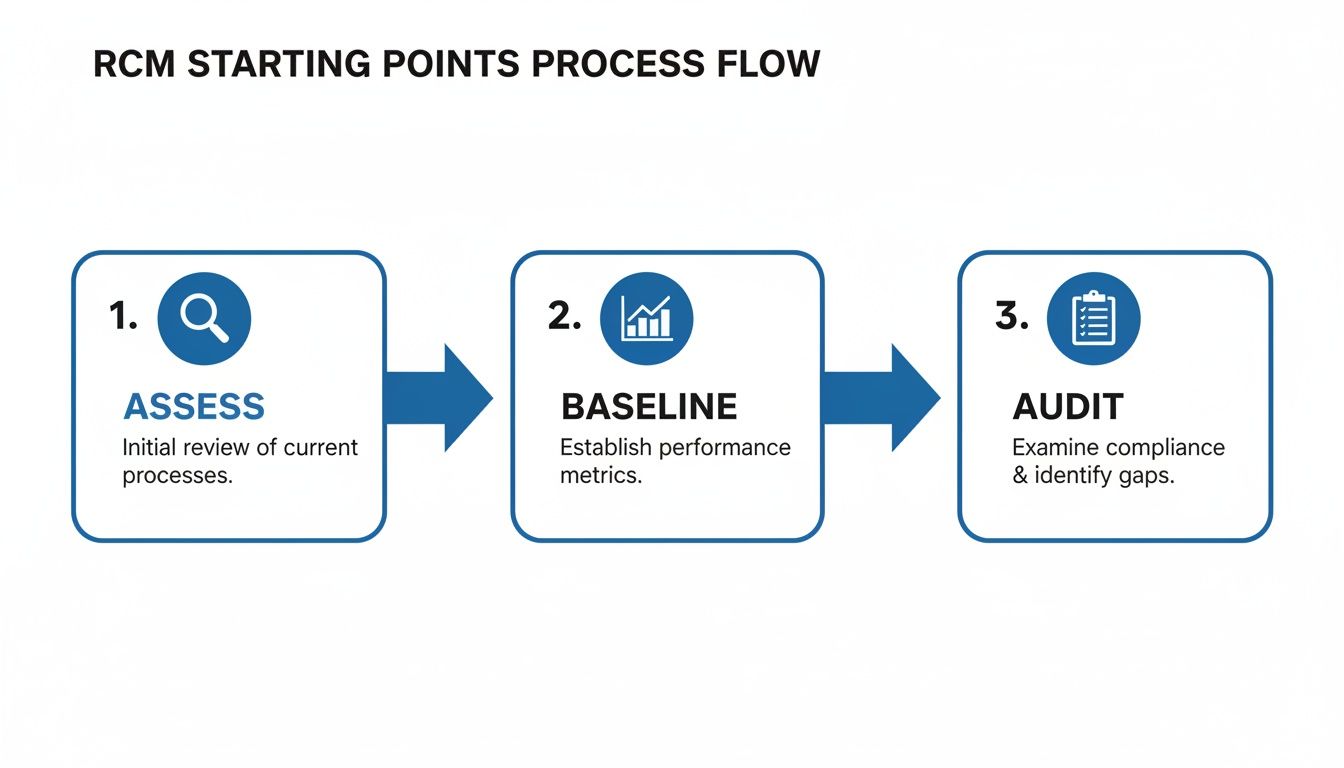
This simple flow—assessment, baselining with data, and auditing workflows—forms the bedrock of any successful RCM optimization strategy.
Establishing A Meaningful Baseline With KPIs
Once you have a general idea of your problem spots, it’s time to put some numbers to them using Key Performance Indicators (KPIs). These metrics are the vital signs of your revenue cycle.
Tracking KPIs allows you to measure your starting point, set realistic goals for the future, and see if your changes are actually working. To get a deeper dive into the fundamentals, check out our complete guide on understanding revenue cycle management.
Your KPIs tell the story of your revenue cycle. A high denial rate isn’t just a number; it’s a symptom of a breakdown somewhere upstream. A rising number of days in A/R is a flashing red light for your collections strategy.
The key is to focus on a handful of high-impact KPIs instead of getting lost in a sea of data. We've compiled the most critical metrics below to help you get started.
Essential RCM Performance Indicators To Track
Here are the essential KPIs you should be tracking to baseline your performance, along with the ideal industry benchmarks to see how you stack up.
Clean Claim Rate
- What It Measures: The percentage of claims accepted by a payer on the first submission.
- Industry Benchmark: 95% or higher
Denial Rate
- What It Measures: The percentage of claims denied by payers.
- Industry Benchmark: 5-10%
Days in Accounts Receivable (A/R)
- What It Measures: The average number of days it takes to collect payments due.
- Industry Benchmark: Under 40 days
Net Collection Rate
- What It Measures: The percentage of reimbursement you collect out of the total you're allowed to collect.
- Industry Benchmark: 95-99%
First Pass Resolution Rate (FPRR)
- What It Measures: The percentage of claims paid in full on the first submission without any rework.
- Industry Benchmark: 90% or higher
Tracking these numbers gives you a powerful, at-a-glance view of your financial performance and operational efficiency. The growing complexity of healthcare administration is exactly why this data-driven approach is no longer optional.
In fact, the global healthcare RCM market was valued at around $102.16 billion in 2024 and is projected to hit $291.19 billion by 2033. This massive growth underscores just how critical mastering your revenue cycle has become for survival and success.
Streamlining Front-End Processes To Prevent Denials
If you want to optimize your revenue cycle, don't start with your back-office collections team. The real magic happens the moment a patient schedules an appointment. It’s a staggering statistic, but some studies show that up to 90% of all claim denials can be traced back to simple errors made right at the front end.
We’re not talking about complex clinical coding mistakes here. We're talking about basic administrative slip-ups in patient registration, insurance eligibility, and prior authorizations.
Fixing these front-end workflows is the ultimate form of proactive denial management. When you build a solid foundation of accurate data before a patient even walks through the door, you eliminate the vast majority of payment headaches before they ever start. This lets your team shift its focus from chasing down old, denied claims to creating a smooth financial experience for everyone involved.

Fortifying Patient Registration And Data Accuracy
Think of your front desk as the first line of defense against claim denials. Every single piece of information they collect is a data point that determines whether you get paid cleanly or have to fight for it later. A single transposed digit in a policy number or a misspelled name is all it takes to bring the whole process to a grinding halt.
You can't leave this to chance. Your staff needs clear, standardized procedures to get it right every time.
- Implement a Registration Checklist: Create a simple, non-negotiable checklist that staff must use for every patient, every time. It should include verifying demographics, scanning the front and back of the insurance card, and confirming the primary subscriber's details.
- Provide Staff With Scripts: Don't make them guess what to say. Develop clear, empathetic scripts for collecting information. This ensures consistency and helps staff navigate tricky conversations, like asking for a Social Security number or discussing an outstanding balance.
- Conduct Regular Quality Audits: Every so often, pull a sample of recent patient registrations and review them for errors. This isn't about blaming anyone; it's about spotting recurring issues and identifying team members who might just need a little extra training.
By treating patient registration as a critical control point, you ensure every claim that follows is built on a rock-solid foundation of accurate data.
Building A Robust Insurance Verification Process
Verifying insurance eligibility isn't a "one and done" task. A patient’s coverage can change at the drop of a hat, even for people you've been seeing for years. A truly robust verification process confirms more than just an active policy—it dives into the specific details of the patient’s benefits before you render any services.
This is the step that prevents those frustrating denials for inactive policies, non-covered services, or unmet deductibles. The goal is to get a complete financial picture upfront.
A proactive eligibility check is the difference between a clean claim and a surprise denial. It transforms a reactive, frustrating process into a predictable, financially sound workflow.
Mastering Prior Authorizations And Financial Communication
Prior authorizations are a massive source of friction for almost every practice. They are time-consuming, maddeningly complex, and failing to get one is a guaranteed denial. There's no way around it; you need a systematic approach. If you're looking to get a better handle on this challenging area, you might find our guide on what prior authorization in healthcare is helpful.
Once you have clarity on benefits and any required authorizations, the final piece of the front-end puzzle is communication. Presenting the patient with a clear, accurate estimate of their financial responsibility is a huge part of the modern patient experience. It gets rid of surprises, makes it far more likely you'll collect their portion at the time of service, and builds a ton of trust. This kind of transparency is a hallmark of any high-performing, patient-focused revenue cycle.
Enhancing Mid-Cycle Workflows For Clean Claims
Once a patient leaves your office, the responsibility shifts from the front desk to your mid-cycle team. The precision and accuracy of their work—especially medical coding and charge capture—directly determine whether a claim gets paid on the first try or gets stuck in a loop of costly rework.
Think of it this way: clinical documentation is the evidence, and medical codes are the legal argument you present to the payer. If the evidence doesn’t fully support the argument, the payer (the judge, in this analogy) will reject the case outright. This is exactly why a sloppy mid-cycle process is a direct cause of cash flow disruption and administrative waste.

Ensuring Clinical Documentation Supports The Codes
The golden rule of medical coding is simple: if it wasn't documented, it wasn't done. Payers and their auditors operate on this principle, and your coding team must as well. A coder’s job isn't just to assign codes, but to make sure the provider's notes contain enough specific detail to justify those codes.
For example, a provider might document "shortness of breath," but a skilled coder knows that’s not enough. They need to know if it was exertional, positional, or paroxysmal nocturnal dyspnea. Each of those specifics points to a different, more accurate ICD-10 code and paints a much clearer picture of medical necessity.
A clean claim starts with clear documentation. By fostering a collaborative loop between your clinicians and coders, you build a powerful defense against audits and denials before a claim is even created.
This means encouraging regular communication. Your coders should feel empowered to query physicians for clarification when documentation is vague or incomplete. It’s not about questioning clinical judgment; it's about ensuring the record accurately reflects the complexity of care provided so you can be reimbursed appropriately.
Keeping Your Team Current With Coding Updates
The world of medical coding is never static. New ICD-10, CPT, and HCPCS codes are released annually, while payer-specific guidelines can change quarterly. A code that was perfectly valid last month might trigger an instant denial today.
This makes ongoing education a non-negotiable part of your RCM strategy. In fact, more than 40% of providers report that it takes two months or longer to receive reimbursement, and outdated coding is a common culprit. Staying current is one of the most direct ways to combat these delays.
To keep your team sharp, consider these practical steps:
- Subscribe to Official Updates: Make sure your team gets updates directly from sources like the AMA for CPT codes and CMS for HCPCS and national coverage determinations.
- Encourage Certification Maintenance: Support your coders in maintaining their credentials (like CPC or CCS), which require ongoing education units.
- Hold Regular Team Huddles: Dedicate a small part of your weekly meetings to discuss recent coding changes or review common denial reasons tied to coding.
These small, consistent efforts compound over time, preventing expensive errors and keeping your coding compliant. For a deeper dive, review our article on common medical coding errors.
A Systematic Approach To Charge Capture
Charge capture is the process of translating documented services into billable charges. A breakdown here means you're literally giving away services for free. A systematic process ensures that every single billable item—from the office visit to administered injections, supplies, and in-office procedures—is accounted for.
A "charge lag"—the time between service delivery and charge entry—is a silent killer of cash flow. The longer the lag, the older your A/R becomes before you even hit "submit." Aiming for a charge lag of 24-48 hours is a realistic and highly impactful goal.
Implementing a charge reconciliation process is key. This involves comparing daily appointment schedules or clinical notes against the charges posted in your system to catch any missed services. This simple daily audit is one of the most effective ways to plug revenue leaks and ensure you capture the full value of the care you provide.
Mastering Back-End Operations For Full Reimbursement
Even if your front-end and mid-cycle processes are flawless, the back-end of your revenue cycle is where the money actually comes in. This is where you manage claims, fight denials, and follow up on outstanding balances. If this final stage isn't buttoned up, all the careful work you did upfront goes to waste.
Think of the back end as your last chance to capture every single dollar your practice has earned. A strong back-end strategy isn't just about chasing down payments; it’s about systematically resolving accounts, spotting trends that are killing your performance, and closing the loop on the entire financial journey.
Proactive Claims Submission And Tracking
Submitting a claim is really just the first step. The real magic happens in the follow-up. You need a rock-solid system to track every claim from the moment it's submitted until the payment is in your bank account, making sure nothing slips through the cracks. This is where your clearinghouse becomes one of your most valuable partners.
Don't just use your clearinghouse as a digital mailbox to send claims. Actively monitor the reports. These reports are your early warning system, flagging simple rejections—like a wrong policy number or a missing modifier—often within hours. Catching and fixing these on the spot, before they escalate into formal denials, is one of the quickest ways to get cash in the door faster.
Your clearinghouse reports are your first line of defense. A claim "rejected at clearinghouse" is an easy fix, but a "denied by payer" claim turns into a complex, time-consuming appeal. Dealing with rejections proactively is a massive win for efficiency.
This simple shift turns claim submission from a passive "send and pray" activity into an active management strategy. By catching errors within a 24-hour window, you keep things moving and prevent tiny mistakes from snowballing into big financial headaches.
Building A Structured Denial Management Program
Denials are a fact of life in medical billing, but they don’t have to bleed your practice dry. The key is to stop just resubmitting denied claims and start building a structured program that gets to the root of why they’re happening in the first place.
A successful program has a few core parts:
- Categorize Everything: Stop looking at denials as one giant pile of problems. Group them by payer, by denial reason code, by provider, and even by CPT code. This is how you spot patterns. Seeing a sudden spike in "non-covered service" denials from a single payer? That’s your cue to go review their latest policy updates.
- Find the Root Cause: For your most common denial types, you have to dig deeper. A denial for "missing information" isn't just a one-off error; it's a symptom of a breakdown somewhere else, maybe at the front desk or during insurance verification. Fix the process, not just the claim.
- Create Team Ownership: Assign specific denial categories to different team members. This creates accountability and lets them become true experts on appealing certain denials, making them way more effective over time.
This analytical approach breaks the endless cycle of rework. Instead of constantly putting out fires, you're fireproofing your entire revenue cycle by fixing the fundamental issues.
Proven Strategies For Accounts Receivable Follow-Up
Your Accounts Receivable (A/R) is all the money owed to your practice. Letting it age without a plan is like watching your revenue disappear into thin air. A strategic follow-up process is absolutely essential. You can dig deeper into effective strategies by exploring our resources on medical billing A/R follow-up.
The secret here is prioritization. Not all outstanding claims are created equal. Your team’s time is finite, so they need to focus their energy where it will have the biggest impact.
The best way to do this is by segmenting your A/R aging report:
- Attack the High-Dollar Claims: Always start with the claims that have the highest dollar values. Resolving a single $5,000 claim makes a much bigger, faster difference to your cash flow than chasing down ten separate $50 claims.
- Focus on the Sweet Spot (30-60 Days): Next, hit the claims in the 30-60 day bucket. These are your most collectible accounts. The longer a claim goes unpaid, the lower the chances you'll ever see that money.
- Analyze the Old Stuff (90+ Days): For older claims, look for patterns. If one particular payer consistently lets claims age past 90 days, it might be time to escalate the issue or take a hard look at your contract with them.
When your team works through the A/R with a clear, systematic plan, they operate far more efficiently. This will dramatically reduce write-offs and ensure the money you've earned actually makes it to your bank account.
Leveraging Technology And Automation In Your RCM
In today's healthcare environment, relying on manual data entry and repetitive administrative tasks is like trying to win a race on foot. It’s not just inefficient; it's a direct threat to your bottom line. Technology isn't a luxury anymore—it's the engine required to optimize your revenue cycle.
By strategically applying automation and integrated software, you can transform your RCM from a collection of clunky, manual steps into a smart, cohesive system that works for you.
The first move is breaking down the walls between your most critical platforms. An integrated Electronic Health Record (EHR) and Practice Management System (PMS) is non-negotiable. When these two systems talk to each other seamlessly, clinical information flows directly into the billing process. This simple connection eliminates tons of duplicate data entry and dramatically cuts down on human error.
Integrating Your Core Systems For A Single Source Of Truth
A disconnected EHR and PMS is a recipe for disaster. Think about it: a clinician updates a patient's diagnosis in the EHR, but that change never makes it to the PMS. Your billing team, working with old information, submits a claim with an outdated code. What happens next? An instant—and completely avoidable—denial.
True integration means that every department, from the front desk to the back office, is working from the same, up-to-the-minute information. This single source of truth is the backbone of a clean revenue cycle. It guarantees consistency and accuracy from the moment a patient checks in to the final payment post.
Finding the right software can be a journey. If you're looking for guidance, explore our guide on the best medical billing software for small practices for some valuable insights.
Unlocking Efficiency With RCM Automation
Once your core systems are connected, you can start automating the high-volume, rules-based tasks that eat up your team's day. Automation isn't about replacing your staff. It’s about freeing them up to focus on the complex, high-value work that actually requires a human touch—like navigating a tricky denial appeal or speaking with a patient about a sensitive bill.
Here are a few areas just waiting to be automated:
- Eligibility and Benefits Verification: Instead of manual checks, automated software can run real-time eligibility on every single patient before their appointment. It instantly flags coverage issues, so you can solve them before the patient is even seen.
- Claim Status Checks: Forget having staff log into endless payer portals or sit on hold. Automated tools can check the status of hundreds of claims at once, only alerting your team to the ones that genuinely need attention.
- Payment Posting: Electronic Remittance Advice (ERA) files can be posted automatically to patient accounts. This saves countless hours of manual keying and virtually eliminates posting errors.
These automated workflows bring a level of speed and precision that manual effort simply can't match.
Shifting From Reactive To Proactive With Predictive Analytics
The most forward-thinking RCM strategies go beyond basic automation and step into the world of predictive analytics. Using artificial intelligence (AI) and machine learning, these powerful tools analyze your historical claim data to spot patterns and predict what’s coming next.
Predictive analytics is like having a crystal ball for your claims. It can flag a claim as high-risk for denial before you even submit it, based on the payer, CPT code, or documentation patterns. This gives your team a chance to fix the problem before it costs you money.
This proactive capability is a total game-changer. It shifts your team's mindset from constantly reacting to problems to actively preventing them. This is where the impact of AI becomes impossible to ignore.
AI and machine learning are fundamentally reshaping RCM. We're seeing predictive tools help providers reach 90% or higher coding accuracy rates and deliver a return on investment of over 300% in the first year alone. By thoughtfully integrating your systems, automating the grunt work, and using predictive insights, you build an RCM that isn’t just more efficient—it's far more profitable.
Frequently Asked Questions About RCM Optimization
When you decide it's time to tackle your revenue cycle management, a lot of questions pop up. It’s a big project that touches every single financial aspect of your practice. To help clear things up, we've put together answers to some of the most common questions we hear from practice administrators.

What Is The First Step I Should Take To Optimize My Revenue Cycle?
Before you do anything else, you need a comprehensive assessment of where you stand right now. You simply can't improve what you don't measure. The first move is always to establish a solid baseline with key performance indicators (KPIs) like your clean claim rate, overall denial rate, and days in A/R.
Think of this data as a diagnostic report for your practice’s financial health. It will immediately show you where the biggest opportunities are hiding. For instance, a high denial rate often points directly to front-end issues like patient registration errors, while a high days in A/R could mean your follow-up process isn't working. This data-first approach ensures you focus your energy on the specific breakdowns costing you the most money.
How Often Should My Practice Review RCM Performance?
Consistent review is non-negotiable, but the frequency depends on what you're looking at. A layered approach works best, allowing you to stay on top of performance without drowning in data.
Here's a rhythm we recommend:
- Daily Monitoring: Keep a quick pulse on operational metrics like daily charge entry, claim submissions, and any clearinghouse rejections. These are the frontline activities that fuel the entire cycle.
- Weekly/Bi-Weekly Reviews: Dig into your core KPIs—denial trends, A/R aging buckets, and collection rates—every one to two weeks with the practice manager or billing lead. This is where you spot trends.
- Monthly Strategic Meetings: Hold a high-level strategic review once a month with practice leadership. This is the time to look at the big picture, discuss persistent challenges, and make decisions on process improvements or technology investments.
This cadence ensures you catch small issues before they snowball into major financial headaches.
When Should A Practice Consider Outsourcing RCM?
A practice should start seriously looking at outsourcing its RCM when the in-house team is consistently struggling to solve problems on their own. The decision usually comes down to a few key indicators that your internal processes are stretched too thin.
Major red flags include a denial rate that stays stubbornly above the 5-7% industry benchmark, a growing chunk of your A/R aging past 90 days, or constant difficulty keeping staff trained on ever-changing payer rules and coding updates.
Outsourcing becomes a strategic move when billing and administrative tasks begin to divert too much time and focus away from patient-facing activities. It's about reallocating your team's energy back to what they do best: providing excellent care.
It's also a smart move for practices that want access to specialized expertise and better technology without the huge upfront cost. A dedicated RCM partner gives you a team of certified experts, powerful software, and scalable processes that a single practice would find difficult to afford or manage. It’s about tapping into a deeper well of resources to truly secure your practice’s financial future.
At One For All Medical Billing, we partner with practices to eliminate billing stress, reduce denials, and accelerate cash flow. Our U.S.-based team of certified experts becomes an extension of your own, handling the complexities of the revenue cycle so you can focus on patient care. Schedule your free consultation today and discover a healthier financial future for your practice.

