

table of contents
Prior authorization in healthcare is one of those administrative hurdles that sounds simple on paper but creates massive headaches in the real world. At its core, it’s a cost-control process where your practice must get an official green light from a patient’s health plan before you can provide a specific service, prescribe certain medications, or order medical equipment.
Think of it as a mandatory “permission slip” from the insurance company. They want to verify that a treatment is medically necessary according to their rulebook before they agree to pay for it. This checkpoint has become a standard, and often frustrating, part of delivering patient care.
Unpacking The Prior Authorization Process
Sometimes called pre-authorization or pre-certification, this process acts as a gatekeeper in the healthcare system. It's the primary tool insurance companies use to manage their costs and ensure the care you’re recommending aligns with the patient's specific coverage plan and their internal clinical guidelines. While the concept makes sense from a payer's perspective, its execution often creates significant friction for both medical practices and patients waiting for care.
The process is far more than a quick yes-or-no question. It kicks off a detailed review of the patient's medical history, your clinical notes, and a formal justification explaining why a particular treatment is the right choice.
You’ll most often run into prior authorization requirements for:
- High-Cost Medications: Specialty drugs for conditions like cancer, multiple sclerosis, or rheumatoid arthritis.
- Advanced Imaging Services: Procedures like MRIs, CT scans, and PET scans that come with a high price tag.
- Planned Surgeries: Elective procedures, such as joint replacements or bariatric surgery.
- Durable Medical Equipment (DME): Items like insulin pumps, specialized wheelchairs, or home oxygen equipment.
For a clearer picture, here’s a quick breakdown of the moving parts.
Key Aspects Of Prior Authorization At A Glance
Let's break down the key components involved in this process:
- The Goal: To confirm medical necessity and control costs for the payer before a service is delivered.
- The Players: Your practice (the provider), the patient, and the health insurance company (the payer).
- The Trigger: A provider recommends a service, medication, or device that is on the payer’s pre-approval list.
- The Outcome: An approval (allowing the service), a denial (requiring an appeal), or a request for more info.
This breakdown shows just how many steps and stakeholders are involved in what should be a straightforward decision about patient care.
The Real-World Impact On Care Delivery
While payers frame prior authorization as a quality control tool, its administrative weight is undeniable. A staggering national survey revealed that 94% of physicians report this exact process leads to delays in necessary patient care.

This isn't just a minor inconvenience; for many patients, it becomes a serious barrier to getting the treatment they need when they need it. The volume of these requests in the U.S. healthcare system is immense. For example, Medicare Advantage plans alone fielded nearly 50 million prior authorization requests in a single year. These administrative hurdles are a major factor in a practice's financial health and are a core piece of the puzzle when you start exploring what is revenue cycle management.
The core definition is consistent across all systems: prior authorization is an insurer’s demand that a provider obtains approval before delivering a specific service, drug, or device if they expect to be paid for it.
Ultimately, this entire process forces your team to pour precious time and resources into administrative tasks instead of focusing on patients. The endless paperwork, phone calls, and portal submissions required to chase down an approval can stall treatment for days or even weeks. This not only frustrates patients but also strains the operational capacity of your practice, making efficient management of authorizations absolutely essential for survival.
Why Do Payers Require Prior Authorization Anyway?
From a medical practice's point of view, prior authorization often feels like an arbitrary roadblock thrown up just to make life harder. To get through it, though, you have to understand what it looks like from the other side of the fence. For insurance companies, it isn't a hurdle—it's a fundamental tool for managing risk and controlling costs.
At its core, the system is a financial checkpoint. Payers use it to make sure the recommended treatments, tests, or medications are medically necessary and cost-effective based on established clinical guidelines. This verification step is their main defense against unnecessary spending, ensuring their resources go toward appropriate care.
Guarding Against Unnecessary Costs
The biggest reason for prior authorization is the relentless rise of healthcare costs. As brand-new, expensive technologies and specialty drugs hit the market, payers put these checks in place to validate their use. They want to avoid paying for a premium option when a more affordable, equally effective alternative is available.
This is especially true for services with a high potential for overuse or those that come with a hefty price tag. By requiring pre-approval, payers get to scrutinize the clinical reasoning before they commit to paying for the service.
The central goal for a payer is to confirm that a proposed treatment aligns with both the patient's coverage plan and accepted standards of care, thereby preventing payment for services deemed experimental, cosmetic, or not medically justified.
This gatekeeper role helps them manage their financial risk across millions of members, which they argue is essential to keeping health plans sustainable. Without it, they say, premiums for everyone would climb even faster.
What Services Usually Trigger A Review?
While you don't need pre-approval for a routine check-up, certain categories are almost guaranteed to be flagged for a prior authorization review. Knowing which procedures fall into this bucket helps your practice get ahead of the game by gathering the necessary documents from the start.
Common services that almost always need pre-approval include:
- Expensive Specialty Drugs: High-cost pharmaceuticals and biologics for treating complex conditions like cancer, rheumatoid arthritis, or hepatitis C are prime candidates.
- Advanced Diagnostic Imaging: Services like Magnetic Resonance Imaging (MRIs), Positron Emission Tomography (PET) scans, and Computed Tomography (CT) scans are frequently reviewed due to their high cost.
- Major Elective Surgeries: Non-emergency procedures, such as joint replacements, spinal fusions, or bariatric surgeries, typically require a deep dive into the patient's clinical history.
- High-Tech Medical Equipment: Durable medical equipment (DME) like advanced prosthetics, power wheelchairs, or infusion pumps often needs a green light before being dispensed.
By flagging these specific services, payers can focus their energy on the procedures that carry the biggest financial weight.
Ensuring Care Follows Clinical Guidelines
Beyond just saving money, prior authorization also serves to promote standardized, evidence-based medicine. Insurance companies build their policies around extensive clinical guidelines developed from medical research and expert consensus.
When your office submits a request, the payer’s clinical review team compares it against these internal standards. They’re checking to see if the proposed treatment is the right next step in the patient’s care journey. For instance, they might want to see proof that a patient has already tried and failed a less invasive treatment before they’ll sign off on a major surgery.
This process ensures that care decisions line up with widely accepted best practices, which is meant to improve patient safety and outcomes. When your practice understands this part of the process, you can better anticipate the clinical details payers need to see, setting up your submissions for a much smoother, faster approval.
The Step-By-Step Prior Authorization Workflow
Navigating the prior authorization process can feel like you're trying to solve a puzzle with constantly changing pieces. But when you break it down, the workflow is actually a logical sequence of steps. Understanding this flow turns what feels like a confusing administrative burden into a manageable checklist.
Think of it like building a case for your patient's care. Your practice gathers all the evidence—clinical notes, test results, and medical history—and presents it to the payer for review. The strength and clarity of that initial submission directly impact how quickly and favorably the insurance company responds.
Stage 1: Verifying Authorization Requirements
The journey starts the moment a provider decides a particular service, medication, or piece of equipment is medically necessary. Before a single form is filled out, the very first step is to confirm if a prior authorization is even required. This isn't always obvious, as payer rules can change without notice and vary wildly between different health plans.
This initial check involves matching the patient’s specific insurance plan against the CPT or HCPCS code for the proposed service. Skipping this step is a recipe for disaster. You could either face an automatic denial down the road for a service that did need pre-approval, or waste precious time submitting an unnecessary request.
This is especially true for services that payers watch closely.
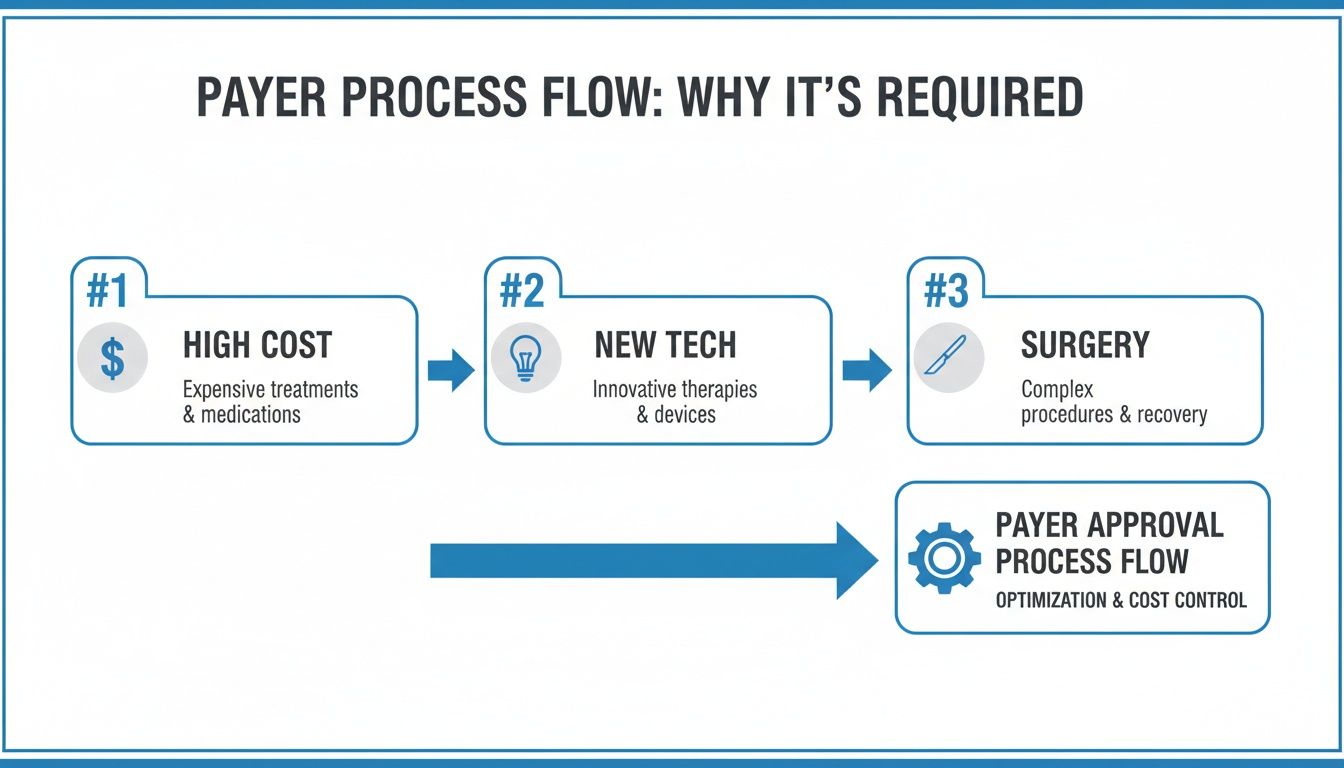
As the diagram shows, payers focus their review efforts on procedures that carry the highest financial risk, like major surgeries or treatments involving new tech. Verifying the need for a PA on these is non-negotiable.
Stage 2: Compiling Clinical Documentation
Once you've confirmed an authorization is needed, it’s time to gather all the required clinical documentation. This is where you build your argument for medical necessity. A weak or incomplete submission is one of the top reasons for a flat-out denial.
The goal here is simple: paint a complete picture of the patient's condition and leave no doubt about the rationale behind the recommended treatment.
Key documents almost always include:
- Detailed Provider Notes: These should clearly explain the patient's diagnosis, symptoms, and the specific reasons for ordering the service.
- Relevant Test Results: Be sure to include labs, imaging reports, and any other diagnostic findings that back up the provider's decision.
- Treatment History: Document any previous treatments or medications that were tried and failed. This demonstrates a thoughtful progression of care and strengthens your case.
A well-documented prior authorization request tells a clear story, leaving no room for the payer to question the medical necessity of the proposed care. This proactive approach is fundamental to avoiding delays.
This compilation phase is often the most time-consuming part of the entire workflow, demanding meticulous attention to detail.
Stage 3: Submitting The Request
With all the necessary documents in hand, the next step is to formally submit the prior authorization request to the insurance company. Most of the time, this is done through the payer’s dedicated online portal, though some submissions still happen the old-fashioned way via fax or phone.
During submission, accuracy is everything. Even a small clerical error, like a mistyped policy number or an incorrect date of birth, can cause the entire request to be kicked back, forcing you to start over. It's why many practices are exploring the benefits of automating your medical billing workflow—to cut down on these manual errors and get requests submitted faster.
Stage 4: Payer Review And Final Decision
After your request is submitted, it officially enters the payer's review process. A clinical reviewer—usually a nurse or physician working for the insurance company—evaluates the documents you sent against the health plan's specific medical policies and clinical guidelines.
How long this takes can vary quite a bit. Standard requests can take anywhere from seven to fourteen business days, while requests marked as urgent are typically handled within 72 hours.
The final outcome will be one of three things:
- Approved: The service gets the green light, and you receive an authorization number to include on the claim.
- Denied: The payer decides the request doesn't meet their criteria for medical necessity.
- Request for More Information: The reviewer needs additional clinical details to make a final call.
If a request is denied, the workflow isn't over. It simply moves into the appeals process, which requires an even more detailed and strategic approach to overturn the initial decision and secure payment for the care your patient needs.
How Denials Impact Your Practice's Bottom Line
A prior authorization denial is far more than just a piece of administrative bad news. It's a direct and often significant blow to your practice's revenue cycle. Each rejected request triggers a cascade of financial consequences that can strain your resources, hurt patient relationships, and ultimately shrink your bottom line.
Think of a denial not as a final "no," but as the start of a costly and time-consuming battle to get paid for services you’ve already determined are medically necessary. This creates a ripple effect that's felt across your entire operation.
The Direct Hit Of Lost Revenue
The most obvious impact is the immediate loss of revenue. If a service is performed without a valid authorization, the payer has every right to refuse payment. Simple as that.
This leaves you with a tough choice: absorb the full cost as a write-off or try to bill the patient directly. The first option eats into your margins, while the second can damage trust and rarely results in full payment. This uncompensated care adds up fast, especially for practices performing procedures that regularly need pre-approval.
A single denied MRI or a rejected course of specialty medication can mean hundreds or even thousands of dollars in lost income. Over a year, these individual losses can accumulate into a major financial deficit.
The Hidden Costs Of Appeals
Beyond the lost payment, a denial kicks off an expensive internal process. Your administrative team now has to drop what they're doing to investigate the rejection, gather more clinical documentation, and craft a compelling appeal. This isn’t a simple task; it’s a detailed, often frustrating effort that pulls your staff away from essential duties like patient scheduling and submitting new claims.
This is a significant "soft cost." You're essentially paying your team to re-do work that could have been approved the first time with a stronger initial submission. This operational drag reduces efficiency and inflates your cost-to-collect, eroding your profit margins with every appeal letter sent and follow-up call made.
A denied authorization doesn't just halt payment; it creates a new, unfunded workload for your practice. The resources spent on appeals are a direct drain on your operational budget, making a strong initial submission the most cost-effective strategy.
To help you get ahead of these issues, here's a quick look at the most frequent denial reasons we see and how to proactively address them.
Common Denial Reasons And How To Prevent Them
- Denial Reason: Missing or Incomplete Information
- How To Prevent It: Double-check that all fields on the submission form are complete and accurate before sending. Use a checklist for every submission.
- Denial Reason: Lack of Medical Necessity
- How To Prevent It: Ensure the clinical documentation clearly and explicitly supports why the service is medically necessary for that specific patient.
- Denial Reason: Service Not Covered by Plan
- How To Prevent It: Always perform a thorough insurance verification check before submitting the request to confirm the patient’s benefits.
- Denial Reason: Untimely Filing
- How To Prevent It: Know each payer’s submission deadlines and have an internal process to submit requests well before the service date.
- Denial Reason: Incorrect CPT or ICD-10 Codes
- How To Prevent It: Have certified coders review all codes for accuracy and specificity before the authorization request is sent.
Avoiding these common pitfalls is the first step toward reducing your denial rate and protecting your bottom line.
Damaged Patient Experience And Retention
The financial fallout of denials extends beyond your practice's ledger. When a patient’s necessary treatment is delayed or denied, it causes them significant stress, anxiety, and frustration. They often don't understand the complex administrative battle happening behind the scenes and may blame your practice for the delay in their care.
This negative experience can have long-term consequences. A patient who feels their care was mishandled due to red tape is less likely to return and more likely to share their poor experience with others. In a competitive healthcare market, patient retention is crucial, and a reputation for authorization headaches can drive patients to seek care elsewhere.
Effectively handling these issues is a core part of comprehensive medical billing denial management, which aims to resolve claims efficiently while preserving the all-important patient relationship.
Proven Strategies To Cut Down Authorization Delays
Once you see how denials drain your finances and create operational headaches, the natural next step is to get proactive. Winning the prior authorization battle isn't about working harder; it's about working smarter. By implementing a few proven strategies, your practice can shift from constantly putting out fires to preventing them in the first place.
This means building a solid system that anticipates what payers want, sidesteps common errors, and gets clean, well-documented requests out the door from the start. The goal is to smooth out the process, slash the time spent on rework, and get that first-pass approval rate way up.
Fortify Your Upfront Processes
The absolute best way to prevent delays and denials is to stop them before they even have a chance to happen. Bolstering your front-end administrative tasks is the single most important move you can make. It all starts with rigorous insurance eligibility and benefits verification for every single patient, every single time. No exceptions.
Your team has to confirm not only that the patient’s coverage is active but also the specific prior auth requirements for the planned service under their exact plan. Top-performing practices treat this as a non-negotiable checkpoint that flags potential issues right away.
Think of a well-run verification process as your early-warning system. It spots authorization needs immediately, buying your team the maximum amount of time to prepare and submit a complete request—which is absolutely critical for timely patient care.
Another game-changer is creating standardized documentation templates for services you perform often. For common procedures that need a green light, having a ready-made checklist ensures everyone—from clinical to admin staff—gathers the exact information payers are looking for. It takes the guesswork completely out of the equation.
Embrace Technology And Automation
Let’s be honest: managing prior authorizations with phone calls and fax machines is a relic of the past. The healthcare industry is finally moving toward digital solutions, and using electronic prior authorization (ePA) technology is now essential for any practice that’s serious about efficiency.
These platforms often plug right into your Electronic Health Record (EHR) system, automating a huge chunk of the submission process. They can pull patient data, attach clinical notes, and fire off requests directly to payer portals, which dramatically reduces clerical errors and saves your team from countless hours of tedious work.
This isn't just a trend; it's a massive shift driven by new regulations. The sheer inefficiency of the old system triggered a wave of reforms, including the CMS Interoperability and Prior Authorization Rule, which forces many government-regulated plans to make faster decisions and exchange data electronically. Industry groups are also pushing to move submissions online, aiming for real-time approvals for most requests. For anyone managing a complex revenue cycle, like in a high-volume clinic, keeping up is non-negotiable. You can learn more in our detailed guide to urgent care revenue cycle management. These changes mean that modern workflows must support ePA and talk to payer APIs to meet tighter deadlines. To see how the industry is adapting, you can read the full analysis on the prior authorization shakeup from Everest Group.
Create A Proactive Tracking System
Hitting "submit" on a request is only half the job. Diligent follow-up is what actually gets it across the finish line. A "submit and forget" attitude is a surefire way to cause preventable delays. What you need instead is a systematic process for tracking every single submission from start to finish.
This could be a dedicated spreadsheet, a project management tool, or a feature built into your practice management software. The tool doesn't matter as much as the discipline. The key is having one central place to log every request and set reminders for follow-up.
Implement this simple tracking checklist:
- Log Every Submission: Immediately record the patient's name, payer, service, submission date, and any confirmation number.
- Set Follow-Up Dates: Look up the payer’s stated turnaround time and schedule a calendar reminder to check the status a day or two before the deadline hits.
- Document All Communication: Keep detailed notes of every phone call or portal message. Include the date, time, and the name of the representative you spoke with.
- Confirm the Approval Number: Once it's approved, make sure the authorization number is correctly entered into the patient's file and attached to the future claim.
This disciplined approach ensures no request falls through the cracks and empowers you to resolve issues before they ever affect patient care or your bottom line.
How Expert Medical Billing Services Streamline Authorizations
Let's be honest: managing prior authorizations can feel like a full-time job. It’s a huge administrative headache that pulls your staff away from what they're supposed to be doing—caring for patients. For practices feeling buried under the paperwork, partnering with an expert medical billing service isn't just a relief; it's a powerful strategic move.
Handing over the authorization process means lifting that entire burden from your team. A dedicated partner steps in and handles the whole lifecycle, from proactively verifying requirements during eligibility checks to submitting meticulously prepared clinical packets. Their specialized knowledge becomes your greatest asset, ensuring every submission is complete, accurate, and ready to meet payer guidelines right from the start.

Unlocking Efficiency And Protecting Revenue
The real value of bringing in a billing partner is the immediate boost to your efficiency and financial stability. A specialized team lives and breathes payer rules. They know the nuances between different insurance companies and stay on top of their constantly shifting requirements. That insider knowledge is exactly what you need to navigate the system effectively and get approvals faster.
Their process typically includes:
- Diligent Request Tracking: Every single submission is monitored from beginning to end. Proactive follow-ups ensure nothing falls through the cracks and costly delays are avoided.
- Expert Appeals Management: If a denial does happen, the team manages the entire appeals process. They know how to build a compelling case to overturn the decision and recover the revenue you’ve earned.
This focused approach has a direct impact on your clean claim rate—the percentage of claims paid correctly on the very first submission. When that rate goes up, your cash flow accelerates and your practice's bottom line gets a lot healthier.
By entrusting prior authorizations to a dedicated team, medical practices can significantly reduce staff burnout, minimize administrative errors, and allow clinical teams to focus entirely on what matters most—delivering exceptional patient care.
The Strategic Advantage Of A Billing Partner
Ultimately, outsourcing your authorizations is a strategic play to optimize your entire revenue cycle. It frees your in-house staff to concentrate on patient-facing roles, which improves both the employee and the patient experience. When your clinical team isn't bogged down by insurance paperwork, they can dedicate their full attention to patient needs, leading to better outcomes and higher satisfaction.
This partnership acts as a shield for your practice's financial health, preventing the revenue leaks caused by denials and delays. It transforms a frustrating administrative bottleneck into a smooth, predictable operation managed by professionals. By leveraging the expertise of medical billing services near me, practices can lock down their financial stability while doubling down on their commitment to patient care. This doesn't just help you survive in today's complex healthcare landscape—it helps you thrive.
Answering Your Top Prior Authorization Questions
Even once you get the hang of the prior authorization process, specific questions always seem to pop up. Let's tackle some of the most common ones we hear from medical practices and patients.
How Long Does A Prior Authorization Usually Take?
This is the big one, and unfortunately, the answer is "it depends." The timeline for getting a decision hinges on the urgency of the request, the complexity of the case, and how efficient the insurance company is.
For an urgent request—where a delay could seriously harm the patient's health—payers are typically required to give an answer within 72 hours. Standard, non-urgent services are a different story; they can take anywhere from a few days to a few weeks. The good news is that new regulations are starting to push health plans to speed things up.
What’s The Difference Between Prior Authorization And Precertification?
You’ll often hear these terms used interchangeably, but there's a slight difference. It helps to think of them as two sides of the same coin.
- Precertification is the clinical review. It’s the step where the payer checks if a service is medically necessary and aligns with standard care guidelines.
- Prior Authorization is the official green light that follows. It not only confirms medical necessity but also serves as the formal approval from the insurer to cover the cost.
So, while they are closely related, prior authorization is the final financial approval you absolutely need before moving forward with a service.
While a service might be "precertified" as medically appropriate, it's the final "prior authorization" that locks in the payer's promise to pay for it, making it the more critical step for your revenue cycle.
Can A Patient Receive A Service Without Prior Authorization?
Technically, yes, a patient can physically receive a service without getting the required pre-approval. Financially, though, it’s a disaster waiting to happen. If your practice provides a service that needed a prior auth but you didn't get one, the insurance company will almost certainly deny the claim.
That leaves you with two terrible options: your practice eats the entire cost, or you have to bill the patient for the full amount. This can ruin the patient relationship and put a major dent in your finances, which is why securing that authorization upfront is non-negotiable.
How Does Technology Help With The Prior Authorization Process?
Technology is a massive help in taming this beast of a process. The biggest leap forward has been Electronic Prior Authorization (ePA). These digital platforms often integrate directly with a practice's Electronic Health Record (EHR) system to automate huge chunks of the workflow.
With ePA, your team can submit requests, attach clinical documents, and get real-time status updates—all from one place. This slashes the time spent on phone calls and faxes, cuts down on manual errors, and speeds up the entire approval timeline.
Navigating the minefield of prior authorizations is vital to your practice's financial health. One For All Medical Billing provides expert revenue cycle management to handle the entire authorization process for you, reducing denials and accelerating your cash flow. Learn how our dedicated team can protect your revenue and free your staff to focus on patient care at https://oneforallmed.com.

