

table of contents
Think of Revenue Cycle Management (RCM) as the financial engine of your healthcare practice. It’s not just about sending out bills and waiting for checks. It’s the entire, end-to-end process that starts the moment a patient books an appointment and only finishes when you’ve been paid in full for your services.
Getting a handle on RCM is non-negotiable for keeping your practice financially healthy so you can stay focused on what matters most—caring for patients.
What Exactly Is Revenue Cycle Management?
Let's use an analogy. If your practice's cash flow is its circulatory system, then RCM is the heart that pumps life-sustaining revenue to every part of the organization. A healthy revenue cycle delivers the cash you need to pay your staff, invest in new equipment, and keep the lights on.
When this system is running smoothly, your practice thrives. But just one small clog—a typo during patient registration, an incorrect medical code, a missed filing deadline—can disrupt the entire flow. Suddenly, you’re dealing with delayed payments, denied claims, and financial stress that pulls your attention away from patient care.
More Than Just Billing
It’s a common misconception that RCM is just a fancier term for medical billing. While billing is a critical step, it’s only one piece of a much larger, interconnected puzzle.
True RCM covers every single administrative and clinical function that contributes to capturing, managing, and collecting revenue for the services you provide. This includes everything from the front desk to the back office, creating a seamless journey that catches errors early and maximizes reimbursement. The growing complexity of healthcare finance highlights its importance; the global RCM market was valued at over $58 billion and is projected to expand significantly, showing an urgent need for providers to modernize. You can learn more about the market growth from this revenue cycle management market research.
To put it simply, RCM is about connecting the dots between the clinical side of your practice (patient care) and the business side (financial management). Let's break down the core functions.
The Core Functions Of Revenue Cycle Management
At a high level, the RCM process can be broken down into several essential functions, each with a specific objective aimed at ensuring timely and accurate payment.
- Patient Registration & Eligibility Verification: The objective is to collect accurate demographic and insurance data, and confirm coverage before the visit to prevent front-end denials.
- Medical Coding & Charge Capture: The objective is to translate clinical services into standardized codes (CPT, ICD-10) and ensure all billable services are captured correctly.
- Claim Submission & Scrubbing: The objective is to submit clean, error-free claims to payers electronically and fix any potential issues before submission.
- Payment Posting & Reconciliation: The objective is to accurately post payments from payers and patients, and reconcile accounts to ensure everything balances.
- Denial Management & A/R Follow-Up: The objective is to investigate, appeal, and resolve denied claims while actively pursuing unpaid accounts receivable (A/R).
Viewing these steps as an interconnected cycle, rather than separate tasks, is the key to building a resilient financial foundation for your practice.
At its core, RCM is a strategic framework designed to prevent revenue leakage. It ensures you are properly compensated for the valuable services you provide.
Ultimately, a strong grasp of RCM is what gives you the financial stability to navigate payer complexities, regulatory changes, and rising operational costs. Understanding the benefits of revenue cycle management is the first step toward building a more successful practice. In the following sections, we'll dive into each stage of this vital process.
Navigating Each Stage Of The RCM Process
The best way to understand revenue cycle management is to see it as a chain of events, not a list of separate tasks. Each link depends entirely on the one before it. A tiny mistake at the very beginning—something as simple as a typo in a patient's name—can cause huge financial headaches down the road, turning a simple reimbursement into a time-sucking, costly mess.
To really get a handle on it, let's break the cycle into three main phases: the front-end, the mid-cycle, and the back-end. Each one has critical steps that have to be done right to keep cash flowing. We'll walk through the whole journey, from the first time a patient calls to the final payment hitting your account.
This chart shows the core flow, mapping the simple but essential path from scheduling an appointment to getting paid for the care you provide.
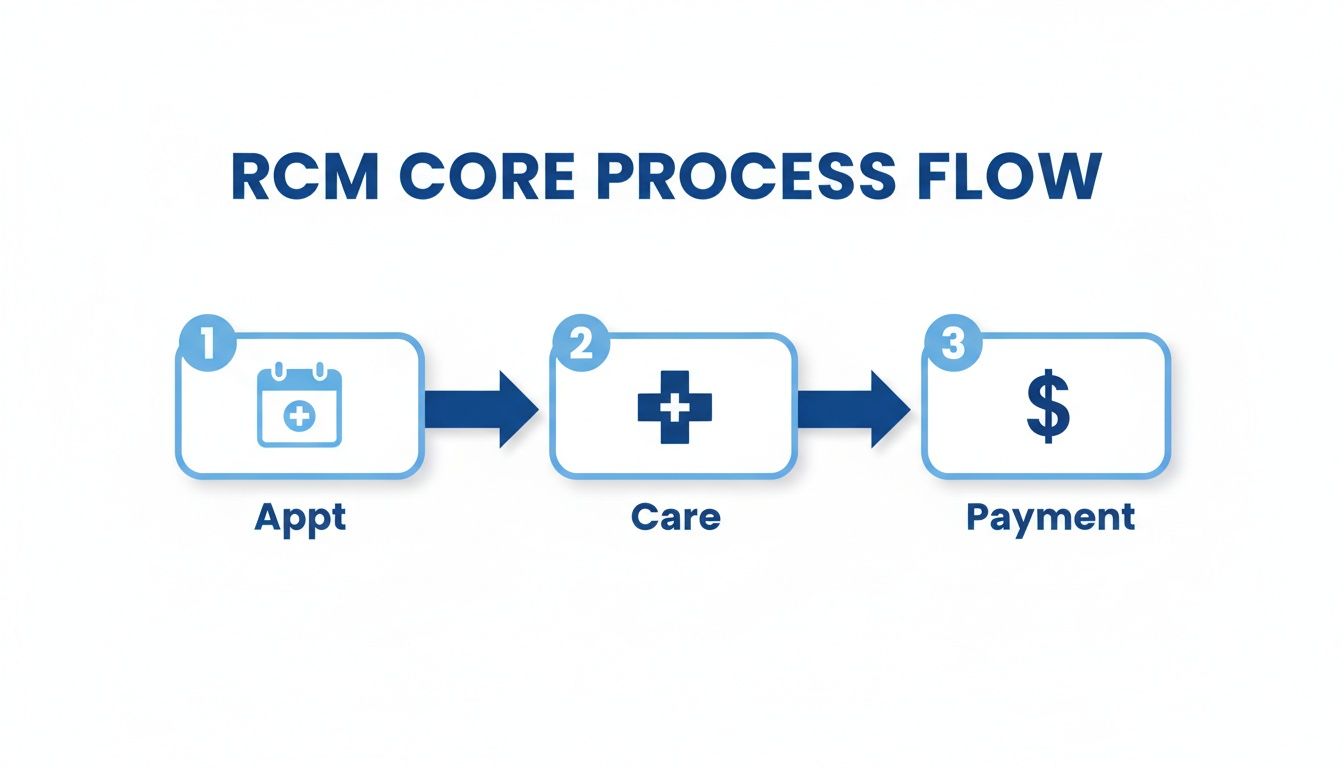
As you can see, every single step is part of one continuous financial journey.
The Front-End: Where It All Begins
The front-end covers everything that happens before or during the patient's visit. This stage is, without a doubt, the most important because it sets the foundation for the entire claim. Get it wrong here, and you're practically guaranteeing a denial later.
The key activities at this stage are all about getting the data right:
- Patient Registration and Scheduling: This is your first shot at collecting accurate information. It's about more than just a name and phone number; it’s about getting the patient’s demographics and insurance details 100% correct. A single digit off in a policy number can bring the whole process to a halt.
- Insurance Eligibility and Benefits Verification: Before the patient even walks in the door, your team needs to confirm their insurance policy is active and actually covers the services you plan to provide. This simple check uncovers co-pays, deductibles, and prior authorization needs, preventing those dreaded surprise bills for patients and denials for you.
- Prior Authorization Management: Many payers demand pre-approval for certain procedures. This isn't optional. Failing to get a required prior authorization is one of the fastest ways to get a claim denied, period.
Think of the front-end process as pouring the foundation for a house. If the concrete is mixed wrong or poured unevenly, everything you build on top of it will be unstable and eventually crack.
A disciplined front-end process catches the vast majority of preventable errors, paving the way for a smooth reimbursement.
The Mid-Cycle: Translating Care Into Charges
The mid-cycle is where the clinical work gets translated into the language of billing. It’s the crucial bridge between what happens in the exam room and what gets sent to the insurance company, and it requires absolute precision.
Here’s what happens in the middle:
- Clinical Documentation: The physician’s notes have to be detailed and accurate. This documentation is the "source of truth" that justifies the codes you choose and is your best defense in an audit.
- Medical Coding: Certified coders take those clinical notes and assign standardized codes (CPT, ICD-10, HCPCS) to every diagnosis and procedure. Accurate coding tells the payer a clear, correct story about the patient's visit.
- Charge Capture: This is the process of making sure every single billable service is actually accounted for. Revenue leakage is a huge problem here—services are provided but never make it onto the claim, which is just lost money.
This phase is all about the details. One wrong code or a missed charge doesn't just mean you get paid less; it can also trigger compliance red flags if an auditor comes knocking.
The Back-End: Collecting And Finalizing Payment
The back-end is where the money comes in—or doesn't. This is where your team submits claims, posts payments, and chases down every last dollar to close out the account.
The journey ends with these final, critical steps:
- Claim Submission: All the coded information is bundled into a formal claim and sent to the payer. Most practices today use a medical billing clearinghouse to "scrub" claims for errors before they go out, which massively improves the odds of getting paid on the first try.
- Payment Posting: Once the payer processes the claim, they send back a payment and an explanation (an EOB or ERA). Your team posts this payment to the patient’s account, making any contractual adjustments along the way.
- Denial Management: If a claim gets denied, the work is just getting started. A dedicated team has to dig in, figure out why it was denied, fix the error, and appeal the decision. A shocking 63% of denied claims are recoverable, but too many practices just write them off.
- Accounts Receivable (A/R) Follow-Up: This is the active management of all unpaid claims. The A/R team hounds payers for delayed payments and works to resolve any issues holding up your money.
- Patient Collections: After insurance pays its share, the remaining balance (co-pays, deductibles) is billed to the patient. Clear communication and offering flexible ways to pay are essential to actually collecting these final amounts.
Each stage flows directly into the next. It’s easy to see how a small slip-up during registration can create a massive denial management headache weeks or even months later. A holistic view is the only way to build a financially strong practice.
The Metrics That Truly Measure RCM Success
After you've navigated the complexities of the revenue cycle, one big question remains: how do you actually know if it’s working? The answer is by tracking a few essential key performance indicators (KPIs). These aren't just abstract numbers; they're the diagnostic tools that turn the fuzzy concept of "financial health" into concrete, measurable results.
Think of these KPIs as the vital signs for your practice's revenue cycle. Just like a doctor checks a patient's pulse and blood pressure, you have to monitor these figures to see what’s healthy and what needs immediate attention. They tell the real story behind your cash flow and point directly to the weak spots in your process so you can make targeted improvements.

Without tracking these core metrics, you're essentially flying blind. You can't tell the difference between a minor hiccup and a major financial threat.
Clean Claim Rate
Your Clean Claim Rate (CCR) is arguably the most important front-end metric. It measures the percentage of claims that get accepted and processed by a payer on the very first try, with no errors or rejections. A high CCR is a direct reflection of a detail-oriented and efficient front-end process.
- What It Reveals: A low CCR almost always signals trouble at the start of your cycle, like issues with patient registration, insurance verification, or coding accuracy. It means your team is spending way too much time on rework.
- Industry Benchmark: Top-performing practices consistently hit a CCR of 90% or higher.
- How to Calculate It: (Total number of clean claims accepted / Total number of claims submitted) x 100.
Improving this one metric creates a powerful ripple effect, lightening the load on your back-end team and speeding up your entire payment timeline.
Days In Accounts Receivable
Days in Accounts Receivable (A/R) measures the average number of days it takes for your practice to actually get paid. Put simply, it tells you how long your money is stuck in unpaid accounts. A lower number is always better—it means you have a swift and effective collections process.
A high Days in A/R number is a major red flag. It suggests that a significant chunk of your cash flow is tied up in unresolved claims, which can seriously strain your ability to cover day-to-day operational expenses.
Keeping this number down requires a proactive approach. You can learn more about how to strengthen this part of your cycle by exploring our detailed guide on medical billing A/R follow-up.
- What It Reveals: High Days in A/R often points to bottlenecks in your back-end process, like slow denial follow-up or a failure to chase down aged claims.
- Industry Benchmark: A healthy A/R is typically under 40 days, with high-performers aiming for under 30.
- How to Calculate It: Total Accounts Receivable / Average Daily Charges.
Denial Rate
Your Denial Rate is the percentage of claims that get kicked back by payers. While a 0% denial rate isn't realistic, you have to keep this metric as low as humanly possible. Every single denial disrupts your cash flow and eats up staff time to investigate and appeal.
Tracking this metric consistently helps you spot patterns. For example, you might discover that one specific payer frequently denies claims for a particular service, allowing you to get to the root of the problem and fix it.
This is an area where modern technology is making a huge difference. AI-powered RCM tools are now automating claim scrubbing and flagging potential errors before submission, which directly lowers denial rates. In fact, AI could generate up to $360 billion in annual savings by reducing denials and cutting administrative costs across the healthcare industry.
Net Collection Rate
Finally, the Net Collection Rate (NCR) shows you how much of the money you're supposed to be paid you're actually collecting. This is the ultimate bottom-line metric because it measures your ability to collect the maximum allowable reimbursement from both payers and patients.
- What It Reveals: A low NCR is a clear sign of revenue leakage. It means money is being left on the table due to things like uncollected patient balances, unresolved denials, or missed filing deadlines.
- Industry Benchmark: An excellent NCR is 95% or higher.
- How to Calculate It: (Total payments received / Total charges allowed by payers) x 100.
By consistently keeping an eye on these four KPIs, you can move from guessing to knowing. You can transform your RCM from a reactive cost center into a proactive, data-driven financial engine for your practice.
Fixing The Most Common Revenue Cycle Failures
Even the sharpest, most efficient practices can watch their revenue cycle grind to a halt. The financial engine of a healthcare group is a complex machine, and a few loose bolts can quickly cause a major breakdown in cash flow. Pinpointing these common failure points is the first, and most important, step to fixing what’s broken.
Think of it like being a detective. When your cash flow slows to a trickle, you have to trace the problem back to the source. It’s almost never one single, catastrophic event—it’s usually a series of small, overlooked mistakes that have snowballed over time. By zeroing in on these frequent roadblocks, you can put targeted solutions in place and get your financial health back on track.
Inaccurate Patient Data Capture
The most damaging mistakes often happen right at the very beginning: the front desk. A simple typo in a patient's name, a transposed digit in an insurance ID, or an old address can guarantee a claim denial before the patient even sees a doctor.
Real-World Scenario: A patient’s claim is denied again and again for "incorrect patient information." The billing team wastes hours on the phone with the payer, only to finally discover the front desk staff keyed in the wrong date of birth during check-in. That one tiny error cost the practice weeks of delayed payments and countless hours of staff time.
To stop this from happening, you have to lock down your front-end processes. Data accuracy needs to become a non-negotiable.
- Create Data Checklists: Give your front desk team a simple checklist for every single patient registration. Make sure they confirm the legal name, date of birth, and policy number, every single time.
- Invest In Card Scanners: Technology is your friend here. Use scanners to automatically pull data from insurance cards and driver's licenses. This dramatically cuts down on the risk of manual typos.
- Conduct Regular Training: Hold quick but consistent training sessions to reinforce why accuracy is so critical and to review the most common slip-ups.
Incomplete Insurance Verification
Just assuming a patient's insurance is active and will cover the planned services is a high-stakes gamble. Coverage can change overnight, policies can lapse, and many procedures require pre-approval. Failing to verify eligibility before the visit is one of the most common—and costly—ways to lose revenue.
Real-World Scenario: A patient comes in for a specialized injection. The claim is later denied because the payer required a prior authorization, a step the practice completely missed. The practice now can't bill the patient for the full amount and has to eat the cost—a 100% revenue loss for that service.
Proactive verification is your best defense against these kinds of surprise denials. It turns what is often a reactive scramble into a controlled, predictable workflow.
Automated eligibility tools can make this almost effortless, checking benefits in real-time without bogging down your staff. A solid verification process confirms not just active coverage but also the patient's co-pay, deductible status, and any pesky authorization requirements.
Disorganized Denial Management
Denials are going to happen. It's an unfortunate reality of the business. But how you handle them is what determines whether you recover that revenue or write it off as a loss. Far too many practices fail here because they simply lack a structured, systematic process for managing denials. Claims get pushed aside, appeal deadlines fly by, and good money gets left on the table.
To learn more about building a robust process, check out our guide on effective medical billing denial management.
A disorganized approach lets recoverable cash slip right through your fingers. The key is to treat every single denial as a learning opportunity—a chance to not only get paid but also to find and fix the root cause of the problem. A winning strategy involves four key steps:
- Categorizing Denials: Start grouping denials by reason (e.g., coding error, no medical necessity, registration issue). This will help you spot troublesome trends fast.
- Prioritizing Appeals: Don’t treat all denials equally. Go after the high-dollar claims and the ones with the best chance of being overturned first.
- Assigning Ownership: Make specific team members responsible for working certain types of denials. This builds expertise and, just as importantly, accountability.
- Tracking Everything: Use your practice management software to monitor the status of every appealed claim. Nothing should ever get lost in the shuffle.
Why Smart Practices Outsource Revenue Cycle Management
Trying to manage the entire revenue cycle in-house can feel like you’re fighting an uphill battle. It takes a dedicated team of experts, a hefty investment in billing software, and constant vigilance to keep up with ever-changing payer rules. For many growing practices, this DIY approach quickly becomes a major drain on time and money, pulling focus away from what really matters: patient care.
This is exactly why so many practices are making a strategic shift. They’re choosing to partner with a specialized RCM provider—not as a loss of control, but as a savvy business move that shores up their financial health. Outsourcing gives a practice instant access to the skills and efficiency of a dedicated financial team without the crippling overhead.

Access To Specialized Expertise And Technology
A top-tier RCM partner brings a level of specialized knowledge that’s incredibly difficult and expensive to build from scratch. Their teams are made up of certified coders and billing pros who live and breathe the tangled web of healthcare finance. They’re masters at navigating the unique rulebooks of different payers, from Medicare and Medicaid to the commercial insurance giants.
This deep expertise has a direct impact on your bottom line. An outsourced team can:
- Improve Coding Accuracy: They make sure you’re using the most specific CPT, ICD-10, and HCPCS codes to maximize what you’re owed while staying compliant.
- Slash Denial Rates: With dedicated experts scrubbing claims before they ever go out the door, errors and the denials they cause drop like a rock.
- Stay Ahead of Changes: A good partner keeps up with the constant firehose of regulatory and payer policy updates so you don’t have to.
Outsourcing isn't just about handing off tasks; it's about plugging into a higher level of skill and technology. It’s like hiring an entire team of financial specialists for a fraction of what it would cost to employ them yourself.
It’s no surprise this is quickly becoming the industry standard. The healthcare RCM outsourcing market flew past $34 billion and is on track to nearly double in just four years. A staggering 70% of hospitals and health systems plan to expand their outsourcing, a clear signal of its proven value. You can find more insights in this report on 2026 healthcare revenue cycle management trends.
Significant Cost Reduction And Improved Focus
The financial perks of outsourcing go way beyond just collecting more money. Partnering with an RCM provider dramatically cuts your operational overhead by taking the costs of an in-house billing team completely off your plate.
Just think about the direct savings:
- Lower Staffing Costs: You can say goodbye to salaries, benefits, and payroll taxes for billers and coders. You also get to skip the endless cycle of recruiting, hiring, and training new staff.
- No More Software Fees: You save on expensive billing software licenses, annoying maintenance fees, and the big-ticket cost of system upgrades.
- Reduced Administrative Burden: Your front-office team is freed from chasing down claims and fielding billing calls, letting them focus on patient-facing activities that improve the entire care experience.
At the end of the day, outsourcing lets your practice redirect its most valuable resources—time, money, and attention—back where they belong. By entrusting the financial headaches to a dedicated partner, your clinical team can focus entirely on delivering outstanding patient care. That’s how you build a stronger, more resilient practice that’s set up for long-term success.
How To Choose The Right RCM Partner
Outsourcing your revenue cycle is a big decision. But the real make-or-break moment comes when you choose your partner. The truth is, not all RCM vendors are the same, and picking the wrong one can create more financial headaches than it solves.
You're not just looking for a vendor; you're looking for an extension of your team. Think of it like hiring a critical new employee. You have to look past the sales pitch and really dig into their experience, their tech stack, and how they actually operate to see if they’re a fit for your practice.
Key Evaluation Criteria
When you start vetting potential partners, you need to zero in on a few critical areas. Their answers will tell you everything you need to know about their skills and whether they operate with the transparency you need.
A solid checklist is your best friend here. It’ll help you make a confident, informed choice.
Start by asking about their experience with practices just like yours. A vendor that’s great with massive hospital systems might not get the unique challenges of a multi-site urgent care or a specialty rheumatology clinic.
- Specialty-Specific Experience: Do they have a proven track record in your medical specialty? Don't be shy—ask for case studies and references from similar practices to back up their claims.
- Technology and Reporting: What software do they use? How will it plug into your existing EHR? You absolutely need to see sample reports and dashboards to make sure you'll have a clear line of sight into your financial performance.
- Fee Structure and Transparency: How do they get paid? Whether it's a flat monthly fee or a percentage of collections, the structure needs to be crystal clear, simple, and completely free of hidden costs.
A great RCM partner operates with total transparency. They should be able to walk you through their processes, pull up detailed performance reports whenever you ask, and feel like a seamless part of your own team.
Verifying Their Process And Performance
Beyond what they say they can do, you need to understand how they do it. This means getting into the nitty-gritty of their day-to-day operations and their approach to the back-end functions that directly impact your cash flow. This is where you separate the average vendors from the top-tier partners.
If you're looking for a place to start your search, our guide on the top revenue cycle management companies can give you a helpful lay of the land.
To help you structure these conversations, here's a simple checklist of questions to ask any potential RCM partner.
RCM Partner Evaluation Checklist
This checklist will help you systematically compare vendors and ensure you're asking the right questions to find a partner who truly aligns with your practice's needs.
Evaluation Area: Specialty Experience & Results
- Key Questions to Ask: "Can you share case studies or references from practices in our specialty?" "What's your average clean claim rate?"
Evaluation Area: Technology & Integration
- Key Questions to Ask: "Which EHRs are you most familiar with?" "Can we see a demo of your reporting dashboard?" "How do you ensure data security?"
Evaluation Area: Process & Workflow
- Key Questions to Ask: "Walk me through your exact process for appealing a denied claim." "What's your typical turnaround time for claim submission?"
Evaluation Area: Communication & Reporting
- Key Questions to Ask: "Who will be our main point of contact?" "How often will we receive performance reports?" "Are your reports customizable?"
Evaluation Area: Pricing & Contract Terms
- Key Questions to Ask: "Is your fee based on gross charges or net collections?" "Are there any setup fees or hidden costs?" "What are the contract termination terms?"
Finally, make sure you clarify how they handle the toughest parts of RCM, like denial management and accounts receivable follow-up. Ask them to walk you through their exact process for fighting a denied claim. A vague answer is a huge red flag. A detailed, step-by-step response shows they have the kind of systematic approach needed to recover every dollar you've earned.
This careful vetting process is what ensures you end up with a partner who will protect and grow your revenue for years to come.
Common Questions About RCM
Even with a clear map of the RCM process, it's natural to have a few practical questions before making a change. Let's tackle some of the most common ones we hear from practice owners. Getting these answers straight is the final step before you can move forward with confidence.
What Does Outsourced RCM Typically Cost?
This is usually the first question on everyone's mind. The good news is that most RCM partners use a performance-based model, charging a percentage of the net collections they secure for you. This fee typically falls between 4% and 10%.
This approach aligns their incentives directly with yours—they don’t get paid unless you do. This fee usually covers the full suite of services, from submitting claims to chasing down denials and managing patient billing. The exact rate will depend on things like your specialty, patient volume, and the complexity of your payer contracts. Just make sure the fee structure is spelled out clearly, with no hidden charges.
How Long Does Onboarding And Implementation Take?
Getting a new RCM partner up and running is often quicker than you might think. A well-organized onboarding process typically takes between 30 to 60 days. This window gives both teams enough time to get the systems connected, map out workflows, and train your front-desk staff.
During this time, the RCM team will:
- Integrate their software with your existing EHR system.
- Dig into your current processes to find quick wins.
- Set up clear communication channels and a reporting schedule.
A great partner manages this entire transition, making it feel seamless for your team so you can stay focused on your day-to-day operations without disruption.
Will A New Partner Work With My Existing EHR?
Absolutely. Any reputable RCM provider will be able to integrate smoothly with your current Electronic Health Record (EHR) system. It’s a non-negotiable part of the service.
Top-tier partners have experience with all the major EHR platforms, ensuring clinical and financial data moves between systems without a hitch. This connection is critical for accurate coding and efficient claim processing, and it means you won't have to go through the headache of switching systems.
Ready to transform your practice's financial health? One For All Medical Billing provides the specialized expertise and dedicated support needed to reduce denials, accelerate payments, and free you to focus on patient care. Schedule your free consultation today and see how our tailored RCM solutions can drive your success.

