

table of contents
Denial management in healthcare is the game plan for preventing, catching, appealing, and ultimately fixing denied insurance claims. It’s a proactive strategy that goes way beyond just reacting to rejections. Instead, it’s about actively protecting your practice's revenue to ensure you stay financially healthy.
This entire process is about recovering the money you've already rightfully earned.
What Is Denial Management And Why It Matters Now More Than Ever

Think of denial management as the financial immune system for your healthcare practice. A good immune system works around the clock to prevent illness and fight off infections. In the same way, an effective denial management strategy works tirelessly to stop claim denials before they even happen and fights hard to overturn them when they do.
It's a critical business function, not just another administrative headache. Denial management is a core piece of your overall revenue cycle. In fact, you can learn more about how denial management fits into the larger picture by understanding revenue cycle management. Without a strong system in place, practices are literally leaving money on the table—money that could be invested back into patient care, technology, and your team.
The Growing Financial Threat Of Denials
Claim denials aren't just a minor annoyance; they're a massive and growing financial threat to healthcare providers of all sizes. The numbers tell a pretty clear story of a problem that's getting worse and directly hitting the bottom line.
Recent data shows that initial denial rates have climbed to a staggering 11.8% across U.S. medical claims, which is a sharp jump from previous years. This surge has huge financial consequences, with hospitals alone losing an estimated $262 billion every year to these initial denials. What's crucial to remember is that a big chunk of this lost revenue is actually recoverable. Research shows that roughly 63% of these denials could be overturned with the right appeals strategy.
Denial management is no longer optional—it's a requirement for survival. A well-executed strategy directly protects revenue, improves cash flow, and ensures the long-term financial health of any medical organization.
Moving From Reactive To Proactive
One of the most common mistakes is treating denial management as a purely reactive task—something that only kicks in after a claim gets denied. That approach is slow, inefficient, and expensive. The most successful practices build their strategies on a foundation of prevention.
- Front-End Defense: The work starts the moment a patient interacts with your practice. This means nailing accurate data collection, running eligibility verification, and securing prior authorizations every single time.
- Systematic Analysis: It’s all about tracking your denial trends to pinpoint the root causes. Are they coming from simple admin errors, sloppy coding, or gaps in documentation?
- Continuous Improvement: Once you know why claims are being denied, you can implement changes to stop those same issues from happening again. This creates a powerful cycle of continuous improvement that strengthens your revenue flow over time.
Ultimately, a robust denial management plan transforms a frustrating administrative burden into a strategic advantage. It ensures you get paid fairly and promptly for the essential care you deliver, safeguarding your financial future in an increasingly complex healthcare world.
The Most Common Reasons Your Claims Get Denied
To solve the puzzle of claim denials, you first have to understand why they’re happening. Denials are rarely random events. Instead, they’re usually symptoms of a deeper crack in your revenue cycle foundation. Once you start categorizing these common slip-ups, you can shift from just reacting to rejections to proactively fixing the systemic issues causing them.
Pinpointing the "why" behind each denial is the first step toward building a more resilient financial future for your practice. These rejections typically fall into a few key areas, from simple front-desk mistakes to complex clinical documentation issues.
Administrative And Registration Errors
A claim’s journey starts the second a patient picks up the phone to schedule an appointment—and that’s exactly where many preventable denials are born. Simple administrative mistakes are frustratingly common, but they’re also the easiest to fix with stronger front-end processes.
A single typo in a patient's name, a wrong date of birth, or a transposed digit in their policy number is all it takes to trigger an instant denial. These aren't complicated medical issues; they're data entry errors that stop a claim in its tracks before it ever gets a fair review from the payer.
The most common culprits for denials are often the simplest. Missing data stands as the top reason, while authorization and intake errors can account for as much as 10% of all denials.
For specialty practices in fields like allergy, immunology, or chronic care, the financial hit is often worse because of the high value of the services being scrutinized. When you add coding and eligibility issues to the mix, it becomes clear how billions in revenue are put at risk each year. You can explore further insights on managed care denial trends to see the full scope of the problem.
Authorization And Eligibility Breakdowns
Another major source of denials comes down to problems with authorizations and eligibility. These are process-driven failures that happen when crucial steps are missed before or during patient care. Payers have strict rules, and failing to follow them is a guaranteed way to get a denial notice back.
Here are a few common scenarios that fall into this category:
- Failure to Obtain Prior Authorization: Many procedures and services require the insurance company’s stamp of approval beforehand. If this step gets skipped, the payer will almost certainly deny the claim. You can read our guide on what prior authorization in healthcare entails to build a rock-solid workflow and prevent this.
- Inactive or Incorrect Insurance: A patient's coverage can change at the drop of a hat. If your team isn't verifying eligibility at every single visit, you risk submitting a claim to an inactive policy, which leads straight to a denial.
- Service Not Covered: Sometimes, the service provided simply isn't a covered benefit under the patient's specific health plan. This really highlights why it’s so important to run thorough eligibility checks that go beyond just confirming a policy is active.
Coding And Documentation Discrepancies
Finally, a huge chunk of denials originate from the back office, specifically from issues with medical coding and clinical documentation. These are often the toughest denials to resolve because appealing them successfully requires both clinical and coding expertise.
The core issue here is a mismatch between what’s documented in the patient’s chart and the codes submitted on the claim. For example, if a physician's notes don't have enough detail to support the level of service billed, an auditor might flag it as upcoding and deny it for lack of medical necessity. In the same way, using an outdated or incorrect CPT or ICD-10 code will get the claim kicked right back. It’s a perfect illustration of why clear, detailed documentation is just as important as accurate coding—one simply can’t exist without the other.
To help you connect the dots, we've broken down some of the most frequent denial reasons and traced them back to their source.
Common Denial Reasons And Their Root Causes
This breakdown connects the most frequent types of claim denials to their specific root causes within the revenue cycle, helping you identify areas for improvement.
Registration Errors
- Denial Reason: Invalid Policy Number, Mismatched Name/DOB
- Root Cause: Front-desk staff not verifying patient demographics at check-in.
Eligibility Issues
- Denial Reason: Policy Terminated, Service Not a Covered Benefit
- Root Cause: Failure to run real-time eligibility checks before every single appointment.
Authorization Problems
- Denial Reason: No Prior Authorization on File
- Root Cause: Lack of a clear workflow to identify services needing pre-approval.
Coding Errors
- Denial Reason: Incorrect CPT/ICD-10 Code, Missing Modifier
- Root Cause: Coders using outdated resources or not receiving ongoing training.
Documentation Deficiencies
- Denial Reason: Lack of Medical Necessity
- Root Cause: Physician notes are not detailed enough to justify the services billed.
Timely Filing
- Denial Reason: Claim Submitted Past Payer's Deadline
- Root Cause: Inefficient charge entry or claim submission processes causing delays.
Credentialing Issues
- Denial Reason: Provider Not Credentialed with Payer
- Root Cause: Slow or incomplete provider enrollment and credentialing management.
By tracing these denial reasons back to their root causes, you can stop plugging individual leaks and start fixing the pipes. A systematic approach is the only way to build a truly denial-proof revenue cycle.
Building An Effective Denial Management Workflow
A solid denial management workflow does more than just chase down unpaid claims—it transforms a chaotic, reactive process into a smart, proactive strategy. Instead of constantly putting out fires as denial notices roll in, a strong workflow creates a continuous improvement loop that stops future issues before they start.
Think of it as a system built on four strategic pillars: prevention, identification, management, and analysis. Each pillar plays a distinct but connected role, working together to protect your practice’s revenue and keep you on solid financial ground.
Pillar One: Prevention
The most powerful step in any denial management strategy is prevention. It’s far more efficient and less costly to stop a denial before it ever happens than to try and overturn it later. This proactive phase is all about tightening up your front-end processes to ensure every claim is clean from the get-go.
Prevention starts the moment a patient schedules an appointment. It’s a commitment to getting the details right, every single time.
- Eligibility and Benefits Verification: This is non-negotiable. Your team must verify every patient's insurance eligibility and benefits before each visit—not just for new patients. This confirms active coverage and flags any potential issues with non-covered services upfront.
- Prior Authorization Excellence: A missed prior authorization is one of the quickest ways to get a denial. A good workflow has a system to flag services that require pre-approval and a process to obtain and document those authorizations long before the service is provided.
- Accurate Patient Information: Simple data entry mistakes, like a misspelled name or an incorrect date of birth, are a leading cause of initial rejections. A simple double-check system for patient demographics can wipe out these frustrating and completely preventable denials.
Pillar Two: Identification
Even with the best prevention efforts, some denials are bound to slip through. The second pillar, identification, is all about speed and accuracy. The moment a payer sends a denial, the clock starts ticking. A slow or disorganized process here can lead to missed appeal deadlines and permanently lost revenue.
The goal is to quickly detect, categorize, and route denials to the right person for action. This means monitoring all incoming remittance advice and systematically logging each denial into a tracking system.
A successful identification process isn't just about finding denials; it's about understanding them. Each denial should be categorized by payer, reason code, and dollar amount to begin spotting trends immediately.
This initial sorting is crucial. It helps your team prioritize which claims to tackle first and gives you the raw data needed for the final analysis phase, turning each denial into a learning opportunity.
Pillar Three: Management And Appeals
With denials identified and sorted, the management and appeals phase kicks in. This is the hands-on work of digging into the root cause, gathering the necessary documentation, and building a compelling appeal to the insurance company.
This stage requires a mix of diligence, expertise, and smart prioritization. Not all denials are created equal; high-dollar claims or those with a good chance of being overturned should be tackled first. A well-managed process for medical billing AR follow-up is a critical part of this pillar, ensuring persistent action on outstanding claims.
The infographic below shows how errors at different stages—intake, coding, and authorization—are the primary culprits behind claim denials.
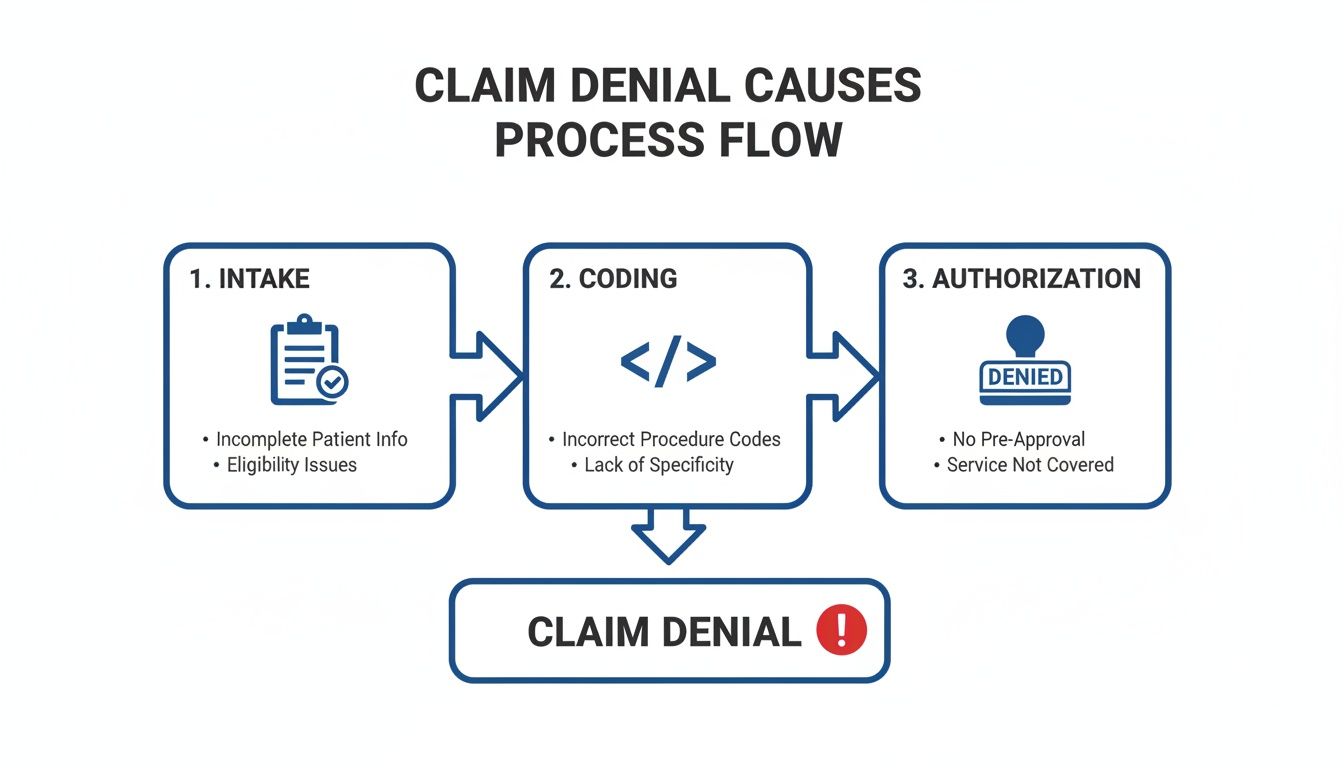
This visual drives home the point that a denial is often the end result of a process breakdown that happened much earlier, reinforcing why a workflow needs to address every potential failure point.
Pillar Four: Analysis
The final pillar, analysis, is what closes the loop and separates great denial management from just average. This is where you turn raw denial data into actionable intelligence. By analyzing trends, you can uncover the systemic root causes of your most frequent and costly denials.
Your analysis should answer critical questions:
- Which specific payers deny our claims most often?
- What are the top five denial reason codes we see every month?
- Are denials concentrated with a particular provider or for a specific service?
The insights you gain here feed directly back into the prevention pillar. For example, if you find a surge in denials for a lack of medical necessity from one physician, you can provide targeted documentation training. If you see repeated eligibility denials from a specific front-desk team member, you can offer a refresher course. This data-driven approach ensures your prevention efforts are focused where they’ll have the biggest impact, creating a cycle of continuous improvement that systematically lowers your denial rate over time.
Key Metrics For Measuring Denial Management Success

How do you know if your denial management strategy is actually working? You have to measure it. Tracking the right Key Performance Indicators (KPIs) is like checking the dashboard of your revenue cycle engine—the data tells you exactly what’s running smoothly and what needs an immediate tune-up.
Without metrics, you’re flying blind. You’re left relying on gut feelings instead of hard data, turning a critical business function into a guessing game. These numbers are what transform denial management from reactive firefighting into a precise, data-driven strategy for financial health.
And the stakes are incredibly high. Providers recently spent nearly $20 billion in a single year just appealing denied claims, with the average cost per denial creeping up to $44. A recent survey painted a grim picture: 41% of providers now face denial rates of 10% or higher, and 54% confirm that denials are on the rise. You can explore the 2025 denials outlook and why partnerships are key to financial growth to see the full financial picture.
Initial Denial Rate And Clean Claim Rate
The first metric you should have on your radar is your Initial Denial Rate. This KPI tells you the percentage of claims denied on their first submission. Think of it as a front-line diagnostic tool—a high rate is a clear red flag that something is broken in your front-end processes, like registration, eligibility checks, or coding.
Initial Denial Rate = (Total Dollars of Claims Denied / Total Dollars of Claims Submitted) x 100
A healthy target for most practices is an initial denial rate below 5%. If yours is higher, it’s time to start looking for cracks in your pre-submission workflow.
On the flip side is the Clean Claim Rate. This measures the percentage of claims that sail through on the first try, getting accepted and paid without a single error. It's one of the best indicators of your overall RCM efficiency. Hitting a clean claim rate of 95% or higher is the gold standard, proving your team is knocking prevention out of the park.
Final Denial Rate And Appeal Success Rate
While your initial denial rate diagnoses the health of your front-end, the Final Denial Rate (also called the Write-Off Rate) shows you how effective your appeals process is. This metric tracks the percentage of denied claims you ultimately fail to overturn and have to write off as lost revenue.
A high final denial rate means one of two things: your team isn't appealing winnable claims, or their efforts are falling flat. This number needs to be as close to zero as humanly possible.
To figure out why your appeals are or aren't working, you need to track your Appeal Success Rate. This measures the percentage of appealed claims that you successfully get overturned and paid.
- Formula: (Number of Successfully Overturned Appeals / Total Number of Appeals Submitted) x 100
- What It Means: A high success rate shows your team knows how to spot valid appeal opportunities and build a strong case. A low rate could mean you’re wasting time appealing unwinnable claims or that your appeal letters just aren't persuasive enough.
Days In Accounts Receivable And Cost To Collect
Finally, let's talk about cash flow. Days in Accounts Receivable (A/R) measures the average number of days it takes your practice to actually collect the money it's owed. Denials are a direct cause of high A/R, trapping revenue in limbo and starving your practice of cash. A tight denial management process helps keep your Days in A/R low, ideally under 40 days.
The Cost to Collect is another KPI that gets to the heart of efficiency. It calculates how much you spend to bring in every dollar. Appealing denials isn't cheap—it costs staff time, administrative resources, and sometimes even legal fees. An effective denial management program lowers this cost by focusing on prevention, which is always cheaper than correction.
Proven Best Practices To Reduce Claim Denials
Knowing your denial rate is one thing. Actually improving it is another game entirely. Making the leap from just tracking denials to actively preventing them requires a smart, strategic approach. This isn't about a massive, complicated overhaul; it's about making targeted adjustments to your daily operations.
These best practices strengthen your revenue cycle at every weak point, turning potential leaks into solid revenue streams. The goal is to build a resilient system that churns out clean claims, day in and day out.
Fortify Your Front-End Data Collection
The most effective way to manage denials starts long before a claim is even created. Your front-end team is your first line of defense, and a simple data entry error during registration can completely derail all the perfect work done by your clinicians and coders.
Consistency is key here. Every single patient interaction has to include a thorough check of their demographic and insurance information—yes, even for returning patients whose coverage could have changed since their last visit. Implementing real-time eligibility checks is non-negotiable. It confirms active coverage on the spot and flags potential issues, like non-covered services, preventing a costly denial weeks down the line.
Invest In Continuous Staff Education
The rules of medical billing are a moving target. Payer policies get updated, new coding guidelines are released, and compliance requirements are always shifting. A "set it and forget it" attitude toward staff training is a guaranteed recipe for a rising denial rate. Think of ongoing education as an investment that pays for itself over and over again.
This training should be specific to each role:
- Front-Desk Staff: Regular refreshers on accurate data entry, insurance verification protocols, and why collecting co-pays upfront is so important.
- Coders and Billers: Continuous education on the latest CPT, ICD-10, and HCPCS code updates, along with deep dives into payer-specific billing rules.
- Clinical Staff: Training on documentation best practices that clearly paint a picture of medical necessity for the services they provide.
When your whole team understands how their role impacts the revenue cycle, they become active partners in preventing denials.
Leverage Technology Like Claim Scrubbers
Let's be honest, even the most detail-oriented person can make a mistake. That’s where technology steps in to be your safety net. Claim scrubbing software automatically scans your claims for errors before you send them to the payer. It's like having a super-powered spell-checker for your entire billing process.
These tools are designed to catch common mistakes like invalid diagnosis codes, missing modifiers, or a mismatch between patient data and what the payer has on file. By flagging these issues for your team to fix before submission, claim scrubbers give your clean claim rate a massive boost and cut down on time-wasting appeals.
Perform Regular Internal Audits
You can't fix what you can't see. Regular internal audits give you a clear snapshot of your revenue cycle's health, helping you spot recurring problems and negative trends in your denials. This shouldn't be a panicked reaction to a bad month; it should be a routine part of your operational calendar.
By reviewing a random sample of claims—both paid and denied—you can zero in on specific weak spots. Maybe you'll find that one payer consistently denies a particular procedure, which tells you it's time to review their specific policy. These insights are pure gold for fine-tuning your processes and training. Exploring broader revenue cycle management best practices can give you a solid framework for these essential reviews, turning your own data into a roadmap for continuous improvement and a much stronger bottom line.
Partnering With An RCM Expert To Elevate Your Strategy
Managing claim denials in-house can feel like an uphill battle. It’s tough, especially when you’re already dealing with limited resources, staff shortages, and the constant need to stay on top of ever-changing payer rules.
For many practices, this is where partnering with a dedicated Revenue Cycle Management (RCM) team becomes a powerful strategic move—not just a way to offload administrative work.
An expert RCM partner acts as a specialized extension of your own team. Instead of stretching your existing staff thin, you get immediate access to certified, U.S.-based billers and coders who live and breathe denial management every single day. Their entire job is to navigate the complex world of payer rules and coding guidelines to protect your revenue.
Overcoming In-House Limitations
Let's be honest: keeping up with the sheer volume and complexity of payer requirements is a massive challenge for any practice. An RCM partner brings advanced technology and deep, specialty-specific knowledge to the table, something that's difficult for a single practice to maintain on its own. They’re equipped to handle the entire lifecycle of a claim, from submission to final payment.
This kind of partnership helps you achieve a few key things:
- Higher Clean Claim Rates: With experts focused on getting it right from the start, more claims get paid correctly on the first submission.
- Accelerated Cash Flow: A professional team dedicated to aggressive A/R and denial follow-up means you get paid faster. Simple as that.
- Reduced Administrative Burden: Your team is freed from the time-consuming grind of chasing down denied claims, allowing them to refocus on their core duties.
A partnership with an RCM expert is about more than just outsourcing billing. It's about gaining a strategic ally dedicated to maximizing your financial performance so you can concentrate on what matters most—patient care.
Gaining A Strategic Financial Advantage
By working with an RCM expert, practices can turn a reactive, frustrating process into a streamlined and profitable operation. These teams don't just fix denials; they analyze trends to spot the root causes, giving you valuable feedback that helps you fix systemic issues inside your practice. This continuous improvement loop is what drives long-term financial health and stability.
Ultimately, the goal is to shift your focus from administrative headaches back to clinical excellence. With a trusted partner managing the financial side, you can have confidence that your revenue cycle is in expert hands.
For those considering this path, you can explore guides on choosing from the top revenue cycle management companies to find the right fit for your practice's unique needs. It’s a move that allows you to build a more resilient and efficient financial future.
Answering Your Top Questions About Denial Management
As we wrap up our guide, let's tackle a few of the most common questions that pop up when practices start getting serious about managing denials. Getting these concepts straight is a huge step toward building a healthier revenue cycle.
What Is The Difference Between A Rejected Claim And A Denied Claim?
Think of it like this: a rejected claim is like a letter returned by the post office for a bad address. It never even made it to the insurance company because of a simple mistake, like a typo in a patient’s ID number or a missing digit. You just fix the error and resubmit it.
A denied claim, on the other hand, is like a letter that was delivered, opened, and read by the insurance company, who then sent back a formal "no." They processed the claim and decided not to pay for a specific reason, such as the service not being a covered benefit. Denials are a much bigger deal because they require a formal, and often lengthy, appeal to get overturned.
How Long Does The Claim Appeal Process Typically Take?
The timeline for an appeal can really vary. If it's a straightforward fix for a simple coding error, you might see a resolution in 30 to 60 days.
But when you get into more complex issues, like a dispute over medical necessity, you’re in for a longer haul. These appeals often need multiple levels of review and a mountain of supporting documentation. It's not uncommon for them to take several months to finally get a decision from the payer, which is exactly why prevention is so critical.
Tackling the root causes of denials is always more efficient than managing the appeal process. A strong denial management strategy focuses on stopping rejections before they ever happen.
Can Small Practices Implement An Effective Denial Management Strategy?
Absolutely. In fact, small practices can make a huge impact by doubling down on prevention. This means getting really disciplined with front-end processes, like verifying insurance eligibility for every single patient, every single time. It also means consistently securing prior authorizations before services are rendered.
For many smaller practices, the most practical and cost-effective route is to partner with an RCM service. This gives you immediate access to a team of denial management experts without the overhead of hiring, training, and retaining that specialized talent in-house.
Ready to stop leaving money on the table? The expert team at One For All Medical Billing has the specialized know-how and proven strategies to boost your clean claim rate and get you paid faster. Schedule your free consultation today and see how a dedicated RCM partner can transform your practice's financial outlook.

