

table of contents
Your schedule is full, patients are being seen, and the clinical side looks productive. But cash still lands late, denials keep stacking up, and no one can give you a straight answer about what's breaking. That's where most practice administrators start looking at revenue cycle management services. Not because they want another vendor, but because they need control.
The hard part is that cash flow problems rarely come from one isolated billing mistake. They come from disconnected handoffs. Registration misses an insurance detail. Authorization isn't checked closely enough. Coding goes out with documentation gaps. A claim gets denied, then sits in A/R too long. Patient balances age because the statement process is confusing. Each step looks minor on its own. Together, they choke revenue.
Strong revenue cycle management services fix that by treating the entire payment path as one operating system. They connect front desk accuracy, coding quality, claim submission, denial recovery, payment posting, reporting, and patient collections into a single financial process. That's what turns a busy practice into a paid practice.
Your Guide To Better Revenue Cycle Management Services
Most groups don't realize they have an RCM problem until the symptoms become impossible to ignore. Reimbursements slow down. A/R ages. Staff spend their day answering payer questions instead of preventing them. Physicians see a packed calendar and assume revenue should follow. It doesn't, unless the financial workflow is built to capture the value of that care cleanly and consistently.
That's why Revenue Cycle Management Services matter. They don't just send claims. They organize the full path from patient intake to final payment so the practice gets paid faster, with fewer avoidable write-offs and less staff burnout. For multi-site groups, that matters even more because inconsistency from one location to another creates revenue leakage you can't see in a simple billing report.
A practical RCM approach does three things at once:
- Protects revenue early: Front-end checks stop bad claims before they start.
- Shortens payment delays: Clean claims and tighter follow-up reduce rework.
- Improves patient experience: Clear financial communication lowers confusion and collection friction.
Practical rule: If your team is constantly fixing claims after submission, the real problem usually started before the visit.
Administrators need more than a list of services. They need a way to judge what's working, what isn't, and where profit is leaking. That means understanding the full revenue cycle, knowing which operational points affect collections most, and tracking the right financial indicators instead of reacting to monthly surprises.
What Are Revenue Cycle Management Services Really
Medical billing is one part of the job. Revenue cycle management services are the whole system.
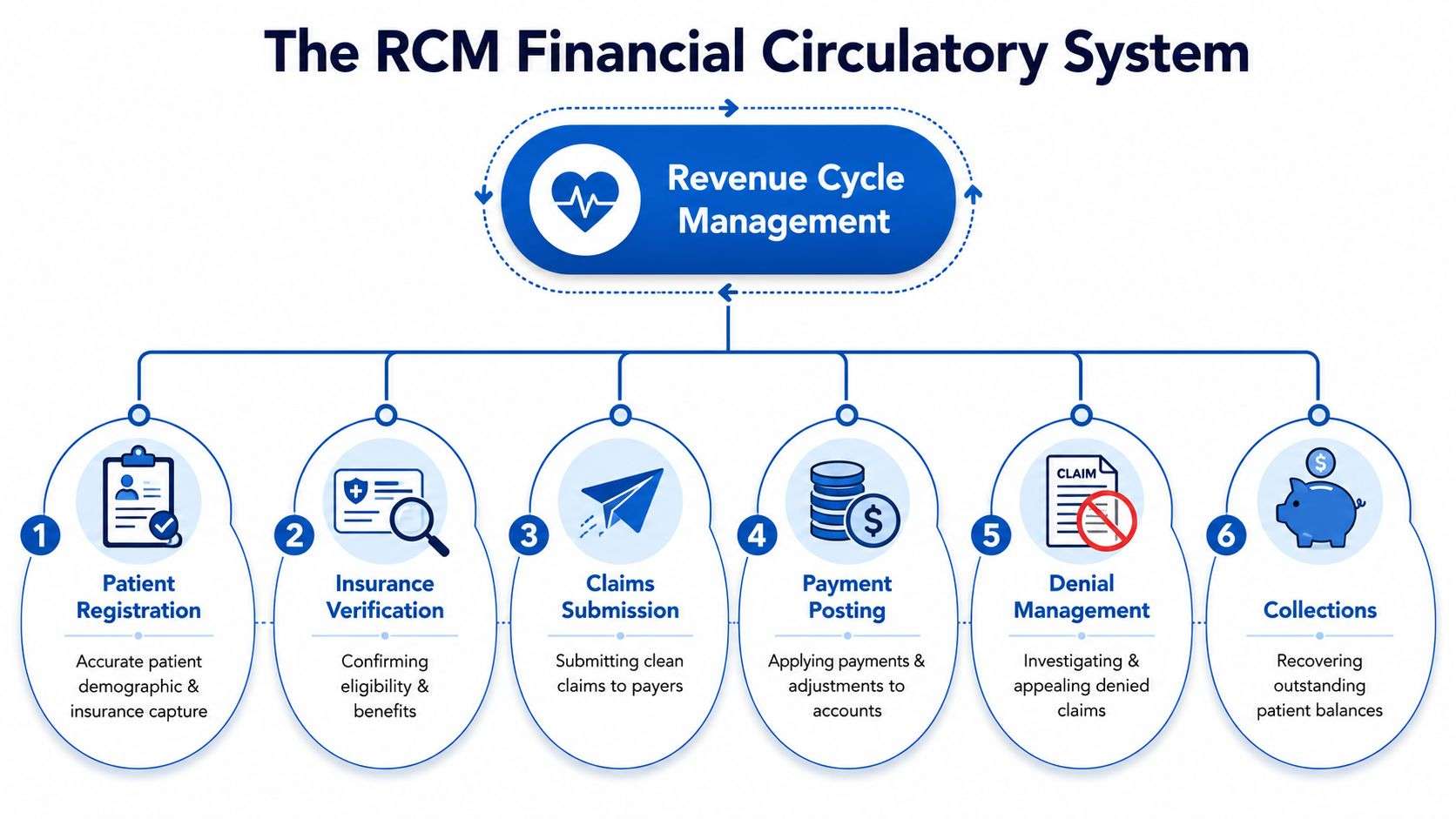
Think of RCM as the practice's financial circulatory system. Care creates value, but that value only becomes operating cash when every administrative and financial step supports payment. If one part fails, the money doesn't stop forever, but it slows, leaks, or gets lost in rework.
Billing Is A Function. RCM Is A Strategy
Traditional billing focuses heavily on coding, claim creation, submission, and posting. That work matters, but it starts too late to solve many of the most expensive problems. By the time a bad claim reaches the biller, the damage often began at scheduling, registration, or eligibility.
End-to-end RCM starts before the patient is seen and continues until every legitimate dollar is collected. That includes demographic capture, insurance verification, authorization workflows, coding oversight, payer edits, denial recovery, patient statements, A/R follow-up, and management reporting. If you want a plain-language overview of that full lifecycle, this guide on understanding revenue cycle management is useful.
What Changes When You Treat RCM As End To End
When a practice treats RCM as a connected process, the conversations change. Staff stop saying, “billing will fix it later,” because they understand later is expensive. Leaders stop looking only at charges and start looking at preventable friction. Patient experience improves too, because people get clearer expectations about coverage and balances before confusion turns into complaints.
A complete RCM model usually includes:
- Front-end intake controls that capture accurate demographics and insurance data.
- Eligibility and benefits review before service, not after denial.
- Coding and charge integrity tied to documentation quality.
- Clean claim submission workflows with payer-specific edits.
- Posting and reconciliation to catch underpayments and mismatches.
- Denial and patient balance recovery with disciplined follow-up.
Revenue doesn't fail only in the billing office. It fails at every handoff where no one owns the financial outcome.
That's the primary distinction. Billing asks, “Was the claim sent?” RCM asks, “Was the entire payment path designed to succeed?”
The Eight Essential Components Of The Revenue Cycle
The most expensive RCM failures usually don't happen in one dramatic event. They show up as small misses repeated across the patient journey. A registration shortcut today becomes a denial next week. A coding delay turns into aged A/R next month. A weak reporting process leaves leadership guessing all quarter.
For that reason, the strongest revenue cycle management services don't treat the cycle as a back-office checklist. They manage it as an operating discipline from first contact through final reconciliation. If you want a process map that shows how these handoffs fit together, this breakdown of the medical billing process steps is a good companion.
Front-End Steps That Decide Whether Cash Moves Smoothly
The first three components carry more financial risk than many groups admit.
Patient Pre-Registration And Scheduling
Staff collect demographics, insurance details, referral information, and visit type. If appointment templates are wrong or information is incomplete, downstream staff are forced to guess. That creates bad claims and bad patient estimates.Eligibility And Benefits Verification
Coverage needs confirmation before service, including active plan status, service limits, and authorization needs where applicable. Many practices underinvest here, even though up to 60% of claim denials are driven by front-end issues, such as errors in patient registration or eligibility verification according to Auxis on revenue cycle management challenges.Medical Coding And Charge Capture
Documentation has to support the codes billed, and charges need to enter the system quickly enough to avoid delays. Specialty-specific coding matters here. For example, providers who want a cleaner operational understanding of exam-related coding can review this resource on understanding CPT physical exam codes.
Common front-end failures include:
- Mismatched demographics: A small name or date-of-birth error can trigger avoidable payer rejection.
- Inactive coverage assumptions: Staff rely on prior visits instead of verifying current eligibility.
- Authorization blind spots: The visit is clinically appropriate, but the payer still won't pay without the required approval.
- Charge lag: Documentation sits unfinished, and billing loses time before a claim is even created.
Mid-Cycle Execution That Protects Margin
Once coding is complete, execution has to be tight.
Claims Submission
This step sounds simple. It isn't. Good teams scrub claims against payer rules, identify missing data before transmission, and make sure filing deadlines aren't overlooked. A claim sent quickly but inaccurately is worse than a claim held briefly for correction.Payment Posting
Posting isn't just data entry. It's where practices confirm what was paid, what was adjusted, and what still needs action. If staff post payments loosely, underpayments and contract variances stay buried.Denial Management
Denial work should never be limited to reworking single claims. True value comes from pattern recognition. If one payer repeatedly rejects a service line, or one location has a registration issue, leadership needs that surfaced fast. Payer-specific denial analytics matter because generic denial categories often hide the operational root cause.
Denial teams that only resubmit claims stay busy. Denial teams that identify patterns change cash flow.
Back-End Follow-Up That Determines Final Collections
The cycle doesn't end when insurance responds. It ends when collectible revenue is either recovered or consciously written off for a defined reason.
Accounts Receivable Follow-Up
A/R follow-up includes insurer follow-up, patient balance pursuit, escalation of stalled accounts, and prioritization of claims most likely to convert. Teams that work A/R by age bucket alone often miss the better strategy, which is to work by payer behavior, denial reason, balance size, and filing risk.Reporting And Analytics
Reporting is the control panel. It should show where cash is slowing, which locations are underperforming, what denial categories are rising, and where staff process changes would improve collection speed. Basic month-end summaries aren't enough for multi-site operations.
A solid analytics rhythm should answer questions like these:
- Which sites create the most preventable front-end errors
- Which payer rules cause recurring denials by specialty
- Where charge entry delays are extending the billing cycle
- Which patient balance workflows create the highest confusion or abandonment
The eight components aren't separate departments protecting their own tasks. They're linked decisions affecting profitability. When one breaks, the others absorb the cost.
The Tangible Business Benefits And ROI Of Expert RCM
A practice can look busy all month and still miss payroll targets because cash is stuck in preventable places. The usual pattern is familiar. Claims go out, payments trickle in, patient calls increase, and leadership spends the last week of the month trying to explain a shortfall that started at registration.
That is why RCM ROI should be measured in cash speed, preventable write-offs, labor cost, and patient friction.
Better Collections Come From Better Front-End Discipline
The highest-return RCM work often happens before the claim is submitted. Eligibility errors, missing authorizations, weak intake scripting, and inaccurate demographics create denials that cost far more to fix on the back end than to prevent at the front desk.
For multi-site groups, that changes where improvement efforts should go. A practice does not improve profitability by spreading attention evenly across every billing task. It improves profitability by fixing the intake points that create the most expensive rework, then tightening charge capture, coding accuracy, and payer follow-up around those fixes.
That shows up in real financial outcomes. Cash arrives sooner. Fewer balances age into difficult collections. Staff spend less time correcting errors that should never have reached the claim stage. Leaders get a cleaner view of which locations, specialties, and payer contracts are producing margin.
ROI Includes Labor Savings, Not Just Posted Payments
Many administrators evaluate RCM services based only on collection lift. That is incomplete.
A good RCM operation also cuts the hidden cost of rework. Front desk staff spend less time explaining denied visits. Billers spend less time reopening claims for missing insurance data. Coders spend less time chasing documentation gaps that delay submission. Site managers spend less time sorting through conflicting reports to find the actual cause of a slowdown.
Those labor savings matter because billing inefficiency is expensive. It pulls high-value staff into low-value correction work and leaves less time for patient service, scheduling, and growth planning.
If you are comparing internal billing against outsourced or hybrid support, this breakdown of the benefits of revenue cycle management gives a useful practice-level view of where those gains show up.
Communication Quality Has Financial Value
RCM performance depends on execution. It also depends on responsiveness.
A technically capable billing partner still creates problems if the practice cannot get clear answers on denial trends, payer issues, or unresolved patient complaints. Multi-site groups feel this quickly because one communication gap at the vendor level can create confusion across several locations. The same service principle applies outside healthcare, and Halo AI on B2B client service makes the point well. Clear communication protects trust, speeds decisions, and reduces operational drag.
In RCM terms, that means faster escalation, cleaner accountability, and fewer days lost waiting for someone to explain what happened to the money.
Patient Satisfaction And Profitability Move Together
Practices often treat billing operations and patient experience as separate issues. They are tied together in daily operations.
Patients are more likely to pay when estimates are discussed early, coverage is verified correctly, and statements are easy to understand. They are less likely to call in frustration when the amount due matches what they were told before the visit. That lowers call volume, reduces complaint handling, and improves collection rates without adding pressure tactics.
Good RCM does not remove every hard conversation. It prevents the avoidable ones. That is one of the clearest returns a practice can get from expert revenue cycle management services.
Key Performance Indicators For Your Financial Health
A practice usually notices a cash problem too late. The schedule is full, charge volume looks healthy, and patient visits are steady, yet cash is slower than expected and staff spend more time fixing old claims. The gap is almost always visible in a short KPI set before it shows up clearly in the bank account.
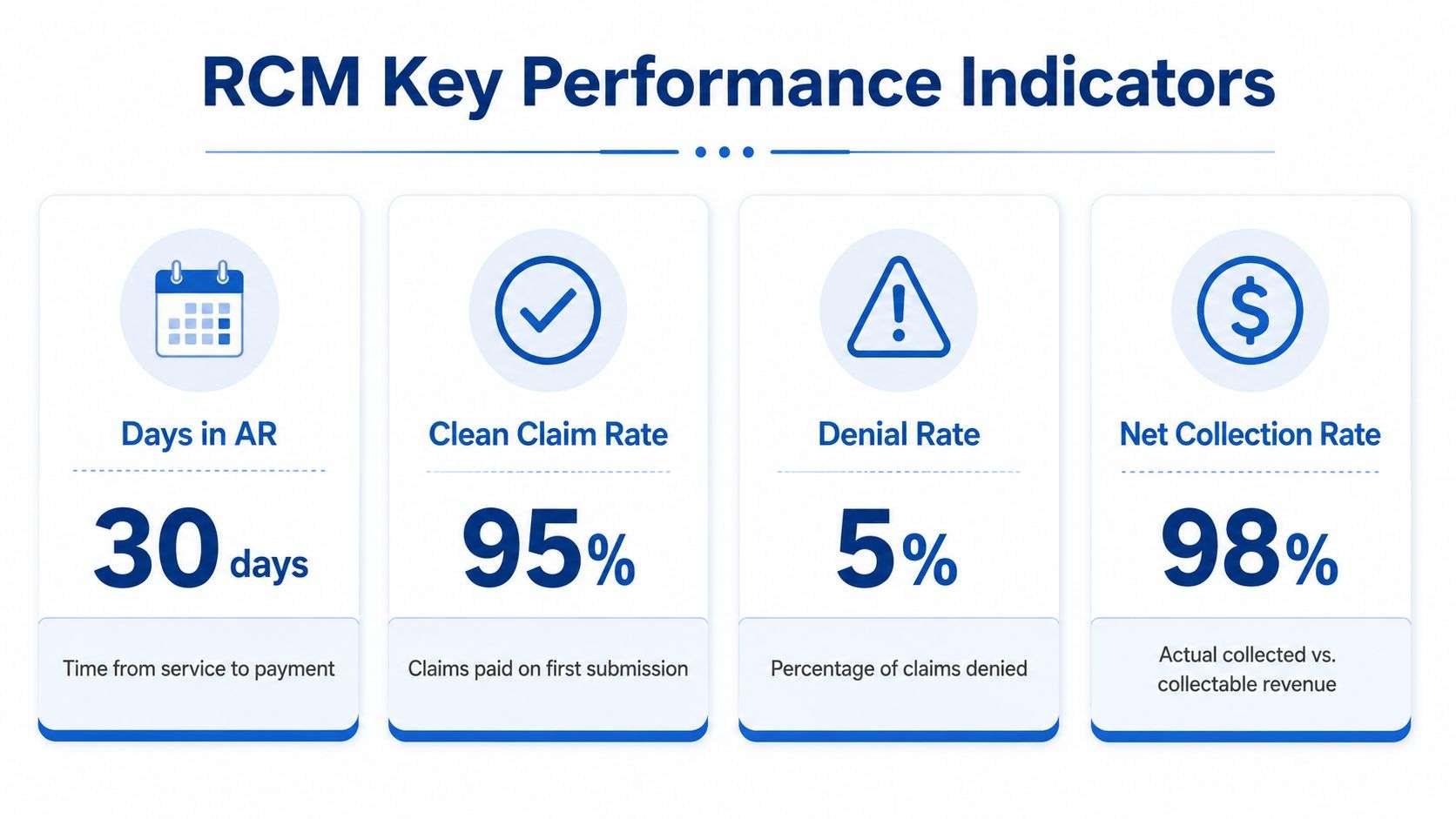
Four measures give administrators the fastest read on financial health: clean claim rate, denial rate, days in A/R, and net collection ratio. Review them together, by payer and by location, or they lose value.
Clean Claim Rate
Clean Claim Rate measures how many claims pass through on first submission without edits, rejections, or requests for more information. RCM benchmark guidance and MD Clarity's RCM KPI guide both point to a high-performing operation keeping this metric in the mid-to-high 90s, with top performers pushing higher.
This is one of the clearest front-end indicators in the revenue cycle. When it drops, the root cause often sits upstream in registration, eligibility checks, prior authorization, or coding handoff, not in the billing office alone. That matters because front-end mistakes create the most expensive denials. They delay payment, force rework across multiple teams, and leave patients dealing with corrected bills they do not trust.
Denial Rate
Denial Rate shows the share of claims a payer refuses to process or reimburse without correction. Dean Dorton's healthcare metrics summary notes that once denial rates move into double digits, the revenue cycle is under strain.
A rising denial rate hurts margin in two ways. Cash arrives later, and labor cost rises because staff must touch the same account again. In multi-site groups, denial rate is also a management signal. If one location is consistently worse than the others, the issue is usually process discipline, training, or local registration habits.
Watch denials by reason code, not just the total percentage. Eligibility, authorization, coding, timely filing, and medical necessity denials require different fixes and different owners.
Days In A/R
Days in Accounts Receivable tracks how long it takes to convert billed services into cash. It is one of the simplest measures of billing speed and follow-up effectiveness.
If this number climbs, start with operational checkpoints. Look at charge lag, claim submission timing, unresolved rejections, slow secondary billing, payer follow-up cadence, and payment posting delays. Then look at aged A/R by bucket. A practice with acceptable overall A/R days can still have a serious collection problem hiding in balances over 60 or 90 days.
This metric also affects patient satisfaction. Old balances generate more statement confusion, more inbound calls, and more disputes about what should have been handled earlier.
Net Collection Ratio
Net Collection Ratio measures how much collectible revenue the practice turns into cash after contractual adjustments. It answers a hard question that production reports cannot answer on their own: did the organization collect what it had a right to collect?
Administrators should watch this closely because it exposes leakage. Low NCR can point to underpayments, missed follow-up, avoidable write-offs, weak patient balance recovery, or inconsistent adjustment posting. High visit volume does not protect margin if earned revenue is leaking out after the claim is billed.
For teams that want a clearer view by payer, site, and aging bucket, an RCM performance dashboard for revenue cycle trends helps turn these metrics into weekly management decisions instead of monthly surprises.
How To Use The Dashboard Without Drowning In Data
The value is in the pattern, not any single number.
- Clean Claim Rate down, Denial Rate up: Start at the front end. Registration accuracy, eligibility verification, authorizations, and coding edits are the first places to audit.
- Days in A/R rising, Net Collection Ratio holding steady: Cash is slowing even if total collections have not dropped yet. The practice may be living off older receivables.
- Denial Rate stable, Net Collection Ratio weakening: Examine underpayments, write-offs, small balance policies, and patient collections.
- One site far outside the group average: Standardize workflow before blaming payer mix.
- One payer driving the shift: Escalate contract and payment variance review before staff waste time on account-level rework.
Teams outside healthcare handle a similar problem in customer operations. They track a few high-signal metrics, review trends early, and intervene before revenue slips, which is why these essential CRM insights for SMBs are a useful cross-functional comparison.
The point of KPI review is simple. Find friction early, assign ownership fast, and protect both cash flow and the patient financial experience.
A Practical Framework For Choosing Your RCM Partner
A practice usually starts looking for a new RCM partner after a painful quarter. Cash is late, denials are climbing, site managers are frustrated, and no one can explain whether the problem starts at scheduling, registration, coding, or follow-up. In that situation, a polished sales call is not enough. You need a partner that can show how it will protect revenue at each step of the cycle and reduce friction for patients before balances turn into complaints.
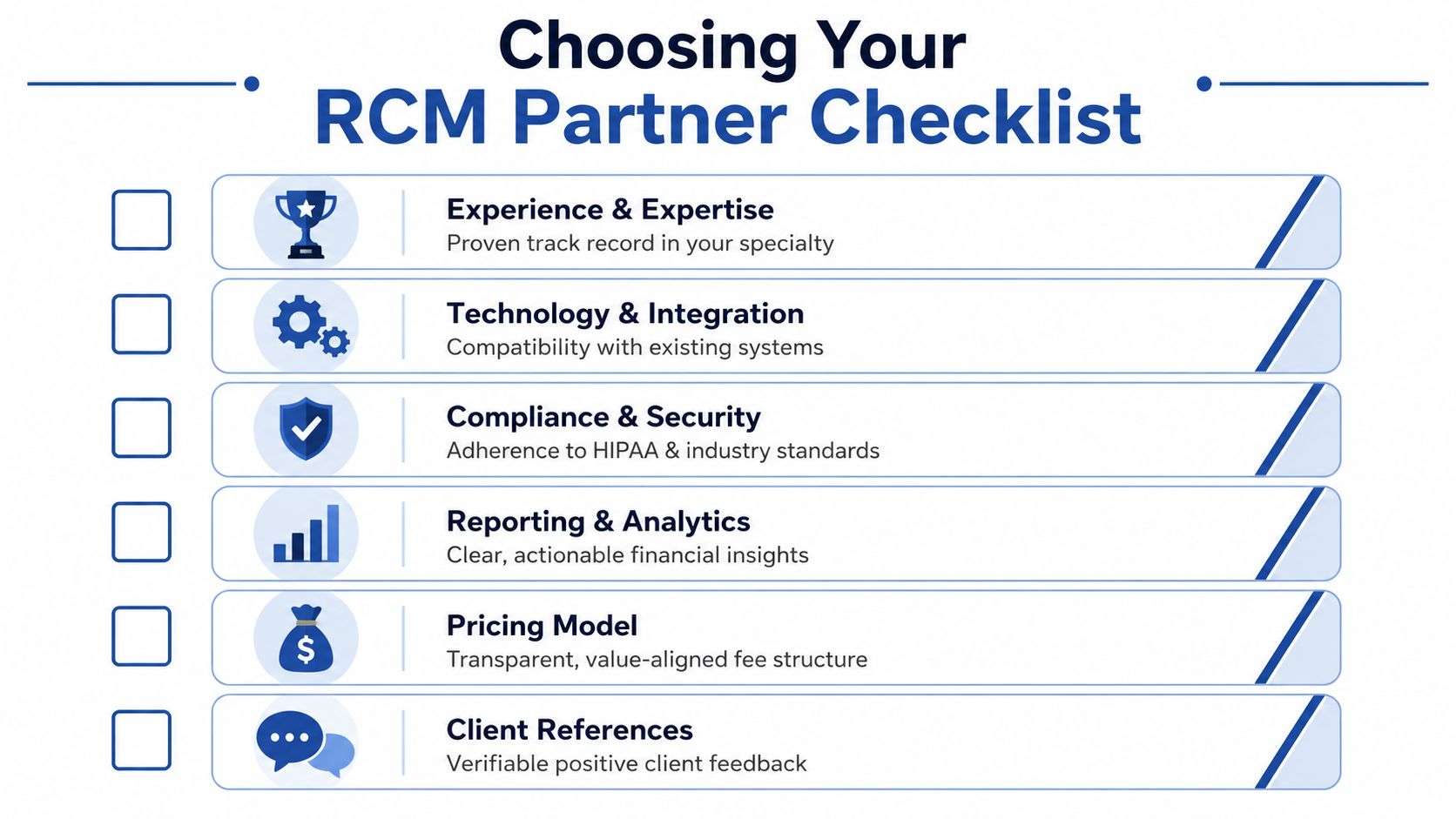
Vendor selection should work like operational due diligence. The right questions are not just about fees or software connections. They are about accountability, reporting, handoffs, and front-end discipline. Many expensive denials start before the claim is ever created, so your evaluation process should test whether the vendor knows how to prevent avoidable rework, not just chase it after the fact.
Start With Specialty And Site Complexity
Your RCM partner has to fit the way your practice gets paid.
Urgent care, behavioral health, surgery, primary care, and multi-site physician groups create different documentation patterns, authorization risk, payer rules, and patient balance behavior. A generic workflow often breaks in the departments that generate the most revenue or require the most payer-specific handling. For a group with several locations, the problem gets bigger. A process that works at one site can fail at another if registration standards, provider habits, or payer mix differ.
Ask direct questions:
- Which specialties do you support every month, not occasionally
- How do you handle payer variation across sites and service lines
- What front-end requirements do you expect from our staff
- How do you report registration errors separately from coding and billing errors
- How do you prevent authorization and eligibility misses before the visit
Those answers matter because specialty knowledge affects both margin and patient experience. A partner that understands your service lines can reduce preventable denials, shorten rework cycles, and help patients get cleaner estimates and fewer corrected statements.
Evaluate Reporting Before You Evaluate Promises
Strong reporting makes operational problems visible early. Weak reporting hides them behind broad summaries and delayed month-end reviews.
Practice leaders need reports they can use in an operations meeting. That means site-level trends, payer-specific denial patterns, aged A/R segmented by responsibility type, and root causes tied to actual workflow failures. If a dashboard shows denial volume but not whether the issue started with insurance discovery, authorization, coding, or filing delay, your team will waste time arguing instead of fixing the process.
Good reporting also supports patient satisfaction. If self-pay balances are rising because eligibility checks are inconsistent, the financial consequence is obvious. So is the patient consequence. More surprise bills, more inbound calls, and more staff time spent calming people down after the visit.
Teams in other service businesses face the same handoff problem between operations, systems, and customer communication. Some of the same habits show up in these essential CRM insights for SMBs, especially the focus on visible ownership and usable reporting.
If you want a structured way to compare vendors, use a due diligence checklist for evaluating an RCM partner so every finalist is scored against the same operational criteria.
Watch For Red Flags Early
Problems usually show up before the contract is signed.
- Vague pricing: If the fee model is hard to follow, scope gaps usually follow.
- Unclear ownership: If they cannot explain who handles edits, denials, appeals, underpayments, and patient balances, expect dropped tasks.
- Thin onboarding detail: A weak transition plan creates charge lag, missed claims, and payer access delays.
- Generic specialty language: If every answer sounds interchangeable, they probably do not understand your revenue drivers.
- Limited front-end focus: Many practices underinvest here, and weak vendors do the same. If they talk only about claims and A/R, they are ignoring the source of many preventable denials.
- No escalation path: You should hear exactly how unresolved payer issues move from staff follow-up to management review.
A vendor that cannot explain failure points in plain language will struggle to fix them under pressure.
What A Strong Partner Discussion Sounds Like
A capable RCM partner asks detailed operational questions early. They want to know how eligibility is verified, when authorizations are obtained, how providers close encounters, how quickly charges drop, what edits fire before submission, and who communicates with patients about balances. That level of questioning usually signals a team that understands the financial effect of front-end process discipline.
One option in the market is One For All Medical Billing, which states that it supports full-cycle billing functions including eligibility verification, coding, claims submission, payment posting, denial follow-up, reporting, credentialing assistance, and compliance consulting for practices nationwide. That scope is useful as a comparison point when deciding whether your practice needs a vendor for isolated billing tasks or a partner that can help manage the full revenue cycle.
Choose the partner that can explain how it will improve cash flow, reduce avoidable denials, and make the patient financial experience easier to manage. If the answers stay high level, keep looking.
Frequently Asked Questions About RCM Services
Financial control doesn't come from working harder inside a broken process. It comes from fixing the points where revenue is delayed, denied, or written off unnecessarily. That's what solid revenue cycle management services are built to do.

What's The Real Difference Between Medical Billing And RCM
Medical billing usually refers to coding, claim submission, payment posting, and related follow-up. RCM is broader. It includes front-end intake, eligibility, authorization workflows, denial prevention, A/R strategy, reporting, and patient financial communication. Billing is a task set. RCM is the full financial operating model.
How Difficult Is It To Switch RCM Vendors And Onboard With A New Partner
It depends on how organized the transition is. The risk points are usually open claims, payer access, data mapping, workflow ownership, and staff training. A good onboarding plan includes responsibility handoff, claim status review, EHR or practice management access, payer portal transition, and a short-term monitoring period so cash flow doesn't disappear during the change.
Can RCM Services Integrate With My Practice's Existing EHR System
In many cases, yes. The key question isn't just whether the system connects. It's whether the workflow between the EHR, practice management platform, clearinghouse, and reporting tools is clean enough to avoid duplicate work and missing data. Integration should reduce friction, not hide it.
If your practice is busy but cash still feels unpredictable, it's time to review the revenue cycle end to end. One For All Medical Billing offers free consultations to help practices assess where denials, delays, and collection gaps are affecting financial performance.

