

table of contents
At its core, the biggest benefits of revenue cycle management are getting paid faster, seeing fewer claim denials, and running a much smoother operation. By wrangling the entire financial journey of a patient—from the moment they book an appointment to the day their balance is zero—a solid RCM process makes sure your practice is paid fully and on time for the services you provide.
What Is Revenue Cycle Management And Why It Matters
Think of Revenue Cycle Management (RCM) as the financial lifeblood of your healthcare practice. It’s not just about sending out bills; it’s the entire, end-to-end process of managing your revenue. The cycle starts when a patient first contacts you and only truly ends when you’ve collected every last dollar for the care you delivered.
When this cycle flows smoothly, your practice is financially healthy and stable. But when it gets clogged with errors, delays, or inefficiencies, it’s a different story. You’ll see payments drag out, revenue slip through the cracks, and your administrative team buried in paperwork. These issues directly hamstring your practice's ability to operate, let alone grow.
The Core Of Your Practice's Financial Health
The first step to unlocking RCM’s potential is to stop seeing it as just a back-office chore. It’s a core strategic function that bridges the gap between providing excellent clinical care and running a sustainable business. Every single step is connected, meaning a simple mistake at the front desk can snowball into a massive headache down the line.
To get a clearer picture of how this works, it helps to break the RCM process down into its core stages. Each one plays a critical role in turning a patient visit into collected revenue.
The Core Stages Of Revenue Cycle Management
The RCM process is a journey that moves a patient encounter through your financial system. Breaking it down shows how broad and vital each component is.
- Patient Pre-Registration & Scheduling: The process starts here by collecting accurate demographic and insurance information. A clean registration is the foundation for a clean claim.
- Eligibility & Benefits Verification: This involves confirming a patient’s active coverage before their visit. It prevents denials from inactive policies or out-of-network issues.
- Charge Capture & Medical Coding: Next, clinical services are translated into standardized billing codes. Accurate coding ensures you are paid appropriately for the work performed.
- Claim Submission & Scrubbing: The coded claim is then sent to the payer after being checked for errors. Clean claims get paid faster, accelerating your cash flow.
- Payment Posting & Reconciliation: This stage involves posting payments from payers and patients to the correct accounts, giving you a clear picture of your financial performance and outstanding A/R.
- Denial Management & Appeals: This is where you recover revenue that would otherwise be lost by investigating, fixing, and resubmitting rejected claims.
- Patient Collections & Follow-Up: The final step is billing patients for their portion (deductibles, copays) and managing collections, which captures the final piece of the revenue puzzle and closes the loop.
By optimizing each one of these stages, you can effectively plug revenue leaks and build a predictable, efficient financial engine for your entire practice.
Visualizing The RCM Journey
The RCM process isn't just a list of tasks; it's a logical flow that moves a patient's account from start to finish. This diagram gives a simple but powerful overview of that journey.
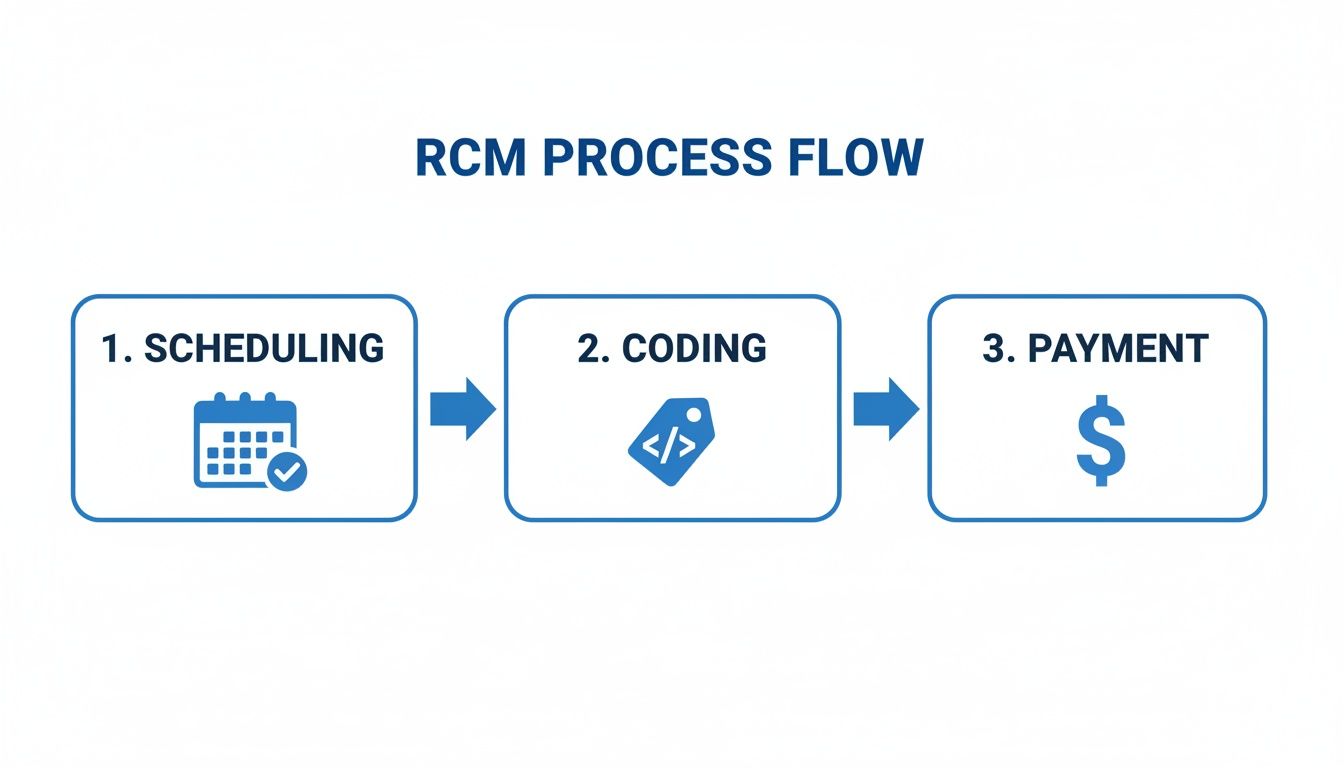
As you can see, each phase builds directly on the one before it. It all starts with getting things right at the beginning—accurate scheduling and registration are non-negotiable for clean coding and, ultimately, timely payment. If you don't have a streamlined process, bottlenecks will inevitably form, pushing back reimbursements and driving up your administrative costs.
Boost Your Cash Flow And Lower AR Days

Let’s be honest: one of the biggest reasons to focus on revenue cycle management is to get paid faster. A strong RCM process is like a financial accelerator for your practice. It directly improves cash flow, giving you the money you need to cover daily essentials like payroll, rent, and supplies.
Without a predictable stream of cash, even the busiest practices can find themselves in a tight spot.
At the center of all this is a metric called Accounts Receivable (AR) days. This number is simple but powerful: it tells you the average number of days it takes for your practice to collect payment for the services you’ve already provided. High AR days are a silent killer, meaning your hard-earned money is stuck in limbo with payers instead of sitting in your bank account.
Turning Services Into Available Cash
Think of your AR days like the time it takes for a check to clear. If it takes 60 days to get paid for a patient visit, you’ve essentially given the insurance company an interest-free loan for two months. Now, multiply that delay across hundreds of patient encounters, and you start to see how it creates a serious financial drag.
Effective RCM is all about shortening that delay. When you optimize every step—from the moment a patient books an appointment to the final payment posting—you can shrink the time it takes to turn a service into cash.
This is where meticulous front-end work pays off big time. For example, diligently verifying insurance eligibility before a patient walks in the door prevents one of the most common reasons for a claim denial. Confirming coverage upfront helps you avoid the lengthy back-and-forth that comes from billing an inactive policy, a mistake that can easily add weeks to your payment timeline.
The Power Of Clean Claims And Persistent Follow-Up
Getting a high first-pass clean claim rate is another game-changer. A "clean claim" is exactly what it sounds like: a claim submitted to a payer with zero errors, ready to be processed without any corrections. The more claims you get right on the first try, the faster you get paid. It's that simple.
Getting there requires a combination of:
- Accurate Data Entry: Making sure all patient demographic and insurance info is perfect from the start.
- Precise Medical Coding: Using the right codes that accurately reflect the services performed and are backed by solid clinical notes.
- Claim Scrubbing: Using smart technology and human expertise to review claims for common mistakes before they're sent out.
By focusing on front-end accuracy and clean claim submission, a practice can fundamentally change its financial trajectory. It shifts the dynamic from reactively chasing down payments to proactively ensuring they arrive on time.
Of course, even with the best processes, some claims will get held up or denied. That’s where a persistent, systematic AR follow-up strategy becomes essential. Good RCM includes a dedicated team that actively works your aging AR, figures out why payments are delayed, and takes immediate action to get things moving. Without this critical step, outstanding claims can sit for months, eventually becoming uncollectible.
This comprehensive approach delivers real, measurable results. Organizations with optimized RCM can see a significant decrease in AR days. That means reimbursements arrive much faster, easing financial pressure on practices of all sizes.
Ultimately, lowering your AR days through strong RCM provides the financial stability you need to invest, grow, and keep delivering excellent patient care.
Slash Claim Denials And Stop Leaving Money On The Table

Claim denials are so much more than a daily annoyance. They’re a direct hit to your practice’s bottom line. Each rejection represents a service you’ve already provided but haven’t been paid for, forcing your team into a frustrating—and expensive—cycle of appeals and rework.
One of the most powerful benefits of a strong revenue cycle management (RCM) system is that it builds a fortress against these costly denials. A smart RCM strategy isn’t about chasing down denials after the fact; it’s about stopping them from ever happening. Think of it as a financial quality control system that catches mistakes before a claim even goes out the door.
Finding The Real Culprits Behind Denials
Most denials aren’t caused by complex clinical disagreements. They come from simple, entirely preventable errors. A dedicated RCM process is built to systematically hunt down and fix these common culprits before they ever have a chance to sabotage your revenue.
Here are the everyday issues a solid RCM system tackles head-on:
- Inaccurate Patient Data: A single typo in a name, a wrong date of birth, or a mistyped policy number is often all it takes for an instant rejection. RCM puts the focus on getting this right from the very beginning, at patient registration.
- Missing Prior Authorizations: Many payers require pre-approval for certain procedures. Forgetting to secure that authorization is a surefire way to get a denial that’s incredibly tough to overturn.
- Coding and Modifier Errors: Using an old CPT code, an incorrect ICD-10 code, or leaving out a required modifier can lead to a flat-out denial or a significant underpayment.
- Coverage and Eligibility Issues: It’s a common trap—submitting a claim for a patient whose coverage has lapsed or for a service that isn’t covered under their specific plan.
By getting ahead of these root causes, RCM shifts your billing from a reactive, fire-fighting mode into a proactive, revenue-protecting operation.
A well-managed revenue cycle treats claim submission like a pre-flight checklist. Every single component—from patient demographics to medical codes—is thoroughly checked to give the claim the best possible chance of getting paid on the first pass.
Your First Line Of Defense: A Proactive Strategy
A huge benefit of revenue cycle management is its multi-layered defense system. It starts with specialty-specific coding experts who live and breathe the unique rules and payer quirks relevant to your practice. They make sure your services are documented and coded with the highest possible accuracy.
Next comes the technology. Modern RCM uses automated claim scrubbing technology to add another layer of protection. This acts like an intelligent filter, scanning every claim for potential mistakes against a massive database of payer rules. It can flag anything from mismatched codes to missing information, allowing your team to make corrections on the spot.
The final layer is a systematic pre-submission audit. This last check ensures all the necessary pieces, like prior authorizations and supporting documents, are attached and correct. This meticulous, preventative approach is the heart of effective medical billing denial management. The goal is simple: get your first-pass clean claim rate as high as possible.
The Real-World Impact Of A Lower Denial Rate
Bringing your denial rate down has a massive financial impact. It means more predictable cash flow, less time and money wasted on appeals, and a healthier bottom line. It frees up your staff to focus on patient care and high-value tasks instead of spending hours on hold with insurance companies.
This isn’t just a small tweak; it’s a game-changer for any practice feeling the squeeze from payers. RCM systems, especially those using AI and automation, can significantly reduce first-pass denials. For complex specialties, that translates directly into capturing more of the revenue you’ve earned.
Ultimately, by cutting down on claim rejections and underpayments, a strong RCM process ensures you get paid fully and fairly for the incredible care you provide.
Enhance Efficiency And Lighten Your Administrative Load
Beyond the direct financial wins, one of the most significant benefits of a sharp revenue cycle management process is the massive operational lift it provides. It transforms a chaotic, paper-heavy environment into a well-oiled machine, freeing your team from the administrative quicksand that slows down your entire practice.
Think about a typical day in a practice with a disjointed RCM process. Staff members spend hours on the phone with payers, fighting just to get answers on delayed claims. They manually enter and re-enter patient data across different systems, hoping to avoid the typos that lead to denials. All the while, they're trying to keep up with an endless stream of changing payer rules and complex compliance demands. It's exhausting, and frankly, it's inefficient.
From Administrative Overload To Strategic Focus
Now, picture the "after" scenario with an optimized RCM system in place. The endless phone calls diminish because a dedicated process or partner is systematically working through outstanding accounts receivable. Manual data entry is minimized as information flows seamlessly from your EHR to the billing system, drastically reducing the chance of human error.
Most importantly, your team is no longer buried under a mountain of administrative busywork. They can now focus on high-value activities that directly impact patient care and practice growth.
A streamlined RCM process allows your most valuable asset—your staff—to operate at the top of their license. Instead of chasing paperwork, they can dedicate their energy to improving the patient experience, coordinating care, and supporting your providers.
This shift doesn't just improve morale; it boosts productivity across the board. When your front desk staff can focus on welcoming patients and ensuring accurate registrations, the entire revenue cycle starts on a stronger footing. When your clinical team isn't bogged down with billing questions, they have more time to provide excellent care.
A Foundation Built For Scalable Growth
Another powerful benefit of a solid RCM foundation is scalability. For a growing practice, adding a new provider or opening another location can trigger an administrative nightmare. Without a scalable system, your overhead costs for billing and collections often grow in lockstep with your expansion.
A robust RCM process changes that equation completely. It provides a standardized, efficient framework that can easily handle increased claim volume without requiring a proportional increase in administrative staff. This is what allows your practice to grow sustainably, confident that your financial backbone can support your ambitions.
This is exactly why so many practices are turning to dedicated partners for help. Outsourcing revenue cycle management delivers massive financial gains. The market for healthcare RCM outsourcing continues to grow as providers seek relief from labor shortages and increasingly complex billing.
By handing off these time-consuming tasks to experts, you not only improve efficiency but also gain a strategic partner invested in your financial health. You can discover more about how outsourcing medical billing can save your practice time and money in our detailed guide. Ultimately, enhancing efficiency isn't just about saving time—it's about creating the capacity for your practice to truly thrive.
Improve The Patient Financial Experience

A patient’s experience with your practice doesn't end when they walk out the door. The financial journey that follows—from understanding a bill to making that final payment—is a powerful and often overlooked part of their overall satisfaction.
This is where one of the most important benefits of revenue cycle management comes into play. It has the power to transform a potential point of friction into a genuinely positive interaction.
Confusing statements, surprise charges, and a lack of clear communication can quickly sour an otherwise excellent clinical experience. A well-designed RCM process tackles this head-on by prioritizing clarity and support from the very beginning.
Fostering Trust Through Financial Clarity
Let's be honest: the best patient financial experiences are built on trust. And trust starts with transparency.
It begins with accurate insurance verification and upfront communication about a patient's potential out-of-pocket costs before a service is even performed. When patients know what to expect, they feel more in control and less anxious about the financial side of their care.
An effective RCM system ensures that billing statements are easy to understand, free of confusing jargon, and clearly outline what insurance paid versus what the patient owes. This simple act of providing a clear, accurate bill prevents the frustration that leads to endless phone calls, complaints, and delayed payments.
When you eliminate the surprises, you build a stronger, more trusting relationship with your patients.
Empowering Patients With Modern Tools
Modern RCM solutions also provide patient-centric tools that meet today's expectations for convenience and control. These tools empower patients to manage their healthcare finances on their own terms, which reduces their stress and lightens the administrative load on your staff.
Key patient-centric features often include:
- Secure Online Payment Portals: Giving patients a simple, 24/7 way to view their balance and pay online is no longer a luxury—it’s an expectation.
- Flexible Payment Options: The ability to set up automated payment plans for larger balances can make a huge difference for patients, improving your collection rates while showing compassion.
- Digital Communication: Sending billing notifications via text or email provides convenient reminders that help patients stay on top of their responsibilities without intrusive phone calls.
These tools are crucial for a positive experience. For practices wondering about managing patient balances, learning about available support for self-pay and patient statements can provide valuable insights into creating a more supportive financial process.
By transforming the billing process from an adversarial chore into a seamless, supportive interaction, your practice can foster greater patient loyalty and strengthen its reputation for compassionate, comprehensive care.
Ultimately, investing in the patient's financial experience is an investment in your practice's long-term reputation. Happy patients are more likely to return, pay their bills on time, and recommend your practice to friends and family. The benefits of revenue cycle management extend far beyond your balance sheet—they directly impact the human side of healthcare.
Picking the right partner to manage your revenue cycle is a huge decision. It's one thing to know all the benefits RCM can bring, but it's another thing entirely to find the right people to help you get there.
This isn’t just another vendor relationship. The right RCM partner becomes a true extension of your team, directly impacting your practice's financial health and day-to-day sanity. Get it right, and you’ll wonder how you ever managed without them. Get it wrong, and you could end up with more headaches than you started with.
The trick is to look past the slick sales presentations and dig into the criteria that actually matter. You need a partner who not only has the expertise but also genuinely fits your practice’s size, specialty, and specific challenges.
Verify Their Specialty-Specific Expertise
General RCM knowledge just doesn't cut it. Think about it: the billing codes, payer rules, and common denial reasons for a busy pediatric clinic are worlds apart from those of a pain management practice.
A partner with deep experience in your specialty already knows the landscape. They've seen the common pitfalls, they understand the coding nuances that can tank a claim, and they know how to fight the denials unique to your field. This kind of specialized knowledge is non-negotiable if you want to maximize your reimbursements and stay compliant.
When you're vetting a potential partner, ask them for specific examples and case studies from practices just like yours.
Scrutinize Key Performance Metrics
A reputable RCM partner won't hide their numbers. In fact, they should be proud to share them. Don't be shy about asking for hard data on the metrics that directly impact your cash flow. These figures paint a much clearer picture of their effectiveness than any promise they can make.
Here are the critical numbers to ask for:
- Clean Claim Rate: This is the percentage of claims they get right on the first try. You're looking for a high rate—ideally 90% or above—which signals they have solid front-end processes and pay attention to detail. Fewer errors mean faster payments.
- Average Days in AR: This tells you how long it takes them to get you paid. Ask for their average across all clients, but more importantly, for clients in your specialty. A low number is a great sign.
- Net Collection Rate: This is the real measure of their success. It’s the percentage of collectible revenue they actually get in the door after all the write-offs and adjustments. It shows their ability to capture the money you’ve earned.
- Denial Rate: Ask for their first-pass denial rate. A low percentage here shows they’re proactive and work to prevent rejections before they even happen.
This kind of data-driven proof is invaluable. When you’re ready to compare providers, our guide on the best revenue cycle management companies can give you a great starting point.
Assess Their Technology And Integration Capabilities
This is a big one. The partner's technology must integrate smoothly with your existing Electronic Health Record (EHR) or Practice Management (PM) system. A clunky, manual workflow between systems creates bottlenecks and opens the door for errors, completely defeating the purpose of bringing in a partner.
Get specific with your technology questions:
- System Compatibility: Have they integrated with your specific EHR/PM software before?
- Data Flow: Is the data transfer automated and bi-directional? Or will your staff be stuck doing manual data entry?
- Onboarding Process: What does the technical setup involve? Who manages it, and how much work will fall on your team?
A true partner makes the technological transition feel effortless for your team, not burdensome. Their system should work with yours to create a single, unified workflow that improves efficiency from day one.
Finally, insist on total transparency in their reporting. A quality RCM provider will give you clean, easy-to-understand dashboards and regular reports. You should always have a clear view of your financial performance and feel confident that your partner is on top of every dollar.
Got Questions About RCM? We Have Answers.
Even after seeing the benefits laid out, it’s natural for practice managers and providers to have questions about how Revenue Cycle Management works in the real world. Let's tackle some of the most common ones to help you see how RCM could fit into your practice.
What Is The Difference Between Medical Billing And RCM?
It's a common point of confusion, and many people use the terms interchangeably. The truth is, they're worlds apart.
Medical billing is a crucial task within the much larger RCM framework. It’s the part of the process focused on creating claims, submitting them to payers, and following up. Think of it as one essential play in the playbook.
Revenue Cycle Management (RCM), on the other hand, is the entire strategic playbook. It’s an end-to-end system that covers every single financial touchpoint of the patient journey—from the moment an appointment is scheduled (eligibility verification) all the way through coding, claim submission, denial management, and finally, collecting the patient’s payment. Billing gets the claim out the door; RCM protects the financial health of your entire practice.
How Does An RCM Partner Integrate With Our EHR System?
This is a smoother process than you might think. A modern RCM partner is built from the ground up to connect seamlessly with just about every major Electronic Health Record (EHR) and Practice Management (PM) system out there.
The integration itself is a secure, HIPAA-compliant connection that lets the RCM team access the data they need to handle billing—without ever getting in the way of your clinical team's workflow. This automated link virtually eliminates manual data entry, which is a huge win for cutting down on costly human errors. During onboarding, the partner's tech team works hand-in-hand with your practice to make sure the connection is solid and secure, so the transition feels effortless for your staff.
Can A Small Or Solo Practice Truly Benefit From RCM Services?
Absolutely. In fact, you could argue that small and solo practices stand to gain the most from professional RCM services.
In a smaller clinic, the provider and their handful of staff are already wearing too many hats. They're forced to juggle critical patient care with complex administrative work they were never trained for. It's a recipe for burnout and lost revenue.
Outsourcing RCM lifts that massive administrative weight off their shoulders. It frees up precious time and mental energy to focus on what actually matters: treating patients and building the practice. A great RCM partner brings a level of expertise, technology, and manpower that would be impossible for a small practice to afford on its own, effectively leveling the playing field and securing its financial future.
Ready to unlock these benefits for your practice? The team at One For All Medical Billing combines specialty-specific expertise with a commitment to reducing your denials and accelerating your cash flow. Schedule your free consultation today and see how a dedicated RCM partner can transform your financial performance.

