
table of contents
Revenue cycle management challenges often start small. Think of things like minor coding errors, unchecked patient eligibility, and a slow follow-up on accounts receivable. On their own, they seem manageable. But these little leaks create a domino effect, leading to serious cash flow problems and silently draining a practice's profitability.
Why Small Leaks Sink Big Ships In Healthcare Finance
Navigating the financial side of healthcare can feel like you're constantly fighting a tide of administrative tasks. When we talk about "revenue cycle management challenges," we're talking about the real-world roadblocks that stop medical practices from getting paid fully and on time. These aren't just abstract ideas; they're tangible problems that mess with daily operations and long-term financial health.
Picture your practice's revenue cycle as its circulatory system. When it’s working right, cash flows smoothly, nourishing every part of your operation. But even a tiny blockage can disrupt this vital flow, leading to serious issues down the road. A single overlooked detail at the front desk can easily cascade into a costly claim denial weeks later.
The Domino Effect Of Minor Errors
It's tempting to brush off a small coding mistake or a slight delay in chasing an unpaid claim. But that's exactly where the major financial leaks begin.
For example, imagine a patient's insurance information isn't verified correctly before an appointment. This one misstep leads to the claim being denied. Now, your staff has to spend valuable time digging into the problem, correcting the info, and resubmitting the claim—all while that payment is stuck in limbo.
This single front-end failure just kicked off a chain reaction:
- More Administrative Work: Your team is now stuck doing rework instead of focusing on current claims.
- Delayed Cash Flow: The payment that should have hit your account in weeks might now take months to secure.
- Higher Denial Rates: Consistent errors like this inflate your denial stats, which definitely gets you more unwanted attention from payers.
The bottom line is that preventing denials before they happen is far cheaper and more effective than managing appeals after the fact. A proactive approach built on front-end accuracy is the foundation of a healthy revenue cycle.
Setting The Stage For Financial Health
Understanding these hidden weak points is the first step toward building a stronger financial engine for your practice. This guide goes beyond textbook definitions to dig into the root causes of common revenue cycle management challenges and gives you real, actionable strategies to fix them.
From claim denials to patient collections, we’ll show you how to spot these financial leaks before they sink your practice. To get a better handle on how denials fit into this picture, you can learn more about denial management in healthcare in our detailed article. By turning these administrative headaches into opportunities for improvement, you can ensure your practice stays financially strong and keeps its focus where it belongs: on patient care.
Your Guide To The Top 5 RCM Roadblocks
Revenue cycle problems rarely show up as a single, dramatic explosion. Instead, they’re more like a slow leak—a series of small, nagging issues that, over time, quietly drain your practice’s financial health. These roadblocks aren't just administrative headaches; they are direct threats to your cash flow, your staff's sanity, and your ability to focus on what matters most: patient care.
Getting a handle on these common obstacles is the first step to fixing them for good. Let's dig into the five most common and damaging issues practices face every day, looking not just at what they are, but why they happen and the domino effect they have on your entire operation.
To give you a quick overview, here’s a look at the major challenges we'll cover, their direct impact, and the strategies we'll explore to solve them.
Impact And Solutions For Common RCM Challenges
- Claim Denials & Rejections
- Financial Impact: Delayed payments, increased administrative costs, and lost revenue.
- Mitigation Strategy: Implement proactive front-end workflows and conduct thorough root-cause analysis.
- Complex Coding & Payer Rules
- Financial Impact: Underpayments, compliance risks, and outright claim denials.
- Mitigation Strategy: Prioritize continuous education and leverage specialty-specific coding expertise.
- Inefficient AR Follow-up
- Financial Impact: High days in AR, cash flow bottlenecks, and uncollected revenue.
- Mitigation Strategy: Establish systematic, prioritized follow-up processes.
- Eligibility Verification Failures
- Financial Impact: Preventable denials, bad debt, and wasted staff time.
- Mitigation Strategy: Use robust, multi-step verification at every patient touchpoint.
- Growing Patient Collections
- Financial Impact: Increased bad debt and strained patient relationships.
- Mitigation Strategy: Create transparent financial policies and offer convenient payment options.
This overview sets the stage, but now it’s time to dive into the specifics of each challenge and unpack how to build a more resilient revenue cycle.
The Constant Battle With Claim Denials And Rejections
Claim denials are easily the most visible and frustrating part of any revenue cycle. Think of a denied claim like a package returned by the post office for a bad address. The problem didn't happen when it was sent back; it started way back at the beginning, when someone wrote down the wrong street number.
It’s the same with claims. Most denials are born from front-end mistakes made long before the claim is even submitted. These can be anything from a simple typo in a patient’s name to forgetting to secure a prior authorization. While rejections are often clerical errors you can fix and resubmit quickly, denials are a different beast. They require a formal appeal, which eats up a ton of time and resources.
This constant back-and-forth with payers creates a major bottleneck, grinding your financial workflow to a halt. It ties up money that should be in your bank account and forces your team to chase old payments instead of focusing on getting current claims out clean the first time. The impact is direct and painful: delayed payments, higher administrative costs, and a serious drain on your profitability.
The Complex Maze Of Medical Coding And Payer Rules
Medical coding is the language you use to talk to insurance payers. The problem is, it's an incredibly complex language that’s constantly evolving. With thousands of ICD-10 and CPT codes—plus a never-ending stream of payer-specific rules and modifier requirements—the room for error is massive.
A single wrong code can trigger a denial, an underpayment, or even a stressful compliance audit. The challenge gets even bigger when you realize every payer plays by their own set of rules. A claim that sails through with one insurer might get flagged for review by another for the exact same service.
This complexity means that even a fantastic in-house team can struggle to keep up. Without continuous training and deep, specialty-specific expertise, coding errors become a primary source of revenue leakage, silently siphoning thousands of dollars from your practice.
To navigate this maze, you need more than just a coding manual. You need an intimate understanding of how different payers interpret and apply their own guidelines. You can learn more by exploring our guide to the most common medical coding errors and how to prevent them.
This next chart shows how different revenue cycle problems are connected. You can see how one issue, like a coding error, directly leads to others, like unchecked eligibility and slow AR.
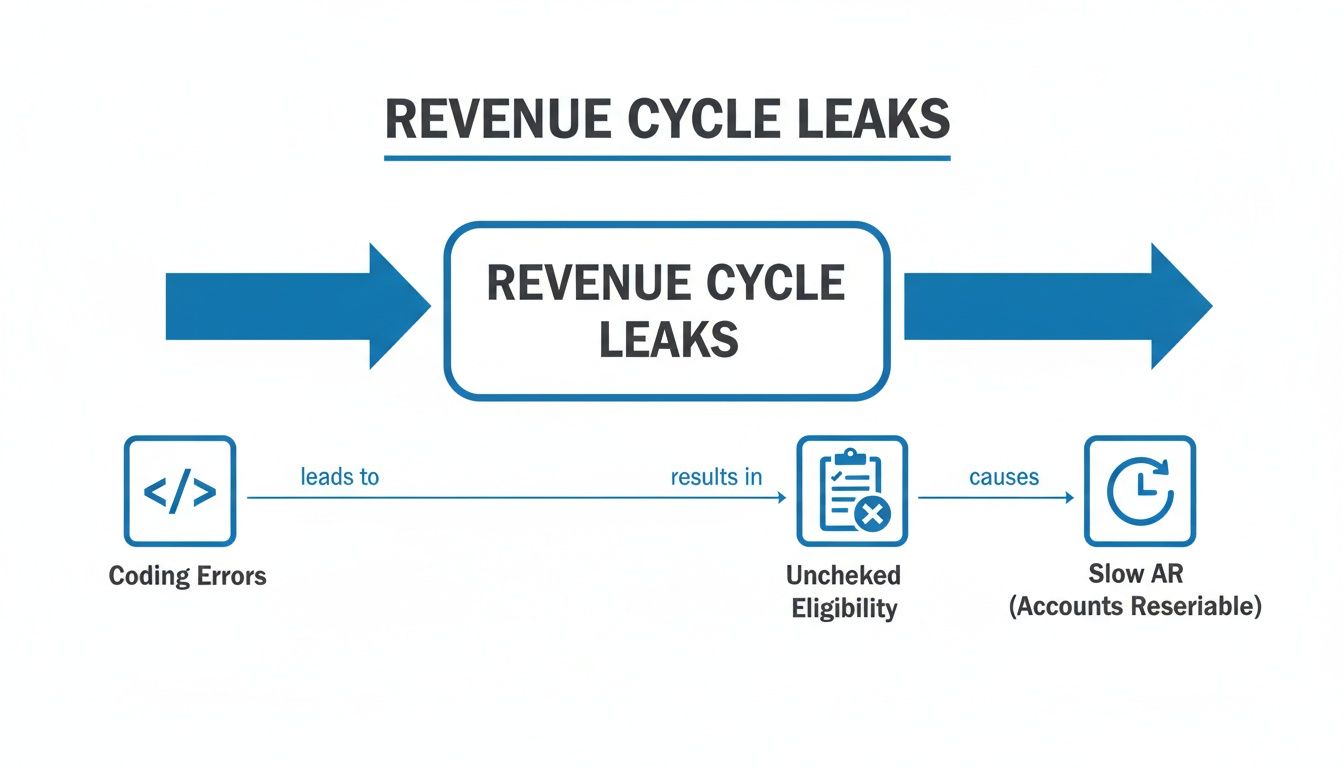
As the visual makes clear, these aren't isolated incidents. They’re part of a chain reaction where one failure fuels the next, ultimately hitting your bottom line.
The Slow Drain Of Inefficient AR Follow-Up
Your Accounts Receivable (AR) is the money you're owed for care you've already delivered. When your AR follow-up is inefficient, it’s like having a slow leak in your practice’s financial plumbing. It might not look like much day-to-day, but over time, the loss is huge.
The problem is that many practices just don't have a system for chasing down unpaid claims. Staff might work on claims at random, without prioritizing them by age or dollar amount. As a result, older, high-value claims get buried at the bottom of the pile, making it more likely they’ll never get paid. Insurance companies have timely filing limits, and once that window slams shut, the money is gone forever.
An effective AR strategy isn’t random; it’s relentless and strategic. It requires a dedicated effort to figure out why a claim is unpaid, get the payer on the phone, and resolve the issue quickly. Without that focus, your days in AR will creep up, your cash flow will tighten, and your practice will be leaving hard-earned money on the table.
Front-End Failures In Patient Eligibility Verification
You’d be surprised how many of the most expensive RCM problems start right at the front desk. Failing to properly verify a patient’s insurance eligibility and benefits before their appointment is a critical mistake that all but guarantees a future denial.
When you don't confirm a patient's coverage, you're flying blind. You risk providing services that aren't covered, billing the wrong insurance plan, or discovering the policy isn't even active. This leads directly to a denial for "patient not eligible"—one of the most common, and most preventable, denial reasons out there.
Fixing these errors after the fact is a painful, time-consuming mess. Your staff has to hunt down the patient, get the right insurance info, and then resubmit the claim, all while the payment clock keeps ticking. A solid, multi-step verification process at every single patient encounter is the only way to ensure claims get paid on the first pass.
The Growing Pressure Of Patient Collections
With high-deductible health plans becoming the norm, patients are now responsible for a much bigger piece of their healthcare bills. This shift has turned patient collections into a massive challenge for practices of every size. The reality is, collecting from patients is often harder, more expensive, and more delicate than collecting from insurance companies.
Practices without a clear financial policy and good communication tools really struggle here. If patients don't understand what they owe and why, they’re far less likely to pay on time. This can quickly lead to a spike in bad debt and can even damage the patient-provider relationship you've worked so hard to build.
To succeed, you need a blend of transparency, convenience, and empathy. This means providing clear cost estimates upfront, offering multiple ways to pay, and training your staff to have financial conversations with confidence and professionalism. It's a growing issue across the board—claims and denial management now represent 33.40% of the entire RCM market. While new AI-powered tools are helping some achieve 98% clean-claim rates, the pressure continues to mount, driving 1.8% of the market's growth.
Practical Strategies To Strengthen Your Revenue Cycle
Identifying the weak links in your revenue cycle is one thing, but fixing them is where the real work begins. It’s time to move from finding problems to putting proven, practical solutions in place—the kind that build lasting financial health for your practice.
A strong revenue cycle doesn’t happen by accident. It’s built on intentional strategies that turn daily administrative headaches into opportunities for real improvement. This section is your roadmap, offering actionable steps to build a more resilient and profitable financial engine.
Building A Proactive Denial Prevention Program
The best way to handle claim denials is to stop them before they even happen. Simply reacting and appealing denials as they roll in is a slow, expensive game of catch-up. A truly proactive program gets to the heart of the matter by finding and fixing the root causes, so those same denials stop showing up again and again.
It all starts with a detailed root cause analysis. Instead of just resubmitting a denied claim, your team needs to dig deeper. Categorize every denial by payer, reason code, and even the department it came from. This data will quickly paint a picture of your biggest vulnerabilities, whether it’s a recurring data entry mistake at the front desk or a specific coding error.
Once you know where the leaks are, you can plug them with targeted fixes. This might mean:
- Focused Staff Training: If eligibility issues are your top problem, it’s time for specific training for your front-desk staff on their verification process.
- Process Improvement: Create simple checklists for prior authorizations to make sure every box is ticked before a patient is even seen.
- Coding Audits: Schedule regular reviews of coding patterns to catch and correct mistakes before claims go out the door.
When you shift your focus from chasing denials to preventing them, you slash administrative busywork, speed up your cash flow, and dramatically cut down on collection costs.
Mastering The Complexities Of Medical Coding
Medical coding is far too intricate for a "set it and forget it" mindset. We’re talking about thousands of codes and payer rules that seem to change every other week. In this environment, continuous education for your coders isn’t a luxury—it’s absolutely essential for financial survival.
Even more important is specialty-specific expertise. A coder who lives and breathes the nuances of orthopedic surgery is going to be infinitely more effective than a generalist trying to tackle a complex procedure. That specialized knowledge ensures every service is captured accurately, the right modifiers are used, and payer-specific quirks are followed to the letter.
Think of a well-trained, specialty-focused coding team as your best defense against revenue leakage. They make sure you get paid correctly for the incredible work you do, all while keeping you safely in compliance.
This commitment to coding accuracy directly fuels a healthier bottom line. For a closer look at improving your financial workflows, you can optimize revenue cycle management in our comprehensive guide.
Implementing A Systematic AR Follow-Up Process
Letting unpaid claims sit and gather dust in your Accounts Receivable (AR) is one of the fastest ways to torpedo your cash flow. An effective AR management strategy isn’t about making random calls; it's a systematic, persistent process designed to bring in every single dollar you’ve rightfully earned.
The key is to prioritize your efforts for the biggest impact. Instead of just working down an endless list, your team should focus their energy by segmenting claims.
- Claim Age: Start with the oldest claims. They’re closest to hitting timely filing deadlines and becoming completely uncollectible.
- Claim Value: Next, target the high-dollar claims. Resolving just one of these can make a huge difference in your monthly revenue.
- Payer Trends: Group claims by payers notorious for slow processing. This allows you to tackle systemic issues with a single, focused push.
This structured approach makes sure nothing slips through the cracks. It turns AR follow-up from a chaotic, reactive chore into a strategic mission to protect your practice's revenue.
Strengthening Front-Desk Eligibility Verification
So many of the most expensive revenue cycle problems start with a simple mistake at the very first patient touchpoint. That’s why robust eligibility and benefits verification is your first line of defense against denials that should have never happened. This has to be a non-negotiable step for every patient, every single time.
A solid verification process is more than just checking if a policy is active. Your front-desk team should be trained to confirm:
- Active Coverage: Is the patient's plan actually in effect today?
- Specific Benefits: Does their plan cover the specific services they’re here for?
- Patient Responsibility: What are the exact copay, coinsurance, and deductible amounts?
- Prior Authorization: Is pre-approval from the insurer required for this service?
Confirming these details upfront gives financial clarity to everyone involved. It prevents a mountain of back-end cleanup, cuts down on those frustrating "patient not eligible" denials, and sets the stage for a much smoother billing cycle.
Improving Patient Collections With Transparency
With patients shouldering more of their healthcare costs, your collection strategy has to evolve. The old way of sending surprise bills and making demanding phone calls just doesn't work anymore. Today’s approach is built on transparency, convenience, and clear communication.
To get better at patient collections, start by creating a crystal-clear financial policy. This means giving patients a good-faith estimate of their costs before services are rendered. This simple act of transparency empowers them and gets rid of the sticker shock later on.
Next, make it incredibly easy for patients to pay you. Offer multiple options like an online portal, automated payment plans, and mobile pay. The fewer hoops they have to jump through, the faster you’ll collect what you’re owed. This patient-first approach doesn’t just boost your cash flow—it builds trust and loyalty.
The Hidden Costs Of In-House RCM And Staffing
Managing your revenue cycle in-house might seem like the most straightforward way to keep control of your finances. But as many practices quickly find out, the real costs are lurking just beneath the surface, going far beyond employee salaries. This approach quietly introduces a swarm of hidden expenses and operational headaches that drain resources and, most importantly, pull your focus away from patient care.
These underlying costs create significant revenue cycle management challenges that are easy to underestimate until they hit your bottom line. From the never-ending cycle of recruitment to mandatory training, the financial and administrative weight of keeping a skilled internal team can be staggering.
Beyond The Paycheck: The Real Cost Of An In-House Team
The most obvious line item for an in-house billing team is their paycheck, but that’s just the tip of the iceberg. When you take a closer look, you'll find a much bigger financial commitment.
When you hire internally, you’re also on the hook for:
- Benefits: Health insurance, retirement plans, and paid time off can easily add 20-30% on top of each employee's base salary.
- Ongoing Training: The world of medical billing never sits still. Constant updates to codes, payer rules, and compliance regulations demand expensive, mandatory training just for your team to keep up.
- Software and Technology: Licensing fees for your practice management software, clearinghouse access, and specialized coding tools add up fast.
- Overhead: This covers everything from the physical office space and utilities to the administrative hours spent actually managing the team.
These costs don't just add up; they compound. What looks like a manageable expense on paper quickly becomes a major financial drain, with each element acting as a slow leak in your practice's budget.
The High Price Of Staff Turnover
One of the most disruptive—and expensive—challenges is staff turnover. When a talented biller or coder walks out the door, the pain is immediate. It’s not just about the cost of recruiting and hiring their replacement; it’s about the massive loss of productivity and institutional knowledge.
The moment they leave, work starts piling up. Claims get delayed, AR follow-up grinds to a halt, and your cash flow takes a direct hit. The remaining team members are stretched thin, leading to burnout and a higher risk of errors, which just creates more denials to deal with later.
The instability from high turnover injects a constant state of risk into your revenue cycle. Each departure jeopardizes your financial consistency and forces you to spend precious time and money rebuilding instead of optimizing.
The Nationwide Talent Shortage
Making matters worse is a nationwide shortage of certified coders and experienced billers. This scarcity of talent makes finding qualified candidates incredibly difficult and expensive. Practices find themselves competing for a limited pool of experts, which naturally drives salaries and hiring costs through the roof.
This talent gap puts independent practices at a serious disadvantage. Without the deep pockets of a large health system, it becomes a constant battle to attract and retain the skilled professionals you need to navigate an increasingly complex billing landscape. The result is often a team that is overworked, undertrained, or both—a perfect recipe for declining financial performance. Partnering with a dedicated RCM provider can be a strategic solution, offering a clear path to healthcare revenue cycle outsourcing and its benefits.
This is exactly why so many providers are looking for outside help. In fact, healthcare providers globally are grappling with such severe staffing shortages that it's forcing them to rethink RCM operations entirely. Outsourced services now dominate the revenue cycle management market, holding a massive 77.30% market share, largely because providers see it as a direct solution to improve collections amid these staffing crises. To see the full scope of this trend, discover more insights about the RCM market from Mordor Intelligence.
Outsourcing As A Strategic Advantage
Shifting to an outsourced RCM partner isn't just a cost-cutting measure; it’s a strategic move to eliminate these persistent staffing headaches and gain a real competitive edge. When you partner with a dedicated firm, you get instant access to a full team of certified, specialty-specific experts who live and breathe this work.
This approach transforms your RCM from a costly, unpredictable overhead expense into a stable, scalable, and results-driven operation. It frees your practice from the endless cycle of hiring, training, and managing a billing team, allowing your leadership to get back to focusing on what truly matters: patient care and strategic growth.
Using Modern Technology Without The Headaches
Everyone thinks technology is the magic wand for fixing revenue cycle problems. But anyone who’s actually tried to implement a new system knows it can create just as many headaches as it solves. Practices sink a ton of money into powerful software, hoping for a quick fix, only to get bogged down in integration nightmares, spiraling costs, and endless maintenance.
What was supposed to be a solution quickly becomes a massive operational burden.
The hard truth is that getting your different systems—your EHR, practice management software, and billing platform—to talk to each other is a huge challenge. When they don’t sync up properly, your staff is left patching the gaps with manual workarounds, entering the same data twice, and trying to make sense of a fragmented financial picture. This isn't just inefficient; it's a direct cause of costly errors.
Then there's the money. These systems require a big upfront investment, not to mention the ongoing fees for licenses, support, and the inevitable "mandatory" updates. For most practices, trying to manage a complex tech stack in-house just isn't sustainable.
The Problem With Disconnected Systems
When your technology is disjointed, it creates dangerous blind spots in your revenue cycle. It's like a relay race where the runners keep dropping the baton—critical information gets lost every time it’s handed off between your EHR and your billing software.
This chaos leads to some very specific and expensive problems:
- Data Mismatches: A patient’s address is updated in the EHR but not in the billing system. Boom—instant claim rejection.
- Wasted Staff Time: Your team has to manually pull charge information from one screen and re-enter it into another. It’s slow, tedious, and a perfect recipe for typos that lead to denials.
- No Clear Picture: You can't pull a single, clean report to see how you're really doing. It becomes impossible to spot negative trends or figure out why denials are piling up.
When your technology works against you, it doesn't just slow down your team—it actively creates the very revenue cycle challenges you were trying to solve in the first place.
A Smarter Approach Through Partnership
Instead of wrestling with the tech yourself, a far better strategy is to partner with a billing expert who manages the entire stack for you. This approach gives you all the power of advanced tools without the upfront costs, implementation risks, or maintenance drama. A skilled partner provides a fully integrated platform that handles everything from the first eligibility check to the final denial follow-up.
This model is quickly becoming the new industry standard. In a major shift, more than 60% of new RCM deployments are now cloud-based. It's a fast-growing market, with a 13.65% compound annual growth rate, because practices are tired of managing clunky, on-premise systems. Cloud vendors, for instance, can push critical regulatory coding updates to everyone at once, so you stay compliant without lifting a finger. You can read the full research on the RCM market's growth to see how this is changing healthcare finance.
By working with One For All Medical Billing, you get immediate access to top-tier tools, advanced analytics, and automated workflows. We handle the technology so you can see the results—like higher clean claim rates and faster payments—without any of the operational drag. This includes seamless claim submission through clearinghouses, a vital part of the process. You can learn more about what a clearinghouse is in medical billing in our detailed guide.
It frees you up to focus on patient care while we make sure your financial engine is running at peak performance.
Frequently Asked Questions About Solving RCM Challenges
When you're in the trenches of running a practice, the same questions about the revenue cycle tend to pop up again and again. Getting straightforward answers is the only way to make smart decisions that actually improve your bottom line. Here are our answers to the questions we hear most often.
What Is The First Step To Reducing Claim Denials?
Before you do anything else, you have to figure out why your claims are being denied in the first place. This means doing a root cause analysis.
Don't just rework and resubmit a denied claim. Instead, your first move should be to categorize every denial by the reason the payer gave you. Is it "patient not eligible"? "Missing information"? "Service not covered"? This data is like a roadmap that points directly to your biggest weak spots.
More often than not, the trail leads right back to the front desk. By pinpointing where the errors are coming from, you can create targeted training and fix broken workflows. This shifts your whole strategy from constantly putting out fires to preventing them from ever starting.
Is Outsourcing Medical Billing Cost-Effective For My Practice?
For most small to mid-sized practices, the answer is a resounding yes. It’s easy to look at the percentage fee and compare it to an employee’s salary, but that’s not the whole picture.
To get a true cost comparison, you have to add up all the hidden expenses of an in-house team: benefits, payroll taxes, ongoing training, expensive software subscriptions, and clearinghouse fees. Then, factor in the financial drag from staff turnover and the time you spend managing it all.
A professional RCM partner operates on a scale you can't match in-house. You get access to a whole team of certified experts and powerful technology for a predictable percentage of what you collect—which is often far less than the true cost of doing it all yourself.
How Can We Improve Patient Collections Without Hurting Relationships?
This is a big one, and it all comes down to clear communication and no surprises. The patient financial experience starts the moment they book an appointment.
Start by thoroughly verifying their insurance benefits before they walk in the door. Then, give them a simple, easy-to-understand estimate of what their financial responsibility will be. When patients know what to expect, the entire conversation changes.
To create a better financial experience, you should:
- Offer convenient ways to pay, like an online portal or flexible payment plans.
- Train your team to have money conversations with empathy and confidence.
- Make the process transparent and easy to navigate so patients feel empowered, not ambushed.
This approach does more than just get you paid. It builds trust and strengthens the patient-provider relationship. When patients feel respected and informed, they are far more likely to take care of their bills without friction.
Ready to stop wrestling with your revenue cycle management challenges? One For All Medical Billing brings the specialty-specific expertise and proven processes you need to slash denials, get paid faster, and finally get some peace of mind. Schedule your free consultation today to see how we can help.

