

table of contents
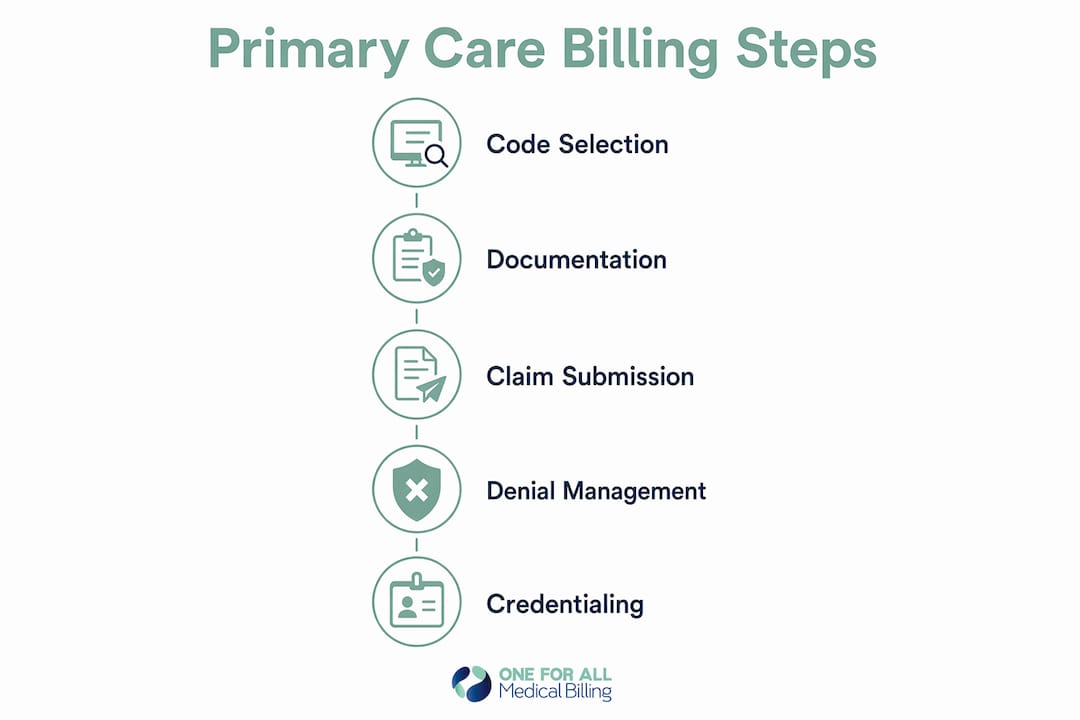
Primary care billing is the process of translating patient encounters into compliant, reimbursable claims using Current Procedural Terminology (CPT) codes, ICD-10 diagnoses, and payer-specific rules. Get it right, and your revenue cycle runs with predictable cash flow and minimal friction. Get it wrong, and you’re staring down a backlog of denials, audit flags, and delayed payments that compound week over week. The fundamentals haven’t changed, but the 2026 regulatory environment has added new layers, particularly around telehealth supervision and evaluation and management (E/M) documentation standards, that every primary care practice needs to understand.
Here’s what drives effective billing for primary care services:
- CPT coding accuracy: Office visit E/M codes (99202–99215), preventive medicine codes (99381–99397), and chronic care management codes (99490) must match documented complexity and time.
- ICD-10 specificity: Unspecified diagnosis codes trigger denials; documentation must support the highest level of specificity available.
- Modifier 25 application: When a problem-based E/M service is performed on the same day as a preventive visit, modifier 25 must be appended to the problem-based code to prevent bundling denials.
- Medicare Physician Fee Schedule awareness: Reimbursement rates are set annually by CMS; understanding relative value units (RVUs) and geographic adjustments directly affects your revenue projections.
- Credentialing as a billing prerequisite: A provider who is not credentialed with a payer cannot bill that payer, regardless of how accurate the claim is. Credentialing timelines average 90–120 days, so gaps here translate directly to lost revenue.
- Documentation correlation: Every billed service must be supported by a clinical note that reflects the medical necessity, complexity, and time spent, whether you’re billing under medical decision making (MDM) or time-based criteria.
Accurate primary care billing isn’t just about getting paid. It’s the foundation of a compliant, financially healthy practice.
How accurate coding drives primary care reimbursement
Coding errors are the single most controllable source of revenue loss in a primary care practice. The good news is that most of them follow predictable patterns, which means they’re fixable with the right processes.

E/M level selection is where most billing errors originate. Under the 2021 AMA E/M guidelines (still governing in 2026), you select the level of service for office visits (99202–99215) based on either MDM complexity or total time on the date of the encounter. Time-based coding has become more common, but it requires precise documentation of the total minutes spent, including pre-visit chart review, the face-to-face encounter, and post-visit work like ordering tests or coordinating care.
For preventive medicine visits, the coding structure is separate. CPT codes 99381–99397 cover new and established patients across age ranges. When a patient presents for a scheduled annual physical but also has an acute complaint, such as a new rash or uncontrolled blood pressure, you can bill both the preventive code and the appropriate E/M code. The key requirement: modifier 25 on the E/M code to signal that the problem-based service was a separately identifiable encounter, not just part of the preventive exam.
ICD-10 coding specificity matters more than many practices realize. A claim submitted with an unspecified code when a more specific one is available will often trigger a denial or a request for additional documentation. Your clinical notes need to support the specific diagnosis you’re billing, and coders need to read those notes fully rather than defaulting to a template-generated code.
- E/M level: Select based on MDM or total time; document whichever method you use.
- Preventive + problem-based visits: Bill both services; append modifier 25 to the E/M code.
- ICD-10 specificity: Use the most specific diagnosis code the documentation supports.
- Chronic conditions: Code all chronic conditions that are addressed or affect management, not just the primary complaint.
- Counseling and coordination: When counseling or care coordination dominates the visit, time-based billing often captures higher complexity more accurately.
Pro Tip: Never assign an E/M level from a template or default code without reading the full clinical note. Retrospective coding based on templates without full note review is one of the leading triggers for audit flags and payment denials in primary care.
What payer regulations mean for your billing compliance
Payer rules in primary care aren’t static, and 2026 has brought meaningful updates that affect how you bill, document, and supervise services. Staying current isn’t optional; it’s the difference between a clean claim and a denial that takes weeks to resolve.

Medicare and Medicaid policy updates continue to shape the billing environment. One of the most significant 2026 changes is CMS’s permanent authorization of virtual direct supervision via real-time audio/video technology for most Medicare Part B services. This matters directly for incident-to billing, where a non-physician provider delivers a service under a physician’s supervision. Previously, direct supervision required the supervising physician to be physically present in the office suite. Now, real-time audio/video presence satisfies that requirement for most services, excluding audio-only communication and high-risk surgical procedures.
Telehealth billing has its own documentation requirements. You need to capture the patient’s location, the provider’s location, the technology used, and the patient’s consent to telehealth services. Missing any of these elements can result in a denial even when the clinical care was appropriate and well-documented.
Eligibility verification is a front-end function that has a direct impact on claim acceptance rates. Verifying coverage within 24–48 hours before the visit gives your front desk time to address coverage gaps, confirm copay and deductible amounts, and flag any prior authorization requirements before the patient arrives. Waiting until after the visit to verify eligibility is one of the most common and most avoidable sources of claim denials in family medicine billing.
Common denial reasons tied to compliance failures include:
- Missing or incorrect modifier: Modifier 25 omitted on same-day E/M and preventive visits.
- Insufficient documentation: Clinical notes that don’t support the billed E/M level or diagnosis specificity.
- Telehealth documentation gaps: Missing patient location, consent, or technology type.
- Authorization failures: Services rendered without required prior authorization.
- Incident-to billing errors: Non-physician provider billed incident-to without meeting supervision requirements.
- Timely filing violations: Claims submitted after the payer’s filing deadline, which varies by payer from 90 days to one year.
Commercial payers often have rules that differ from Medicare, sometimes significantly. Reviewing each payer’s provider manual annually is the most reliable way to catch rule changes before they show up as denials.
How to build a claims submission process that reduces denials
A clean claim submitted on time is the goal of every billing workflow. The path to that outcome runs through a series of front-end and back-end controls that, when working together, function like a quality filter for your revenue cycle.
Pre-submission claim scrubbing is the first line of defense. Clearinghouses like Availity, Change Healthcare, and Waystar run automated edits against your claims before they reach the payer, catching formatting errors, missing fields, invalid codes, and mismatched diagnosis-to-procedure combinations. A claim that fails a scrub is far cheaper to fix than one that reaches the payer and gets denied, because a payer denial triggers a formal appeals process with its own timeline and administrative cost. Understanding what claim scrubbing catches versus what it misses is worth knowing before you rely on it as your only quality check.
Timely submission is non-negotiable. Most commercial payers require claims within 90–180 days of the date of service; Medicare’s deadline is one year. Missing a timely filing deadline is one of the few denial types that cannot be appealed on clinical grounds. Build submission workflows that get claims out within 48–72 hours of the encounter, and monitor your aging reports weekly to catch anything that’s slipping.
When denials do occur, denial root cause analysis is the tool that separates practices that fix the same problem repeatedly from those that fix it once. Grouping denials by reason code, payer, provider, and service type reveals patterns. If 30% of your denials in a given month trace back to missing modifier 25 on same-day visits, that’s a training issue, not a random error. Fix the process, not just the individual claim.
Best practices for a denial-resistant claims workflow:
- Verify eligibility 24–48 hours before the visit and confirm authorization requirements.
- Scrub claims electronically before submission; review scrubber reports daily.
- Submit claims within 48–72 hours of the date of service.
- Track denial reason codes by category and payer; review trends monthly.
- Appeal denials with supporting documentation within the payer’s appeal window, typically 30–180 days.
- Use electronic claims submission workflows to reduce manual entry errors and accelerate processing.
- Reconcile payments against expected reimbursement to catch underpayments and contractual adjustments.
Pro Tip: When appealing a denied claim, attach the specific clinical documentation that supports the billed service, along with the payer’s own coverage policy language where it supports your position. A well-documented appeal with policy citations resolves faster than a generic reconsideration request.
Managing patient balances is part of the same workflow. Collecting copays and deductibles at the time of service reduces your patient A/R burden significantly. Clear financial counseling before or at the visit, combined with a straightforward payment policy, reduces the number of patient balance statements that go unpaid.
Why credentialing is the foundation of billing eligibility
You can have perfect coding and spotless documentation, but if the rendering provider isn’t credentialed with the payer, the claim won’t pay. Credentialing is the process by which payers verify a provider’s qualifications, licensure, malpractice history, and training before granting network participation. It’s a prerequisite for billing, not an administrative afterthought.
The credentialing process involves submitting a detailed application to each payer, including the provider’s National Provider Identifier (NPI), DEA registration, board certifications, malpractice insurance certificates, and work history. Most payers use the Council for Affordable Quality Healthcare (CAQH) ProView system as a centralized repository for this information, which reduces the burden of submitting the same documents to multiple payers. Keeping your CAQH profile current is one of the simplest ways to prevent credentialing delays.
Timelines vary. Medicare enrollment through the Provider Enrollment, Chain, and Ownership System (PECOS) can take over a month when submitted correctly. Commercial payer credentialing often takes several months. Medicaid timelines vary by state. For a new provider joining a practice, this means starting the credentialing process well before the anticipated start date, ideally 4–6 months in advance.
Key credentialing considerations for primary care providers:
- Medicare enrollment: Submit through PECOS; verify NPI registration and taxonomy codes before applying.
- Medicaid enrollment: Managed separately by each state’s Medicaid agency; timelines and requirements vary.
- Commercial payers: Use CAQH ProView to maintain a single source of credentialing data across multiple payers.
- Re-credentialing: Most payers require re-credentialing every 2–3 years; missing a re-credentialing deadline can result in termination from the network.
- Privileging vs. credentialing: Hospital-based providers need both; office-based primary care providers typically need credentialing only.
- Monitoring expiration dates: Track license renewals, DEA registrations, and malpractice policy renewals to prevent lapses that trigger payer audits or claim holds.
A provider who is credentialed but whose CAQH profile has lapsed or whose malpractice coverage has expired may find claims denied retroactively. Proactive monitoring of these dates is as important as the initial application.
Common CPT codes you use every day in primary care
Primary care billing relies on a core set of CPT codes that cover the full range of services your practice delivers. Knowing which codes apply, when to use modifiers, and what documentation each requires is the practical foundation of accurate billing.
Office visit E/M codes (99202–99215) are the backbone of primary care billing. New patient codes run 99202–99205; established patient codes run 99211–99215. Level selection is based on MDM complexity or total time. For a complete breakdown of how these codes apply in office visit scenarios, the CPT code for office visit guide covers documentation requirements in detail.
Preventive medicine codes (99381–99397) cover annual wellness exams across age groups. These are not interchangeable with E/M codes; they cover a different scope of service and are reimbursed differently under most payer contracts. When a patient has an acute or chronic issue addressed at the same preventive visit, bill both the preventive code and the appropriate E/M code with modifier 25 on the E/M.
Chronic Care Management (CCM) under CPT 99490 is one of the most consistently underbilled services in primary care. It covers non-face-to-face care management for patients with two or more chronic conditions, requiring at least 20 minutes of documented care management time per calendar month. Many practices provide this care but fail to document the time in a way that supports the code, leaving reimbursement on the table.
Additional billable codes and scenarios worth knowing:
- Advance Care Planning (99497, 99498): Billable separately from E/M visits when the provider spends time discussing advance directives; requires patient consent documentation.
- Social Determinants of Health (SDOH) assessments (96161): Billable when a standardized screening tool is used and results are documented in the medical record.
- Telehealth visits: Use the same E/M codes (99202–99215) with the appropriate place of service code (02 for telehealth, 10 for patient’s home); modifier 95 may be required by some payers.
- Vaccine administration (90471 and add-on codes): Billed separately from the vaccine product codes; vaccine billing requires correct modifier 25 application when a significant E/M service is also performed on the same day.
- Modifier 33: Applied to preventive services that are mandated by the Affordable Care Act (ACA) to indicate the service should be covered without cost-sharing; incorrect use can result in patient balance billing complaints.
For billing preventive and acute care services on the same day, provider resources from Pand Health offer useful guidance on navigating the documentation and modifier requirements that payers scrutinize most closely.
Pro Tip: Advance Care Planning and SDOH screening codes are frequently overlooked in primary care billing. Both require specific documentation, but when that documentation is in place, they represent legitimate reimbursement for work that your providers are already doing.
Expert advice on avoiding the most frequent billing pitfalls
Most primary care billing problems aren’t random. They cluster around a handful of recurring errors that, once identified, can be addressed systematically. Understanding where the signal is in your denial data is the first step toward fixing the underlying process.
Modifier 25 omission is the single most common cause of bundling denials when same-day preventive and problem-based services are billed together. AAFP experts confirm that payers routinely bundle the problem-based E/M into the preventive exam when modifier 25 is absent, resulting in lost reimbursement for a service that was legitimately provided and documented. This isn’t a gray area; the fix is straightforward, and the revenue impact of getting it right is immediate.
Insufficient documentation is the second major driver of denials and audit risk. E/M level selection must be supported by the clinical note, not assumed from the encounter type or the provider’s usual practice. A level 4 established patient visit (99214) requires documentation of moderate MDM or 30–39 minutes of total time. If the note doesn’t reflect that complexity, the claim is vulnerable, whether to a payer denial on review or to a post-payment audit.
Unspecified ICD-10 codes create a different kind of problem. They don’t always cause immediate denials, but they can trigger requests for additional documentation, delay payment, and increase audit risk over time. Coders who default to unspecified codes because the clinical note is ambiguous should flag those notes for provider clarification rather than submitting with a code that doesn’t reflect the documented condition.
Medicare reimbursement has declined 29% since 2001 in inflation-adjusted terms, which means the administrative burden of billing errors hits harder than it did a decade ago. Practices that don’t actively monitor their billing accuracy are effectively accepting a compounding revenue loss.
Common pitfalls and how to address them:
- Missing modifier 25: Implement a billing rule in your practice management system that flags same-day preventive and E/M claims for modifier review before submission.
- Template-driven E/M coding: Require coders to read the full clinical note before assigning a level; retrospective coding from templates is a leading audit trigger.
- Underbilling CCM: Establish a documentation workflow that captures care management time in real time, not retrospectively.
- Timely filing lapses: Set internal submission deadlines at 48–72 hours post-encounter; monitor aging reports weekly.
- Staff knowledge gaps: Schedule quarterly coding education sessions, particularly when CMS or AMA updates affect E/M guidelines.
Denial root cause analysis, driven by reason codes, is the operational tool that turns reactive denial management into a proactive process. When you group denials by type and trace them to their origin, whether that’s a front-desk eligibility gap, a coder training issue, or a documentation problem, you can fix the process rather than just the individual claim.
Pro Tip: Use your practice management system’s reporting tools to pull a monthly denial report segmented by reason code, payer, and provider. If one provider’s claims show a disproportionate share of E/M level denials, that’s a documentation coaching opportunity, not a billing department failure.
How One For All Medical Billing handles what most practices get wrong
Primary care billing is technically demanding, and the margin for error is thin. A single missed modifier, a lapsed credentialing date, or a documentation gap can cascade into weeks of delayed reimbursement and hours of staff time spent on appeals.
One For All Medical Billing brings over 20 years of specialty-focused billing expertise to primary care and family medicine practices across Oklahoma and nationwide. The difference isn’t just experience; it’s a 90% clean claim rate backed by a billing process that catches errors before they reach the payer. From revenue cycle management and denial management to credentialing, ICD-10 and CPT coding, eligibility verification, and compliance consulting, the full service model means your team isn’t managing billing complexity on top of patient care. Whether you’re a solo primary care provider or a multi-site health system, One For All Medical Billing tailors its approach to your payer mix, your specialty, and your revenue goals. If you’re ready to reduce denials and get paid faster, explore medical coding and billing solutions designed specifically for primary care practices.
FAQ
What is primary care billing and how does it work?
Primary care billing is the process of submitting claims to payers using CPT and ICD-10 codes that reflect the services a provider delivered, supported by clinical documentation that meets payer requirements. The workflow runs from patient eligibility verification through charge capture, claim submission, payment posting, and denial management.
What is the difference between a UB-04 and a CMS-1500?
The CMS-1500 is the standard claim form used by physician offices and outpatient providers, including primary care practices. The UB-04 is used by institutional providers such as hospitals and skilled nursing facilities; primary care billing almost exclusively uses the standard physician office claim form.
How does modifier 25 apply in primary care billing?
Modifier 25 is appended to a problem-based E/M code when that service is performed on the same day as a preventive medicine visit. Without it, payers typically bundle the E/M into the preventive exam and deny the separate reimbursement, even when the services were clinically distinct.
What are the most common CPT codes used in primary care?
The most frequently billed codes include office visit E/M codes (99202–99215), preventive medicine codes (99381–99397), Chronic Care Management (99490), Advance Care Planning (99497), and telehealth E/M codes using place of service 02 or 10.
How does One For All Medical Billing support primary care providers?
One For All Medical Billing provides full-service revenue cycle management for primary care practices, including CPT and ICD-10 coding, credentialing, eligibility verification, denial management, and compliance consulting, with a 90% clean claim rate and specialty-specific expertise.
Key Takeaways
Accurate primary care billing requires correct modifier application, ICD-10 specificity, timely credentialing, and denial root cause analysis working together across the full revenue cycle.
| Point | Details |
|---|---|
| Modifier 25 prevents bundling denials | Append modifier 25 to the E/M code whenever a problem-based service is billed on the same day as a preventive visit. |
| Eligibility verification timing matters | Verifying coverage 24–48 hours before the visit reduces claim denials caused by coverage gaps and authorization failures. |
| Retrospective coding triggers audits | Assign E/M levels only after reading the full clinical note; template-driven coding is a leading cause of audit flags. |
| CCM is consistently underbilled | CPT 99490 requires 20 minutes of documented care management time monthly; many practices provide this care but fail to document it. |
| One For All Medical Billing | Delivers specialty-focused primary care billing with a 90% clean claim rate, covering coding, credentialing, and denial management. |
Recommended
- CPT Code for Office Visit: A Complete 2026 Guide – One For All Medical Billing
- Colonoscopy Procedure Code: A Definitive Billing Guide – One For All Medical Billing
- 97112 CPT Code: A Guide to Billing & Compliance in 2026 – One For All Medical Billing
- CPT Code For B12 Injection Your Guide To Clean Claims – One For All Medical Billing

