

table of contents
Monday starts with a denial report. Tuesday brings a stack of front-desk questions about whether a patient is new or established. By Wednesday, a provider has documented a long visit but never stated total time, and the biller has to decide whether the note supports the code or needs a query. That's the daily reality behind the search for the right CPT code for office visit.
Most practices don't struggle because they lack a code list. They struggle because office visit coding lives where clinical documentation, payer rules, scheduling patterns, and revenue integrity all collide. A simple undercode leaves money unbilled. An aggressive code without support creates audit exposure. And the hardest part is that many errors happen in ordinary follow-up visits, not rare edge cases.
What works is a disciplined process. Identify the correct code family first. Decide whether the level is supported by medical decision-making or total time on the date of service. Then check whether place of service, modifiers, or after-hours add-on rules change the claim. That's where clean billing usually gets won or lost.
Why Accurate Office Visit Coding Is Your Practice's Lifeline
A practice manager usually notices office visit coding problems indirectly. Collections soften. Denials creep up. Providers feel like they're documenting more but not seeing cleaner payment. The root issue often isn't one big mistake. It's a steady drip of small coding mismatches across high-volume office encounters.
Office visits sit at the center of the revenue cycle because they're billed constantly and reviewed constantly. The office and outpatient E/M family is built around 99202 to 99215, and those codes function as the standard language for outpatient billing across Medicare and commercial plans, as described in this overview of primary care CPT code ranges and office visit coding. When a practice gets these claims right, the rest of the revenue cycle becomes easier to manage. When it gets them wrong, everything downstream becomes heavier.
Small Coding Errors Create Big Operational Problems
An undercoded visit doesn't usually trigger an alert. It just posts lower. An overcoded visit may pay today and create a problem later. Both outcomes damage revenue integrity.
What I see most often is this pattern:
- Front desk classifies the patient incorrectly: The claim starts in the wrong code family.
- Provider note tells the story clinically but not for billing: The encounter may support a higher level, but the documentation doesn't.
- Billing team chases the claim too late: The denial shows up after filing, not before submission.
Practical rule: Office visit coding isn't a back-office data entry task. It's a revenue cycle control point.
If your team is trying to reduce denials, improve consistency, and tighten payment performance, office visit coding belongs inside the broader healthcare revenue cycle management process, not off to the side as a coding-only issue.
The Real Trade-Off
Practices often swing too far in one direction. Some code conservatively because they fear audits. Others let templates push levels higher without proving medical necessity. Neither approach is stable.
The better approach is simple. Code exactly what the documentation supports, train providers to document the work they did, and build a quick review step for the office visits your payers scrutinize most heavily.
Decoding New Vs Established Patient Visit Codes
The first decision in office visit coding is not the level. It's the patient status. If your staff gets that wrong, nothing that follows will be right.
The modern outpatient E/M family uses 99202 through 99205 for new patients and 99211 through 99215 for established patients, with level selection tied to visit complexity rather than just the fact that a visit occurred, according to this review of common CPT codes in primary care.

The Two Office Visit Code Families
Think of office visit coding as two parallel tracks.
- New patient codes 99202 to 99205: These apply when the patient belongs in the new-patient category for office or outpatient E/M.
- Established patient codes 99211 to 99215: These apply when the patient belongs in the established category.
Operationally, this matters because new-patient visits and established-patient visits don't just use different numbers. They reflect different coding expectations, different time ladders, and different payer scrutiny patterns.
Why Teams Mix These Up
The confusion usually happens before the chart reaches coding. Scheduling staff may rely on what the patient says. Registration may see an old account and assume established. A multisite group may have one location treat the patient as new while another location sees prior specialty care in the same organization.
That's why patient-status logic can't live only in someone's memory. It should be built into the scheduling and registration workflow.
A practical office workflow looks like this:
- Check prior professional services in the PM or EHR system.
- Confirm provider specialty and group relationship.
- Flag uncertain status before the visit closes.
- Resolve the code family first, then review level selection.
The fastest way to lose time on a claim is to argue about 99213 versus 99214 when the patient should never have been in the established series to begin with.
What Changed In Office Visit Coding
The old habit was to focus heavily on counting history and exam bullets. That's no longer the center of office/outpatient E/M coding. The 2021 revision shifted code selection to medical decision-making or total time on the date of service, replacing the older emphasis on tallying individual history and exam elements. That change gave practices more flexibility, but it also removed a crutch. Teams now have to understand the encounter more clearly, not just count documentation pieces.
For practice managers, that means training should move away from checklist-style note audits alone. Ask a harder question instead: did the provider document the complexity of the visit or the total qualifying time in a way that clearly supports the level?
Mastering The E/M Coding Rules MDM Vs Time
Once the patient is in the correct code family, the next question is how the provider earns the level. Since the office/outpatient E/M revisions, code selection can be based on medical decision-making or total time on the date of service. Teams that still code these visits as if every level depends on history and exam counts are working off an outdated mental model.
The 2021 office/outpatient changes were designed to reduce documentation burden, and under that framework, total time includes same-day work such as chart review, face-to-face care, post-visit documentation, and ordering tests or referrals, while excluding staff time and separately billed procedures, according to the American College of Surgeons summary of office and outpatient E/M coding changes.

When MDM Is The Better Path
MDM is usually the cleaner path when the note clearly shows the complexity of the problems addressed, the data reviewed, and the risk tied to management decisions. Here, office visit coding reflects the provider's cognitive work, not just the clock.
That's why many coders talk about the intellectual labor of E/M coding when training providers. A short note can still support a higher level if it clearly captures medically necessary decision-making. A long note can still fail if it says a lot without proving complexity.
Use MDM when:
- The assessment and plan are strong: The provider explains problems, options, testing, and management clearly.
- Data review matters: Records, test interpretation, or care coordination affect decision-making.
- Risk is visible in the plan: Medication management, treatment changes, or escalation decisions are documented well.
When Time Is The Better Path
Time works best when the provider performed substantial same-day work and documented it precisely. The key word is precisely. Vague statements like “spent considerable time” don't help.
Established-patient office visit times move in roughly 10-minute steps under the updated framework, which is why small documentation gaps matter. If the provider spent time reviewing records, counseling, documenting, and coordinating care on the date of the encounter, time may better reflect the service than MDM alone.
A practical example is the common established patient follow-up. If the note supports the work and the provider documented qualifying time appropriately, review the guidance for CPT 99212 and established patient office visit thresholds as part of your internal training logic.
Use one path well. Don't try to stack weak time documentation on top of weak MDM and hope the visit survives review.
What Usually Fails In Real Claims
Three things break otherwise valid office visit claims:
- Missing total time on the date of service
- Assessment that lists diagnoses without showing active management
- Imported template language that inflates the chart but not the support
If you want cleaner coding, train providers to state the work they performed and why it mattered medically. That habit beats any template.
Office Visit Coding In Action With Real Examples
Theory is useful until you're staring at a note that could land in more than one level. Office visit coding gets easier when you look at real encounter patterns and ask one question: what does the documentation support?
Example One, Straightforward Established Follow-Up
An established patient comes in for a routine medication refill and brief symptom check. The provider evaluates the patient, confirms stability, updates the medication plan, and documents 15 total minutes on the encounter date.
That visit sits comfortably in the established-patient family, and the time supports the lower end of the series. The AMA notes that 99212 requires 10 to 19 total minutes on the encounter date, and because the threshold is tight, even one documented additional minute can move the visit to a higher code when the rest of the record supports it, as explained in this AMA overview of CPT 99212 time requirements for established patient office visits.
What works here is clear time documentation and a focused plan. What doesn't work is billing a higher level because the patient has chronic conditions listed in the chart if those conditions weren't meaningfully addressed during the visit.
Example Two, Established Patient With More Work Than The Schedule Suggests
Now take a follow-up patient with worsening symptoms, medication review, test ordering, and counseling. The provider's note documents 35 total minutes on the date of service, including chart review, face-to-face evaluation, and post-visit documentation.
Often, practices undercode. The schedule may show a “follow-up” slot, but the encounter may support a higher level based on total time. For teams that audit these visits regularly, it helps to compare internal notes against the coding logic in this guide to 99213 CPT code description and established office visit use, especially when deciding whether a note sits at the lower or middle range of established care.
Example Three, New Patient With Moderate Complexity
A new patient presents with multiple concerns, outside records need review, and the provider develops an initial management plan with referrals and follow-up testing. If the documentation supports the complexity of decision-making, MDM may be the strongest path. If the provider instead clearly documented same-day total time and that time supports the level, time may be cleaner.
For new patients, the timing ladder differs from established visits. In the older descriptor set reflected in the verified data, 99203 is 30 minutes and 99204 is 45 minutes. The practical point isn't memorizing every number. It's knowing that new-patient encounters sit on a different ladder and often demand tighter front-end classification plus stronger provider documentation.
The note should answer the coding question without forcing the biller to reconstruct the visit from fragments.
The Real Lesson From These Examples
Most office visit coding disputes come down to one of three failures:
- The provider did the work but didn't document it
- The biller selected a level from habit instead of the note
- The team ignored threshold-sensitive time rules
Practices improve fastest when they review a handful of real office visit notes every week and compare the documented work to the submitted code. That kind of audit catches pattern errors before payers do.
Avoiding Common Payer Gotchas And Denials
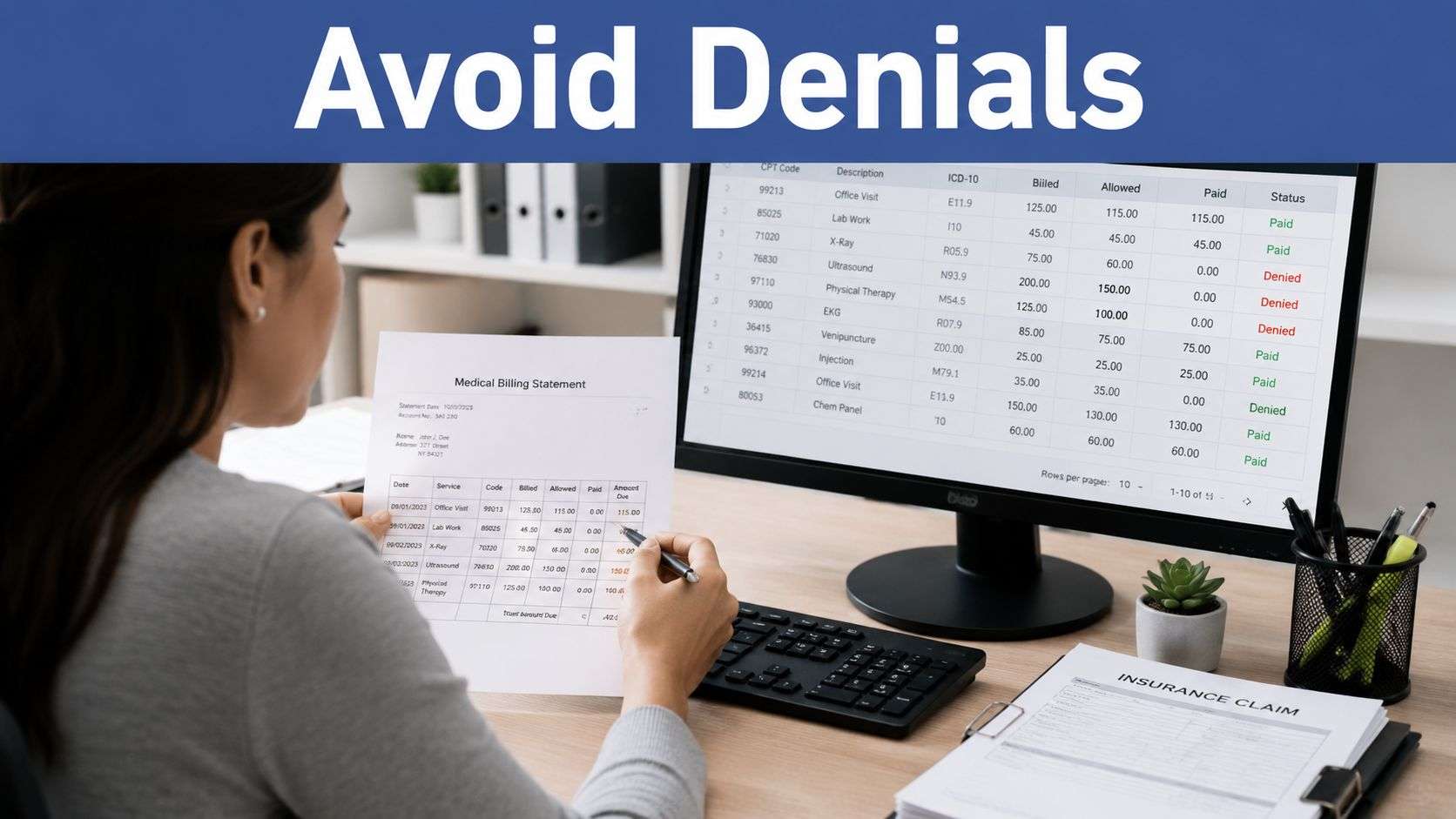
Many articles stop at the 99202 to 99215 range. That's useful for beginners, but it doesn't solve the denials that hit urgent care centers, walk-in clinics, and multi-site groups. The claim often fails because of the rules around the visit, not the office visit code itself.
Add-On Codes For After-Hours And Special Encounters
Billing teams regularly ask whether codes such as 99050 or 99051 can be billed in addition to the office visit. The answer depends on the operational setting. Was the office normally closed? Was the clinic already scheduled for extended hours? Was the schedule disrupted by an emergency patient? Those distinctions matter.
That operational nuance is why after-hours billing is easy to get wrong. Staff may assume any evening visit qualifies. It doesn't. The setting and schedule pattern affect whether the add-on is appropriate, as outlined in this billing discussion of special encounter codes, after-hours services, and place of service issues.
Place Of Service Can Change Payment Logic
Another common denial source is Place of Service. The same CPT code can process differently depending on where the service occurred. POS 11 identifies an office setting, and that distinction matters when comparing office claims with telehealth or other care sites.
Here, experienced billers slow down. They don't just ask, “Is 99213 the right office visit level?” They ask, “Was this billed with the right setting, and does the payer treat that setting differently?” That second question prevents a surprising number of avoidable rejections.
Modifier Discipline Matters
Modifier use creates another layer of risk. Teams often know modifier 25 exists, but they don't apply it consistently, or they apply it too broadly. Either mistake invites trouble.
A practical safeguard is to train staff on when CPT modifier 25 applies to a separately identifiable E/M service and to require note review before adding it. Modifier logic should never be automatic just because a procedure happened on the same day.
Payers don't deny many office visit claims because the code number is unfamiliar. They deny them because the claim tells an incomplete story.
What Works Better Than A Generic Cheat Sheet
A generic code list won't protect revenue here. A payer-aware office visit workflow will.
Use this review pattern before claim submission:
- Confirm setting: Check whether the visit was performed in the office and whether POS is correct.
- Review add-on eligibility: Don't append after-hours codes unless the clinic's schedule and circumstances support them.
- Audit modifier use: Especially on same-day procedure claims.
- Compare note to claim line by line: If the documentation doesn't justify the extra code or modifier, remove it before filing.
That discipline usually reduces friction faster than any one-time coding seminar.
Your Quick Reference Office Visit Coding Checklist
Most coding improvement comes from repeatable habits, not heroic effort. A good checklist keeps the team from relying on memory during busy days and gives supervisors something concrete to audit.

The Claim Review Sequence That Actually Helps
Use this checklist before an office visit claim goes out the door.
Identify Patient Status
Start with the code family. If the patient is placed in the wrong family, every later step is wasted effort.Select The E/M Level
Choose one method. Either the note supports the level through MDM, or it supports it through total time on the date of service.Read The Assessment And Plan Closely
Don't let the HPI or imported template carry the claim. The strongest support usually sits in the provider's active management decisions.Check Time Documentation If Time Is Driving The Code
Same-day total time needs to be explicit. If the note is vague, the code may not be defensible.
The Revenue Protection Layer
Coding accuracy alone isn't enough. The claim also has to survive payer processing.
- Verify place of service: Office, telehealth, and other settings don't always process the same way.
- Review modifier needs: Use them when the note supports them, not because the schedule suggests them.
- Look for add-on opportunities carefully: After-hours logic depends on real clinic operations, not assumptions.
- Match the claim to medical necessity: If the service looks inflated compared with the documented reason for the visit, stop and review.
What Managers Should Audit Weekly
If you manage a billing team, don't review everything at once. Sample a small set of claims that are most likely to drift.
Focus on:
- Borderline established visits: Encounters that sit near level thresholds
- New-patient office visits: These often expose front-end classification issues
- Same-day procedure and E/M combinations
- After-hours and urgent walk-in claims
- Visits with documentation-heavy templates
A strong office visit coding process is usually boring. That's a good sign. Boring means the team is following a standard instead of improvising.
The Best Use Of This Checklist
Print it. Put it in front of coders, billers, and providers. Use it when onboarding staff. Use it during denial reviews. Use it when comparing one provider's documentation style against another's.
The goal isn't to turn every visit into a compliance drill. It's to make the right CPT code for office visit easier to select consistently, even on a busy clinic day when everyone is moving fast.
If your practice needs a billing partner that can tighten office visit coding, reduce denials, and support cleaner claims across specialties and locations, One For All Medical Billing is worth a look. Their team supports providers with coding, claims management, denial follow-up, and full revenue cycle operations built for real-world practice workflows.

