

table of contents
A sound denial write-off policy triages every denied claim by recoverability and dollar value, requires documented rationale before any balance leaves the books, and gets measured against HFMA MAP KPIs like AR-6. Get those three pieces right, and you stop losing recoverable dollars to habit. One For All Medical Billing builds this exact structure into client revenue cycles, pairing CMS-aligned appeal timelines with disciplined KPI reporting.
TL;DR:
- Establishing objective criteria ensures appeals are prioritized for high-dollar, well-documented claims, reducing unnecessary write-offs and maximizing recoverable revenue.
- Training staff to log denials within 24 to 48 hours and assess recoverability based on documentation, payer history, and appeal windows improves recovery chances.
- Implementing dollar-band thresholds for write-offs simplifies decision-making, with high-value claims requiring mandatory appeals and low-dollar claims often eligible for automatic write-offs.
- Tracking denial KPIs like AR-6 and time to appeal provides visibility on revenue leakage sources and helps benchmark against industry standards.
- Building a structured workflow with clear ownership, decision points, and escalation rules prevents claims from aging past recoverability and maintains policy consistency.
What Should a Denial Write-Off Policy Actually Do?
A denial write-off policy exists to answer one question consistently: does this claim get appealed, or does it get written off? Without a written policy, that decision falls to whoever touches the claim last, on whatever day they happen to be busiest. That inconsistency is exactly what drains recoverable revenue.
The policy’s real job is threefold. First, it sets objective criteria (dollar value, documentation strength, payer behavior) so the appeal-versus-write-off call doesn’t depend on who’s working the queue. Second, it forces a paper trail: every write-off needs a documented reason, an owner, and a sign-off, so auditors and payers alike can see the logic behind it. Third, it feeds a measurement system. Without KPI tracking, you can’t tell whether your policy is preventing revenue leakage or just organizing it.
This distinguishes a denial write-off policy from generic write-off procedures, which often lump denials in with courtesy adjustments and bad debt. Denial write-offs deserve their own rules because, unlike bad debt, a meaningful share of them are recoverable if someone appeals in time.
Quick Policy Checklist and Decision Matrix
Before anything else, every denied claim needs a fast, consistent intake process. Skipping this step is how claims age past appeal windows and turn into write-offs by default.
Immediate triage steps for every denial:
- Log the denial code, payer, date received, and dollar value within 24 to 48 hours.
- Assign a single owner responsible for the decision.
- Flag the claim’s appeal deadline immediately, not after research begins.
- Note whether documentation already exists to support an appeal.
Recoverability assessment factors:
- Strength of existing documentation (medical necessity, prior authorization proof, coding accuracy).
- Payer history: does this payer typically overturn this denial reason on appeal?
- Dollar value against staff-hours required to pursue it.
- Time remaining in the appeal window.
Decision rules by dollar band (detailed further below): small balances often route to automatic write-off with a checklist, while high-value or well-documented claims should trigger a mandatory denial appeal process. This is the core of any workable denial resolution policy — recoverability and dollars decide the path, not habit.
Every write-off, regardless of size, needs a documented reason code and an approver’s initials. That audit trail is what separates a financial write-off guideline from an informal shortcut.
Pro Tip: Build the recoverability check into your claims software as a required field, not a side conversation. If staff can close a denial without answering “did we check the appeal window?”, they will skip it under deadline pressure.
Denial Write-Offs vs. Contractual and Bad Debt Write-Offs
Confusing these categories distorts your financial statements and makes your KPIs meaningless. Each type of write-off has a distinct cause and belongs in its own bucket for reporting.
- Contractual write-off: the difference between billed charges and the payer’s contracted rate. Expected and routine, with no recovery attempt needed.
- Denial write-off: revenue lost because a claim was denied and either not appealed or lost on appeal. This is the category a policy for denied claims governs.
- Patient bad debt: amounts owed by the patient that go uncollected after billing efforts. A collections issue, not a payer issue.
- Courtesy or charitable write-off: a discretionary reduction, often for financial hardship, unrelated to any denial.
Denials that convert to write-offs typically stem from a short list of causes: timely filing misses, an uncredentialed provider on the claim, disputed medical necessity, and coding errors. Misclassifying these as bad debt hides the real, preventable cost. Our top claim denial reasons breakdown covers the specific codes worth tracking first.
Which Denial KPIs Actually Matter, and How Do You Calculate Them?
If you’re not measuring denial write-offs with standard formulas, your benchmarking is guesswork. The HFMA Claim Integrity Task Force built its MAP Key AR-6 metric specifically because organizations were calculating denial rates differently and couldn’t compare results across payers or peer institutions.
The core metrics worth tracking:
- Initial denial rate: total claims denied on first submission ÷ total claims submitted. This is your leading indicator of upstream problems.
- Primary denial rate: denials by specific reason code, which points to root causes rather than just volume.
- Denial write-offs as a percentage of net patient service revenue (AR-6): total dollars written off due to denial ÷ net patient service revenue. This is the metric that ties denial management directly to the bottom line.
- Time to appeal: days between denial receipt and appeal submission, measured against each payer’s window.
- Time to resolution: total days from denial to final closure, whether by payment or write-off.
- Overturn rate: percentage of appealed claims that result in payment.
By the Numbers: HFMA’s task force coverage points to industry-wide initial denial rates hovering around 9 percent, a figure that makes clear how much revenue is at stake before a single appeal decision even happens. Separately, industry benchmarking on hospital revenue leakage shows tens of billions of dollars lost annually to denials and uncollected balances, with final denial rates trending upward and overturn rates softening.
Standardized definitions matter because they let you compare your denial rate against a peer system’s rate and trust the comparison. Track AR-6 monthly, segment it by payer and service line, and you’ll see exactly where write-off dollars concentrate. Our denial management guide walks through how these numbers connect to payer negotiation leverage.
What Does the Denial Workflow Look Like From Receipt to Close?
A denial without a defined workflow drifts. Staff work whatever is loudest that day, and low-dollar, high-effort claims get ignored until they age past recovery. A structured SOP fixes that by putting decision points at specific, repeatable steps.
- Intake: log the denial within 24 to 48 hours, capturing code, payer, dollar value, and deadline.
- Root-cause classification: sort by reason code (timely filing, medical necessity, eligibility, coding) to route it to the right specialist.
- Recoverability assessment: score documentation strength, payer history, and appeal window remaining.
- Assign an owner: one named person accountable for the next action, no shared queues.
- Branch decision: prepare an appeal packet, or document the write-off rationale and route for approval.
- Close and feedback loop: log the outcome and send root-cause data back to registration, coding, or clinical documentation teams.
The branch at step five is where most policies fail in practice. Teams write off claims that were actually recoverable simply because appeal prep felt like more work than closing the file. A recoverability rubric that scores documentation, payer behavior, and dollar value removes that bias and improves recovered dollars per staff-hour.
Set an operational cadence around this: daily triage for new denials, a weekly denial review meeting for anything approaching its appeal deadline, and firm aging rules that trigger escalation, not automatic write-off, at 30 and 60 days.
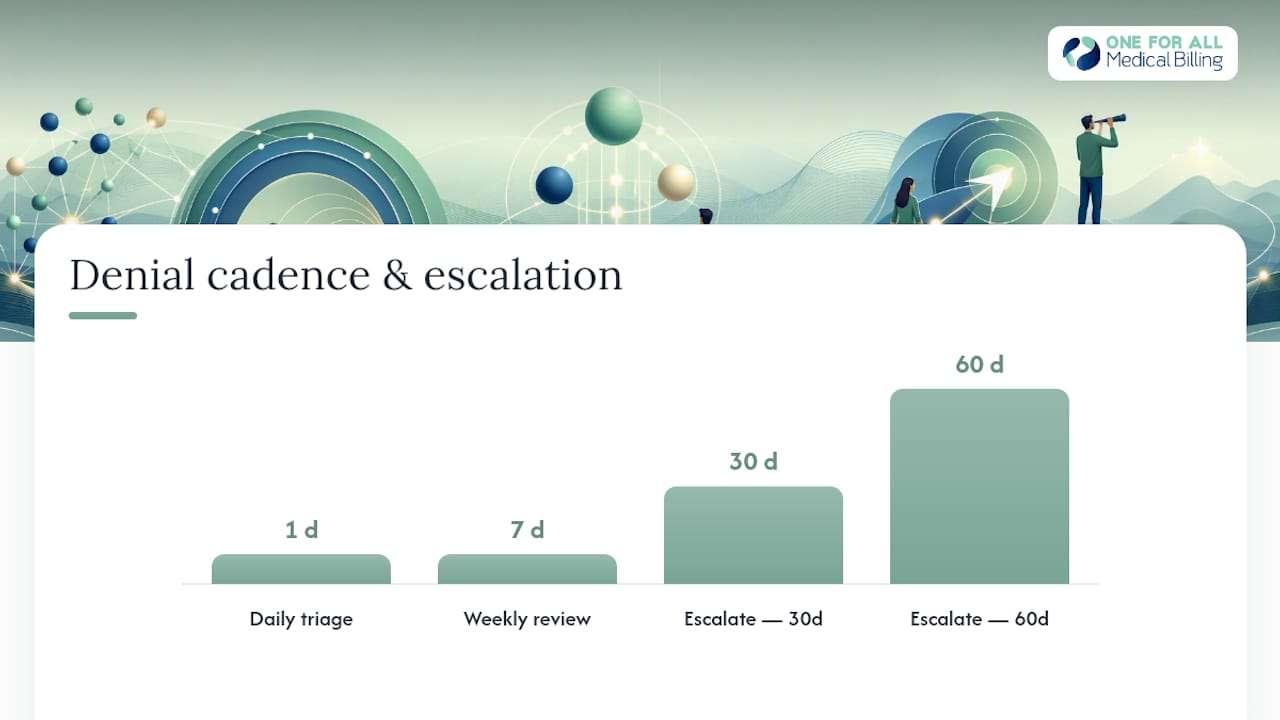
Pro Tip: Route claims by age AND dollar value, not age alone. A $40 claim sitting at 45 days is a non-issue; a $4,000 claim at 45 days needs an owner in the room today.
Sample Dollar-Band Rules for Write-Off Policies
Copy-ready thresholds remove ambiguity from the appeal-versus-write-off call. These bands are a starting framework, not a legal standard, so adjust the dollar figures to your organization’s claim volume and staffing.
- Under $25: automatic write-off, provided the intake checklist confirms no clear payer error. Requires a supervisor spot-check on a sample of these monthly, not individual sign-off.
- $25 to $250: one resubmission or corrected claim attempt permitted before write-off. No formal appeal required unless documentation clearly supports one.
- $251 to $2,500: case-by-case appeal review required. A denial analyst must document the recoverability score before any write-off is approved.
- Over $2,500: mandatory appeal review, with finance sign-off required to override and write off instead of appealing.
Cap appeal attempts per payer and reason code, usually at two or three rounds, beyond which continued effort rarely changes the outcome. Any write-off that skips these bands (an early close on a high-dollar claim, for instance) needs documented justification and a named approver, not just a note in the system. Our appeal decision framework covers how to structure that override process in more detail.
What Are the Appeal Windows You Need to Track by Payer?
Missing an appeal window turns a recoverable claim into a forced write-off, regardless of how strong your documentation was. CMS appeal frameworks set specific timelines for Medicare redetermination requests and separate reconsideration rules for Medicare Advantage plans, and those deadlines don’t bend for a backlog.
Commercial and Medicaid plans vary by contract and state, which is exactly why a payer-by-payer appeal-window mapping table matters more than a generic rule of thumb.
- Build one master reference showing each payer’s first-level appeal deadline, second-level deadline, and required submission format.
- Flag payers with unusually short windows (some commercial plans give as few as 30 days) for priority triage on intake.
- Watch for retroactive eligibility changes; a claim denied for coverage gaps sometimes becomes payable once retroactive enrollment posts, but only within a tight recovery window.
Our guide on appealing a denied insurance claim breaks out submission requirements payer by payer.
How Do You Use Denial Data to Prevent Future Write-Offs?
Every write-off is also a data point, and organizations that ignore that fact keep writing off the same denial reasons year after year. AHIMA’s guidance on denial prevention frames this as a cross-functional problem, not something billing can fix alone.
- Segment denial data by payer, reason code, service line, and even individual clinician to find concentration points.
- Run eligibility verification before the visit, not after the claim denies, to catch coverage gaps early.
- Tighten prior authorization workflows for the service lines generating the most medical-necessity denials.
- Build concurrent documentation checks into clinical workflow so notes support the billed code before the claim goes out.
- Feed coder education sessions directly from your top five denial reason codes each quarter.
A prevention-first approach that routes denial outcomes back to scheduling, registration, and clinical documentation steadily shrinks write-off volume over time, rather than just processing it faster. Denial patterns by payer also become leverage in contract negotiations: a payer with an outlier denial rate on a specific code has a harder time defending that pattern once you bring the data to the table.
Pro Tip: Pull your top five denial reason codes every quarter and route them straight into your next coder training session. Reactive training on old denials doesn’t move the needle; training tied to this quarter’s actual pattern does.
Who Owns Write-Off Approval, and What Should Get Reported?
Governance is what makes a write-off policy defensible during an external audit or payer review, not just efficient day to day.
- Role matrix: a denial analyst assesses recoverability, a coding lead validates the reason code and documentation, and a finance approver signs off above defined dollar thresholds.
- Required reports: a monthly AR-6-style write-off report, an aging report segmented by payer, and a recoverability pipeline showing claims still in active appeal.
- Recordkeeping: every write-off needs its reason code, approver, and supporting documentation retained in a format ready for payer audits, not scattered across email threads.
Our accounts receivable best practices resource covers how this reporting cadence fits into broader AR discipline.
One For All Medical Billing: Applying This Policy in Practice
Over 20 years of specialty-focused billing work has shown us that the policies described here only hold up when someone owns the KPI reporting weekly, not quarterly.
We build appeal-versus-write-off decision points directly into each client’s workflow, tailored to their specific payer mix and service lines, rather than handing over a generic template. That includes setting up the AR-6 tracking, mapping payer appeal windows, and training staff on the documentation standard that holds up under audit.
The Governance Mistake Billing Managers Keep Making
The biggest failure I see in denial management isn’t a bad appeal process. It’s a write-off culture that treats denials as an unavoidable cost rather than a data and workflow problem. Leaders add staff to clear the queue faster instead of asking why the same denial code keeps reappearing. Treat your write-off policy as a standing agenda item for revenue cycle leadership, reviewed with the same rigor as your monthly financials, not a form staff fill out to close a file.
— One For All Medical Billing
Let One For All Medical Billing Review Your Write-Off Policy
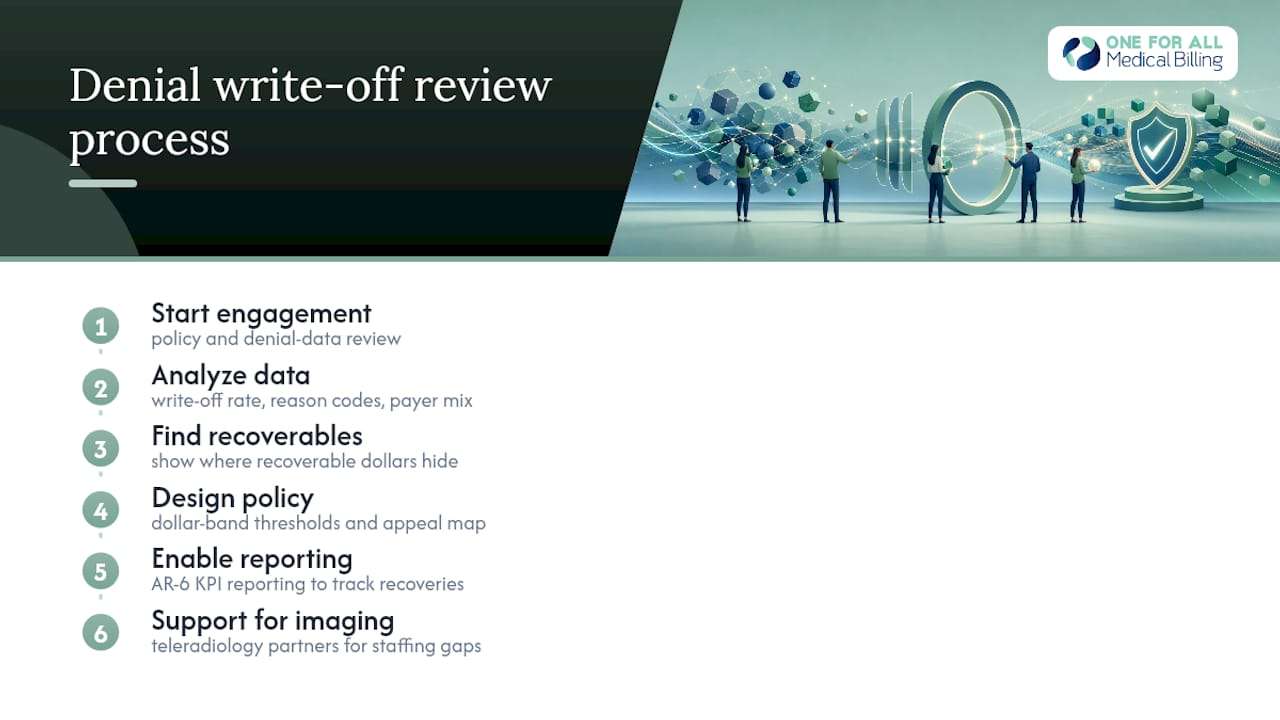
One For All Medical Billing gives you a specialty-tuned denial policy without the trial-and-error most practices go through building one from scratch internally. We design the dollar-band thresholds, build the payer appeal-window map, and set up AR-6 style KPI reporting so you see recoverable revenue before it turns into a write-off.

Our engagements typically start with a policy and denial-data review: we look at your current write-off rate, reason codes, and payer mix, then show you where the recoverable dollars are hiding. This applies whether you’re a single specialty practice or a multi-site health system managing denials across several payer contracts. For teams working with imaging-heavy service lines, our partner network includes teleradiology coverage solutions that help reduce the staffing gaps behind certain denial patterns.
Ready to see where your current policy is leaking revenue? Request a denial write-off policy review and get a direct look at your KPI baseline before you commit to any changes.
This article is general information, not a substitute for advice from a qualified financial advisor. Consult a qualified financial professional about your own circumstances before acting on anything here.
Sources
- Standardizing denial metrics for the revenue cycle | HFMA
- Denial Workflow SOP · Playbook · Stratevora
- Best practices for denials prevention and management | AHIMA
- Hospitals lost over $48B from claims denials and uncollected bills
FAQ
What are the common reasons for claims denials?
The most frequent causes are timely filing misses, medical necessity disputes, eligibility and coordination-of-benefits errors, coding mistakes, and claims submitted under an uncredentialed provider.
What is a CO 252 denial code?
Denial codes indicating that the claim lacks required documentation or information the payer needs to process it typically require resubmission with the missing records attached rather than an appeal.
What is the protocol to have a denied claim resolved?
Log the denial immediately, assess recoverability against documentation strength and the payer’s appeal window, then either submit a documented appeal or close the claim as a write-off with a recorded rationale and approver sign-off.
What does “write-off” mean in insurance billing?
A write-off is the portion of a billed charge removed from a provider’s receivables, whether because of a contracted payer rate, an unrecoverable denial, uncollectible patient bad debt, or a discretionary courtesy adjustment.
How does One For All Medical Billing help with denial write-off policy design?
One For All Medical Billing builds payer-specific appeal-window maps, sets dollar-band decision rules, and establishes AR-6 style KPI reporting so recoverable claims get appealed instead of defaulting to write-off.

