

table of contents
TL;DR:
- Most U.S. healthcare providers lose revenue by neglecting payer contract management and audits. Systematic CPT-level audits and early preparation improve negotiation leverage and help recover unpaid claims. Outsourcing with specialty expertise ensures accurate monitoring and lasting revenue enhancement.
For most U.S. healthcare providers, outsourcing payer contract management is the fastest path to recovering revenue that’s already being lost. According to the Physicians Practice 2024 Payer Scorecard, 37% of medical practices never negotiate their payer contracts at all. That’s not a minor oversight; it’s a direct transfer of revenue to payers. The immediate next step is a CPT-level contract audit: compare your last 12 months of ERA remittances against your contracted fee schedules, line by line. The American Medical Association’s payor contracting toolkit provides the definitional framework for which payer types you’re dealing with and what’s actually negotiable. One For All Medical Billing runs exactly this kind of audit-first engagement for specialty and multi-site practices nationwide.
What does payer contract management actually cover?
Payer contract management is the ongoing process of negotiating, executing, auditing, and monitoring the agreements that determine how much your practice gets paid. It covers fee schedules, contract amendments, ERA reconciliation, notice windows, utilization management rules, prior authorization requirements, and renewal calendars.
The AMA defines “payer” broadly to include commercial insurers, Medicare and Medicaid, employer and self-insured plans, pharmacy benefit managers (PBMs), third-party administrators (TPAs), and any other entity that assumes financial risk for healthcare services. That distinction matters because your negotiation strategy shifts by payer type. Medicare rates are set by law and largely non-negotiable; commercial insurer rates are negotiable; employer/self-insured plans often offer the most flexibility.
Payer contracts are not static documents. Amendment attachments and unilateral updates are among the most common sources of revenue leakage, because they can quietly supersede the master agreement without triggering a formal renegotiation.
Core records to centralize before you do anything else:
- Master payer agreements and all active amendments
- Fee schedule exhibits (by CPT code, by effective date)
- ERA samples covering the last 12 months
- Prior authorization and utilization management policies
- Notice window and auto-renewal clauses
- Credentialing status and timelines per payer
Why active payer contract management preserves revenue
Unmanaged contracts don’t stay neutral. They drift against you through silent underpayments, auto-renewals that lock in below-market rates, and unilateral amendments you may not catch until months later.

The Physicians Practice Payer Scorecard found that 37% of practices never negotiate their contracts. For a mid-size specialty practice, that figure represents years of compounding revenue loss on every claim submitted. Payers have no incentive to volunteer rate increases, and most auto-renewal clauses are written to favor the payer.
Common problems from neglected contracts:
- Silent underpayments on high-volume CPT codes
- Denials driven by prior authorization language that’s never been challenged
- Auto-renewals that extend below-market rates for another two or three years
- Unilateral amendments that tighten timely-filing windows or add bundling rules
What active management recovers:
- Identified underpayments and formal dispute resolution
- Renegotiated fee schedules benchmarked against market rates
- Reduced denial rates tied to clearer authorization language
- Improved cash flow from shorter payment timelines
The MGMA Analyzing Payer Contracts Playbook frames this clearly: failing to regularly analyze and negotiate contracts leaves significant revenue on the table, especially as operating costs rise and payment models evolve.
How to run a systematic payer contract audit
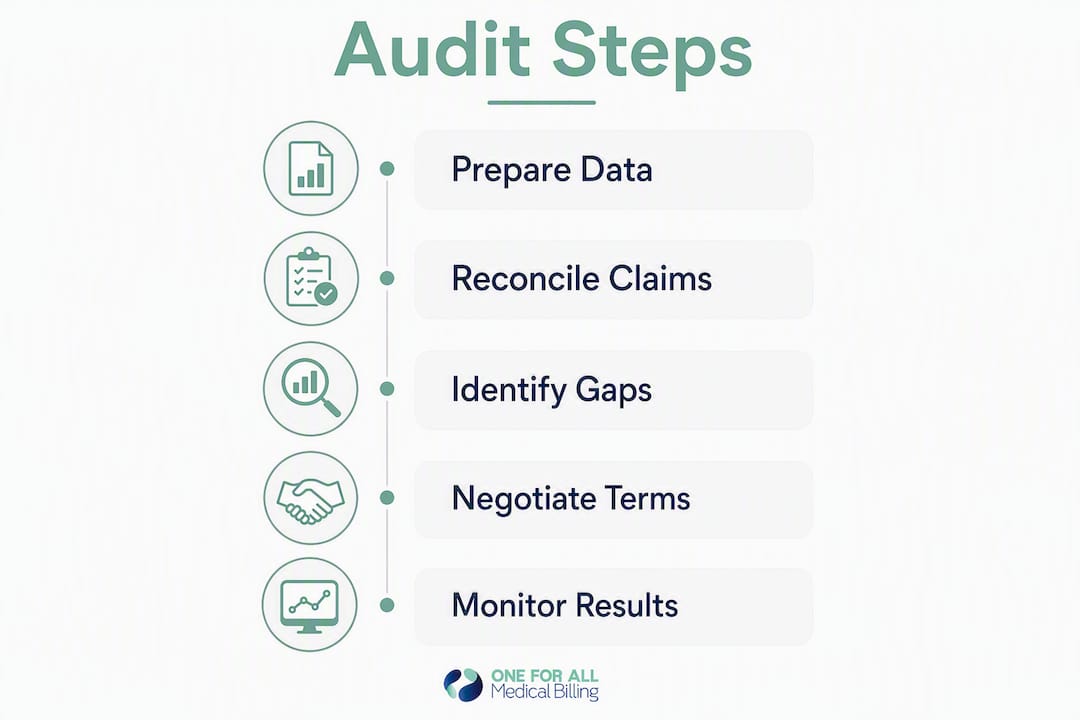
A CPT-level audit that compares ERA remittances to contracted fee schedules is the single highest-value first move. Here’s the step-by-step workflow:
- Centralize all contracts. Collect executed agreements, every amendment, and all fee exhibits into one repository. Track effective dates and version history.
- Prioritize payers by revenue. Rank your top five to ten payers by total annual collections. Start there.
- Extract fee schedules by CPT. Pull the contracted rate for each CPT code from the fee exhibit. If amendments have modified rates, use the most current version.
- Map CPT volumes. Pull your claims volume by CPT code for the last 12 months. Identify your highest-volume and highest-margin codes.
- Load ERA and payment data. Import 12 months of ERA files. Match each payment to the corresponding claim and CPT code.
- Run contract-to-ERA reconciliation. Compare what the payer paid against what the contract says they owe, at the CPT level. Flag every shortfall.
- Sample-check denials and prior-auth rates. Pull denial logs and identify which payers and CPT codes generate the most prior-auth denials. These are negotiation targets.
Pro Tip: Start this process 12–18 months before your contract renewal date. Waiting until 90–120 days out reduces your leverage significantly, and you’ll need benchmark comparators, financial models, and stakeholder alignment before you sit down to negotiate.
Minimum fields for each contract record: contract owner, effective date, expiration and auto-renewal date, fee exhibit version, amendment history with dates, notice window length, and ERA samples for the last 12 months.
Which contract terms should you prioritize in negotiations?
Focus on fee schedules for your highest-volume and highest-margin CPT codes first, then on the administrative language that drives denials. A headline rate increase means nothing if prior authorization rules are generating a 20% denial rate on your top procedures.
Priority contract terms to review:
- Fee schedules at CPT level (especially for your top 20 codes by volume)
- Timely-filing limits (shorter windows increase denial risk)
- Prior authorization scope and appeal rights
- Payment accuracy and recoupment clauses
- Auto-amendment language (can payers change terms unilaterally?)
- Credentialing timelines and effective-date provisions
- Carve-outs for specific service lines or modifiers
- Reimbursement methodology: fee-for-service vs. alternative payment models (APMs)
Negotiation levers to use:
- Volume and market share (your patient panel size in their network)
- Quality scores and HEDIS performance data
- Geographic coverage gaps you fill for the payer
- Speed of credentialing and clean-claim submission rates
- Willingness to participate in value-based or APM arrangements
Industry experts recommend shifting from purely volume-based metrics toward strategies that incorporate APM terms and quality metrics. Payers are increasingly receptive to providers who can demonstrate outcomes data. Understanding the difference between fee-for-service and capitation models helps you evaluate which payment structure actually benefits your practice before you agree to anything.
Red flags in contract language:
- Unilateral amendment clauses with no opt-out right
- Notice windows shorter than 60 days
- Aggressive recoupment windows with no audit appeal process
- Vague prior authorization definitions that give payers broad denial authority
When should you renegotiate, and where do you start?
Begin preparation 12–18 months before contract expiration. If you detect systematic underpayments or a rising denial rate tied to a specific payer, start earlier regardless of the renewal date.
Prioritization checklist:
- Payers representing your top revenue share (start here)
- CPT codes with the largest net payment shortfalls
- Payers with the highest prior-auth denial burden
- Contracts with auto-renewal clauses or harmful amendment language
- Any contract where you haven’t renegotiated in more than three years
Renegotiation timeline milestones:
- Months 1–3: Data collection, ERA reconciliation, and shortfall identification
- Months 4–6: Benchmarking against Transparency in Coverage (TiC) data or equivalent market comparators
- Months 7–9: Prepare negotiation packet with financial models and supporting data
- Months 10–12: Active negotiation and counter-proposal management
- Post-signature: Monitor payment accuracy against new terms for 90 days
One common mistake: accepting a headline rate increase without auditing whether net collections actually improve. A payer offers a 3% rate increase, but if bundling rules or prior-auth requirements tighten at the same time, your net realizable revenue may stay flat or decline. CPT-level reconciliation after the new contract takes effect is the only way to confirm the gain was real.
How do you evaluate an outsourced payer contract management partner?
Prioritize vendors that deliver CPT-level audits, transparent analytics, and measurable ROI guarantees. Specialty experience and audit methodology matter more than firm size.
Vendor evaluation checklist:
- Specialty-specific billing experience in your service lines
- Audit methodology: do they reconcile at CPT level or only at the claim level?
- Access to benchmark data (TiC files or equivalent market rate databases)
- Integration capability with your EHR and ERA systems
- Staffing model: dedicated account team or shared pool?
- Pricing model transparency (see below)
- References and case studies with measurable net collection lift
- SLAs and guarantees on audit deliverables and timelines
Questions to ask during an RFP:
- Can you provide a sample audit deliverable from a similar specialty?
- What is your typical timeline from contract ingestion to first findings?
- What net collection rate improvements have you documented for comparable practices?
- How do you handle payer dispute resolution and follow-up?
- Who owns the audit artifacts at contract end?
Pricing model options:
- Fixed-fee audit: Predictable cost; best for practices that want a defined scope before committing to ongoing management.
- Success-fee model: Vendor earns a percentage of recovered underpayments; aligns incentives but can be costly if recoveries are large.
- Percentage-of-collections: Ongoing fee tied to total collections; common in full-service RCM engagements.
The right outsourced partner doesn’t just find underpayments. They build the amendment-tracking infrastructure, renewal calendar, and CPT-level monitoring that prevents the same leakage from recurring after the initial audit.
One For All Medical Billing brings over 20 years of specialty billing experience and a documented 90% clean claim rate to every engagement. For smaller practices evaluating their options, medical billing for small practices outlines what a managed engagement looks like at that scale.
What do payer contract management services cost, and what ROI should you expect?
Net collection rate and CPT-level payment accuracy are the clearest ROI drivers. Track these from day one.
KPIs to monitor:
- Net collection rate (target: 95%+)
- Clean-claim rate (One For All Medical Billing targets 90%)
- Denial rate by payer and CPT code
- Days in A/R (target varies by specialty; watch for trends)
- Payment accuracy at CPT level vs. contracted rate
- First-pass acceptance rate
- Prior authorization burden per payer
- Time-to-payment from claim submission
Sample ROI model: A practice collecting $2 million annually from its top three payers that achieves a 3% net collection lift recovers $60,000 per year. At 5%, that’s $100,000. For multi-site systems, the numbers scale proportionally. The revenue cycle management strategies that compound these gains fastest are the ones that combine contract remediation with clean-claim discipline.
A fixed-fee audit typically runs a defined project scope with a clear deliverable. Success-fee arrangements align vendor incentives with recovery outcomes. Percentage-of-collections models work best when you’re outsourcing the full RCM function, not just the audit.
Your 90-day plan to start contract remediation
The first 90 days focus on data ingestion, validation, and a pilot audit on your top three payers. Here’s the phased plan:
- Weeks 1–3: Centralize all executed contracts, amendments, and fee exhibits. Assign a contract owner for each payer.
- Weeks 4–6: Extract fee schedules by CPT and pull 12 months of ERA files. Confirm amendment versions are current.
- Weeks 7–10: Run CPT-level reconciliation on your top three payers. Document shortfalls and denial patterns.
- Weeks 11–13: Prepare negotiation packets with shortfall data, volume analysis, and benchmark comparators.
- Weeks 14–90: Begin remediation, submit disputes, and implement monitoring for new and renegotiated contracts.
Data to prepare before engaging an outsourced partner:
- All executed payer contracts and amendments
- 12 months of ERA files (835 transaction files preferred)
- Claims volume by CPT code for the last 12 months
- Denial logs with reason codes
- Credentialing status per payer
- Prior authorization metrics and denial rates
Stakeholder roles:
- Billing lead: Owns data extraction, ERA reconciliation, and denial log analysis
- Finance owner: Validates shortfall calculations and approves negotiation targets
- Legal reviewer: Reviews amendment language and recoupment clauses
- Clinical director: Confirms CPT coding accuracy and prior-auth clinical criteria
A contract management system with version control and automated renewal alerts reduces the manual overhead of this process significantly, especially for practices managing ten or more payer relationships.
Why One For All Medical Billing handles this well
One For All Medical Billing delivers an audit-first, specialty-aware payer contract management service built for U.S. providers navigating both fee-for-service and value-based arrangements. The service covers CPT-level audits, ERA reconciliation, amendment tracking, renewal calendar management, negotiation support, and post-signature monitoring.
With over 20 years of specialty billing experience and a 90% clean-claim rate, the team brings both the technical depth and the payer relationship knowledge that generic billing services lack. The focus on specialty-specific billing means the audit methodology accounts for modifier rules, bundling logic, and carve-outs that vary by service line.
Practices that engage One For All Medical Billing for a scoped audit typically begin with a contract bundle review and CPT-level shortfall analysis before any negotiation begins. That sequence protects against accepting a headline rate increase that doesn’t translate to actual net collection improvement.
To get started, prepare your executed contracts, 12 months of ERA files, and CPT volume data. That’s the minimum needed to scope an initial audit and identify your highest-priority renegotiation targets.
Key Takeaways
Systematic CPT-level contract audits are the single highest-ROI first step in payer contract management, and 37% of practices never negotiate their payer contracts at all.
| Point | Details |
|---|---|
| Start with a CPT-level audit | Compare ERA remittances to contracted fee schedules at the CPT level to find silent underpayments. |
| 37% of practices never negotiate | Inaction compounds revenue loss annually; the Physicians Practice 2024 Payer Scorecard documents this gap. |
| Begin 12–18 months before renewal | Early preparation builds benchmark data and negotiation leverage; 90–120 days out is too late. |
| Track net collection rate and denial rate | These two KPIs move fastest with contract remediation and confirm whether rate changes are real. |
| One For All Medical Billing | Offers audit-first, specialty-specific payer contract management with a 90% clean-claim rate for U.S. providers. |
What most RCM guides get wrong about contract management
The conventional wisdom says negotiate harder and get higher rates. That’s incomplete advice. Rate increases without payment accuracy monitoring are the “3% illusion” in practice: a payer grants a headline increase, but tightens bundling rules or prior-auth scope in the same amendment, and net collections stay flat. We’ve seen this pattern repeatedly across specialty practices that accepted rate bumps without running post-signature reconciliation.
The second mistake is treating contract management as a one-time event. Payer contracts are living documents. Unilateral amendments arrive quietly, often buried in provider portal notices, and they can supersede the master agreement without a signature. Practices that don’t have an amendment-tracking workflow in place are effectively renegotiating blind.
The third mistake is waiting too long. Providers who start audit preparation 12–18 months before renewal have time to build financial models, gather benchmark data from TiC files, and align clinical and finance stakeholders. Those who start at 90 days are reacting, not negotiating.
The fix for all three: treat your contracts as a dataset, not a filing cabinet. Load fee exhibits and amendment history into a queryable system, run CPT-level reconciliation regularly, and build a renewal calendar that triggers preparation well in advance.
Ready to recover revenue with a scoped contract audit?
If your practice is leaving money on the table through underpayments, auto-renewals, or unaddressed amendments, a scoped CPT-level audit is the fastest way to quantify the problem and build a remediation plan.

One For All Medical Billing provides audit-first payer contract management for specialty and multi-site practices across Oklahoma and nationwide. The engagement starts with your contract bundle and 12 months of ERA data, moves through CPT-level reconciliation, and delivers a prioritized shortfall report with negotiation targets. No guesswork, no generic rate benchmarks. Just a clear picture of what you’re owed and a plan to recover it.
To understand how pricing works for a managed engagement, review billing services pricing models before your first conversation. When you’re ready to get started, schedule a discovery call and bring your top three payer contracts and your most recent ERA files.
Useful sources and further reading
- AMA Payor Contracting Toolkit: Best for payer definitions, contracting considerations by payer type, and a structured negotiation checklist.
- MGMA Analyzing Payer Contracts Playbook: Step-by-step guidance for evaluating payer agreements and strengthening negotiation strategy.
- MGMA Payer Contracting Checklist: Ten action items to optimize negotiations, created by healthcare consultant Doral Davis-Jacobsen, MBA, FACMPE.
- PayerPrice: Payer Contract Management for Medical Groups: Covers audit methodology, benchmarking with TiC data, and the 2024 Payer Scorecard findings.
- ContractSafe: Payer Contract Management: Practical guidance on amendment tracking, version control, and renewal workflows.
- Becker’s ASC: 4 Steps to Better Payer Contract Management: Expert perspective on shifting from fee-for-service metrics to value-based contract strategy.
- CAQH/Stanford Contracting Issue Brief: Research on current contracting process maturity across payers and providers, including manual tool prevalence.
This article provides general information about payer contract management practices. It is not legal or financial advice. Consult qualified legal counsel before executing or modifying any payer contract.
FAQ
What is payer contract management in healthcare?
Payer contract management is the process of negotiating, auditing, and monitoring the agreements between healthcare providers and payers that define reimbursement rates, covered services, and payment terms. It includes fee schedule management, amendment tracking, ERA reconciliation, and renewal oversight.
How often should you audit your payer contracts?
Run a CPT-level reconciliation at least annually, and immediately after any contract amendment or rate change. Waiting longer allows silent underpayments to compound across thousands of claims.
What is the “3% illusion” in payer contract negotiation?
The 3% illusion occurs when a practice accepts a headline rate increase without auditing whether net collections actually improve. If the payer simultaneously tightens bundling rules or prior-auth requirements, the rate increase may not translate to real revenue gains.
When should you start preparing to renegotiate a payer contract?
Begin preparation 12–18 months before contract expiration to allow time for benchmarking, financial modeling, and stakeholder alignment. Starting at 90–120 days out significantly reduces your negotiation leverage.
What KPIs confirm that contract remediation is working?
Track net collection rate, clean-claim rate, denial rate by payer and CPT code, and days in A/R. A meaningful improvement in net collection rate, typically 2–5% on top payers, is the clearest signal that contract remediation is generating real revenue recovery.

