

table of contents
Appeal the denial if the dollar value justifies the labor and you can still meet the filing window. That is the entire decision tree at its simplest. Before anything else, pull the claim record and confirm you have the raw materials to fight it:
- The CARC/RARC reason code exactly as the payer reported it
- The clearinghouse acceptance report or EDI/ERA log showing your original submission date
- The denial date and the payer’s specific appeal deadline for that denial type
If you cannot produce proof of timely original submission, a timely-filing denial is almost always a lost cause. Every other denial type is worth a second look before you write it off.
Key Takeaways
Recovering denied claims requires fast triage by dollar value, evidence that matches the payer’s own policy language, and disciplined tracking through every appeal level.
| Point | Details |
|---|---|
| Triage before you appeal | Sort denials by type and dollar value first; timely-filing cases without proof of submission rarely overturn. |
| Build packets around payer policy | Match your appeal language and attachments to the payer’s own criteria rather than writing a general narrative. |
| Confirm receipt every time | Log a reference number and check status within 10 to 14 days of every appeal submission. |
| Track KPIs, not just cases | Monitor first-pass rate, appeal overturn rate, and days-to-first-appeal to catch systemic problems. |
| Specialty partners compress the cycle | One For All Medical Billing combines a 90% clean claim rate with denial-specific playbooks to speed recoveries. |
How to Triage Denials Before You Appeal Insurance Denials
Not every denial deserves a formal appeal. Some deserve a five-minute correction and resubmission; others deserve a write-off the same afternoon they arrive. The teams that recover the most money are the ones that sort denials into buckets before anyone touches a keyboard, rather than working them in the order they land in the queue.
Start by classifying every denial into one of six categories: timely filing, medical necessity, prior authorization, coding or bundling (CO-97, CO-151, and similar edits), eligibility or registration error, and coordination of benefits. Each category has its own evidence requirements and its own odds of success, so lumping them together wastes staff time on cases that were never going anywhere.
Once classified, prioritize by four factors:
- Recoverable dollar value. A $40 denial and a $4,000 denial should never sit in the same queue with equal urgency.
- Appealability and deadline proximity. A strong case with three days left on the clock outranks a weak case with sixty.
- Payer behavior history. Some payers overturn coding denials routinely; others almost never budge without a peer-to-peer review.
- Preventable-share signal. If a denial type keeps repeating from the same provider or front-desk workflow, flag it for the prevention team, not just the appeal queue.
From there, a structured denial workflow SOP with clear decision points speeds everything downstream: correct and resubmit, request additional documentation, file a formal appeal, or write off and move on.
Pro Tip: Build a one-page “denial disposition” cheat sheet that maps each CARC code to a default action. Staff shouldn’t have to reinvent the decision every time CO-50 shows up.
What Evidence Do You Need to Win an Appeal?
The strength of your appeal packet, not the eloquence of your appeal letter for insurance reviewers, determines whether a denial gets overturned. Payers process thousands of appeals a week. Give the reviewer exactly what they need to say yes, and nothing extra to slow them down.
For timely-filing denials, the only evidence that matters is proof of original submission: clearinghouse acceptance reports, EDI transaction logs, or certified mail receipts with a date stamp. Timely-filing denials depend almost entirely on this transmission proof; without it, most payers uphold the denial regardless of how strong the clinical case is. Save these reports for at least a year. That single habit turns an unwinnable dispute into a routine overturn.
For medical necessity denials, assemble the relevant chart notes, a brief provider attestation, supporting test results, and a citation to the payer’s own medical policy or LCD language. Reviewers respond faster when your packet mirrors the exact policy criteria they’re checking against.
For authorization, coding and bundling, and eligibility denials, attach the authorization confirmation number, the modifier justification (distinct procedural service, separate encounter, etc.), or the corrected eligibility record, depending on the code.
A consistent packet structure keeps this fast:
- Header with patient, claim number, and denial date
- The exact CARC/RARC code and its stated reason
- Your appeal basis in one sentence
- Policy or LCD citation
- Clinical summary (if applicable)
- Attachment list
- The specific remedy you’re requesting (reprocess, reconsider, pay at contracted rate)
Pro Tip: Building CARC-specific packet templates in advance, rather than starting from scratch each time, is one of the fastest ways to speed up appeals and improve consistency across your team. Our guide on top claim denial reasons breaks down fixes by code family in more depth.
Where and How Should You File the Appeal?
Submission mechanics kill more appeals than weak arguments do. A perfectly documented case gets bounced when it lands on the wrong form, misses a reference number, or uses an incorrect claim frequency code. Confirm the payer’s required channel before you send anything: most commercial payers now require portal submission with structured fields, some still accept fax, and a few require the appeal attached directly through the clearinghouse.
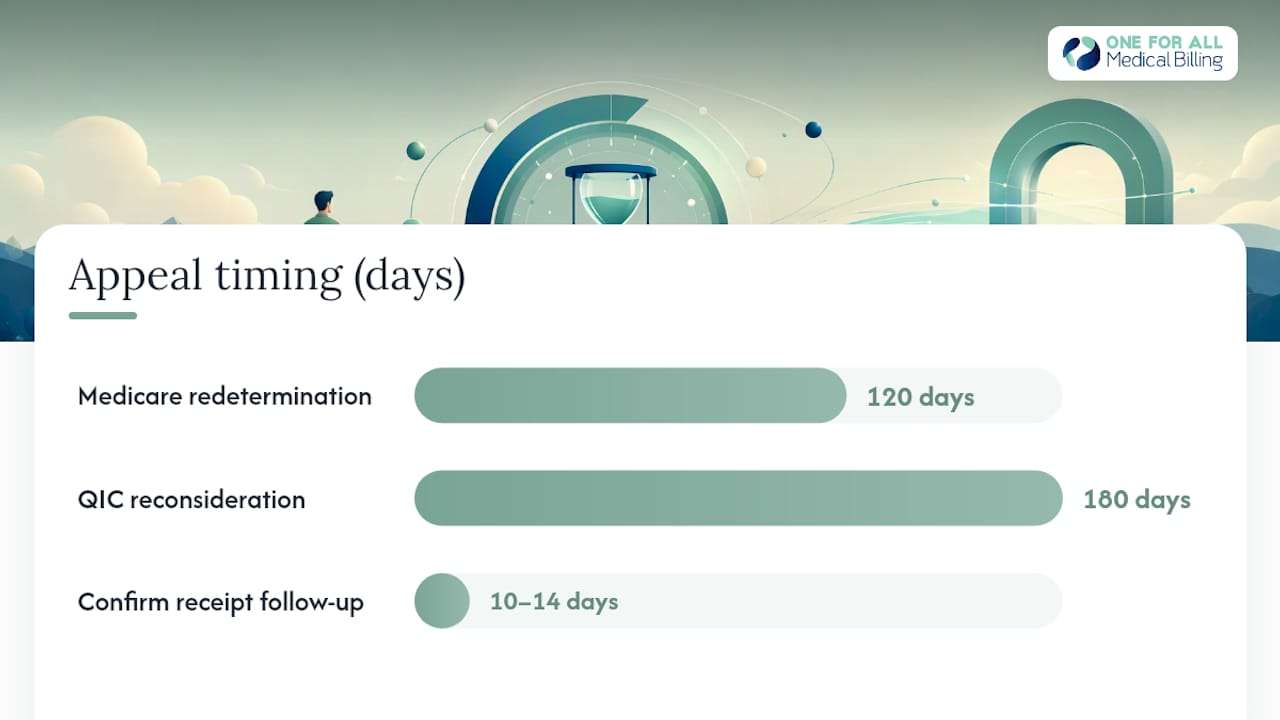
Medicare denials follow a defined ladder: first-level redetermination, then reconsideration through a Qualified Independent Contractor (QIC), and finally an Administrative Law Judge (ALJ) hearing if the dollar threshold is met. Medicare’s redetermination window runs 120 days, with 180 days for the QIC reconsideration step. Commercial and Medicaid payers set their own windows by contract or state rule, so check the specific payer’s timely appeal filing limits rather than assuming a standard.
Common administrative traps that get appeals returned unprocessed:
- Using an outdated payer-specific form
- Omitting the original claim or reference number
- Filing with the wrong claim frequency code (submitting as a new claim instead of a corrected one)
- Missing a required cover sheet or attestation signature
Once submitted, follow a simple three-step SOP: log the reference number the payer’s system assigns, set a reminder for the expected decision date, and confirm receipt within 10 to 14 days through the portal or a status call. That single follow-up habit catches lost appeals before the deadline passes twice.
How Do You Track Appeals and Know When to Escalate?
An appeal without a tracking record is an appeal you’ll forget about until the payer’s deadline for the next level has already closed. Every open appeal needs a record with these fields at minimum: owner, CARC/RARC code, root cause, submission date, reference number, expected decision date, outcome, and next action.

Escalate when the dollar value clears your threshold for a second-level review, when you’ve exhausted the current level without a response by the expected date, when the payer has a documented history of upholding first appeals but reversing on reconsideration, or when the denial reveals a systemic policy mismatch worth flagging to a provider relations contact.
When an appeal overturns, the work isn’t finished. Reconcile the remittance against the original charge, confirm payment posts correctly against the corrected claim, update your appeal overturn rate KPI, and loop the outcome back to whoever owns prevention so the same denial doesn’t recur next month.
Pro Tip: Assign a single owner to every appeal in your tracker, even if it moves between people during escalation. Shared ownership is how appeals quietly die in a shared inbox.
What Upstream Fixes Reduce Future Denials?
Appeals are recovery work. The bigger win is shrinking the number of denials you need to recover in the first place. A pre-bill scrub layered across format, payer policy, and coding checks catches the majority of preventable denials before the claim ever leaves your building.
Three controls do most of the heavy lifting:
- Format and eligibility scrubs. Catch missing modifiers, invalid member IDs, and mismatched demographics before submission.
- Modifier governance. Apply risk-weighted sampling to E/M levels, anesthesia units, and distinct-procedure modifiers so a coder reviews the claims most likely to trigger a bundling edit.
- Provider-facing evidence grids. Give clinicians a simple reference for what documentation supports common codes, so notes match billing before the claim goes out.
Run four KPIs consistently: first-pass rate (the share of claims paid without any touch), preventable-denial reduction rate, appeal overturn rate, and days-to-first-appeal. Feed every recurring denial pattern into a corrective-action cycle. Repeated errors from the same source, whether a scheduling gap or a coding habit, signal an upstream process failure, not a one-off mistake worth appealing forever. Our denial management guide walks through building this KPI stack in a practice setting.
Why a Specialty Billing Partner Changes the Math
Twenty years of running appeal playbooks across specialties teaches you which CARC codes are worth fighting and which aren’t. One For All Medical Billing pairs that judgment with a 90% clean claim rate and denial analysts who already know each major payer’s habits. For a practice, that means fewer denials reach the appeal stage at all. The ones that do move faster because the packet, the policy citation, and the payer contact are already mapped.
Ready to Cut Your Denial Backlog?
If your team is buried in appeal letters instead of patient care, a specialty billing partner changes the equation without asking you to hire another full-time analyst. One For All Medical Billing runs denial-specific playbooks built from two decades of payer behavior, so appeals get filed with the right evidence the first time instead of bouncing back for a second round.
Before your first call, pull together a denial-mix snapshot (your top five CARC codes by volume), your payer mix, current A/R days, and one sample denied-claim packet. That gives our team enough to spot patterns fast and tell you honestly where the recoverable dollars are sitting. Visit One For All Medical Billing to request a denial-mix assessment and see what a specialty-specific approach could recover for your practice.
Sources
- Denied Medical Billing Claim 2026: How to Appeal Correctly
- Denial Management in Medical Billing: 2026 Guide | Zedtreeo
- Denial Management in Medical Billing: A Complete Guide | Greenlight Medical
FAQ
What Is the Insurance Denial Appeal Process for Providers?
It’s a structured sequence: classify the denial, assemble evidence matching the payer’s policy, submit through the correct channel, then track the appeal through each level until it resolves or the reader exhausts appeal rights.
How Long Do You Have to Appeal a Denied Claim?
It depends entirely on the payer. Medicare gives 120 days for redetermination and 180 days for reconsideration, while commercial and Medicaid windows vary by contract or state rule.
What Percentage of Appealed Claims Get Overturned?
Well-prepared first-level appeals overturn roughly 40 to 60% of denials, and top-performing teams reach 70% or higher on cases with strong documentation.
What Should an Appeal Letter for Insurance Include?
A strong packet includes the denial code, your appeal basis, a citation to the payer’s own policy language, supporting clinical documentation, and the specific remedy requested.
Should Practices Handle Appeals In-House or Outsource Them?
It depends on volume and staff bandwidth; practices with rising denial backlogs often see faster recoveries when a specialty billing partner like One For All Medical Billing runs the appeal playbooks instead.

