

table of contents
A partial mastectomy claim goes out clean. The operative note looks complete at first glance. Then the remittance comes back with a denial, or worse, a reduced payment because the payer treated part of the case as bundled, unsupported, or coded to the wrong breast excision family.
That's the kind of friction practice managers run into with CPT Code 19301. The surgery was medically necessary. The physician did the work. The documentation may even describe the clinical story well. But if the claim doesn't line up with coding rules, margin requirements, diagnosis support, and bundling edits, the revenue cycle takes the hit.
For administrators, coders, and billers, this code sits at the intersection of oncology, surgery, compliance, and reimbursement. It isn't hard because the code definition is obscure. It's hard because small mistakes create expensive downstream work in appeals, corrected claims, and aging A/R. If your team is tightening processes around breast surgery billing, it helps to view 19301 the same way you'd view any high-scrutiny surgical code in the healthcare revenue cycle. The code itself matters, but the operational process around it matters just as much.
Your Guide To Mastering CPT Code 19301
One of the most common scenarios looks like this. A surgeon performs a breast-conserving cancer excision, the coder selects 19301, and the claim still stalls because the record doesn't clearly support margin-based oncologic excision, or because another code was appended that shouldn't have been there.
That's where many practices lose time. They focus on whether the procedure was a lumpectomy in a general sense, but payers focus on whether the record supports the specific coding standard attached to CPT Code 19301. If the claim lacks the right diagnosis linkage, pathology support, side modifier, or clean separation from bundled closure work, payment gets delayed.
Practical rule: For 19301, the denial often starts long before claim submission. It usually starts in the op note template, the pathology workflow, or the coder's decision tree.
The financial impact isn't only the missed payment on one claim. Staff then spend time on rework, physician queries, corrected submissions, appeal letters, and follow-up calls. In a multi-site setting, one weak workflow can spread quickly across several surgeons or facilities.
The good news is that 19301 becomes much easier to manage when your team treats it as a repeatable revenue cycle pathway rather than a one-off surgery code. The strongest workflows usually include three checkpoints:
- Pre-bill review: Confirm the procedure documented is a partial mastectomy and not a simpler excision code scenario.
- Clinical support review: Make sure the record shows lesion details, margins, and pathology support before the claim leaves.
- Edit review: Check for modifier issues, diagnosis mismatches, and closure codes that trigger bundling denials.
That discipline is what keeps a valid surgical service from turning into an avoidable collections problem.
What CPT Code 19301 Actually Represents
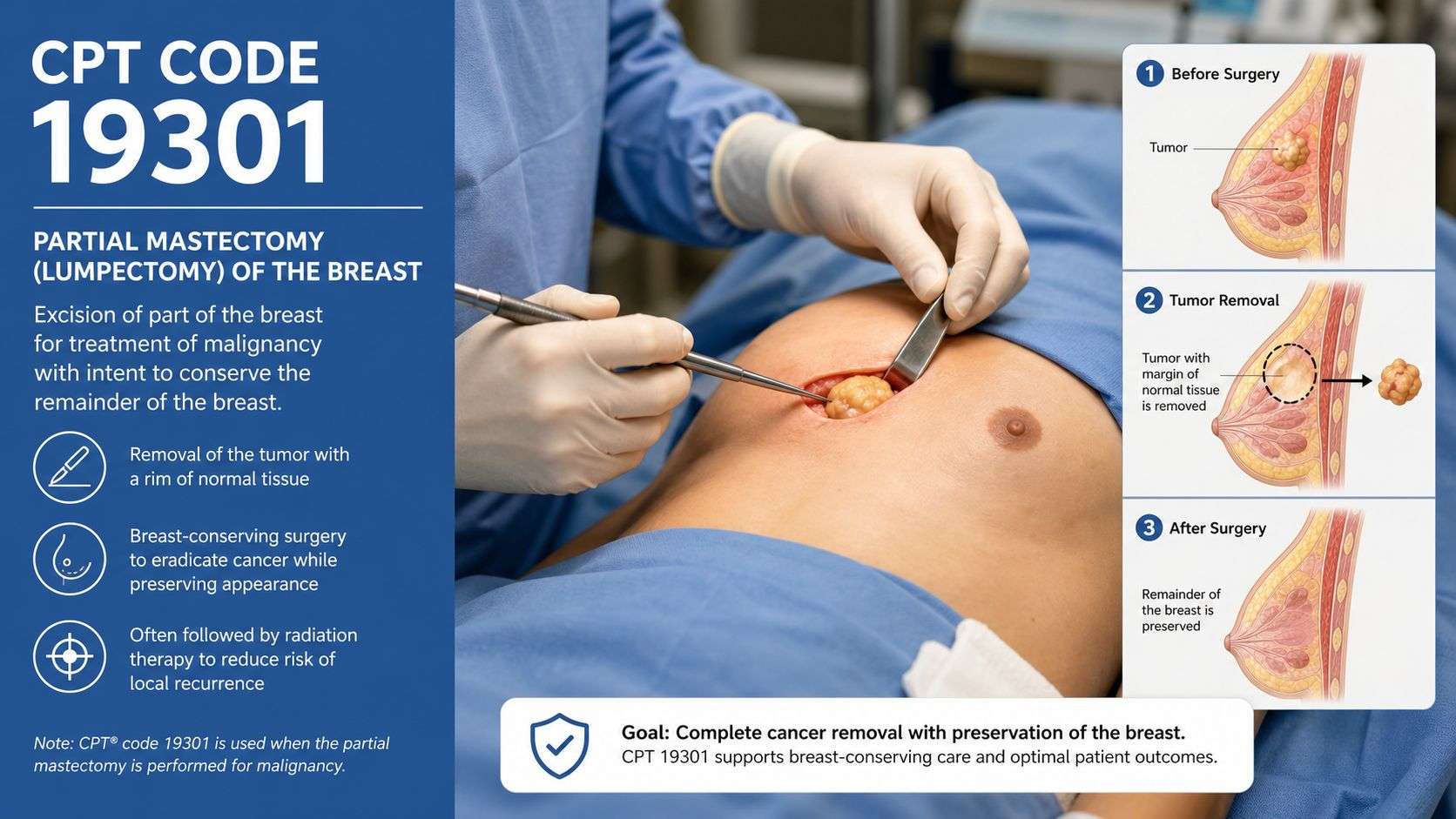
CPT Code 19301 is the standardized billing code for a specific type of breast surgery, not a catch-all label for any breast lesion removal. The official definition matters because it drives medical necessity, documentation, and payment.
According to the AMA categorization summarized in the AAPC CPT 19301 descriptor, CPT Code 19301 is the nationally standardized billing identifier for a partial mastectomy, clinically defined as the surgical removal of a breast lesion along with surrounding margins or a significant portion of the breast. This code encompasses specific oncologic procedures including lumpectomy, tylectomy, quadrantectomy, and segmentectomy, and is officially categorized by the AMA under Mastectomy Procedures.
Thinking About The Procedure The Right Way
For non-clinical staff, the easiest way to understand 19301 is this. It's a targeted breast-conserving operation, not a simple lump removal and not a full breast removal. The surgeon removes the lesion and surrounding tissue with attention to margins, but does not remove the entire breast under this code.
That distinction is why coder language matters. If the documentation only reads like an excision of a mass, but doesn't show the margin-focused oncologic work, the claim may belong in a different coding pathway. If the note supports a true segmental or quadrant-based cancer excision, 19301 is the correct family.
Procedures Included Under 19301
Practices usually see this code tied to these documented procedure terms:
- Lumpectomy
- Tylectomy
- Quadrantectomy
- Segmentectomy
Each term may sound slightly different in the operative note, but they funnel into the same coding concept when the service meets the partial mastectomy standard with margin-focused tissue removal.
Why This Matters For Practice Operations
This is also the point where coding and patient education overlap. Patients may hear “lumpectomy,” while the billing team sees “partial mastectomy.” Those terms can describe the same coded service under 19301 when the record supports it.
For teams that also coordinate postoperative planning, it helps to understand where this surgery sits in the broader cancer care path. Some patients later explore options related to reconstructive surgery after mastectomy, even though 19301 itself is a breast-conserving procedure rather than a total mastectomy. And if your staff also handles diagnostic workflows before surgery, keeping a separate reference for breast biopsy CPT coding helps prevent upstream confusion between diagnostic and definitive surgical services.
Essential Documentation For Ironclad Claims
A payer can't see the surgery. The payer only sees the documentation. That's why CPT Code 19301 lives or dies on the record.
The operative report has to show more than “breast mass removed.” If the note reads like a generic excision, coders and auditors lose the elements that justify a partial mastectomy. The case for 19301 is built on the surgeon's description of the lesion, the approach, and the margin-focused intent of the procedure.
What Must Appear In The Operative Record
At minimum, the chart should clearly support these elements:
- Lesion size and location: The note should identify where the lesion was found and document it specifically enough to support medical necessity and code selection.
- Surgical technique used: The record should describe the type of partial mastectomy performed, not just that tissue was removed.
- Margin-focused excision: The note needs to show that surrounding tissue or a significant portion of the breast was removed with oncologic margin attention.
- Clinical rationale: The claim should connect the surgery to the diagnosis that explains why this wasn't a benign lesion excision workflow.
When those details are vague, coders start making assumptions. That's when denials become more likely.
If the op note doesn't show margin work, many payers won't infer it from the procedure name alone.
Why Pathology Is Not Optional
This is the part many practices underweight operationally. The pathology report isn't just a clinical add-on. It's core claim support.
As noted in the NHSN-related documentation reference, the requirement to document pathology reports confirming diagnosis and margin status is essential for 19301, as the code's validity depends on the oncologic necessity of removing margins, distinguishing it from benign lesion excisions where margins are not the primary focus.
That means your billing workflow should not rely on the surgeon's note alone if pathology is pending and the diagnosis or margin story remains incomplete. A fast claim isn't always a clean claim.
A Better Internal Checklist
Before releasing a 19301 claim, many high-performing teams use a simple record review checklist:
- Confirm the surgeon documented a partial mastectomy-level service
- Check that laterality is clear in the chart
- Verify the note supports removal with margins
- Match the pathology findings to the diagnosis billed
- Review whether any secondary codes create edit risk
For organizations dealing with repeated denials, this is a good area to formalize physician queries and pre-bill audits. A structured medical record review workflow can catch unsupported coding before a payer does.
What Doesn't Work
Two habits create preventable trouble:
- Coding from the schedule or case name alone
- Submitting before pathology support is aligned with the claim
Both shortcuts increase the odds of rework. For 19301, the chart must show the difference between a simple breast lesion excision and a margin-based oncologic surgery. If that distinction is missing, reimbursement gets harder to defend.
Navigating ICD-10 Pairings And Correct Modifiers
A clean 19301 claim doesn't stop with the procedure code. You also need the diagnosis and modifier logic to make sense on the same claim.
The diagnosis tells the payer why the surgery was necessary. For many breast cancer cases, that support comes from the C50 family when the documentation reflects malignant neoplasm of the breast. The code choice must match the physician's documentation, including site specificity when available.
Distinguishing 19301 From Similar Codes
The coding risk around 19301 often comes from confusing it with nearby breast excision codes. The differences aren't cosmetic. They determine whether the payer sees a margin-focused breast-conserving cancer surgery, a simpler lesion excision, or a more extensive partial mastectomy with lymph node work.
Per Coding Mastery's distinction of lumpectomies and breast mass excision, CPT code 19301 is distinct from code 19302 (partial mastectomy with axillary lymphadenectomy) and code 19120 (excision of tumors without margin attention). The most common modifiers for 19301 are LT (Left side) and RT (Right side), reflecting its use in an outpatient hospital or Ambulatory Surgical Center setting.
Comparing Breast Excision CPT Codes
| CPT Code | Description | Key Differentiator |
|---|---|---|
| 19301 | Partial mastectomy | Requires margin-focused breast-conserving excision |
| 19302 | Partial mastectomy with axillary lymphadenectomy | Includes axillary lymph node dissection work |
| 19120 | Excision of breast tumor | Does not hinge on margin attention in the same way |
Modifier Use That Actually Matters
For most claims, the laterality modifier is straightforward:
- LT: Use when the procedure was performed on the left breast
- RT: Use when the procedure was performed on the right breast
Those modifiers aren't decorative. Missing laterality can create avoidable edits or confusion during review.
There's also a more situational issue that matters in real-world surgical oncology billing. When the same physician performs a staged or related procedure during the postoperative period, modifier 58 may be needed. One example is a return for additional tissue removal after the initial partial mastectomy when that later procedure fits the staged or related framework.
Coding judgment matters here: modifier use should follow the operative facts, not a blanket office habit.
Teams that want cleaner diagnosis linkage often maintain an internal map for breast findings, malignant diagnoses, and surgical pathways. A separate reference for breast mass ICD-10 coding can help coders keep diagnosis selection aligned with surgical documentation rather than defaulting to unspecified choices.
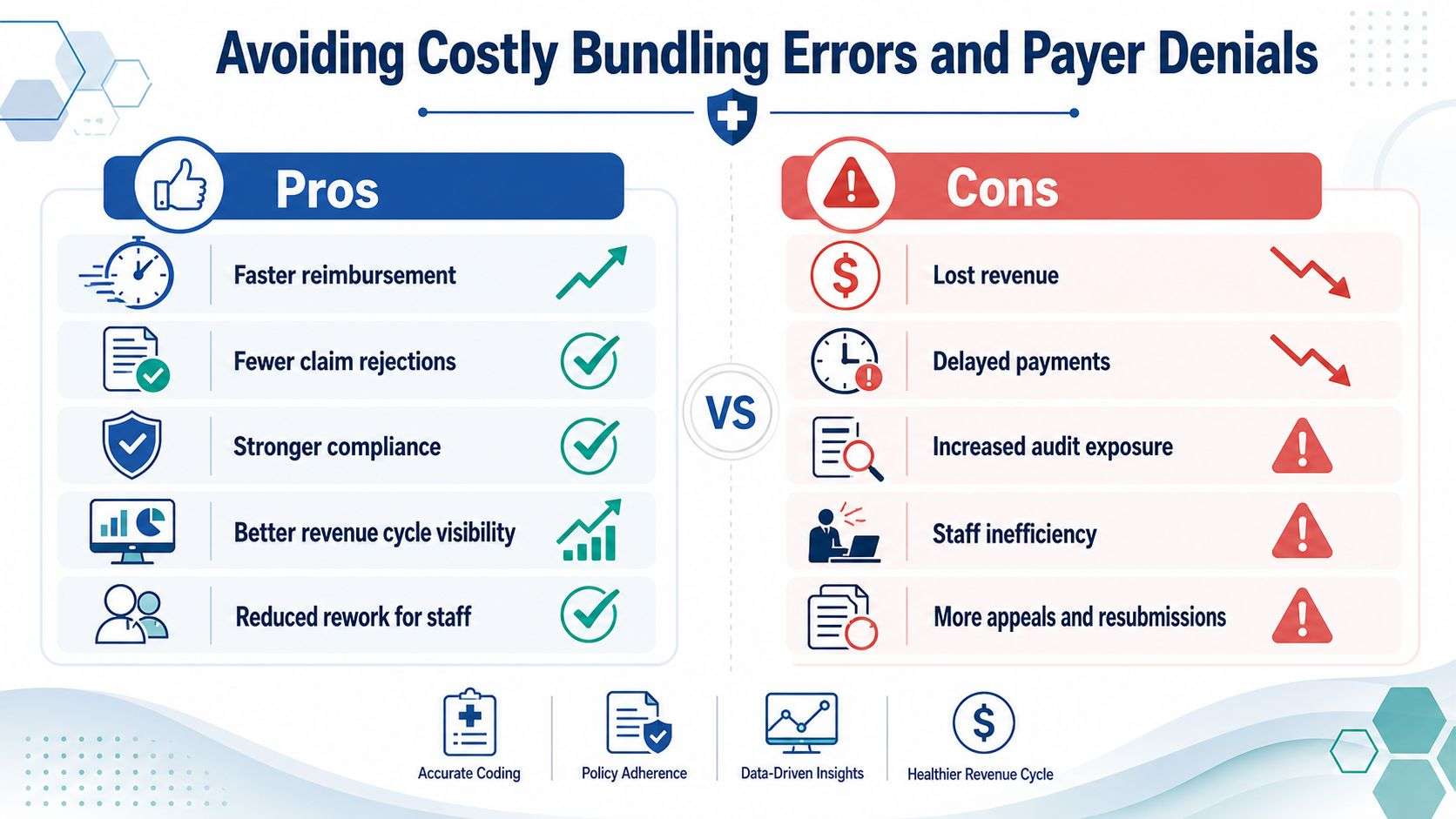
Avoiding Costly Bundling Errors And Payer Denials
The most expensive 19301 mistakes usually don't come from the base code. They come from what gets billed next to it.
A frequent problem is adding adjacent tissue transfer codes when the surgeon used local tissue movement to close the breast defect. Teams often assume that a more complex closure should automatically support separate payment. With partial mastectomy billing, that assumption often causes denials.
The Oncoplastic Closure Trap
The key issue is bundling. According to the KZA coding guidance on partial mastectomy closure billing, a critical gap in existing coverage is the frequent but incorrect billing of adjacent tissue transfer codes (14301, 14302) alongside CPT 19301. Closure after a partial mastectomy using a local advancement flap is bundled into 19301, and adding these codes often triggers automatic Medicare denials.
Many practices burn time on unnecessary appeals. The claim may look stronger because it captures more work, but if the closure is considered inherent to the partial mastectomy, the extra code creates an edit rather than extra revenue.
What Works And What Backfires
What works:
- Review op notes for closure language before coding adjacent tissue transfer
- Train coders to recognize when local advancement is inherent to the partial mastectomy
- Flag combinations involving 19301 and 14301 or 14302 for manual review
What backfires:
- Assuming larger defects always justify separate closure coding
- Relying on generic surgery coding cheat sheets
- Sending the claim first and sorting bundling on appeal
The operational lesson is simple. A coder needs more than a codebook definition. They need specialty-specific rules about what payers treat as integral to the surgery.
Separate Services That Can Be Reportable
Not every additional service is bundled. The verified guidance tied to 19301 allows separate reporting of CPT 38792 when a sentinel lymph node is identified via dye injection during a procedure involving 19301. That's a very different situation from trying to unbundle inherent closure work.
That distinction matters in breast surgery administration because cases often involve reconstruction discussions, oncology coordination, and staged planning. If your patient-facing staff also field insurance questions after surgery, a practical resource on mastectomy reconstruction coverage can help them understand how reconstruction benefits are often handled separately from the partial mastectomy claim itself.
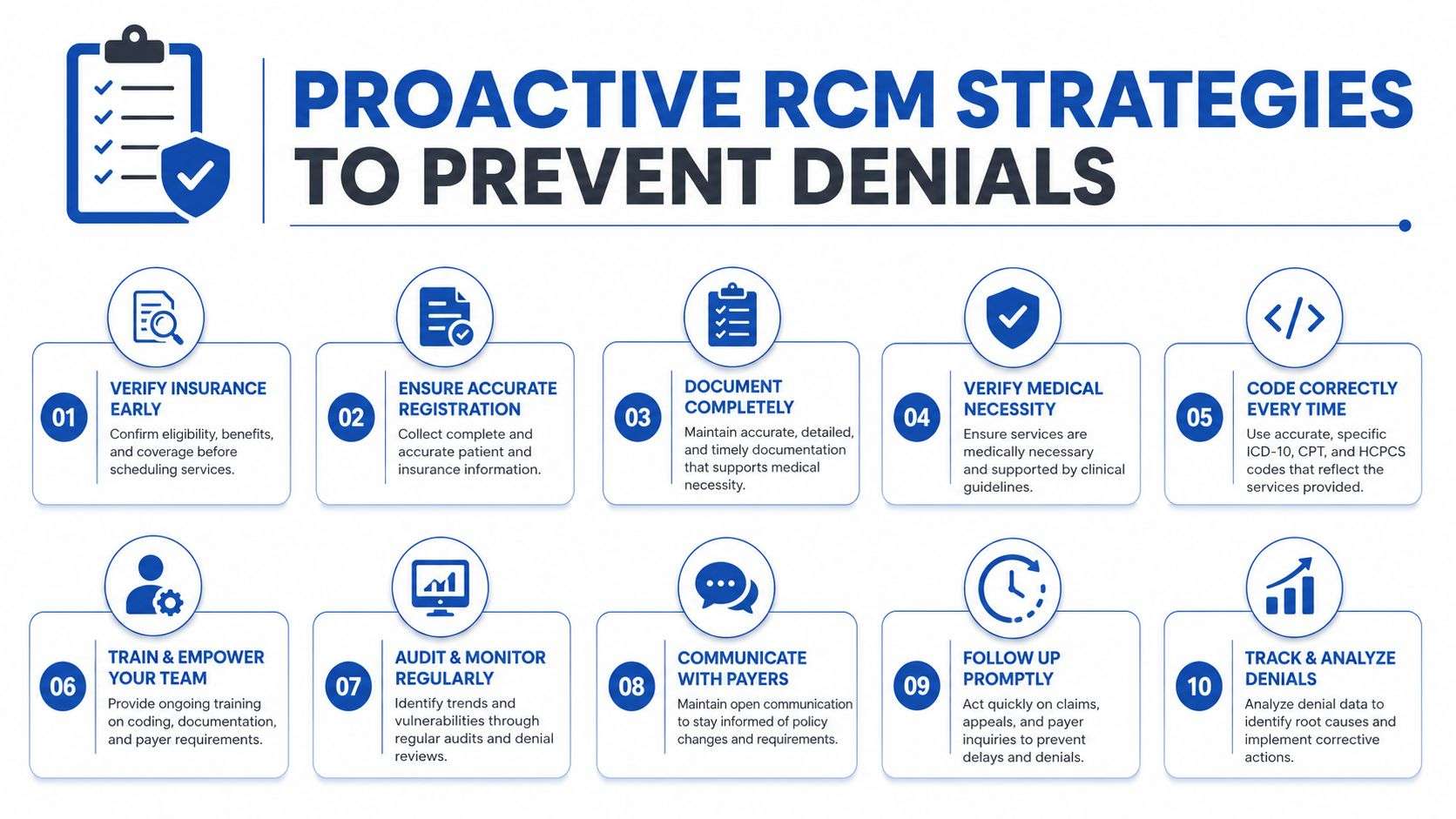
Proactive RCM Strategies To Prevent Denials
By the time a 19301 denial appears on the aging report, the practice has already spent money. The staff time, delayed cash, and follow-up burden are already in motion. The better approach is to build denial prevention into the workflow before the claim is ever created.
That matters because this code carries real reimbursement weight. The MedibillMD reimbursement overview for CPT 19301 states that the national average Medicare facility reimbursement for CPT 19301 is $652.79, with private payer rates often exceeding $1,000. This significant reimbursement value underscores the financial importance of accurate billing and denial prevention through detailed documentation and correct coding.
A Practical 19301 Revenue Cycle Checklist
Here's the workflow I'd want every practice administrator to pressure-test:
- Before surgery: Verify benefits, confirm whether prior authorization is required, and document the approved service scope in the account notes.
- Before coding: Make sure the surgeon's note identifies the lesion, laterality, and the margin-based nature of the excision.
- Before claim release: Hold the claim until pathology support aligns with diagnosis selection when the documentation still leaves questions.
- Before submission: Run an edit check for side modifiers, diagnosis linkage, and any code combinations likely to bundle.
- After submission: Track denials by surgeon, coder, and payer so patterns become visible quickly.
Operational Habits That Improve Collections
Strong teams also do a few quieter things well:
- They build surgeon-specific query templates for common missing elements.
- They teach coders the difference between a revenue opportunity and a denial trap.
- They audit paid claims, not just denied claims, because undercoding can hide in the background.
The cleanest 19301 claims usually come from offices where the surgeon, coder, and billing lead all use the same checklist.
For larger groups, centralized oversight pays off. A standardized revenue cycle management strategy helps keep one location's bad habits from becoming enterprise-wide leakage.
What Administrators Should Watch Monthly
If you manage multiple surgeons or sites, monitor:
- Denials tied to medical necessity
- Denials tied to missing or incorrect modifiers
- Claims delayed for missing pathology
- Edits involving closure or add-on service combinations
Those categories tell you whether the problem is documentation, coding, or payer rule interpretation. Fixing the root cause is always cheaper than chasing the denial later.
Frequently Asked Questions About CPT 19301
Can You Bill Sentinel Lymph Node Mapping With 19301
Yes, in the right circumstance. When a sentinel lymph node is identified via dye injection during a procedure involving 19301, the identification step is separately reported with CPT 38792. The key is documenting the distinct mapping work clearly enough that the claim reflects both the breast excision and the lymph node identification service.
What If The Surgeon Returns To Remove More Tissue For Positive Margins
That situation often raises modifier questions. When the same physician performs a staged or related procedure during the postoperative period, modifier 58 may apply. A common example is returning to remove additional tissue after the initial partial mastectomy. The record needs to support that the later procedure fits the staged or related framework, rather than treating modifier 58 as automatic.
How Should Staff Think About The Global Period
For administrators, the practical issue is that postoperative services related to the surgery may fall within the global package, while certain distinct procedures may still require separate reporting if the coding rules allow it. The safest internal process is to review any postoperative service tied to 19301 against the operative facts, timing, and modifier requirements before releasing another claim.
Does Every Breast Lesion Excision Qualify As 19301
No. That's one of the easiest ways to create denials. 19301 is used for a partial mastectomy with margin-focused excision. A breast tumor excision without that margin-centered oncologic standard may belong under a different code set, depending on the documented service.
What Is The Most Common Preventable Error With 19301
In many practices, it's one of two things: weak documentation of margin-based excision, or adding closure codes that are bundled into the primary service. Both errors are avoidable if the team reviews the op note with a breast surgery-specific checklist before coding.
Should The Billing Team Wait For Pathology
If pathology is necessary to support diagnosis and margin status, waiting can prevent a much bigger problem later. A slightly delayed clean claim is usually better than a fast unsupported claim that comes back denied and requires full rework.
What's The Best Way To Reduce Repeat Denials
Use a closed-loop process. Review denials, identify the exact failure point, update the surgeon template or coder edit rule, and monitor the next batch of claims. When practices treat each denial as a system problem instead of a one-off mistake, 19301 performance usually improves.
If your team wants help tightening surgical coding workflows, preventing denials, and improving collections on complex claims like CPT 19301, One For All Medical Billing offers end-to-end billing and revenue cycle support built for practices that need cleaner claims and less rework.

