

table of contents
The healthcare revenue cycle is the complete financial journey a patient's account takes, from the moment they book an appointment to the day their balance hits zero. Think of it as the entire process that connects the care you provide to the money that keeps your practice running. In short, it’s how you get paid for your work.
What Is The Healthcare Revenue Cycle And Why It Matters
Imagine your practice is a living, breathing organism. If high-quality patient care is its heart, then the healthcare revenue cycle is its circulatory system—the intricate network that keeps financial resources flowing to every part of the operation. This isn't just some background administrative task; it's the engine that powers your ability to treat patients day in and day out.
A healthy revenue cycle means that for every service you perform, the correct payment is collected on time. That financial stability is the bedrock of your practice. It’s what allows you to pay your staff, stock medical supplies, invest in better equipment, and even expand your services. When this system runs smoothly, your team can finally focus on what they do best: caring for patients.
The Foundation Of Financial Health
For any practice looking to survive and thrive long-term, an optimized healthcare revenue cycle isn't optional. It goes way beyond just sending out bills. It covers every single touchpoint that has a dollar sign attached to it. This includes:
- Accurate Patient Information: Getting details like demographics and insurance right from the very first phone call or form.
- Verified Insurance Eligibility: Confirming a patient’s coverage before they are seen to head off easily avoidable denials.
- Correct Medical Coding: Translating the clinical care provided into the universal language that payers understand.
- Timely Claim Submission: Sending clean, error-free claims to insurance carriers for fast processing.
- Diligent Follow-Up: Actively chasing down denied claims and outstanding patient balances to capture every dollar you've earned.
A breakdown at any one of these points creates a bottleneck. These clogs lead to delayed payments, a mountain of denials, and a serious drain on your time and resources.
A Growing Area Of Focus
As providers face tighter margins and ever-changing payer rules, it’s no surprise that the focus on financial optimization is growing. The global healthcare revenue cycle management market is expected to hit a staggering $189.6 billion by 2026 and an incredible $505.8 billion by 2035. North America alone accounts for a commanding 56% of that market, showing just how critical this has become for practices here.
A well-run revenue cycle does more than just improve cash flow; it reduces administrative burdens on your staff, which directly impacts morale and retention. When your team isn't constantly chasing down payments or fighting with payers over denied claims, they can dedicate their energy to creating a positive patient experience.
Ultimately, mastering your healthcare revenue cycle is about securing your practice's future. It gives you the financial strength to handle industry shifts, deliver outstanding care, and grow. Understanding the many benefits of revenue cycle management is the first step toward building a more resilient and profitable practice.
Mapping Your Revenue Cycle From Start To Finish
To get paid what you've earned, you need to understand how money moves through your practice from start to finish. The healthcare revenue cycle isn’t a single event but a chain of interconnected steps. When you can visualize this entire journey, you can spot inefficiencies and fix problems before they start.
The whole process breaks down into three core phases: the Front-End, the Mid-Cycle, and the Back-End. Think of them like a production line—a mistake at the beginning can cause major jams and lost revenue down the road.
This chart shows how the financial process connects the patient care you deliver to the long-term financial health of your practice.
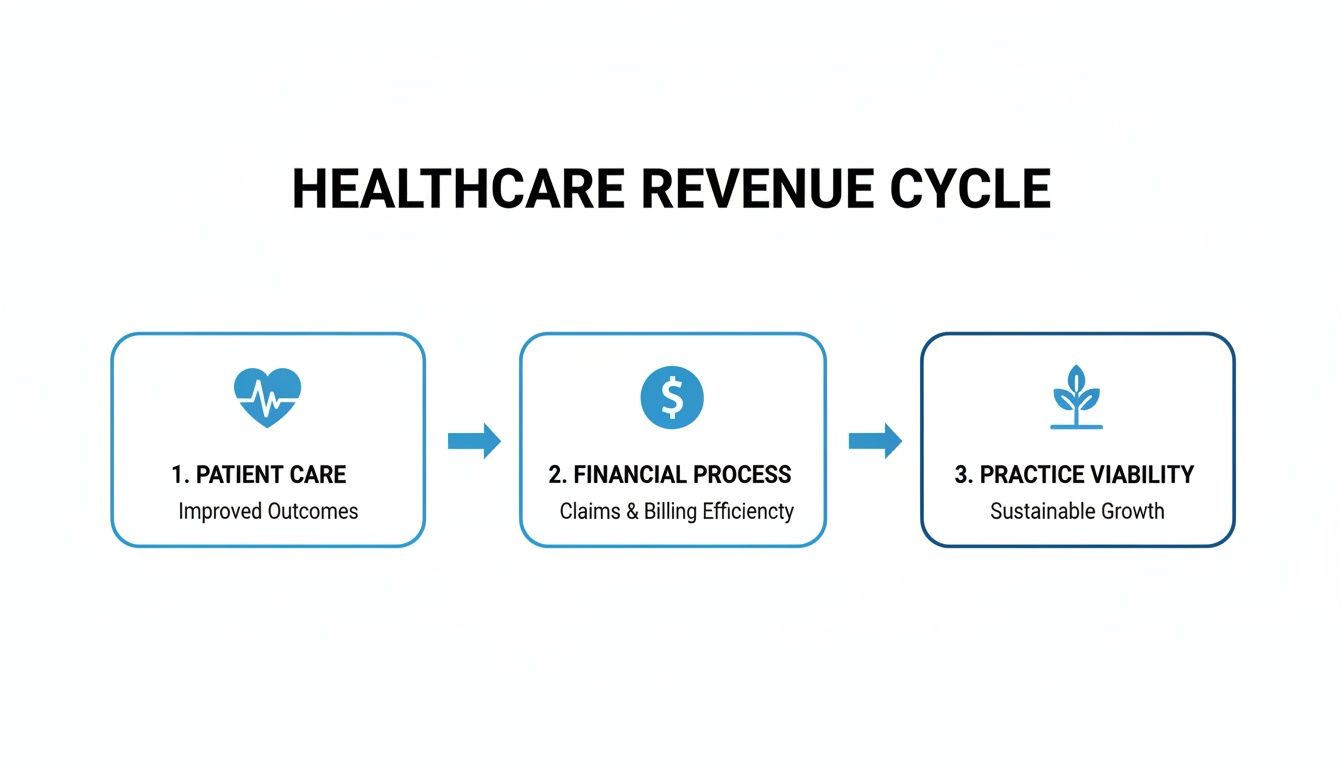
Without a solid financial bridge, even the best clinical care can’t sustain a practice.
The Front-End: The Foundation Of Your Revenue
The Front-End covers everything that happens before or during the patient's visit. This is your first—and best—chance to prevent billing headaches later. Getting this stage right is the secret to avoiding denials and keeping the entire process running smoothly.
Key steps at the Front-End include:
- Patient Registration and Scheduling: This starts the moment a patient books an appointment. Your team needs to capture perfect demographic details—name, date of birth, address—and double-check that existing records are up to date.
- Insurance Eligibility Verification: Before a patient is ever seen, your team has to confirm their insurance policy is active. This crucial step clarifies what’s covered, what the co-pay is, and if a prior authorization is lurking.
- Prior Authorization: Many payers require pre-approval for specific procedures to confirm they’re medically necessary. Skipping this step is a surefire way to get a claim denied, no questions asked.
- Patient Financial Responsibility: This is all about clear communication. Your team should explain the patient’s estimated out-of-pocket costs and collect co-pays at the time of service. This improves upfront cash flow and saves your back-end team a lot of work.
A simple mistake here, like a misspelled name or an unverified policy, is a leading cause of claim denials. A strong Front-End acts as a gatekeeper, making sure only clean data enters your billing system.
The Mid-Cycle: Translating Care Into Cash
The Mid-Cycle is where the clinical care you provided gets turned into billable charges. It’s a phase that demands precision because it directly connects what happened in the exam room to the claim sent to the payer.
Think of the Mid-Cycle as the translation phase. Your clinical team documents the "what" and "why" of patient care, and your Mid-Cycle team translates that story into the specific language payers require for reimbursement.
Core components of the Mid-Cycle are:
- Charge Capture: This is the process of documenting every single billable service performed during the visit. Any missed charge is simply lost revenue.
- Medical Coding: Certified coders take the clinical notes and assign standardized codes—like ICD-10 for diagnoses and CPT for procedures. The coding must tell an accurate story that justifies medical necessity.
Accuracy is everything here. The wrong code can trigger a denial, an audit, or an underpayment. This is exactly why so many practices rely on certified professionals who know the complex rules for their specialty. If you want to go deeper, you can explore the detailed steps of the medical billing process in our other guide.
The Back-End: Collecting What You Have Earned
The Back-End is the final, crucial phase focused on getting paid. This is where your team makes sure the practice collects every dollar it's owed, both from payers and patients. A proactive and persistent Back-End team is the engine that drives your practice's profitability.
This final phase is a continuous loop of several key activities:
- Claims Submission: Once the charges are coded, a formal claim is created and sent to the insurance payer, usually through an electronic clearinghouse.
- Payment Posting: As payments come in, they are posted to the right patient accounts. This step reconciles what you billed against what was actually paid, highlighting any discrepancies.
- Denial Management: If a claim gets denied, this team becomes a detective. They investigate the reason, fix the error, and appeal the payer’s decision to recover that revenue.
- Accounts Receivable (A/R) Follow-Up: This is all about persistence. The team diligently follows up on unpaid claims with insurance companies and outstanding balances with patients to keep your A/R days low.
By mapping out your healthcare revenue cycle from start to finish, you create a clear roadmap for financial success. Each phase is a vital link in the chain, and strengthening every step is the only way to ensure your practice’s long-term financial stability.
The Most Important Metrics For RCM Performance
You can’t improve what you don’t measure. Trying to manage your practice’s finances without tracking key metrics is like flying blind—you might be moving, but you have no idea if you're heading in the right direction.
Think of these metrics as your financial dashboard. They give you the hard data needed to stop guessing about your performance and start making strategic decisions. By focusing on a few core Key Performance Indicators (KPIs), you can diagnose problems early, celebrate wins, and drive real growth.

Clean Claim Rate
Your Clean Claim Rate (CCR) is the ultimate measure of your front-end efficiency. It tells you what percentage of your claims get accepted and paid on the very first try, with no errors or pushback from the payer.
A high CCR means your team is nailing the details: capturing accurate patient information, verifying insurance eligibility correctly, and ensuring coding is spot-on. If this number is low, it’s a sign that small mistakes at the beginning of the process are causing big headaches down the line.
A healthy practice should aim for a Clean Claim Rate of 95% or higher. Anything less is a signal to dig into your front-desk and charge-entry workflows to find and fix the leaks.
Denial Rate
If CCR is about what you get right, the Denial Rate is about what’s going wrong. This metric tracks the percentage of claims that payers reject. Each denial isn't just a delay; it's lost revenue and extra work for your staff who have to investigate, appeal, and resubmit.
Keeping a close eye on your denial rate helps you spot patterns before they become catastrophes. Are most denials coming from a single insurance company? Is a specific CPT code getting flagged over and over? This is the data you need to stop denials at the source. A high-performing practice keeps its denial rate at 5% or less.
Days In Accounts Receivable
Days in Accounts Receivable (A/R) is your practice’s financial pulse. It measures the average number of days it takes to get paid for your services. A lower number is always better—it means cash is flowing into your practice quickly, not sitting on someone else's books.
This KPI gives you a bird's-eye view of your entire revenue cycle’s health. If your Days in A/R is creeping up, it could point to anything from slow claim submissions to a broken follow-up process or poor patient collections.
- Excellent: Under 40 days. Your cash flow is healthy and efficient.
- Average: Between 40-50 days. There’s definitely room for improvement here.
- Warning Zone: Over 50 days. This signals serious bottlenecks that are strangling your cash flow.
Tracking this metric shows you just how long your hard-earned money is tied up. For a deeper dive, you can learn more about the accounts receivable days calculation and strategies to bring that number down.
Net Collection Rate
Finally, the Net Collection Rate (NCR) gets to the bottom line: how much of the money you're entitled to collect are you actually collecting? After accounting for contractual adjustments with payers, this metric reveals your true collection effectiveness. It’s the ultimate report card for your back-end team.
A low NCR can mean money is slipping through the cracks from unappealed denials, failures in patient collections, or write-offs due to timely filing limits. Top-tier practices consistently achieve a Net Collection Rate of 97% or higher, proving they have a rock-solid process for securing every dollar they’ve earned.
To help you keep these critical numbers in focus, here’s a quick summary of the metrics that matter most.
Essential RCM Performance Metrics At A Glance
Clean Claim Rate
- What It Measures: The percentage of claims paid on the first submission.
- Good Benchmark: 95% or higher
Denial Rate
- What It Measures: The percentage of claims denied by payers.
- Good Benchmark: 5% or less
Days in A/R
- What It Measures: The average time it takes to collect payments.
- Good Benchmark: Under 40 days
Net Collection Rate
- What It Measures: The percentage of collectible revenue you actually receive.
- Good Benchmark: 97% or higher
Monitoring these four KPIs is the first step toward building a more resilient and profitable practice. They provide the clarity you need to move from reacting to financial problems to proactively optimizing your entire revenue cycle.
Common Revenue Cycle Problems And How To Fix Them
Even the most well-oiled revenue cycle can spring costly leaks. These aren't just minor administrative hiccups; they're significant financial drains that can choke your practice’s cash flow and steal focus away from what truly matters—patient care.
The good news is that identifying and plugging these leaks is entirely possible. Many of them start long before a claim is ever sent, with simple errors at the front desk or during documentation that snowball into major payment delays. By understanding where these breakdowns happen, you can put proactive strategies in place to protect your revenue.
Inaccurate Patient Registration
It all starts at the front desk, and unfortunately, this is often the first point of failure. A misspelled name, an outdated insurance ID, or a wrong date of birth might seem like a small slip-up, but these are some of the top reasons for instant claim denials. When front-end data is wrong, the entire claim is built on a shaky foundation.
The fix is to treat data collection with the same precision as a clinical procedure.
- Implement a multi-point check: Train your staff to not just ask for information but to actively verify it. This means matching the spelling of the patient's name on their ID directly to their insurance card.
- Use real-time eligibility software: Before the patient is even seen, run their information through a tool that instantly confirms their policy is active and covers the planned services. This one step can prevent a massive number of avoidable denials.
- Make it a routine: For every returning patient, make it standard practice to ask, "Has any of your information changed since we last saw you?" This simple question catches new insurance plans or a change of address before they become a problem.
Missed Prior Authorizations
A missed prior authorization is a guaranteed denial—and often represents revenue that’s nearly impossible to get back. Payers demand pre-approval for many procedures to confirm medical necessity. Failing to get it before providing care is a costly, unforced error that hits your bottom line directly for services you've already rendered.
Proactive management is the only way to solve this. Your team needs a master list of the services and payers that frequently require authorization. Before scheduling these appointments, a dedicated person must be responsible for getting that approval and documenting the authorization number right in the patient’s record.
Ineffective Denial Management
Claim denials are a frustrating part of the business, but how your practice responds makes all the difference. Too many practices either write off denials as an unavoidable cost or let them pile up, creating a backlog of aging accounts receivable. An ineffective denial process means you’re simply leaving earned money on the table.
This is a critical area to get right, as the costs add up fast. Providers spend an average of $43.84 per claim to fight with health plans, totaling an eye-watering $19.7 billion annually across the industry. With private payers initially denying around 15 percent of all claims, a smart denial management strategy isn't just a good idea—it's essential for survival.
A strong denial management strategy turns a reactive problem into a proactive solution. It’s not just about appealing a single denial; it’s about analyzing the root cause to prevent the next ten from ever happening.
To truly fix your approach, you have to track and categorize every single denial. By identifying patterns—like a recurring coding mistake for one procedure or a specific payer's tricky requirement—you can give targeted feedback to your team and fix the broken workflow. For a deeper dive into mastering this critical function, check out our in-depth guide to medical billing denial management. This is how you stop revenue leaks for good.
Using Technology And Outsourcing To Optimize RCM
Let's be honest: with shrinking margins and payer rules that change on a dime, relying on manual billing processes is a recipe for leaving money on the table. To protect your revenue and build a more resilient practice, you have two powerful options: embracing modern technology and partnering with expert outsourcers.

These two strategies aren't mutually exclusive. In fact, they work best together, turning the administrative headache of the healthcare revenue cycle into a source of financial stability.
The Rise Of Automation And AI In RCM
Technology is no longer a "nice-to-have" in revenue cycle management—it’s essential. Artificial intelligence (AI) and automation are solving real problems by taking over the repetitive, data-heavy tasks that slow your team down. This frees up your staff to focus on what matters most: patient care and resolving complex claim issues.
The industry is adopting these tools at a breakneck pace. Over 60 percent of new RCM deployments are now cloud-based, and this model makes up nearly 70% of the entire RCM market. If you're curious about the data, you can read the full research on how cloud and AI are redefining healthcare finance.
Here’s how technology makes a practical difference:
- Automated Eligibility Verification: Instantly confirms patient coverage before the appointment, slashing front-end denials.
- Predictive Denial Analytics: AI analyzes historical data to flag claims that are likely to be denied, giving you a chance to fix them pre-submission.
- Intelligent Charge Capture: Makes sure every single billable service is captured and coded correctly, plugging revenue leaks from missed charges.
- Robotic Process Automation (RPA): Automates mind-numbing tasks like posting payments or checking claim statuses, saving your team countless hours.
The Strategic Value Of RCM Outsourcing
While technology gives you the tools, an outsourced RCM partner provides the specialized expertise to use them effectively. This isn't just about offloading your billing; it's a strategic move to gain a team of specialists dedicated to your financial health.
Think of it this way: your team members are experts in clinical care. A great RCM partner is an expert in the business of getting paid for that care.
Outsourcing the healthcare revenue cycle transforms a potential cost center into a powerful revenue engine. A top-tier partner leverages advanced technology and a team of specialists to stay ahead of changing payer rules and compliance demands, ensuring your revenue is captured and protected.
This approach frees you from the endless cycle of hiring, training, and retaining skilled billing staff. Instead, you get immediate access to a team of certified coders and billing pros whose only job is to maximize your collections.
A good partner delivers a clear return on investment by:
- Reducing Operating Costs: You eliminate the salaries, benefits, and training expenses that come with an in-house billing department.
- Increasing Collections: They bring proven strategies for denial management and A/R follow-up that recover more revenue, faster.
- Improving Compliance: A dedicated team stays on top of all regulatory and payer updates, minimizing your audit risk.
- Providing Actionable Insights: You get clear, data-driven reports that help you make smarter decisions about your practice.
By combining the right tech with dedicated experts, practices can build a revenue cycle that’s not just efficient, but profitable. To explore what this could look like for your practice, check out our guide on healthcare revenue cycle outsourcing.
How To Choose The Right RCM Partner For Your Practice
Picking a partner to manage your healthcare revenue cycle is one of the most important financial decisions you’ll make for your practice. This isn't just about handing off billing paperwork; it’s about trusting another team with the lifeblood of your business.
The right partner can be a powerful engine for growth and efficiency. But the wrong one? That can lead to financial chaos, mounting denials, and a lot of headaches. To avoid that, you need to look past the polished sales pitch and really dig into what a vendor can do for you.
Evaluate Specialty-Specific Expertise
First and foremost, does the potential partner actually understand your medical specialty? The billing world for a family practice is completely different from that of a surgical center or a pain management clinic. Billing rules, common procedure codes, and typical denial patterns vary wildly from one field to the next.
A partner who lacks experience in your specific niche can cause a world of problems. Get straight to the point and ask them directly:
- What percentage of your clients are in our specialty? This tells you how much of their daily work is dedicated to your world.
- Can you describe your team’s experience with our most common procedures and codes? Listen for a deep, confident answer, not a generic one.
- How do you keep your team trained on coding and policy updates specific to our field? This shows their commitment to staying current and protecting your revenue.
Vet Their Technology And Reporting
A great RCM partner uses smart technology to drive results and gives you a clear window into their performance. Their software should work hand-in-hand with your current Electronic Health Record (EHR), creating a smooth flow of data without disrupting your clinical team.
But just as important is how they share results with you.
Don’t settle for vague promises of "great results." Demand access to clear, data-driven reports that show you exactly how they are performing against key metrics like your Clean Claim Rate, Denial Rate, and Days in A/R.
Before you even think about a contract, you should know exactly what reports you’ll get and how often you’ll get them. The best partners act like an extension of your own team, offering proactive insights and transparent data that let you see the health of your healthcare revenue cycle at a glance. That kind of clarity is what builds trust and ensures everyone is held accountable.
Your RCM Questions Answered
Thinking about overhauling your revenue cycle naturally brings up some big questions. What's the real impact on my practice? How soon will I actually see a difference? And will this just create more headaches for my team?
Let's get straight to it and tackle some of the most common concerns we hear from practice owners.
How Quickly Can I See Financial Improvements?
This is usually the first question on everyone's mind, and for good reason. While every practice has its own unique challenges, you can realistically expect to see meaningful progress within the first 90 days after you start optimizing your RCM or bring on a new partner.
It’s not an overnight fix, but the improvements build on each other.
- First 30-60 Days: The first thing you'll notice is a drop in your denial rate. Why? Because the most common, preventable errors—like eligibility issues and simple data entry mistakes—are fixed right at the front end. Getting this right from the start has an immediate ripple effect.
- 60-90 Days: Your Days in Accounts Receivable (A/R) should start ticking down. As clean claims sail through the system and get paid faster, you'll see your cash flow improve. This is also when a more disciplined follow-up process begins to clear out older, stubborn balances.
- Beyond 90 Days: This is when the most important metric, your Net Collection Rate, starts to climb. It’s the ultimate proof that the system isn’t just moving faster—it's actually capturing more of the money you've rightfully earned.
These early wins lay the foundation for long-term financial stability.
Will This Create More Work For My Staff?
Many practice managers worry that a new RCM process will pile more work onto their already swamped administrative and clinical teams. The truth is, a well-designed RCM strategy does the exact opposite. Its entire purpose is to reduce your staff's administrative burden, not add to it.
A well-managed healthcare revenue cycle doesn't add to your team's workload; it frees them from it. By letting experts handle the billing complexities, your staff can fully dedicate their time and energy to patient care and experience.
Imagine your front desk team focusing on welcoming patients instead of wrestling with payers over denied claims. Think about your clinical staff providing care, confident that their documentation won't create a billing headache weeks later. That's the goal.
How Is Success Actually Measured?
Success isn't a vague feeling—it's measured with hard data. Any RCM partner worth their salt won't just tell you they're doing a great job; they'll prove it with clear, transparent reports on the numbers that matter most to your practice's health.
We're talking about tangible Key Performance Indicators (KPIs):
- Clean Claim Rate: A high percentage here means claims are being submitted correctly the first time, avoiding unnecessary delays.
- Denial Rate: You want to see this number consistently low and trending downward, proving that the root causes of denials are being fixed for good.
- Days in A/R: A shrinking number of days is concrete proof that you're getting paid faster.
- Net Collection Rate: An increasing collection rate is the bottom line. It shows you’re collecting more of the revenue you are owed.
Ready to see how a dedicated partner can strengthen your practice's financial health? The team at One For All Medical Billing combines specialty-specific expertise with proven processes to help you get paid faster, with fewer denials. Schedule your free consultation today at https://oneforallmed.com.

