

table of contents
You're probably dealing with one of two problems right now. Claims are getting denied for reasons that seem preventable, or your providers are documenting real patient care in a way that still leaves your billing team exposed. In both cases, the chart is the weak link.
That's why medical record review matters so much. It isn't paperwork for paperwork's sake. It's the control point where clinical care, coding accuracy, payer expectations, and compliance all meet. If the record is incomplete, unclear, duplicated, out of order, or unsupported, revenue slips and audit risk rises.
A strong review process gives your practice something every manager wants. Fewer surprises. Cleaner claims. Faster follow-up. More confidence that the story told to a payer matches the care your team delivered.
Beyond Billing Why Medical Record Review Is Your Financial Safeguard
A denied claim rarely starts in the billing office. It usually starts earlier, inside the patient record.
If the assessment doesn't support medical necessity, if the diagnosis isn't tied clearly to the service, or if the dates and provider details don't line up, your billing team is forced to work with weak source material. They can submit the claim, but they can't manufacture support that the chart doesn't contain.
That's the first mindset shift. Medical record review is not just an administrative task. It's revenue protection.
Why The Record Controls Payment
Payers don't reimburse based on what your team meant to document. They reimburse based on what the chart shows. Auditors work the same way.
A structured review helps your practice answer four business-critical questions before problems spread:
- Is The Service Supported: Does the note justify why the visit, procedure, or treatment was medically necessary?
- Is The Documentation Complete: Are signatures, dates, orders, diagnoses, and follow-up details present and usable?
- Is The Coding Defensible: Can your coder connect the clinical content to the billed ICD-10, CPT, or HCPCS codes?
- Is The Record Audit Ready: Would an outside reviewer understand the case without guessing?
Practical rule: If a payer has to infer the story, you've already weakened the claim.
This is also a risk management issue. A practice that reviews records consistently can spot patterns early. That might be a provider who underdocuments chronic conditions, a location with recurring modifier problems, or a service line where denials point to the same missing element over and over. A broader risk management framework in healthcare operations helps, but the chart review process is where those risks become visible in daily operations.
What It Protects Beyond Compliance
Most practice managers first think about compliance when they hear medical record review. That's valid, but incomplete.
It also protects:
- Cash Flow: Cleaner documentation supports cleaner claims.
- Staff Time: Teams spend less time chasing addenda, rework, and appeal support.
- Provider Productivity: Feedback becomes specific instead of vague.
- Operational Stability: Leadership can trust what denial and coding trends are saying.
When your review process is weak, the damage shows up everywhere. Denials rise, coding confidence drops, and staff start solving the same problem repeatedly. When the process is disciplined, revenue cycle performance gets steadier because the record itself gets stronger.
What Is Medical Record Review Really
Medical record review is a quality control check on your practice's most valuable operational asset: the patient chart.
Consider the analogy of reconciling a bank account. Your clinical team performs the care. Your billing team reports the care. The medical record is what proves both happened the right way. If the record and the billed claim don't match, the difference turns into lost revenue, compliance exposure, or both.
What Reviewers Are Actually Looking For
A reviewer isn't just hunting for mistakes. They're validating whether the record tells a complete and credible care story.
That usually means checking whether the chart:
- Identifies The Patient Correctly: The right patient, right encounter, right ordering or rendering provider
- Explains The Clinical Reasoning: Symptoms, findings, assessment, and plan should fit together
- Supports The Codes Selected: Diagnoses and procedures should be traceable to what's documented
- Shows Continuity Of Care: Follow-up, orders, test results, and treatment changes should make sense in sequence
In a busy practice, that sounds simple but often breaks down in predictable ways. Notes get copied forward. Problem lists aren't updated. Diagnoses stay vague. Services are documented, but not linked clearly to medical necessity. Those gaps create downstream friction.
Why It Matters To Revenue Cycle Teams
For a practice manager, the practical definition is even simpler. Medical record review is the checkpoint between care delivery and reimbursement.
A good review process helps your team confirm that what happened in the exam room can survive payer scrutiny. That includes front-end documentation quality, mid-cycle coding accuracy, and back-end appeal readiness. It also supports stronger clinical documentation improvement workflows, especially when providers need focused feedback tied to specific claim outcomes.
A chart can be clinically useful and still be financially weak. Review closes that gap.
Here's a plain example. A provider treats a patient for uncontrolled diabetes during a follow-up visit, adjusts medication, documents risk factors, and orders labs. If the note only says “diabetes follow-up, continue meds,” the care may have been appropriate, but the chart doesn't fully support the complexity involved. Review catches that disconnect before it becomes a payment problem.
What It Is Not
It isn't random spot-checking. It isn't just a coding audit. And it isn't a one-time cleanup project after denials spike.
A true medical record review process is structured, repeatable, and tied to operational goals. It helps the practice validate documentation, support coding, reduce preventable denials, and strengthen compliance without slowing down patient care.
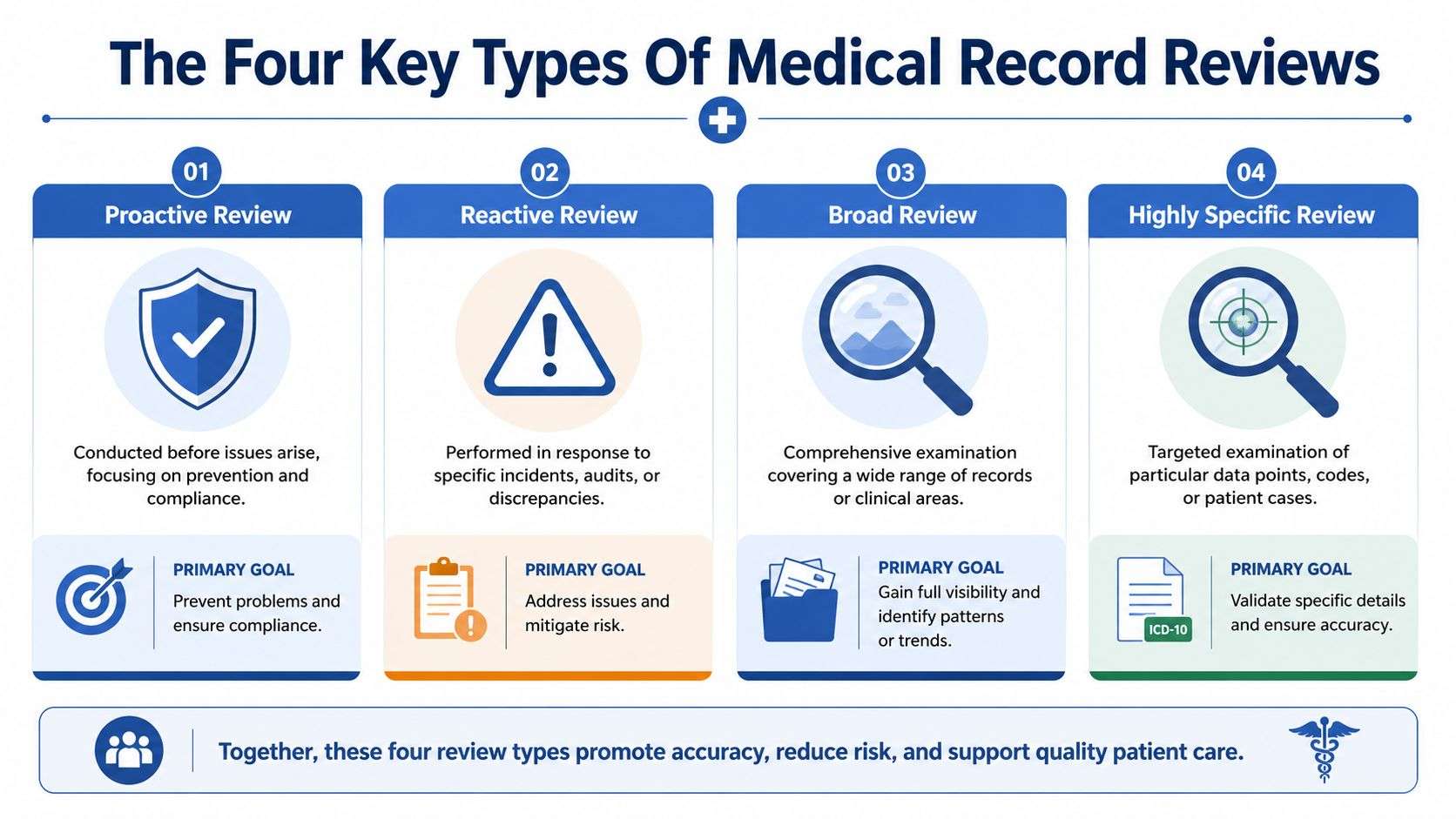
The Four Key Types Of Medical Record Reviews
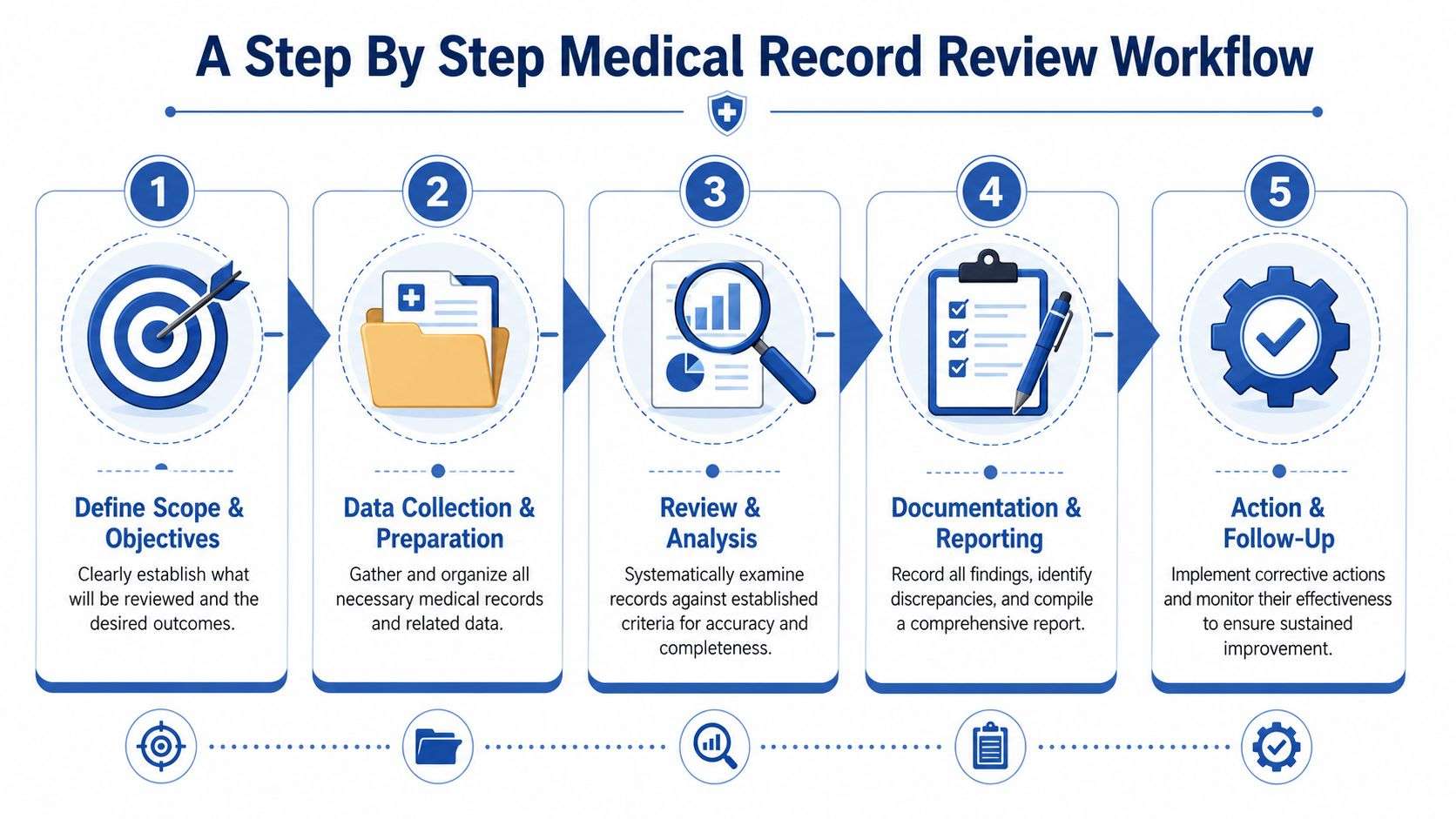
Not every review serves the same purpose. Some happen while care is still in progress. Others look backward to find patterns, defend claims, or improve documentation habits. If you mix them together, your team ends up doing a lot of work without getting clear answers.
Concurrent Review
This happens during the episode of care or very soon after the encounter. The goal is speed.
A concurrent review is useful when your team wants to catch missing details before the claim goes out. In hospital-based settings, CDI specialists often work at high volume. According to the ACDIS white paper on medical record review workflow, CDI specialists who conduct medical record reviews process an average of 16 to 24 patient charts daily, with 6 to 10 new reviews initiated each day. The same source notes that 32% of CDI specialists strictly follow prioritization procedures for cases lacking CC/MCC indicators.
For a practice, the lesson is straightforward. Real-time review requires triage. Your team can't review everything with the same intensity, so it needs clear priorities.
Retrospective Review
This review happens after discharge, after claim submission, or after payment activity reveals a problem. It's the best format for trend analysis.
Use it when you want to answer questions like these:
- Why Are These Claims Denied: Is the issue medical necessity, missing signatures, unsupported coding, or poor sequencing in the note?
- Which Providers Need Feedback: Are certain documentation habits causing repeat rework?
- What Should Be Standardized: Are there templates or workflows that need to change?
Retrospective chart review also matters outside payment operations. A review of retrospective chart data use in clinical journals states that at least 25% of scientific publications published in clinical journals utilize data extracted from patient medical records through retrospective chart review. That tells you how central chart review is when organizations need reliable historical data.
Coding Audit Review
This is narrower and more technical. The reviewer compares documented care to the assigned ICD-10, CPT, and HCPCS codes.
The trigger is usually one of three issues: a denial trend, a compliance concern, or uncertainty about provider documentation. Coding audit reviews often pair well with front-end edits and claim scrubbing controls in the billing workflow, because both are designed to stop weak claims before they reach the payer.
If coding audit findings keep repeating, the root problem usually sits in documentation habits, not coder effort alone.
Utilization And Peer Review
This type focuses less on code assignment and more on whether care was appropriate, consistent, and sufficiently supported.
A utilization review may ask whether the level of care fits the documented condition. A peer review may examine whether the provider's decisions align with accepted clinical standards. These reviews are especially useful when leadership needs a fuller view of quality, resource use, and documentation credibility across service lines.
The right mix depends on what your practice is trying to fix. If denials are climbing, retrospective and coding audit reviews usually matter first. If documentation breaks down before claims are filed, concurrent review becomes more valuable.
A Step By Step Medical Record Review Workflow
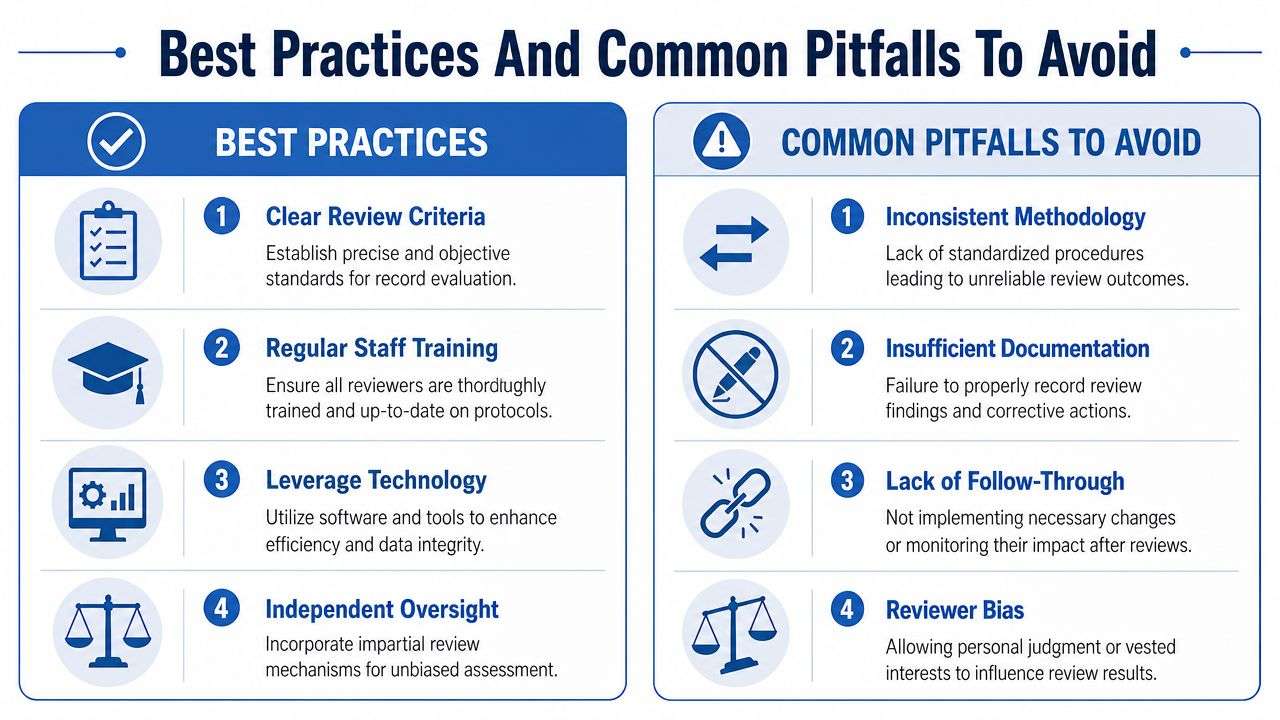
A reliable medical record review process doesn't start with pulling random charts. It starts with deciding what question you need the review to answer.
That sounds basic, but many practices skip it. They review records because leadership wants “an audit,” then end up with findings that are too broad to fix and too inconsistent to defend.
Step One Define The Scope Before You Touch A Chart
Start with a focused objective. Are you reviewing records for denial prevention, coding validation, audit readiness, provider education, or risk adjustment support?
If the review is being used for research rather than operations, governance changes. The UCSF guidance on medical record review and IRB requirements explains that retrospective record review studies require IRB prior review and approval when used for research purposes, while IRB review isn't required when records are used solely for treatment, payment, or operations.
For internal operational reviews, define:
- Which Charts Will Be Reviewed: By provider, location, payer, service line, denial category, or diagnosis
- What Criteria Will Be Applied: Documentation completeness, code support, medical necessity, timeliness, or signature requirements
- What Output You Need: Provider feedback, appeal support, training priorities, or trend reporting
Step Two Gather The Right Records And Clean The File
Record collection sounds mechanical, but it's where confusion starts. Missing pages, duplicate uploads, outside consults in the wrong encounter, and scanned records without order can distort the whole review.
If your staff handle inbound record requests or outside records often, it helps to understand medical record request forms because the request format affects whether your team receives complete, usable documentation the first time.
The file should then be organized inside your electronic medical records system workflow so the reviewer isn't reconstructing the patient story from fragments.
Step Three Standardize The Record Before Analysis
Official review guidance offers practical directives. The CMS RADV reviewer guidance states that to avoid a discrepant finding, documentation must explicitly confirm the correct beneficiary, an acceptable provider type, and dates of service within the review period. The same guidance calls for a structured technical approach that includes deduplication and chronological sorting.
That means your team should:
- Remove Duplicates: Don't let repeated scans create the illusion of more documentation than exists.
- Index The Record: Separate notes, imaging, labs, procedures, referrals, and correspondence into logical sections.
- Sort Chronologically: Build a clean timeline so reviewers can follow the patient journey without jumping around.
- Confirm Critical Identifiers: Patient name, provider credentials, encounter dates, signatures, and document source.
Clean organization isn't clerical busywork. It determines whether reviewers find the right facts at the right time.
Step Four Review Against Fixed Criteria
Now the reviewer can evaluate the chart consistently. The point isn't to “read everything.” The point is to test the record against predefined standards.
A useful review asks:
- Does the note support the billed diagnosis and service?
- Is medical necessity obvious from the assessment and plan?
- Are there missing orders, signatures, attestations, or follow-up details?
- Do lab or imaging results align with the documented decision-making?
- Does the timeline show a coherent course of treatment?
Step Five Report Findings And Assign Action
The review only creates value if someone acts on it. Findings should be categorized by issue type, impact, and owner.
Some items go to providers for documentation coaching. Some go to coding for guideline clarification. Some go to front-desk or medical records staff because the problem started at intake, scanning, or release-of-information handling.
A strong workflow turns chart review into a repeatable operating process instead of a one-off project.
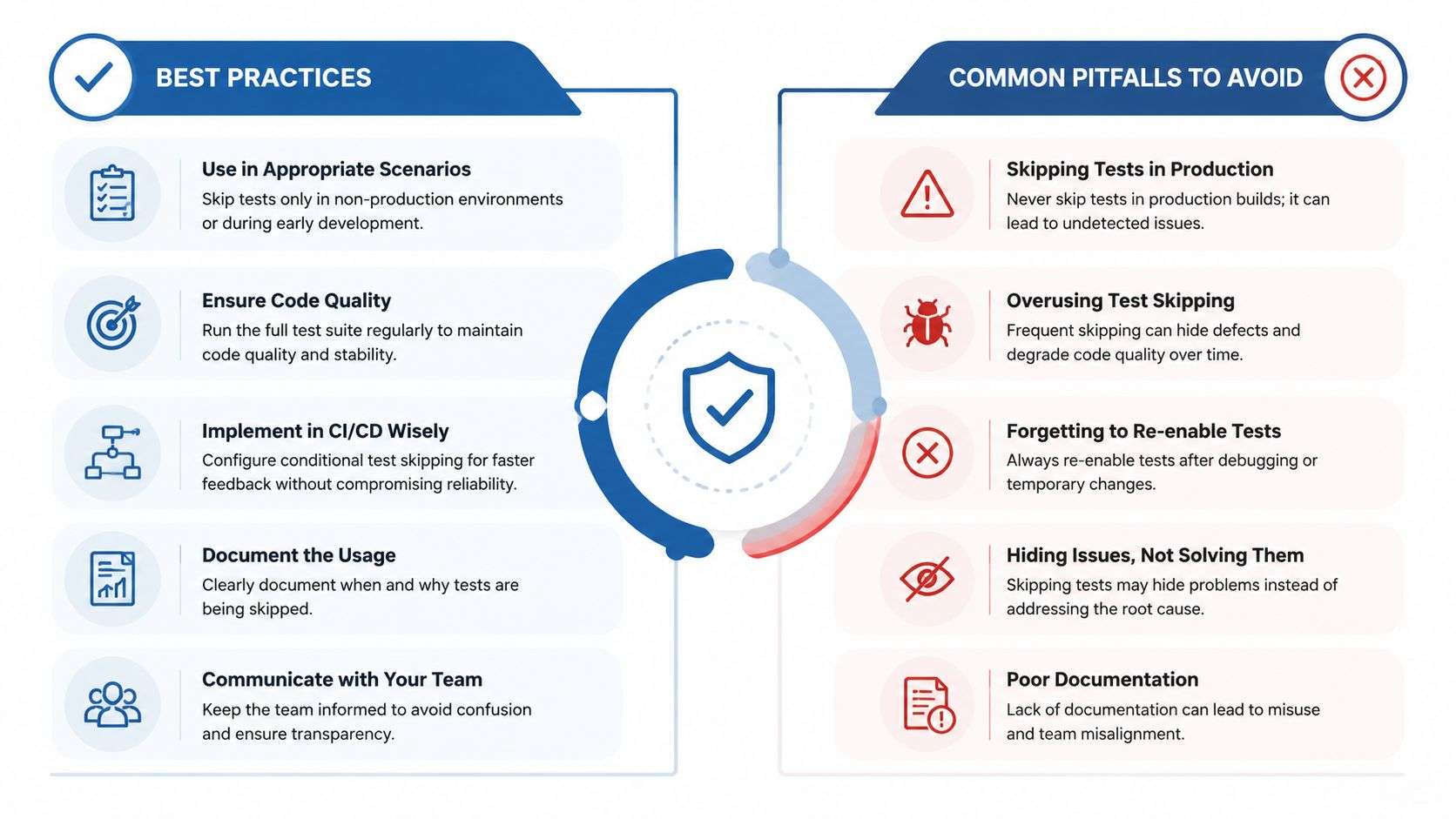
Best Practices And Common Pitfalls To Avoid
Most medical record review programs fail in ordinary ways. The criteria are vague. Reviewers interpret standards differently. Findings are documented loosely. Providers get generic feedback, then nothing changes.
That's why the process has to be standardized. In a study of transitional medical record review methods in General Practitioner records, record quality was rated as 'poor' in up to 10.2% of records, and the study reported low inter-rater reliability, meaning reviewers often differed in what they identified. For a practice manager, that's the warning sign. If your reviewers aren't aligned, your results won't be dependable.
Best Practices That Protect Revenue
The strongest review teams do a few things consistently.
- Use Written Review Criteria: Reviewers need the same definitions for medical necessity support, diagnosis specificity, signature sufficiency, and code validation.
- Train Reviewers On Real Charts: Policy alone won't align judgment. Teams need calibration using actual chart examples from your specialties.
- Document Findings In A Standard Format: Every finding should show what was reviewed, what was missing or unsupported, why it matters, and who owns correction.
- Close The Loop With Providers: Feedback works best when it is tied to a specific note, a missed element, and a billing consequence.
A practical checklist can help teams stay consistent. If you want a general framework for evaluating documents systematically, Superdocu's document review guide is a useful reference for thinking through completeness, organization, and review discipline.
Pitfalls That Quietly Undermine Reviews
Some problems are obvious. Others look harmless until they create denials or audit exposure.
Inconsistent Methodology
One reviewer flags vague assessments. Another ignores them. One counts unsigned entries as incomplete. Another treats them as acceptable if the provider is easy to identify. That inconsistency makes trend data unreliable.
Weak Documentation Of The Review Itself
If your team can't show what standard was applied and what evidence supported the finding, the review becomes hard to defend internally. It also limits provider buy-in because feedback sounds subjective.
No Follow-Through
Practices often identify the same issues repeatedly because no one assigns deadlines, tracks remediation, or checks whether the correction worked. Review without follow-up creates reports, not improvement.
Standardization matters twice. It improves the patient chart, and it improves the quality of the review itself.
What Better Looks Like In Daily Operations
A mature process feels less dramatic than people expect. It doesn't require constant audits or long memos.
It looks like this:
- Providers Receive Short, Specific Feedback: “Document status and treatment impact for chronic conditions,” not “improve documentation.”
- Coders Escalate Predictable Gaps: They don't guess when support is missing.
- Managers Track Patterns By Issue Type: They separate isolated mistakes from system problems.
- Compliance And Billing Work From The Same Rules: The chart is reviewed once, using standards everyone understands.
That's how medical record review becomes a quality loop instead of a cleanup exercise.
How To Measure The Success Of Your Review Process
You don't need a complicated dashboard to know whether your review program is working. You need metrics that connect chart quality to revenue outcomes.
Start with a simple question. After review findings are shared, do claims become cleaner and easier to defend? If the answer is no, the process may be generating activity without changing behavior.
Metrics That Matter Operationally
Track a short set of indicators your managers can act on:
- Denial Rate By Cause: Separate documentation denials from eligibility, authorization, and filing issues.
- Coder Accuracy Score: Measure whether coding aligns with documentation and current rules.
- Claim Lag Time: Watch how long it takes encounters to move from date of service to claim submission.
- Query Rate And Response: Monitor how often coders or reviewers need clarification and whether providers respond promptly.
- Repeat Findings By Provider Or Location: If the same issue appears again and again, training or workflow redesign is needed.
How To Read The Results
A rising query rate isn't always bad. In the short term, it can mean reviewers are catching unsupported documentation before the claim leaves the building. Over time, you want the underlying issue to decline as providers adjust.
Likewise, faster claim submission isn't automatically better if speed comes from skipping review steps. The goal is balanced performance. Clean claims, defensible documentation, and fewer preventable rework cycles.
Measure the review process by what it changes, not by how many charts it touches.
Good reporting also helps leadership justify staffing, training, and technology decisions. When you can connect review findings to denial prevention and coding accuracy, medical record review stops looking like overhead and starts looking like an operational control.
When To Outsource Medical Record Reviews For Scalable Results
There comes a point when internal teams can't keep pace. Usually the warning signs are clear. Review backlogs grow, denial analysis gets delayed, provider feedback becomes inconsistent, and specialty-specific chart issues sit unresolved because no one has the bandwidth or technical depth to tackle them.
That's when outsourcing becomes a business decision, not a convenience.
Signs Your In House Model Has Reached Its Limit
An outside review partner makes sense when your practice is dealing with conditions like these:
- Volume Outruns Capacity: Multi-site growth or higher encounter volume leaves too many charts unchecked.
- Specialty Complexity Increases: Services in pain management, endocrinology, rheumatology, behavioral health, or surgical care often require tighter documentation support.
- Objectivity Is Missing: Internal reviewers may be too close to the workflow to spot recurring habits clearly.
- Technology And Retrieval Work Become Burdens: Organizing, indexing, and validating records takes time your staff no longer have.
The broader market is moving in that direction too. The medical record access and retrieval market analysis says the global medical record access and retrieval market is projected to grow from $1.1 billion in 2024 to $2.8 billion by 2034, and 47.40% of law firms rely exclusively on external vendors due to growing complexity. While law firms aren't medical practices, the operational signal is relevant. Complex record work increasingly demands specialized outside support.
What A Good Outsourcing Decision Should Deliver
The right partner should give you more than labor. It should provide consistency, specialty knowledge, defensible review criteria, and scalable throughput.
Look for:
- Reviewer Calibration: Findings should be standardized across reviewers
- HIPAA-Compliant Workflows: Privacy controls can't be an afterthought
- Clear Escalation Paths: Coding questions, provider queries, and compliance concerns should move quickly
- Operational Reporting: You need trend visibility, not just completed reviews
- Support For Broader Due Diligence: Record quality often affects payer contracts, acquisitions, and compliance planning, which is why many groups tie reviews into a broader due diligence checklist for healthcare operations
Outsourcing is usually the right move when leadership wants dependable results at scale without pulling internal staff away from patient care and daily billing execution.
If your practice needs cleaner documentation, fewer preventable denials, and a more disciplined revenue cycle, One For All Medical Billing can help build a review process that supports both compliance and cash flow. Their U.S.-based team works with practices nationwide to strengthen coding accuracy, tighten claim support, and turn documentation quality into measurable financial performance.

