

table of contents
TL;DR:
- ASC facility claims are filed using the CMS-1500 form with POS 24, the ASC facility NPI in item 33a, and specific modifiers; Medicare pays 80% of the lesser of actual charges or the ASC rate, with the patient responsible for the remainder.
- Operators must verify procedure coverage, updates, and field requirements before submission, ensuring pass-through devices are properly paired, packaged items are bundled, and claims are timely filed within specified windows.
ASC facility claims are filed by the surgery center itself using the ASC facility NPI, Place of Service (POS) 24, and the CMS-1500 claim form (or its EDI equivalent for freestanding centers). Medicare pays 80% of the lesser of actual charges or the ASC payment rate, with the beneficiary responsible for 20% coinsurance after the deductible. Before you submit a single claim, run three checks: confirm the procedure is on the ASC Covered Procedures List (CPL), pull the January 2026 CMS MM14359 update for code and pass-through device changes, and verify field-level requirements with your Medicare Administrative Contractor (MAC).
Immediate pre-submission checklist:
- Verify the CPT/HCPCS code appears on the ASC CPL and is not excluded or contractor-priced
- Place the ASC facility NPI in item 33a on the paper CMS-1500 (or the EDI equivalent field)
- Apply the correct ASC-specific modifiers before submission (FB, FC, LT/RT, PA/PB/PC, 52, 73, 74)
- Bundle all packaged items into the procedure charge; do not bill them as separate line items
- For pass-through devices, pair the device HCPCS code with the correct CPT procedure code per the CMS code-pair file
Pro Tip: Run a sample claim through your clearinghouse’s payer edits immediately after any CMS addenda update. Catching field-level rejections on five test claims costs far less than correcting a batch of 200 denied claims three weeks later.
How does the Medicare ASC payment system determine facility billing rules?
ASC facility payments are prospectively set, meaning CMS calculates rates in advance rather than reimbursing based on actual costs. Most ASC rates are derived as a percentage of the Outpatient Prospective Payment System (OPPS) rates, which is why changes to OPPS often ripple directly into ASC reimbursement. The January 2026 MM14359 update added 80 newly payable procedure and ancillary codes, with corresponding entries in Addenda AA and BB that list payment rates and payment indicators (PIs) for each code.
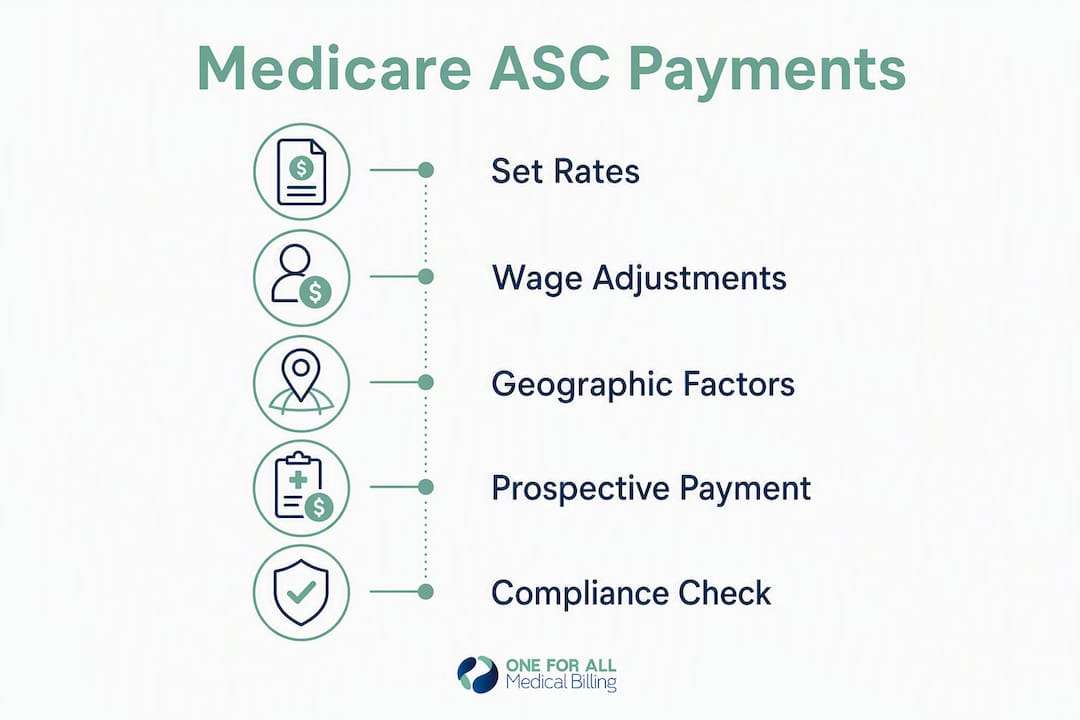
Understanding what is packaged versus what is separately payable is the single most operationally important distinction in ASC billing.
Packaged items (included in the procedure payment, not separately billable):
- Nursing services and recovery room time
- Routine drugs, biologicals, and medical/surgical supplies used during the procedure
- Most implantable items that are not on the pass-through list
- Anesthesia supplies (not the professional anesthesia service itself)
- Durable medical equipment provided at discharge
Separately payable items (billed as distinct line items):
- Pass-through devices (e.g., C1607, C1608 per the January 2026 update)
- Certain drugs and biologicals not packaged under OPPS rules
- Corneal tissue acquisition costs
- Brachytherapy sources
- Certain ancillary services with their own payment indicators in Addenda AA/BB
Wage index adjustments affect the labor portion of each ASC payment rate, so facilities in high-wage geographic areas receive a higher adjusted rate. For most non-pass-through drugs in 2026, CMS applies the ASP+6% rule. Device offset calculations reduce the ASC payment when a device with a pass-through HCPCS code is billed, because CMS assumes the device cost is partially embedded in the procedure rate. Knowing these mechanics helps you estimate expected reimbursement accurately and flag underpayments before they age in your A/R.
Which claim form, place-of-service code, and fields do ASC billers use?
Getting the claim form and field selection right is not a formality. It determines whether your claim routes to the correct payer system and whether the ASC facility payment is triggered at all.
Form selection:
- Freestanding ASCs submit facility claims on the CMS-1500 (or its electronic 837P equivalent), not the UB-04
- Hospital-based ASCs may use the UB-04 (837I), depending on how the facility is licensed and enrolled with Medicare
- Novitas Solutions confirms that ASC providers must accept assignment and report the ASC facility NPI in item 33a on the paper CMS-1500
Critical claim fields to verify before submission:
- Item 21 (Diagnosis codes): Map ICD-10-CM codes to the correct procedure lines; mismatched diagnosis-to-procedure mapping is a frequent front-end rejection trigger.
- Item 24B (Place of Service): Enter POS 24 for all ASC facility claims; an incorrect POS (e.g., POS 11 or 22) will route the claim incorrectly and generate a denial.
- Item 24D (CPT/HCPCS and modifiers): List the primary procedure first, followed by additional procedures in descending payment order; attach modifiers in the correct sequence.
- Item 24G (Units): Report units accurately; overstating units on a single-session procedure is a common audit trigger.
- Item 33a (Billing provider NPI): The ASC facility NPI goes here, not the operating surgeon’s NPI.
- Item 24J (Rendering provider NPI): Leave this field for the physician’s NPI on professional claims; the facility claim uses item 33a.
Timely filing checklist:
- Medicare: claims must be filed within one calendar year of the date of service
- Commercial payers: filing windows vary widely (90 days to 18 months); confirm each payer’s window in the contract or provider manual
- Document the date of original submission for every claim; this timestamp is your evidence in a timely-filing appeal
- Set calendar alerts 30 days before each payer’s timely-filing deadline for any claim still in A/R
Pro Tip: Specialty societies like AAOMS recommend explicitly separating professional and facility charges in your billing workflow. The AAOMS ASC coding paper provides procedure-specific examples that illustrate exactly where the facility fee ends and the physician’s professional claim begins — a useful model for any specialty.
What CPT, HCPCS codes, and ASC modifiers do you need to get right?
ASC facility claims report CPT and HCPCS codes for the services the facility provides, not the physician’s professional work. The CMS code-pair files specify which device HCPCS codes must be billed alongside specific CPT procedure codes; billing a pass-through device without its required CPT pairing will generate a denial.
Key ASC modifiers and when to use them:
- FB: Item provided without cost or full credit received (used with pass-through device codes when the device was provided at no charge)
- FC: Partial credit received for replaced device (use when the manufacturer provides partial credit)
- LT / RT: Left side / right side (required for laterality-specific procedures)
- PA / PB / PC: Wrong surgery modifiers (PA = wrong body part, PB = wrong patient, PC = wrong procedure); use only for the specific wrong-surgery scenarios CMS defines
- 52: Reduced services (procedure partially performed; use when the surgeon stops before completing the full procedure)
- 73: Discontinued outpatient procedure prior to anesthesia administration
- 74: Discontinued outpatient procedure after anesthesia administration
Modifier 26 (professional component) is a physician-only modifier and has no place on an ASC facility claim. Billing modifier 26 on a facility claim is a common error that generates denials and can flag a claim for audit.
Bilateral procedures: When the same procedure is performed bilaterally in the same operative session, Medicare pays 150% of the single-procedure rate. Report the procedure twice, appending modifier 50 to the second line, or follow your MAC’s specific bilateral reporting instructions, which may differ. Novitas Solutions publishes modifier-specific guidance for its jurisdiction that takes precedence over general CMS instructions for claims in that region.

Multiple procedures, same session: Medicare pays 100% of the highest-valued procedure and 50% of each additional procedure. List procedures in descending payment order on the claim. Do not apply modifier 51 on the ASC facility claim; that modifier applies to physician claims.
Pass-through device pairing example: If you are billing a procedure with a C1607 or C1608 device (updated in the January 2026 MM14359 release), the device HCPCS code must appear on its own claim line paired with the CPT procedure code it supports. Include the device acquisition cost in the charge field and attach the device invoice to the record for potential audit.
Pro Tip: Always pull the current CMS ASC code-pair file before billing any new device code. CMS updates these pairings with each addenda cycle, and a device code that was valid last quarter may require a new CPT pairing this quarter.
What documentation does an ASC claim need to survive a MAC audit?
Documentation is the foundation that either supports or collapses an ASC claim under medical review. MACs make the final determination on whether a service is reasonable and necessary, and they base that determination entirely on what is in the medical record.
Minimum documentation for every ASC facility claim:
- Operative report (must describe the procedure performed, the findings, and the medical indication)
- Anesthesia record (type, dosage, and monitoring notes)
- Signed patient consent form
- Pre-operative assessment and H&P
- Nursing notes and medication administration records (especially when billing separately payable drugs)
- Pathology or anatomic pathology report when tissue is sent for analysis
- Device invoice for any pass-through implant or device billed with a HCPCS pass-through code
- Prior authorization documentation when required by the payer
Medical necessity language that satisfies Medicare reviewers:
The operative report should connect the diagnosis to the procedure explicitly. Phrases like “patient presents with [ICD-10-coded condition] refractory to conservative management, requiring [procedure name] to [clinical outcome]” give reviewers the clinical rationale they need without ambiguity. Vague operative notes that describe only the technique without the indication are the single most common documentation gap in MAC medical review.
Audit preparation:
- Organize records by date of service in a consistent folder structure (paper or EHR)
- Flag claims with pass-through devices, bilateral procedures, or multiple procedures as higher audit-risk and pull documentation proactively
- Common audit triggers include unbundling packaged items as separate charges, incorrect POS, and missing device acquisition cost documentation
- Retain ASC records for a minimum of seven years; some state laws and payer contracts require longer retention periods
- Maintain a documentation index that maps each claim line to its supporting record so your team can respond to an ADR (Additional Documentation Request) within the MAC’s response window
How do you build ASC claims for the most common billing scenarios?
Abstract rules become clear when you walk through actual claim construction. These three scenarios cover the situations ASC billing teams encounter most often.
Scenario 1: Single ASC procedure with a pass-through device
- Confirm the CPT procedure code is on the ASC CPL and has a separately payable payment indicator in Addenda AA.
- Add the device HCPCS code (e.g., C1607) as a separate claim line, paired with the CPT code per the CMS code-pair file.
- Enter the device acquisition cost in the charge field for the device line.
- Attach the device invoice to the claim record.
- Apply modifier FB or FC if the device was provided at no cost or partial credit.
- Submit the claim with POS 24 and the ASC facility NPI in item 33a.
Scenario 2: Multiple procedures in the same operative session
- List all CPT codes in descending order by ASC payment rate (highest first).
- Medicare pays 100% of the highest-rate procedure and 50% of each subsequent procedure; verify this payment reduction is reflected in your expected reimbursement calculation.
- Do not append modifier 51; it is not used on ASC facility claims.
- Confirm each additional procedure has its own supporting operative note entry, not just a passing reference.
- Check the CMS code-pair file for any bundling edits that would prevent separate payment for two of the procedures.
Scenario 3: Billing anesthesia and pathology in the ASC setting
Anesthesia in the ASC is typically a professional service billed separately by the anesthesiologist or CRNA under Part B, using the anesthesia CPT codes and the anesthesia time units formula. The ASC facility claim does not include the professional anesthesia charge; it may include anesthesia supplies as a packaged item. Pathology services follow a similar split: the technical component (specimen processing) may be billable by the ASC if performed on-site, while the professional interpretation is billed by the pathologist. Confirm with your MAC whether the technical component of pathology is separately payable in your jurisdiction or packaged into the ASC facility rate.
Pro Tip: For each of these scenarios, run the claim through your clearinghouse’s claim-scrubbing tool before submission. A clean-claim scrub catches modifier conflicts, code-pair mismatches, and POS errors before they reach the payer, which is far less costly than working a denial.
How should your team triage and appeal ASC claim denials?
Denials in ASC billing cluster around a predictable set of root causes. A structured triage workflow gets claims back on track faster than ad hoc corrections.
Most common ASC denial reasons:
- Invalid or incorrect POS (POS other than 24 on an ASC facility claim)
- Unbundled packaged items billed as separate line items
- Procedure not on the ASC CPL or not covered for the billed diagnosis
- Incorrect or missing modifier (especially bilateral and multiple-procedure modifiers)
- Missing device invoice for a pass-through item
- Timely-filing deadline missed
- Claim split errors when multiple procedures are billed across two claims instead of one
Denial triage checklist:
- Identify the denial category: coding error, coverage issue, timely-filing, or documentation gap
- Assign the denial to the correct owner: coder (coding errors), clinical lead (documentation gaps), billing manager (timely-filing or form errors), denials specialist (appeals)
- Pull the original claim, the remittance advice, and the supporting documentation before touching the claim
Appeal workflow:
- Intake (Day 1): Log the denial in your denial tracking system with the denial code, date received, and payer.
- Root-cause review (Days 1–3): Coder and clinical lead review the claim and documentation together; identify the specific error or gap.
- Documentation pull (Days 3–5): Assemble the operative report, device invoice, authorization, and any other records needed to support the appeal.
- Appeal submission (Days 5–7): File the MAC redetermination request with a cover letter that states the specific denial reason, the corrected information, and the supporting documentation. MAC redetermination requests must be filed within 120 days of the initial denial date.
- Follow-up (Day 30): If no response, contact the MAC or payer to confirm receipt and check status. Escalate to a Qualified Independent Contractor (QIC) reconsideration if the redetermination is unfavorable.
For commercial payers, appeal windows vary; many require appeals within 60–180 days of the denial date. Document every appeal submission date and the payer’s acknowledgment.

How do commercial payer contracts change ASC billing in practice?
Medicare rules give you a consistent baseline, but commercial contracts introduce significant variability. A procedure that Medicare pays as a separately billable ASC service may be bundled into a flat facility fee under a commercial contract, or it may require prior authorization that Medicare does not.
Key differences to track in every commercial contract:
- Facility fee definition: Some payers define the facility fee broadly (bundling implants and drugs), while others allow separate billing for the same items Medicare treats as pass-through
- Prior authorization: Many commercial payers require authorization for ASC procedures that Medicare does not; missing an auth generates a denial that is difficult to appeal retroactively
- Covered procedure list: Commercial payers maintain their own lists, which may be narrower or broader than the Medicare ASC CPL
- Modifier acceptance: Not all commercial payers accept the full set of ASC modifiers; confirm which modifiers your contract recognizes
- Timely filing windows: These vary from 90 days to 18 months; confirm each payer’s window and document it in your payer manual
Payer-specific billing manual checklist:
- Contract definition of the facility fee and what it includes
- Prior authorization requirements by procedure category
- Separate payment rules for implants, pass-through devices, and high-cost drugs
- Accepted modifiers and units reporting rules
- Timely filing deadline and appeal window
- Contact information for provider relations and claims disputes
Medicare Advantage (MA) plans deserve special attention. MA plans are required to cover the same services as traditional Medicare, but they may use their own prior authorization processes, network agreements, and reimbursement rates. Always check the MA plan’s contract language separately from your traditional Medicare billing rules; do not assume an MA plan follows the same modifier or authorization rules as fee-for-service Medicare. The AAOMS coding paper notes that contract negotiations should explicitly separate which services are included in the facility fee and which are billed separately, because commercial contracts are highly variable.
What internal controls and roles does a high-performing ASC billing team need?
Correct coding is necessary but not sufficient. The teams that consistently hit clean-claim targets do so because they have defined roles, documented processes, and a monthly routine that keeps them current with CMS and MAC changes. Think of it as the operational infrastructure that makes good coding stick.
Role matrix for ASC billing governance:
- Coder: Owns CPT/HCPCS code updates, modifier rules, and code-pair file review after each CMS addenda release
- Billing manager: Owns contract reconciliation, payer manual updates, and timely-filing monitoring
- Clinical manager: Owns documentation completeness, operative report quality, and audit preparation
- Denials specialist: Owns denial triage, appeal submission, and escalation tracking
Monthly ASC billing routine:
- Review the latest CMS addenda (AA/BB) and any MAC transmittals released since the prior month.
- Update the payer-specific billing manual for any code, modifier, or payment indicator changes.
- Pull a sample of 10 recent claims and review for documentation completeness, correct POS, and proper modifier use.
- Reconcile device invoices to billed pass-through items; flag any discrepancies for correction before the next billing cycle.
- Run a denial rate report by denial category; assign remediation tasks with a deadline.
Operational controls that reduce cycle-to-cycle variation:
- Maintain a version-controlled payer rules binder (digital) that lists allowed modifiers, pass-through devices, prior authorization requirements, and timely-filing windows for each payer
- Keep a documented change log for every CPT/HCPCS or ASC payment indicator update, with the effective date and the staff member who made the change
- Store the current ASC CPL snapshot, MAC local coverage determinations (LCDs), and your internal billing SOP in a single shared folder with access controls
Pro Tip: Embed the monthly billing routine into onboarding for new billing staff. Institutional knowledge that lives in one person’s head disappears when that person leaves. A written, versioned playbook is the only way to preserve it across staff turnover.
For broader revenue cycle management strategies that complement ASC-specific controls, the same governance principles apply across specialties.
Where do you find authoritative ASC billing resources and how do you monitor updates?
The most common reason ASC billing teams get blindsided by a code change or a new device pairing requirement is that they rely on memory or outdated printouts instead of a live monitoring routine. Setting up a simple subscription system takes less than an hour and pays for itself the first time it catches a January 1 code change before your first claim of the year goes out.
Primary resources to bookmark and monitor:
- CMS ASC Payment page: the authoritative source for Addenda AA/BB, the ASC CPL, and payment rate files
- Medicare Claims Processing Manual, Chapter 14: sections covering packaging rules, payment calculations, and the CPL
- MM14359 January 2026 ASC update: the current transmittal with 80 new payable codes and device pass-through changes
- Novitas Solutions ASC billing tips: field-level claim examples and modifier guidance for Novitas jurisdiction providers
- UTHealth ASC coding and billing overview: an educational resource covering coding and billing basics for ASC settings
Monitoring routine:
- Subscribe to CMS MLN Matters email alerts (free; sign up at the CMS MLN Matters page)
- Subscribe to your MAC’s email notification list for transmittals and billing tips
- Set calendar reminders for the four quarterly addenda release cycles (typically January, April, July, and October)
- After any major code or payment indicator update, run a test claim through your clearinghouse or call the payer’s provider helpdesk to confirm the new code processes correctly before mass-billing
Suggested folder structure for your ASC billing team:
- /Current Addenda: Addenda AA and BB, current quarter
- /MAC Transmittals: sorted by effective date
- /Payer Manuals: one subfolder per payer, versioned by date
- /ASC CPL Snapshot: updated each January and after mid-year addenda
- /Device Invoices: organized by date of service and device HCPCS code
- /SOP: current ASC billing standard operating procedure, version-controlled
Key Takeaways
Accurate ambulatory surgery center billing requires correct claim form selection, POS 24, ASC-specific modifiers, and a monthly routine to track CMS addenda and MAC updates.
| Point | Details |
|---|---|
| Medicare payment mechanics | Medicare pays 80% of the lesser of actual charges or the ASC rate; beneficiary owes 20% coinsurance after the deductible. |
| January 2026 update | MM14359 added 80 newly payable procedure and ancillary codes; review Addenda AA/BB and update payer manuals before billing new codes. |
| Packaging rule | Nursing, routine supplies, and most implants are packaged into the procedure payment; billing them separately is a leading denial trigger. |
| Modifier accuracy | Use POS 24, ASC facility NPI in item 33a, and ASC-approved modifiers (FB, FC, LT/RT, 52, 73, 74); never apply modifier 26 on a facility claim. |
| One For All Medical Billing | Provides specialty-focused ASC billing with a 90% clean-claim target, CMS/MAC monitoring, denial management, and device invoice reconciliation. |
Why governance matters as much as coding in ASC billing
The conventional wisdom in ASC billing is that getting the codes right is the hard part. After working through the mechanics of claim construction, modifier rules, and pass-through device pairing, it is tempting to conclude that a well-trained coder solves most problems. That conclusion misses half the picture.
Coding errors are visible and correctable. Governance failures are invisible until they compound. A billing team that has no version-controlled payer rules binder will re-learn the same commercial payer’s modifier rules every time a claim is denied, because no one wrote it down the first time. A team without a defined monthly CMS review routine will discover a January 1 code change in February, after a batch of claims has already been rejected. These are not coding failures; they are process failures.
The teams that consistently achieve clean-claim rates above 90% share a common trait: they treat their billing playbook as a living document, not a training artifact. They assign ownership of each update cycle to a named person, not a department. They run sample audits before problems surface, not after. Centralizing payer rules, maintaining a change log for every code update, and embedding the monthly review routine into staff onboarding are the three practices that cut denial rates and shorten appeal cycles faster than any single coding correction.
The goal is a billing operation where a new staff member can pick up the playbook on day one and submit a compliant ASC claim without relying on institutional memory that may have walked out the door with the previous biller.
ASC billing support that goes beyond the claim form
ASC billing is one of the more technically demanding specialties in revenue cycle management. The combination of Medicare packaging rules, quarterly CMS addenda, pass-through device pairing requirements, and commercial payer variability creates a chain of operational decisions where a single misstep can cascade into a denial batch. One For All Medical Billing is built specifically for this kind of complexity.
With over 20 years of experience and a 90% clean-claim target, One For All Medical Billing handles the full ASC billing cycle: CPT/HCPCS and modifier accuracy, CMS and MAC update monitoring, pass-through device invoice reconciliation, denial triage, and appeals. The onboarding process starts with a rapid billing readiness assessment that identifies your top denial drivers and produces a prioritized remediation plan, so your team knows exactly where to focus first.
For ASC administrators managing orthopedic, bariatric, or multi-specialty caseloads, specialty-specific coding expertise matters. One For All Medical Billing’s team applies specialty-focused billing practices that reflect the actual procedure mix your center runs, not a generic template.
Request your ASC billing readiness assessment to get a clear picture of where your claims stand and what it takes to get to a cleaner, faster revenue cycle.
Useful sources
These are the primary references ASC billing teams should keep accessible and monitor after each CMS update cycle.
- CMS Ambulatory Surgical Center (ASC) Payment page: the authoritative hub for Addenda AA/BB, the ASC CPL, payment rate files, and historical addenda. Bookmark this page and check it at each quarterly update.
- MM14359: Ambulatory Surgical Center Payment — January 2026 Update: the current CMS transmittal covering 80 new separately payable codes, device pass-through assignments (including C1607/C1608), code-pair file updates, and device offset changes effective January 1, 2026.
- Medicare Claims Processing Manual, Chapter 14 (Ambulatory Surgical Centers): the definitive reference for packaging rules, payment calculations, the CPL, and claim submission requirements. Sections covering packaging and separately payable items are particularly relevant for denial prevention.
- Novitas Solutions ASC billing tips: field-level claim guidance for Novitas jurisdiction providers, including POS 24 requirements, NPI placement in item 33a, accepted modifiers, and assignment rules. Check your own MAC’s equivalent page if Novitas is not your contractor.
- AAOMS ASC Coding and Billing paper: specialty-specific examples distinguishing professional from facility charges, accreditation and licensing notes for charging facility fees, and guidance on separating facility fee definitions in commercial contract negotiations.
- UTHealth ASC Series Part 2: Coding and Billing Basics: an educational overview of ASC coding and billing fundamentals, useful for onboarding new billing staff or cross-training coders from inpatient settings.
Internal resources to maintain locally:
- Current ASC CPL snapshot (update each January and after mid-year addenda)
- Payer-specific rule sheet for each commercial and MA payer (one page per payer, versioned)
- Device invoice folder organized by date of service and HCPCS code
- Request support from One For All Medical Billing if your team needs help building or auditing these resources.
FAQ
How do you bill for an ambulatory surgery center?
ASCs file facility claims on the CMS-1500 (freestanding) or UB-04 (hospital-based), using POS 24 and the ASC facility NPI in item 33a. Medicare pays 80% of the lesser of actual charges or the ASC payment rate, with packaged items bundled into the procedure charge rather than billed separately.
Do ambulatory surgery centers bill on a UB-04 or CMS-1500?
Freestanding ASCs generally use the CMS-1500 (or its 837P EDI equivalent) for facility claims; hospital-based ASCs typically use the UB-04 (837I). The correct form depends on how the ASC is licensed and enrolled with Medicare, so confirm with your MAC if you are unsure.
Do ASCs charge a facility fee?
Yes. The ASC facility fee covers the overhead of the surgical encounter, including nursing, routine supplies, and equipment. It is separate from the physician’s professional fee, which the surgeon or anesthesiologist bills independently under Part B.
What does ambulatory billing mean in an ASC context?
Ambulatory billing refers to claim submission for outpatient surgical services where the patient is admitted and discharged on the same day. Unlike inpatient DRG billing, ASC claims use procedure-specific CPT/HCPCS codes for a single encounter, with payment rates set prospectively by CMS based on OPPS-derived percentages.
Which ASC modifiers does Medicare accept on facility claims?
Novitas Solutions confirms that accepted ASC modifiers include FB, FC, LT, RT, PA, PB, PC, 52, 73, and 74. Modifier 26 (professional component) is not valid on ASC facility claims and will generate a denial if appended.
Recommended
- Orthopedic Billing in 2026: Your Complete Practice Guide – One For All Medical Billing
- Medical Billing For Pain Management: A Complete Playbook – One For All Medical Billing
- Your Guide To Bariatric Surgery CPT Codes In 2026 – One For All Medical Billing
- Primary Care Billing in 2026: Your Complete Coding Guide – One For All Medical Billing

