

table of contents
TL;DR:
- Orthopedic billing demands precise coding, thorough documentation, and strict adherence to payer policies to ensure optimal reimbursement.
- Specialized billing services improve claim accuracy, reduce denials, and support faster cash flow by maintaining high clean claim rates.
Orthopedic billing is the process of accurately coding, submitting, and managing claims specific to musculoskeletal procedures to protect your practice’s revenue cycle. It sits at the intersection of high-dollar procedures, intense payer scrutiny, and some of the most complex coding rules in outpatient specialty medicine. Get it right, and your cash flow reflects the care you deliver. Get it wrong, and denials compound faster than in almost any other specialty.
What makes this specialty demanding is the sheer number of moving parts:
- Documentation must capture laterality, fracture status, service type, and approach before a coder touches the chart
- CPT, ICD-10, and HCPCS codes must align precisely with operative reports and payer medical policies
- Modifiers govern bilateral procedures, global periods, assistant surgeons, and distinct services
- Prior authorizations must match billed CPT codes and site of service exactly
- Payer policies for total joints, spine, and fracture care are revised frequently and enforced aggressively
Industry data indicates that a significant proportion of providers report denial rates at or above ten percent. Many expert orthopedic billing services report clean claim rates near 90% or more, which directly supports faster reimbursements and more predictable cash flow.
Common mistakes in orthopedic medical billing and how to avoid them
Most orthopedic billing problems start in the operative report, not the billing system. The clinical care can be flawless, but if the documentation does not reflect what payers require, denials follow.
The most frequent errors billing teams encounter include:
- Missing laterality: Failing to document left vs. right in the operative note causes claim denials at the coding stage, since payers require specific anatomical location on nearly every musculoskeletal claim
- Incorrect modifier use: Overusing Modifier 59 without clear service separation, or misapplying bilateral modifier 50 vs. LT/RT, triggers bundling denials
- Improper fracture coding: Selecting the wrong encounter type suffix (initial, subsequent, sequela) or treatment method code creates both compliance risk and underpayment
- Billing inside the global period without a modifier: Submitting E/M charges during a 90-day post-operative window without modifier 58, 78, or 79 results in automatic denial
- Missing implant charges: Failing to route implant costs and facility fees correctly for hospital or ASC billing leaves revenue uncaptured on complex joint cases
Prevention starts upstream. A pre-bill quality checklist for all major orthopedic cases, where coders verify laterality, service type, fracture status, and approach before final coding, catches most of these errors before submission. When a coder must query the surgeon for missing information, log it, trend the root causes, and update templates accordingly.
Pro Tip: Build a coder-clinician feedback loop. Every documentation query should be tracked and reviewed monthly. Patterns in missing information reveal which operative note templates need updating, and fixing templates is faster than working denials.

Essential CPT, ICD-10, and HCPCS codes and modifiers for orthopedic billing
The 2026 CPT update includes 418 total changes, with 288 new codes, 84 deletions, and 46 revisions effective January 1, 2026. Several hit orthopedics directly.
Key new and revised CPT codes for 2026:
- 27458 (NEW): Femoral osteotomy with externally controlled intramedullary lengthening device; all-inclusive, cannot be billed with 27450, 27466, 27470, 27472, or 27506
- 27713 (NEW): Tibial osteotomy with externally controlled intramedullary lengthening device; covers imaging, alignment assessments, and device management
- 27278/27279 (REVISED): Sacroiliac joint arthrodesis; 27278 for intra-articular devices without cortical piercing, 27279 for transarticular with cortical piercing; hybrid procedures default to 27279
- 63032 (NEW ADD-ON): Annular defect repair with bone-anchored closure device, lumbar spine; add-on to 63030, reported once per session
- 1003T (NEW CAT III): First carpometacarpal joint arthroplasty for hand/wrist practices
- 27445 (DELETED): Hinge prosthesis knee arthroplasty; any use after january 1 generates automatic denials
Critical modifiers in orthopedic insurance coding:
- Modifier 50: Bilateral procedures when payers require it instead of LT and RT with multiple units
- LT and RT: Laterality modifiers for unilateral procedures
- Modifier 59 / X modifiers: Distinct procedures when fractures or services involve separate, non-overlapping anatomy
- Modifiers 58, 78, 79: Global period modifiers for staged procedures, returns to the OR, or unrelated surgeries during the post-op period
- Modifiers 80, 81, 82: Assistant surgeon modifiers, applied in alignment with each payer’s assistant surgery policy
ICD-10 and HCPCS essentials:
- ICD-10 fracture codes require a 7th character specifying encounter type: A (initial), D (subsequent), or S (sequela); selecting the wrong character is a top denial driver
- HCPCS L-codes cover orthotic devices and braces; Q-codes and L-codes apply to DME and implants billed through the facility or ASC
Maintain a specialty-specific modifier matrix listing common orthopedic procedures, typical scenarios, and correct modifier combinations by payer. Update it quarterly.
Managing prior authorizations and payer requirements in orthopedic billing
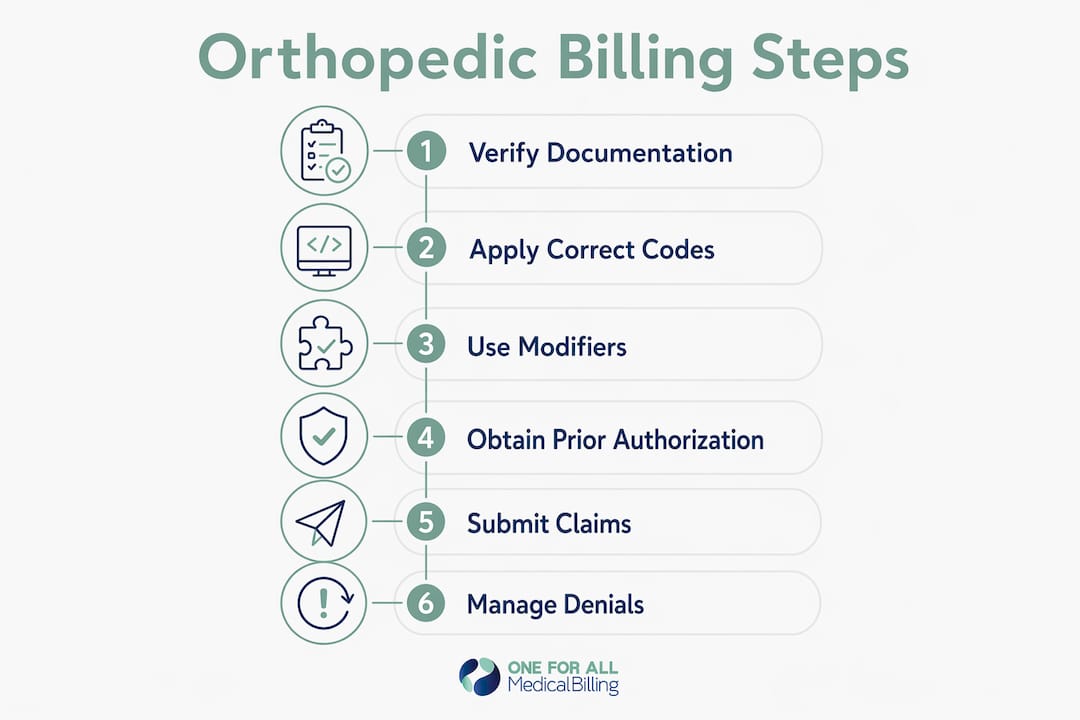
Prior authorization is the single greatest source of preventable revenue loss in orthopedic surgery practices. Total joints, spine cases, and many fracture-related procedures require pre-service review, implant coverage checks, and site-of-service verification. When this work is siloed from scheduling and clinical teams, avoidable write-offs accumulate.
CMS finalized its Prior Authorization Reform Rule in September 2025, cutting payer decision windows from 14 days to 7 calendar days and mandating electronic prior authorization for all Medicare Advantage and commercial payers. Practices still running manual fax-based processes will feel this immediately.
Key steps for managing authorizations effectively:
- Assign dedicated authorization staff with orthopedic training, not generalist staff juggling all specialties
- Use standardized order sets that include planned CPT codes and diagnoses to reduce pended submissions
- Run real-time eligibility checks, including implant coverage, out-of-network situations, and site-of-service restrictions, before surgery is scheduled
- Verify that approved CPT codes match billed services, required modifiers are included in the authorization, and authorization validity dates align with the procedure date
- Build automated expiration alerts so no authorization window closes without staff action
Site-of-service mismatches between authorization, procedure location, and documentation are a top denial cause in orthopedic billing. Authorization obtained for one setting, care delivered in another, is a preventable revenue leak that requires a pre-service verification checkpoint before every case.
Practices that maintain prior authorization approval rates at 90% or above can qualify for gold-card status with certain payers, reducing administrative burden on high-volume approved procedures.
Ensuring compliance and optimizing the revenue cycle in orthopedic practices
Clean claims require more than accurate coding. They require a revenue cycle built around the realities of orthopedic surgery, where documentation, authorization, modifier rules, and global period management all interact. Top-performing practices maintain first-pass clean claim rates near 90% and days in accounts receivable between 32 and 40 days.
Operational steps that protect those benchmarks:
- Conduct targeted coding and documentation audits on high-risk areas: revision joints, bilateral procedures, and complex fractures
- Review NCCI procedure-to-procedure edits for orthopedic code pairs regularly and educate coding staff on which combinations require modifiers and which are not separately payable
- Embed billing software edits that flag claims where a joint or fracture code is billed in the global period without an appropriate modifier
- Run post-payment audits on a sample of high-dollar claims to confirm allowed amounts align with expected payment for bilateral and multiple procedures
- Track denial rates by payer, provider, and procedure group; categorize each denial by root cause within one business day of receipt
EHR interoperability matters here. When your billing software and EHR share data in real time, coders see the complete operative report before claim submission, and authorization data flows directly into the billing workflow. RCM automation tools that handle real-time eligibility checks, claim scrubbing, and denial routing reduce manual rework and keep staff focused on exceptions that require human judgment.
For denial management, every denied claim is a recoverable asset with a finite window. Coding denials are almost always correctable through resubmission, but most payers set a corrected claim filing window at 90 days from the original remittance date. A denial that sits unworked for 60 days or more frequently ages past that window and becomes a permanent write-off. Build a workflow that assigns a follow-up date to every denial at the moment it is received.
Leveraging expert orthopedic billing services to maximize revenue and reduce stress
Orthopedic billing is not a problem that resolves itself with good intentions and general billing knowledge. It requires specialty-specific expertise that updates every time CPT codes change and every time a payer revises its coverage criteria. That is a significant operational demand for any practice managing high surgical volumes.
Expert orthopedic billing services deliver:
- Specialty-focused staff who know common payer policies for hips, knees, shoulders, spine, and fracture repairs
- Updated coding knowledge applied immediately when new CPT codes take effect, so your team is never billing with last year’s code set
- Customized workflows for prior authorization, implant billing, and global period management tailored to your payer mix
- Clean claim rates near 90% or higher, which directly supports faster reimbursements and more predictable cash flow
- Denial management processes that work every claim systematically before recovery windows close
One For All Medical Billing brings over 20 years of specialty-focused revenue cycle experience to orthopedic practices across Oklahoma and nationwide. The team maintains a 90% clean claim rate and handles the full billing lifecycle, from charge capture and coding through denial management and A/R follow-up, so your clinical staff can stay focused on patient care.
Pro Tip: When evaluating a billing partner, ask specifically about their orthopedic denial rate by procedure category and their process for updating coding workflows after annual CPT changes. A partner who cannot answer both questions in detail is not yet specialized enough for orthopedic surgery.
Ready to reduce denials and protect your orthopedic revenue? Get started with One For All Medical Billing today.
Key Takeaways
Orthopedic billing requires specialty-specific coding accuracy, disciplined authorization workflows, and continuous denial management to sustain clean claim rates and protect surgical revenue.
| Point | Details |
|---|---|
| Documentation drives everything | Laterality, fracture status, and approach must appear in the operative note before coding begins. |
| 2026 CPT changes are material | 418 total updates include new osteotomy codes and the deletion of 27445; outdated systems generate automatic denials. |
| Authorization windows shortened | CMS cut payer decision windows to 7 calendar days and mandated electronic prior authorization for Medicare Advantage. |
| Site-of-service mismatches cost money | Authorization obtained for one setting but care delivered in another is a leading, preventable denial cause. |
| Top performers hit clear benchmarks | First-pass clean claim rates near 90% and days in A/R between 32 and 40 days are achievable with the right workflows. |
FAQ
What makes orthopedic billing more complex than general medical billing?
Orthopedic billing involves high-dollar procedures, hundreds of CPT codes across multiple anatomical regions, strict modifier requirements, 90-day global periods, and payer policies that are among the most scrutinized in commercial insurance. A single modifier error on a bilateral joint replacement can translate to a significant underpayment across an entire year of surgical volume.
Which modifiers are most commonly misused in orthopedic claims?
Modifier 59 is the most frequently misapplied, often submitted without clear service separation to override CCI bundling edits. Laterality modifiers LT and RT, bilateral modifier 50, and global period modifiers 58, 78, and 79 are also common sources of denial in orthopedic RCM.
How does the 2026 prior authorization rule change affect orthopedic practices?
CMS reduced payer decision windows from 14 days to 7 calendar days and mandated electronic prior authorization for Medicare Advantage and commercial payers, effective with the 2026 rule. Practices still using fax-based authorization processes face immediate workflow pressure and higher denial risk.
What is a site-of-service mismatch and why does it cause denials?
A site-of-service mismatch occurs when the authorization is obtained for one care setting, such as a hospital outpatient department, but the procedure is performed in an ambulatory surgery center. Payers flag this discrepancy and deny or reduce payment, making pre-service verification of setting alignment a required step before every orthopedic case.
When should an orthopedic practice consider outsourcing its billing?
Outsourcing makes sense when denial rates are rising, days in A/R are climbing past 40, or the internal team lacks the bandwidth to stay current with annual CPT updates and payer policy changes. A specialty-focused billing partner with proven orthopedic expertise handles coding, authorization, and denial management as a core competency, not a secondary task.
Recommended
- Medical Billing For Pain Management: A Complete Playbook – One For All Medical Billing
- 97112 CPT Code: A Guide to Billing & Compliance in 2026 – One For All Medical Billing
- Healthcare Payment Solutions A Complete 2026 Guide – One For All Medical Billing
- Choose Top Medical Coding and Billing Companies – One For All Medical Billing

