

table of contents
The most effective denial management program combines prevention, meaning clean-claim controls at registration and coding, with a disciplined, value-based triage-to-appeal workflow. Immediate priorities include tightening eligibility and prior-authorization checks, closing documentation gaps before coding, automating claims scrubbing, and tracking KPIs weekly. Physician advisor involvement and well-documented appeals packages materially increase overturn rates, so those two levers deserve dedicated staff time, not leftover hours.
TL;DR:
- Automated eligibility and prior-authorization checks at every patient visit are essential to prevent the most common coverage-related denials, especially for high-volume services.
- Classifying denials as soft or hard impacts whether staff correct and resubmit claims or escalate them for appeals, with decoding Claim Adjustment and Remittance Advice codes guiding the appropriate action.
- Building a prioritized denial triage system that scores each case by dollar amount, overturn likelihood, and deadline allows quick routing of high-value, overturn-prone denials to specialists within 48 hours.
- Focusing on automating front-end edits for the top three most frequent denial reasons can deliver faster results than broad workflow overhauls, especially when targeting high-dollar codes.
- Continuous KPI tracking of denial rate, overturn success, and days-to-resolution helps identify root causes and measure the impact of targeted prevention and correction strategies.
Common causes of claim denials and how to spot them fast
Every denial traces back to one of a handful of root causes, and matching the cause to the right fix is the whole game. Eligibility and prior-authorization denials happen when coverage lapses or a required authorization was never obtained. Coding denials stem from incorrect codes, mismatched modifiers, or outdated code sets. Documentation and medical-necessity denials occur when the clinical record does not support the billed service. Bundling and modifier issues arise from NCCI edit conflicts, and submission or format rejects come from missing fields or clearinghouse errors.
- Eligibility and prior-authorization denials: coverage inactive, plan changed, or authorization missing at time of service
- Coding denials: incorrect CPT, HCPCS, or ICD-10 codes, or mismatched code combinations
- Documentation and medical-necessity denials: clinical notes fail to justify the billed service
- Bundling and modifier denials: NCCI edit conflicts or missing required modifiers
- Submission and format rejects: incomplete demographic data or clearinghouse formatting errors
Classifying each denial as soft (correctable and appealable) or hard (final, unless overturned on appeal) determines whether staff resubmit, correct, or escalate. Decoding the Claim Adjustment Reason Code and Remittance Advice Remark Code on every remit lets automated systems route denials to the right queue instead of a generalist inbox, which is where speed gets lost. Our top claim denial reasons and how to fix them guide walks through remediation paths for each category in more detail.
Front-end checks that stop denials before they happen
Prevention beats appeal every time, and most of the highest-yield fixes sit at registration and coding, well before a claim ever reaches a payer. Build an eligibility and benefits verification playbook that checks coverage at every visit, not just the first one, and templates prior-authorization requests by service line so staff are not rebuilding the same request from scratch. Our prior authorization process playbook covers tracking cadence and appeal windows in depth.
- Verify eligibility and benefits at every visit, including secondary payers and plan changes
- Standardize prior-authorization templates by CPT or service line and track approval status in a shared log
- Deploy concurrent clinical documentation templates so physicians close gaps in real time, not after discharge
- Automate claims scrubbing for demographics, missing modifiers, NCCI bundling conflicts, and payer-specific edits
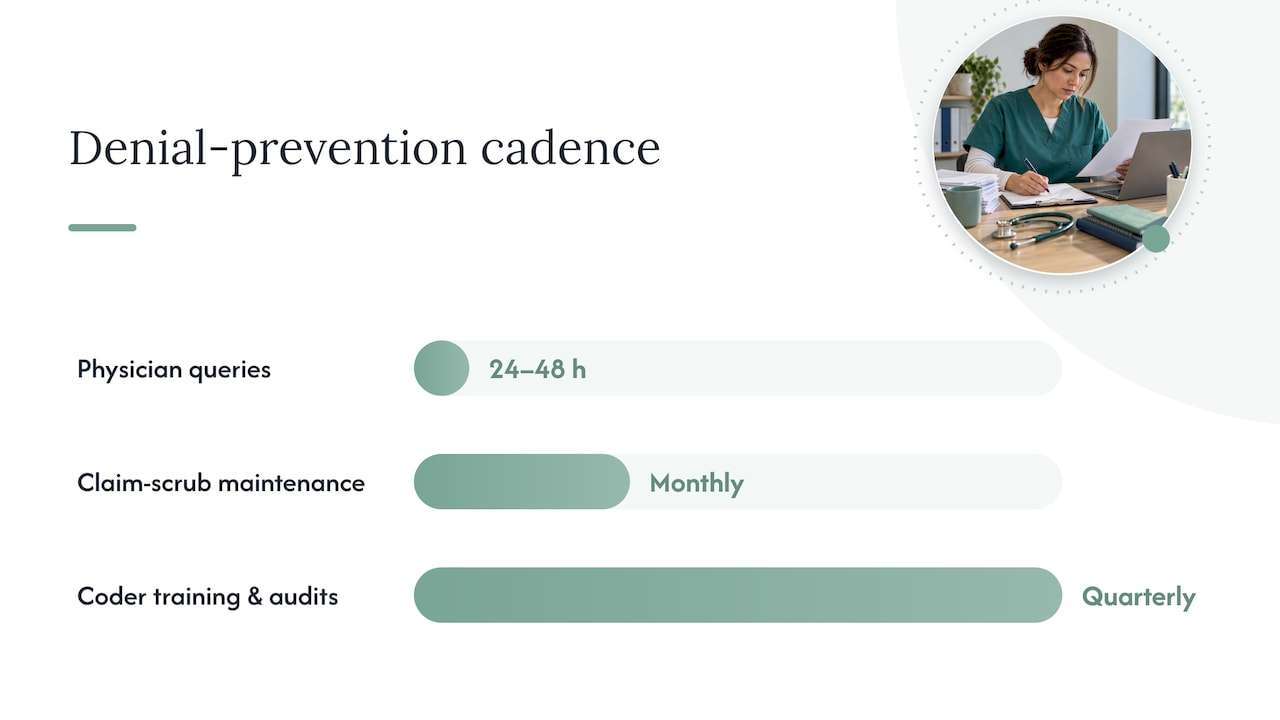
- Run coder training quarterly and audit the top five denial-prone codes monthly
Pro Tip: Fix the five codes causing the most denials this month before starting any larger prevention project. Small, targeted edits often deliver faster returns than a full workflow overhaul.
Physician query best practices matter here: a query sent within 24 to 48 hours of the encounter, while the clinical picture is fresh, closes documentation gaps that would otherwise surface as medical-necessity denials weeks later. Treat claim-scrubbing rule updates and payer-specific edit libraries as an ongoing maintenance task, reviewed monthly, while coder training and CDI template redesign are medium-term projects that earn a quarterly cycle. According to AHIMA’s best practices guidance, a proactive, analytics-driven prevention program built on CDI collaboration and targeted audits reduces denials and strengthens the appeals that do become necessary.
The denial lifecycle: intake, triage, and appeals that win
Denials should enter a single system automatically as remits post, with each CARC and RARC mapped to an internal cause tag so nothing lands in a manual review pile by default. From there, prioritization decides everything: a value-based triage rubric weighs dollar amount, likelihood of overturn, clinical urgency, and how close the appeal deadline sits.
- Ingest remits automatically and tag each denial with a root-cause category
- Score each denial on dollar value, overturn likelihood, clinical urgency, and deadline proximity
- Route high-value, high-likelihood denials to an appeals specialist within 48 hours
- Assemble the appeals package: original claim, clinical documentation, payer policy citation, and a physician advisor letter where clinical validation is disputed
- Choose the correct path, resubmission for a clerical fix, corrected claim for a coding error, or formal appeal and external review for a denied medical-necessity determination, and track the deadline for each
Under CMS appeals guidance, internal appeals and external review carry defined timeframes, with expedited review available for urgent cases and deemed-exhaustion provisions when a plan fails to respond on time. Missing those windows forfeits the appeal regardless of its merit, so deadline tracking belongs on the same dashboard as denial volume. Our provider guide to appealing a denied claim covers documentation checklists in more depth.
KPIs and dashboards that drive continuous improvement
You cannot fix what you do not measure, and denial management lives or dies on a small set of numbers reviewed on a fixed cadence. Track denial rate, clean-claim rate, overturn rate segmented by payer and denial type, days-to-resolution, and final write-off percentage as a share of gross charges.
- Denial rate: total denied claims divided by total claims submitted, segmented by payer and service line
- Clean-claim rate: percentage of claims accepted on first submission with no edits required
- Overturn rate: percentage of appealed denials reversed in the provider’s favor, tracked by payer and denial type
- Days-to-resolution: average time from denial receipt to final payment or write-off
- Write-off percentage: denied dollars ultimately written off as a share of gross charges
KPI-focused industry guidance places national average denial rates around 15% to 20%, with best-practice organizations targeting closer to 5%, though actual thresholds vary by specialty and payer mix. Segment every KPI by payer, clinician, and CPT or DRG code so trends point directly at a root cause, whether that is a specific payer’s new edit or a single clinician’s documentation habit, and feed that signal back into the front-end edits described earlier.
Where automation earns its keep in denial reduction
Not every technology investment pays off at the same speed, so sequence matters. Pre-submission claim scrubbing and eligibility or prior-authorization automation deliver the fastest return because they stop denials before they cost anyone appeal time. Denial-analytics platforms come next, surfacing which codes and which payers generate disproportionate denial volume so audits target the right claims instead of a random sample.
- Prioritize pre-submission scrubbing and eligibility/prior-auth automation for the quickest measurable impact
- Layer in denial-analytics dashboards to flag denial-prone codes and payer-specific outliers
- Connect EHR, RCM platform, clearinghouse, and payer systems so data moves without manual re-entry
- Reserve AI and robotic process automation for repetitive assembly tasks like gathering appeal attachments
- Keep clinical judgment human-led for complex appeals where a physician advisor’s rationale carries the argument
Automation handles volume well. It does not replace the clinical reasoning a payer expects to see in a disputed medical-necessity appeal.
Building the team that sustains lower denial rates
Denial reduction holds up over time only when the organization builds it into role design, not just software. A workable structure separates intake and triage from appeal writing, keeps CDI and coding in close contact, and gives someone ownership of managed-care contract terms so payer-specific quirks do not surprise the team every quarter.
- Intake and triage staff who tag and score denials daily
- Dedicated appeal specialists who own the documentation package end to end
- CDI staff working concurrently with physicians, not after the fact
- A managed-care or contracts liaison who tracks payer policy changes
- A physician advisor who supplies clinical rationale for complex, high-dollar appeals
Pro Tip: Separate the person who approves a write-off from the person who worked the denial. That single control catches errors and prevents avoidable revenue loss before it becomes a pattern.
Physician advisors add outsized value on clinical validation denials, where a peer-to-peer conversation or a well-written rationale letter often changes a payer’s determination. Pair that role with a quarterly training cadence and a rotating audit cycle focused on the highest-dollar denial categories.
How One For All Medical Billing puts these strategies to work
Denial management can be integrated into full-service revenue cycle management, utilizing specialty-specific billing practices for family practice, urgent care, OB/GYN, mental health, surgery, and hospital-based groups.
- Claims submission, coding, and appeals support can be tailored to address specific denial patterns of different medical specialties
- Conducting an initial audit to identify high-volume and high-dollar denial categories
- Implementing targeted front-end edits based on audit findings followed by ongoing KPI reporting to monitor progress
- Offering credentialing assistance and compliance consulting alongside billing to address payer enrollment issues that might cause denials
Engagements typically start with the audit, move into targeted prevention edits, and settle into ongoing denial management with regular KPI reporting so practices see the trend line, not just a monthly total.
Three priorities for next quarter
Automate eligibility and prior-authorization checks for your top ten denial-prone services first. Build a dollar-weighted triage queue and give one appeals specialist dedicated physician advisor time. Then convert your three most frequent denial reasons into automated front-end edits before adding anything else.
— One For All Medical Billing
Let One For All Medical Billing handle your denial management
Fixing denials in-house takes staff time your billing team may not have, especially when eligibility checks, coding audits, and appeals writing all compete for the same hours. One For All Medical Billing offers revenue cycle management services that fold denial prevention, specialty-specific coding, appeals support, and KPI reporting into one contract, so your practice gets a dedicated team instead of a part-time fix.
Practices that want a clearer picture of where their denials originate can request a revenue integrity assessment to see which front-end edits would cut the most avoidable denials first. Reach out through our medical billing services page to start that conversation.
Sources
- Coverage appeals job aid (CMS)
- Best practices for denials prevention and management (AHIMA)
- Improve your revenue integrity program using KPIs (AAPC)
- Success in proactive denials management and prevention (HFMA)
FAQ
What are examples of denial strategies?
Effective denial strategies include eligibility and prior-authorization verification at every visit, concurrent clinical documentation to prevent medical-necessity denials, automated claims scrubbing before submission, and a value-based triage process that routes high-dollar denials to appeal specialists first. Pairing these front-end controls with a KPI dashboard that tracks denial rate and overturn rate by payer keeps the program improving rather than just reacting.
What are the types of denial management?
Denial management generally splits into preventive strategies, which stop denials before submission, and corrective strategies, which resolve denials after they occur through resubmission, correction, or formal appeal. Corrective work further divides by denial type, including eligibility, coding, documentation or medical-necessity, and bundling or modifier denials, each requiring a different remediation path.
What is the 4 denial code?
There is no single universal “4 denial code”: Claim Adjustment Reason Codes and Remittance Advice Remark Codes are standardized but numerous, and their meaning depends on the specific code reported on the remittance advice. Practices should decode the exact CARC or RARC shown on each denial rather than relying on a general number to determine the cause.
What are the steps of denial management?
The core steps are identification, where denials are automatically ingested and tagged by cause; triage, where denials are prioritized by dollar value, overturn likelihood, and deadline; remediation, which includes correction or resubmission; and appeal, which involves assembling documentation and, for complex clinical cases, physician advisor input. HFMA’s denials management framework describes this identify-triage-appeal-prevent cycle as the operational backbone of a mature program.

