

table of contents
National Coverage Determinations (NCDs) are Medicare policies issued by CMS that apply everywhere in the country and bind every Medicare Administrative Contractor. Local Coverage Determinations (LCDs) are policies each MAC writes for its own jurisdiction, used when no NCD exists or when local implementation detail is needed. The billing consequence is simple: an NCD always controls when one exists, so your first move on any coverage question is searching the Medicare Coverage Database, not your MAC’s website.
TL;DR:
- Medicare policy enforcement is governed first by the presence of an NCD, which applies nationwide and overrides any local LCDs within a MAC’s jurisdiction.
- Nearly all LCDs are created through local procedures involving public comments and advisory committees, and they are specific to individual jurisdictions.
- When a claim is denied, verifying the applicable policy starts with searching for an NCD; if none exists, then check the local LCD and its linked billing article for precise coding and documentation details.
- Claims must comply with the exact language, effective dates, and billing guidance of the relevant policy, and outdated or overly restrictive LCDs should be challenged through the MAC.
- Continuous monitoring of both active NCDs and LCDs, along with timely documentation updates, can prevent delays and denials in Medicare billing workflow.
LCD vs NCD Medicare: What an NCD Actually Is
CMS issues NCDs, and they apply nationwide. That national reach means every MAC, every Administrative Law Judge, every Qualified Independent Contractor, and the Medicare Appeals Council must follow them without exception. An NCD tells you whether a service, device, or procedure is covered at all, and under what clinical circumstances. What it does not do is set your payment rate or spell out coding mechanics. That operational detail lives in linked billing guidance, not the NCD itself.
The NCD process and timeline follows a defined sequence: a tracking sheet opens the review, CMS issues a proposed decision with a public comment period, then a final decision, then implementation instructions. CMS guidance suggests a proposed decision typically follows the tracking sheet within several months, though complex evidence reviews run longer. Even after a final decision, system implementation can add more time before contractors process claims under the new rule, so track effective dates and implementation dates separately.
LCD vs NCD Medicare: What an LCD Actually Is
An LCD is a coverage policy your MAC writes for its own jurisdiction, and it only exists where CMS has left a gap or where the MAC wants to add specificity to reasonable-and-necessary criteria. LCDs follow the procedures in PIM Chapter 13: a proposed policy, a public comment period, review by a contractor advisory committee, and a finalization step. Contractors generally have to finalize or retire a proposed LCD within a set window or request an exception.
Document IDs tell you exactly what you’re looking at in the Medicare Coverage Database. According to CMS document type descriptions, an “L” prefix marks a final LCD, while “DL” marks a proposed one still in comment. Nearly every LCD links to a companion Billing & Coding article, and that article is frequently where the actual HCPCS codes, frequency limits, and documentation requirements sit. Reading the LCD alone and skipping the article is one of the most common ways billers miss a required code.
Key Differences at a Glance
Here’s how the two policy types stack up when you’re staring at a denial and trying to figure out which rule applies:
- Scope and authority: an NCD covers the entire country; an LCD applies only inside one MAC’s jurisdiction.
- Who issues it: CMS writes NCDs; individual MACs write LCDs for their own regions.
- Who must follow it: every MAC must follow an NCD without deviation; a MAC’s own LCD binds claims processed in that jurisdiction but can never contradict an active NCD.
- How it gets built: NCDs go through a formal evidence review with public comment; LCDs follow PIM Chapter 13’s local process, including contractor advisory committee input.
- Volume: LCDs vastly outnumber NCDs, since most day-to-day coverage questions never rise to a national policy.
- What to record: document ID, effective date, implementation date, and the linked billing article, every time you check either type.
How NCDs and LCDs Interact in Practice
Precedence is not ambiguous: an NCD always wins. A MAC cannot use an LCD to override, narrow, or contradict a standing NCD, and any attempt to do so would not survive an appeal. Where an NCD stays silent on a specific clinical scenario, MACs fill that gap with LCDs built around the reasonable-and-necessary standard, and those local policies can vary from one jurisdiction to the next.
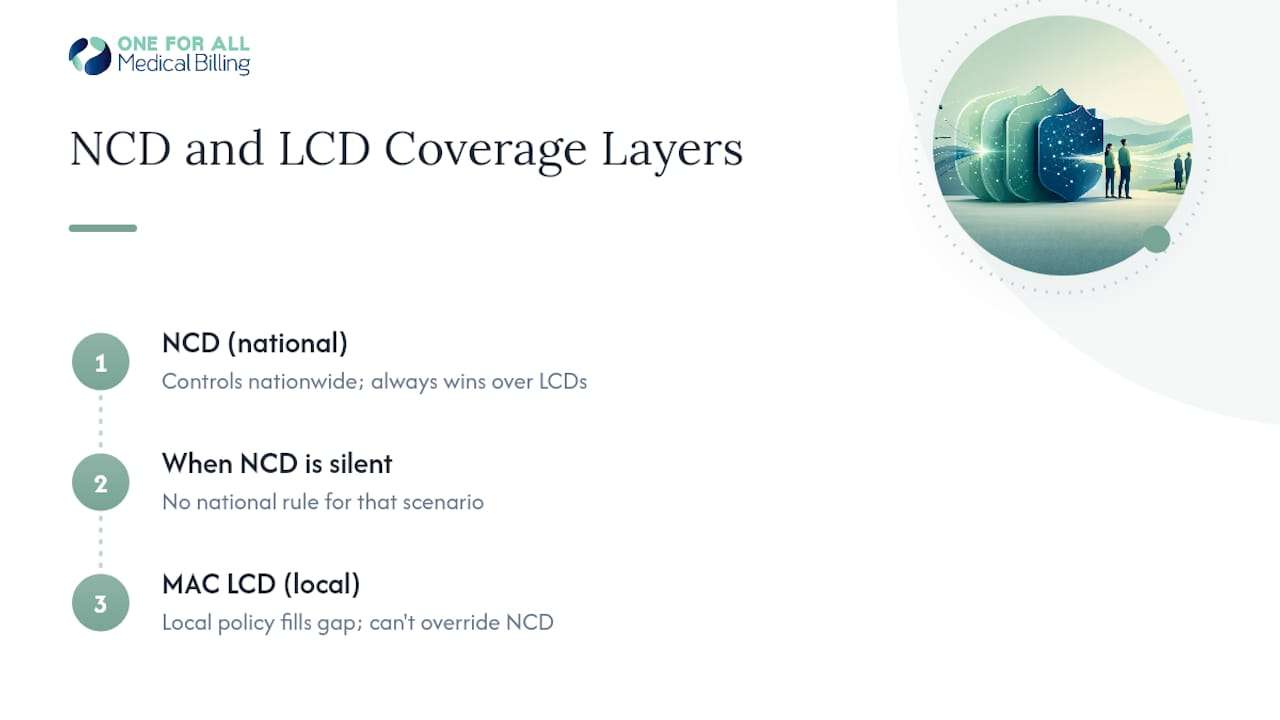
NCD 310.1, covering routine costs in clinical trials, is a clean illustration. It sets one national rule for how Medicare treats routine costs incurred during a qualifying clinical trial, regardless of where the patient lives. But a specific imaging study or diagnostic procedure ordered during that same trial might still fall under a MAC’s LCD for imaging coverage. Both policies apply at once, at different layers, and an appeal that ignores either one is incomplete.
Where to Find and Monitor Both Policy Types
Every coverage question starts and ends at the same address:
- Search the Medicare Coverage Database for an NCD on the service in question first, since it governs regardless of jurisdiction.
- If no NCD applies, search the same database filtered to your MAC’s jurisdiction for a relevant LCD, and open the linked billing article immediately.
- Record the document ID, effective date, and implementation date for both, since appeals reviewers will ask for exactly these details.
- Set up a recurring review cadence, whether that’s a manual tracking sheet or an email subscription through your MAC, since LCDs change more often than most practices expect.
Bookmark PIM Chapter 13 and the CMS NCD process page alongside the MCD search tool. Those three references answer nearly every “is this covered” question you’ll face this year.
What Coverage Determinations Mean for Claims and Denials
When an NCD exists, your MAC has no discretion, it must apply the national rule exactly as written. When no NCD or LCD exists for a service, expect claim-by-claim adjudication, which means the reviewer is making an individual medical-necessity judgment rather than applying a published policy. That’s often where reimbursement gets unpredictable and where documentation quality matters most.
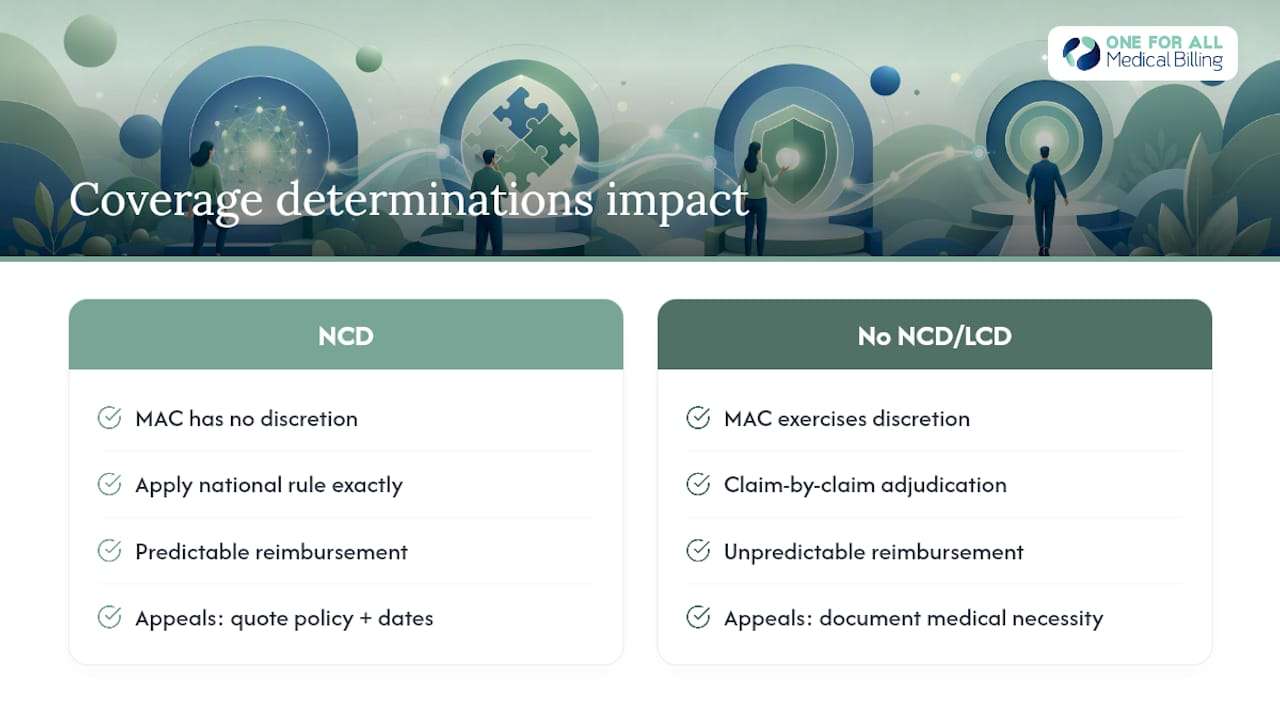
Denials tied to coverage determinations usually trace back to one of three gaps: the chart didn’t demonstrate the exact criteria the policy specifies, the wrong code was billed relative to the linked billing article, or the claim was processed under an outdated version of the LCD. Build appeals around the actual policy text. Quote the relevant section of the NCD or LCD directly, attach the effective and implementation dates, and cite the specific billing article language your claim satisfied. Practices that keep coding templates synced to active policies, rather than relying on memory or outdated cheat sheets, catch these mismatches before submission instead of after a denial. Resources on medical necessity documentation and denial management both walk through how to structure that evidence.
Provider Checklist: Evaluating Coverage Before You Bill
- Search the MCD for an applicable NCD covering the service; if none exists, search for your MAC’s LCD.
- Capture the document ID (L or DL), effective date, implementation date, and the linked billing and coding article.
- Align your chart documentation and code selection to the policy’s exact reasonable-and-necessary language, and keep that evidence ready in case of a denial.
- If the LCD seems too restrictive or outdated, request LCD reconsideration through your MAC; if the issue is truly national in scope, consider submitting evidence toward a formal NCD review.
Pro Tip: Never stop at the LCD text itself. The linked Billing & Coding article usually carries the exact HCPCS codes, frequency edits, and modifier rules your claim needs, and missing that article is one of the most common self-inflicted denial causes we see.
One For All Medical Billing’s Practitioner Perspective
MCD monitoring can be integrated into RCM workflows, checking active NCDs and LCDs against coding templates before claims go out the door, not after a denial arrives. Internal monitoring helps, but pairing it with a specialty-aware billing partner catches what a busy practice misses.
— One For All Medical Billing
Get Help Tracking Coverage Policy Changes
Some billing services offer continuous MCD monitoring paired with coding review that catches policy drift before it becomes a denial pattern.

Tracking active NCDs and LCDs relevant to specialties, flagging when policy updates change documentation requirements, and building appeals around the exact policy language and effective dates is an approach used by some medical billing services. For high-risk procedures where coverage rules shift often, that ongoing oversight replaces the guesswork of checking the database only after a claim bounces back. Some billing services handle coding review and denial management work that follows coverage changes to help prevent weeks of unpaid claims. If your practice is spending staff hours chasing LCD updates across jurisdictions, or your denial rate keeps creeping up around specific procedures, reach out to One For All Medical Billing for a consultation on your specialty’s billing workflow.
FAQ
What is the difference between LCD and NCD for Medicare?
An NCD is a national coverage policy issued by CMS that binds every MAC, while an LCD is a policy written by an individual MAC for its own jurisdiction, used when no NCD exists or to add local implementation detail.
What are the LCD and NCD guidelines for Medicare?
NCDs follow a CMS-run process with a tracking sheet, proposed decision, public comment period, and final decision, while LCDs follow PIM Chapter 13 procedures involving contractor advisory committees and their own public comment requirements.
What is the difference between NCDs and LCDs in practical billing terms?
When an NCD exists, your MAC must follow it exactly with no local variation; when only an LCD applies, coverage rules can differ from one MAC jurisdiction to the next, so always confirm which jurisdiction is processing your claim.
What is LCD in Medicare?
An LCD is a Local Coverage Determination, a coverage policy a MAC issues for the providers in its jurisdiction, identified in the Medicare Coverage Database by an “L” prefix for final versions and “DL” for proposed ones.
When should I request an NCD instead of relying on an LCD?
Request or advocate for a national review when a coverage gap or inconsistency affects providers across multiple MAC jurisdictions rather than just your own region, since NCDs resolve the issue nationwide instead of jurisdiction by jurisdiction.

