

table of contents
The CPT 2026 updates represent the largest single-year overhaul in recent memory: multiple changes involving new codes, deletions, and revisions, all effective January 1, 2026. For medical coders and billing professionals, that scale means one thing: the window to prepare is already closing.
Here is what you need to know at a glance before diving into the details:
- Total changes: numerous new codes, deletions, and revisions
- Primary thematic drivers: digital health and remote monitoring, AI-assisted diagnostics, lower-extremity revascularization, and hearing device services
- Regulatory alignment: CMS finalized the annual CPT/HCPCS code updates effective January 1, 2026, confirming compliance alignment with AMA publications
- Foundational role: The AMA’s Current Procedural Terminology (CPT) code set, containing over 11,520 codes, remains the backbone of U.S. health data interoperability and medical billing
- Key authority: The AMA and CMS are the primary governing bodies; all coding decisions should trace back to their published guidance
The CPT 2026 code set does not just add new codes. It restructures how clinical intensity, care pathway specificity, and technology-driven services are captured in billing, which has direct consequences for your reimbursement rates, claim acceptance, and audit exposure.
Which CPT 2026 changes will have the biggest impact on your specialty?
The 2026 CPT modifications are not evenly distributed across specialties. Several clinical areas received foundational rebuilds, not just incremental tweaks. Understanding where the heaviest changes landed helps you prioritize your team’s review time.

Digital health and remote physiologic monitoring
The 2026 update expands short-duration remote physiologic monitoring codes, introducing new time-based thresholds that require explicit documentation of time spent during monitoring and management. This is a meaningful shift: previously, many remote monitoring claims could be submitted with relatively general documentation. Now, the codes reflect clinical intensity, meaning your documentation must capture the specific duration and complexity of each monitoring session. Practices billing remote patient monitoring reimbursement without updating their workflow templates will face denials.
Key points for remote monitoring codes:
- New shorter-duration monitoring intervals require time-stamped documentation
- Management codes are now time-based, not encounter-based
- Failure to update EHR templates to capture required time fields is the single most common denial trigger in this category
AI and assistive analytics
New codes for algorithm-assisted diagnostics and cardiac risk assessments reflect the AMA’s recognition that AI-driven clinical decision support is now a billable service, not just a background tool. These codes require documentation that the algorithm output was reviewed and incorporated into the clinical decision, not merely generated. This distinction matters enormously for audit purposes.
- New codes cover AI-assisted interpretation in cardiology and diagnostic imaging
- Documentation must confirm physician review of algorithm output
- Payers are still developing coverage policies; early communication with payers is advisable before billing these codes at scale
Lower-extremity revascularization
This is the most structurally significant rebuild in the 2026 CPT code changes. The legacy framework has been replaced with an anatomy- and complexity-based system. Coders who relied on the old bundling logic will find that the new codes require a more granular understanding of the procedure performed, including vessel location, intervention type, and complexity tier. For practices that bill arteriogram and vascular procedures, this rebuild demands a full review of existing charge capture workflows.
- Old bundling logic is obsolete; new codes are anatomy-specific
- Complexity tiers now drive code selection, not just procedure type
- Clinical documentation must reflect vessel-level detail to support the selected code
Hearing device services
The AMA updated hearing device service codes with 12 new time-based codes replacing legacy codes to reflect modern audiology care pathways. The shift to a time-based model mirrors what happened with evaluation and management codes several years ago: the emphasis moves from what was done to how long it took and how complex the encounter was.
- 12 new time-based codes replace legacy hearing device codes
- Documentation must capture time and complexity of each service encounter
- Legacy codes are deleted; continued use will result in claim rejections
Surgery, radiology, and pathology/laboratory
- SI joint fusion: Revised codes reflect updated procedural approaches; coders must confirm which technique was performed before selecting a code
- Radiology: Procedural refinements affect imaging guidance codes; bundling rules have been updated
- Pathology and laboratory: About 27% of new CPT codes are proprietary laboratory analyses (PLA) codes, driven by growth in genomics and specialty diagnostics; these require careful attention to payer coverage policies before billing
A quick snapshot of the 2026 CPT code set changes
If you need a fast-reference summary to share with your billing team or present to leadership, here is the essential picture:
Code change counts:
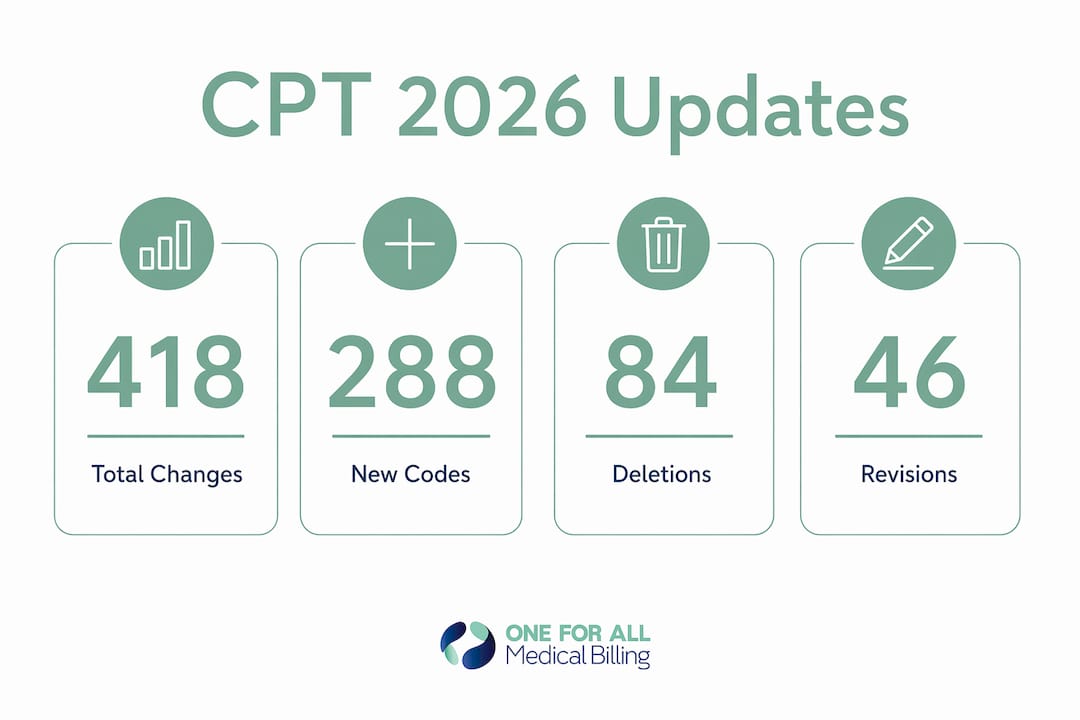
- 288 new codes added
- 84 codes deleted
- 46 codes revised
- 418 total changes across the code set
New code composition:
- A significant share of new codes are proprietary laboratory analyses (PLA) codes, reflecting the expansion of genomics and specialty diagnostics
- A meaningful share of new codes falls under Category III, covering emerging technologies and services including AI-assisted diagnostics and novel remote monitoring approaches
- Digital health and technology-driven services account for a significant portion of the structural additions
Thematic trends driving the 2026 billing code updates:
- A clear shift toward measuring clinical intensity and care pathway specificity, particularly for remote and AI-related services
- Procedural precision replacing broad bundled codes in complex surgical categories
- Time-based documentation requirements expanding beyond evaluation and management into audiology, remote monitoring, and management services
- Growth in laboratory and genomics coding reflecting advances in precision medicine
The AMA’s CPT code set now contains over 11,520 codes, and the 2026 release includes usability improvements to the CPT Standard Data File designed to simplify communication across the healthcare industry.
What makes CPT 2026 implementation harder than past updates?
The volume of changes is one challenge. The structural nature of many of them is another. Several of the 2026 CPT modifications do not just add a new code; they rewrite the logic governing how existing codes interact, which means coders cannot simply append new codes to existing workflows.

Bundling logic and guideline language:
The 2026 update extensively revises bundling logic and guideline language, especially in complex surgical sections. Reading only the code descriptor is no longer sufficient. Coders must review the full revised guideline text to understand what is included, what is separately reportable, and what has been rebundled. Missing this step is one of the fastest routes to a denied claim or a post-payment audit finding.
Documentation gaps:
New time-based codes in remote monitoring and audiology require documentation fields that many EHR templates do not currently capture. If your clinical staff is not documenting time and complexity in the format the new codes require, your billing team cannot fix that gap after the fact.
Cross-team coordination:
Proper coordination of clinical, EHR, and revenue cycle teams is critical for successful implementation. Billing cannot succeed in isolation here. The chain of decisions runs from the clinician’s documentation, through the EHR’s charge capture, to the coder’s selection, and finally to the biller’s submission. A break anywhere in that chain produces a denial.
Best practices to reduce implementation risk:
- Conduct a pre-implementation gap analysis comparing current documentation templates against new code requirements
- Update EHR charge capture fields before January 1 to capture time, complexity, and vessel-level detail where required
- Brief clinical staff on documentation changes before the codes go live, not after the first denial arrives
- Review revised guideline language in full for every surgical section your practice bills, not just the code descriptors
- Establish a denial tracking log specific to 2026 code changes to identify patterns early
Pro Tip: Contact your top payers before billing new AI-assisted diagnostic and remote monitoring codes at scale. Some payers are still finalizing coverage policies for these categories, and early communication can prevent a wave of technical denials that take months to resolve.
Which tools and resources help you stay current with CPT 2026?
Staying compliant with the new CPT guidelines for 2026 requires more than a one-time code update. The AMA publishes ongoing corrections and clarifications, and payer policies continue to evolve after January 1.
AMA resources:
- CPT QuickRef App: The AMA recommends the CPT QuickRef app as a primary digital reference tool. It combines the full CPT code set with educational content and is available via the Apple App Store and Google Play Store. A 14-day free preview is available before purchase.
- CPT Changes 2026: An Insider’s View: The AMA’s official companion publication provides rationales for each change and clinical scenarios illustrating correct application. This is the reference your coders should have open when reviewing revised guideline language.
- AMA Errata and Technical Corrections: The AMA publishes ongoing errata and technical corrections for CPT 2026 post-implementation. Reviewing these regularly is not optional; a correction to a code descriptor can change how a claim should be submitted.
CMS resources:
- The CMS HCPCS Quarterly Update files, released each quarter, reflect additions, revisions, and discontinued codes that affect Medicare billing. The January 2026 file is already available.
- The CMS Physician Self-Referral Law Code List, updated annually, defines which CPT/HCPCS codes fall under designated health service categories, directly affecting referral compliance for clinical laboratory, radiology, physical therapy, and radiation therapy services.
Billing partner expertise:
For practices managing high claim volumes or specialty-specific billing complexity, partnering with a specialized medical billing service provides a layer of ongoing code update management that internal teams often cannot sustain alone. A billing partner with deep CPT expertise monitors AMA errata, updates charge capture logic, and flags payer policy changes before they produce denials.
How should your clinical and billing teams coordinate on CPT 2026?
The most common failure mode in a major CPT update is not ignorance of the new codes. It is the gap between what clinicians document and what coders need to bill correctly. Closing that gap requires deliberate coordination, not just a memo.
Start with multidisciplinary planning:
Bring clinical staff, coders, and revenue cycle leadership together before implementation, not after the first denial cycle. Each group sees a different part of the chain: clinicians know what they are doing clinically, coders know what the code requires, and revenue cycle teams know what payers are accepting. No single group has the full picture.
Align documentation with revised code descriptors:
Every revised CPT code in 2026 comes with updated descriptor language. Your clinical documentation standards should be reviewed against those descriptors, particularly for remote monitoring, audiology, and complex surgical procedures. If the descriptor requires vessel-level specificity or time documentation, the clinical note must provide it.
Training that sticks:
- Schedule joint training sessions that include both clinical and coding staff, not separate tracks
- Use real clinical scenarios drawn from your own practice’s case mix, not generic examples
- Revisit training at 30 and 60 days post-implementation to address issues that surface in live billing
Internal audits post-implementation:
Run a targeted audit of claims submitted under new and revised 2026 codes within the first 60 days. Look for patterns: repeated use of deleted codes, missing time documentation, incorrect bundling. Catching these early prevents a larger audit exposure later. For practices managing denial appeals, early pattern detection is the difference between a correctable process issue and a systemic billing problem.
Leverage specialty-specific billing expertise:
One For All Medical Billing brings over 20 years of specialty-focused billing experience to exactly this kind of transition. With a 90% clean claim rate and deep expertise in ICD-10, CPT, and HCPCS coding, the team supports providers through code updates, documentation alignment, and payer communication, so your revenue cycle does not absorb the cost of a disorganized transition. If your practice is navigating the 2026 CPT coding changes across multiple specialties or sites, working with a medical coding and billing partner that tracks these updates as a core function is one of the most direct ways to protect your reimbursement.

Key Takeaways
The CPT 2026 updates introduce 418 code changes that require clinical documentation alignment, revised bundling logic review, and cross-team coordination to protect reimbursement and avoid audit exposure.
| Point | Details |
|---|---|
| Scale of changes | 288 new codes, 84 deletions, and 46 revisions took effect January 1, 2026. |
| PLA codes are a major driver | About 27% of new codes are proprietary laboratory analyses, reflecting genomics and specialty diagnostics growth. |
| Documentation is the weak link | Time-based codes in remote monitoring and audiology require EHR template updates before billing. |
| Bundling logic has changed | Revised guideline language in surgical sections must be read in full, not just code descriptors. |
| Coordination prevents denials | Clinical, EHR, and revenue cycle teams must align before implementation, not after the first denial. |
FAQ
How many total changes are in the CPT 2026 update?
The 2026 CPT update includes 418 total changes: 288 new codes, 84 deletions, and 46 revisions, all effective January 1, 2026.
What are the biggest clinical areas affected by the new CPT codes for 2026?
The highest-impact areas are digital health and remote physiologic monitoring, AI-assisted diagnostics, lower-extremity revascularization, and hearing device services, each of which received structural rebuilds rather than simple additions.
Why are remote monitoring claims being denied under the 2026 codes?
The new short-duration remote physiologic monitoring codes require explicit time documentation that many EHR templates do not currently capture; claims submitted without the required time fields will be denied.
Where can I find official guidance on the CPT 2026 modifications?
The AMA’s CPT QuickRef app, the CPT Changes 2026: An Insider’s View publication, and the AMA’s ongoing errata and technical corrections document are the primary authoritative references, alongside CMS’s annual HCPCS update files.
How does the lower-extremity revascularization rebuild affect billing?
The legacy bundling framework has been replaced with an anatomy- and complexity-based system; coders must now document vessel location, intervention type, and complexity tier to select the correct code, making detailed clinical documentation non-negotiable.
Recommended
- 97112 CPT Code: A Guide to Billing & Compliance in 2026 – One For All Medical Billing
- CPT Code 49320: A Guide To Stop Denials – One For All Medical Billing
- 43239 CPT Code: A Guide To Stop Denials – One For All Medical Billing
- CPT Code 19301: A Guide to Correct Billing and Coding – One For All Medical Billing

