
table of contents
Most advice on the CPT code for arteriogram starts with a code list. That's where many denials begin.
If a biller treats “arteriogram” as one procedure name with one matching CPT answer, the claim is already on shaky ground. In practice, the hard part isn't finding a code labeled arteriogram. It's determining what vascular territory was imaged, where the catheter ended, whether the study was selective or non-selective, and whether the documentation supports a diagnostic study, runoff, or extremity-only exam.
That distinction changes code families, bundling logic, and modifier decisions. It also changes whether the claim survives payer review.
Why A Single CPT Code For Arteriogram Does Not Exist
The search phrase CPT code for arteriogram sounds simple. The coding reality isn't.
A single all-purpose arteriogram code doesn't fit modern vascular billing because CPT organizes these services by anatomy and catheter position, not by the generic word “arteriogram.” That's why two reports that both say “arteriogram performed” can lead to very different coding outcomes.
The most common error isn't pulling the wrong code from a list. It's misclassifying the scope of the study. Guidance on abdominal aortography and lower-extremity imaging points out that a major source of confusion is deciding whether the service was diagnostic aortography, runoff, or extremity-only imaging, because that decision changes the code family entirely, as discussed in this charge description master resource and in coding guidance from HIAcode on abdominal aortography and lower extremities outpatient coding.
What Practice Managers Need To Watch
If your team asks only, “What's the arteriogram code?” they're asking the wrong operational question. The useful questions are:
- Where did the catheter end? Final catheter location often drives the code pathway.
- What was imaged? The report must show the vascular territory studied, not just access.
- Was the exam selective or non-selective? That distinction affects hierarchy and bundling.
- Was this diagnostic imaging separately supportable? If an intervention occurred, separate billing may be limited.
Practical rule: Code the documented study, not the dictionary term in the procedure title.
A clean claim usually comes from a coder who reads the angiographic narrative closely, not one who scans for the word arteriogram and stops there.
The Foundation Of Arteriogram Coding Principles
Modern arteriogram coding rests on one shift: CPT moved away from older, broad procedure labels and toward a structured vascular framework.
A key milestone came in CPT 2018, when many older angiography codes were consolidated or deleted. For example, CPT 75658 for brachial retrograde angiography was deleted, and coding moved toward existing upper-extremity code pathways instead, according to AAPC's discussion of the 2018 angiography coding changes. That same update also reflected a broader move toward anatomy-specific reporting.

Procedure Name Is No Longer The Anchor
Older habits still show up in billing offices. Staff may look for a phrase like “renal arteriogram” or “extremity arteriogram” and expect a direct one-to-one code match. That approach doesn't hold up under current CPT logic.
What matters now is:
- Anatomic territory
- Selectivity of catheter placement
- Built-in hierarchy
- Bundled diagnostic components
This is one reason utilization review and coding review need to work together. If your team also manages ordering controls, these appropriate use criteria considerations can help tighten the front-end workflow so the back-end claim has clearer support.
Two Concepts That Drive Most Decisions
The first is non-selective versus selective catheterization. A catheter left in a larger parent vessel supports a different coding path than one advanced into a specific branch vessel.
The second is the vascular family concept. CPT often treats vessels in a hierarchy. The farther the catheter advances within that family, the more specific the code selection becomes. That structure is why the operative note and radiology report must identify exact catheter location, not vague language such as “catheter advanced and imaging obtained.”
If the physician documents only access and a generic arteriogram statement, the coder is left guessing. Payers usually won't guess in your favor.
Practices that reduce denials in this area usually standardize physician templates around final catheter position, selected vessel, imaging territory, and whether runoff or intracranial views were obtained.
Coding For Non-Selective And Initial Aortography
Non-selective aortography is one of the easiest places to lose revenue or trigger an overcoding denial because the distinction looks small on paper but matters a great deal on the claim.
For abdominal arteriogram coding, the core split is between 75625 and 75630. Coding guidance states that 75625 applies to abdominal aortography without runoff, while 75630 applies when the abdominal aorta and runoff to the bilateral lower extremities are imaged from a single catheter position, as explained in this angiography CPT coding guidance for abdominal studies.
The Decision Point Is The Imaged Territory
The easiest mistake is to code based on catheter presence alone. A catheter in the aorta does not automatically support runoff coding.
Use this decision logic:
- Read the imaging description first. Did the report document only the abdominal aorta?
- Check for runoff language. Did the imaging extend into lower-extremity arterial runoff from that same catheter position?
- Match the code to documented extent. If only the aorta was studied, the coding path is different from aortoiliac or lower-extremity runoff imaging.
A practical documentation review often starts with the indication and ends with the imaging findings. If the findings describe the abdominal aorta and then continue into bilateral lower-extremity runoff, that points you toward the runoff code family. If the findings stop at the aorta, it doesn't.
What Works And What Fails In Audits
What works:
- Clear statement of the vessels imaged
- Explicit mention of runoff when performed
- Consistent catheter-location narrative
- Findings section that matches the billed territory
What fails:
- “Abdominal arteriogram performed” with no vascular detail
- A charge entry that assumes runoff because the procedure was done for leg symptoms
- Coding based on diagnosis alone rather than the actual imaging record
If your claim also depends on the underlying diagnosis, this abdominal aortic aneurysm ICD-10 reference can help teams validate diagnosis linkage on the back end. The CPT choice still depends on what was imaged, but the diagnosis must support medical necessity for that scope.
Mastering Selective Catheter-Based Arteriogram Codes
Selective arteriogram coding is where many otherwise solid billing teams start to overstate or understate the service. The fix is to think in vascular families, not in disconnected vessels.
Under modern CPT policy, selective extremity and renal arteriography follow a hierarchical vascular-family framework. Diagnostic angiography may bundle catheter placement, contrast injection, post-processing, permanent recording, and radiological supervision and interpretation into one code set. For renal diagnostic angiography, 36251 through 36254 are used when diagnostic angiography is performed, and code choice depends on laterality and selectivity, according to HCPro educational guidance on selective extremity and renal angiography coding.

Think Of The Vessel Tree, Not A Flat List
When the catheter moves from a parent vessel into a named branch, CPT usually treats that as movement through a hierarchy. The billed service should reflect the highest level of diagnostic selectivity documented.
That means coders shouldn't unbundle pieces that are already built into the diagnostic family. In many cases, separate billing for catheter placement and imaging interpretation is not appropriate because the diagnostic code already includes those components.
A Practical Review Method
Use this sequence when reviewing the report:
- Start with final catheter position. That tells you whether the exam remained non-selective or became selective.
- Identify laterality. Renal and extremity work may depend on whether one side or both sides were studied.
- Confirm diagnostic imaging occurred. Access alone is not enough.
- Check for additional vessel work in the same family. Some added imaging is already included. Additional vessel coding requires a specific basis.
The HCPro guidance also notes that 75774 may apply only when a second vessel is studied after a basic exam. That's exactly where many teams either miss legitimate add-on reporting or append it too freely.
The safe approach is simple. If the report doesn't clearly identify a second studied vessel after the basic exam, don't assume add-on eligibility.
What Good Coding Looks Like
A strong selective coding workflow usually includes these elements in the physician note:
- Named vessel selected
- Whether the study was unilateral or bilateral
- Diagnostic intent and findings
- Any additional vessel beyond the primary exam
Selective coding pays off when the documentation is disciplined. Without that discipline, denials often come back as bundling edits or unsupported selective catheter placement.
Navigating Head And Neck Arteriography A Special Case
Head and neck arteriography has its own logic, and coders who apply general vascular habits here often create unbundling problems.
For these studies, CPT uses a hierarchy in which 36221 covers a non-selective arch study, while 36222, 36223, and 36224 reflect progressively more selective catheter placement and added imaging. The hierarchy means only one code per side is typically reported, as explained in this head and neck angiography coding discussion from ICD10monitor MedLearn.
How The Hierarchy Works
This family is progressive. A higher-level code includes the lower-level work on that side.
Use the hierarchy this way:
- 36221 when the study is non-selective at the arch level
- 36222 when catheter placement and imaging move into the next selective level described by the code set
- 36223 when the documented work includes the higher included imaging described in that code
- 36224 when the catheter placement and imaging support the most selective level in the hierarchy
The coding mistake I see most often is stacking these codes because the report contains several imaging steps. That doesn't work when the higher code already includes the lower work for that side.
Side Specific Reporting Matters
Laterality also needs clean documentation. The report should make it obvious which side was studied and which side received the highest level of service.
That becomes even more important when your diagnosis coding must support the exact vessel territory under review. If your team handles carotid disease frequently, this carotid artery stenosis ICD-10 reference is a useful companion during claim review.
In head and neck angiography, the fastest route to denial is usually unbundling included work on the same side.
When a coder respects the hierarchy and the physician documents laterality with precision, these claims are much easier to defend.
Essential Modifiers And Component Coding
Even when the primary CPT code is right, modifier errors can still derail payment. In arteriography, modifier use should reflect who performed which portion of the service, whether distinct work occurred, and whether the study was reduced or partially repeated.
Professional And Technical Components
For imaging services, teams often need to separate the professional component from the technical component.
Common operational scenarios include:
- Modifier 26 when the physician bills only the professional interpretation
- Modifier TC when the billing party reports only the technical component
- No split modifier when the global service is appropriately billed by the entity that performed both components
This sounds basic, but mistakes usually happen during hospital-based arrangements, outsourced reading models, or shared-service workflows. If your charge capture team doesn't know whether the physician or facility owns the technical portion, duplicate or missing billing follows quickly.
Distinct Procedural Services During The Same Session
Modifier logic gets harder when the encounter includes more than one vascular service. Distinct procedural modifiers may be necessary only if the documentation supports a separate service and payer rules allow separate reporting.
Teams should pause before appending a distinct-service modifier automatically. Many edits that look like denials for missing modifiers are denials for included work that never qualified as separate in the first place.
A good internal rule is to verify three items before adding a distinct-service modifier:
- Separate diagnostic purpose
- Separate documentation support
- No hierarchy or bundling rule that already includes the service
If your office also struggles with modifier consistency in office and hospital claims, this CPT modifier 25 billing guide is useful for training staff on the broader principle that modifiers must explain a claim, not rescue a weak one.
Laterality And Reduced Services
Laterality modifiers can help when side-specific reporting is required by payer policy or claim editing. Reduced-service logic also matters when a planned study wasn't fully completed. In those cases, the documentation must explain what portion was completed and why the full intended service wasn't.
The billing principle is straightforward. Modifiers don't create reimbursement. Documentation does. Modifiers tell the payer how to read that documentation.
Documentation And ICD-10 Crosswalk Best Practices
A strong arteriogram claim usually rises or falls on a few lines in the report. If those lines are vague, coding becomes interpretive. If they're specific, coding becomes defensible.
I recommend reviewing the note in the same order a payer auditor would. Start with the indication, move to access and catheter advancement, identify the final catheter position, then read the imaging description carefully to see which vessels were studied. End with findings and impression.
What Good Documentation Looks Like
A solid arteriogram record should answer these questions:
- Why was the study medically necessary?
- Where did the catheter end?
- Was the study non-selective or selective?
- Which vascular territory was imaged?
- Was runoff documented, if relevant?
- Were findings recorded in a way that supports the billed scope?
If your team is tightening report workflows, this expert guide for healthcare providers is a useful read because document routing and record retrieval directly affect whether coding staff can validate the complete angiographic story before claim submission.
A Simple Report-To-Claim Example
Consider a report that states the catheter remained at a single abdominal aortic position and imaging documented the abdominal aorta only. That supports one code path.
Now compare it with a report that documents the abdominal aorta and runoff imaging to the lower extremities from that same catheter position. That supports a different code path because the imaged territory expanded.
The ICD-10 side works the same way in principle. The diagnosis must match the clinical reason for the study, whether that's stenosis, aneurysmal disease, occlusive disease, or another documented vascular condition. The CPT code answers what was done. The ICD-10 code answers why it was medically necessary. If those two don't align, the claim invites denial even when the procedural coding itself is technically correct.
A Documentation Habit Worth Enforcing
Ask physicians to document the final catheter position in explicit vessel language, not shorthand.
That one habit solves a surprising number of downstream coding disputes. It also gives appeal writers something concrete to cite when a payer questions selectivity or study scope.
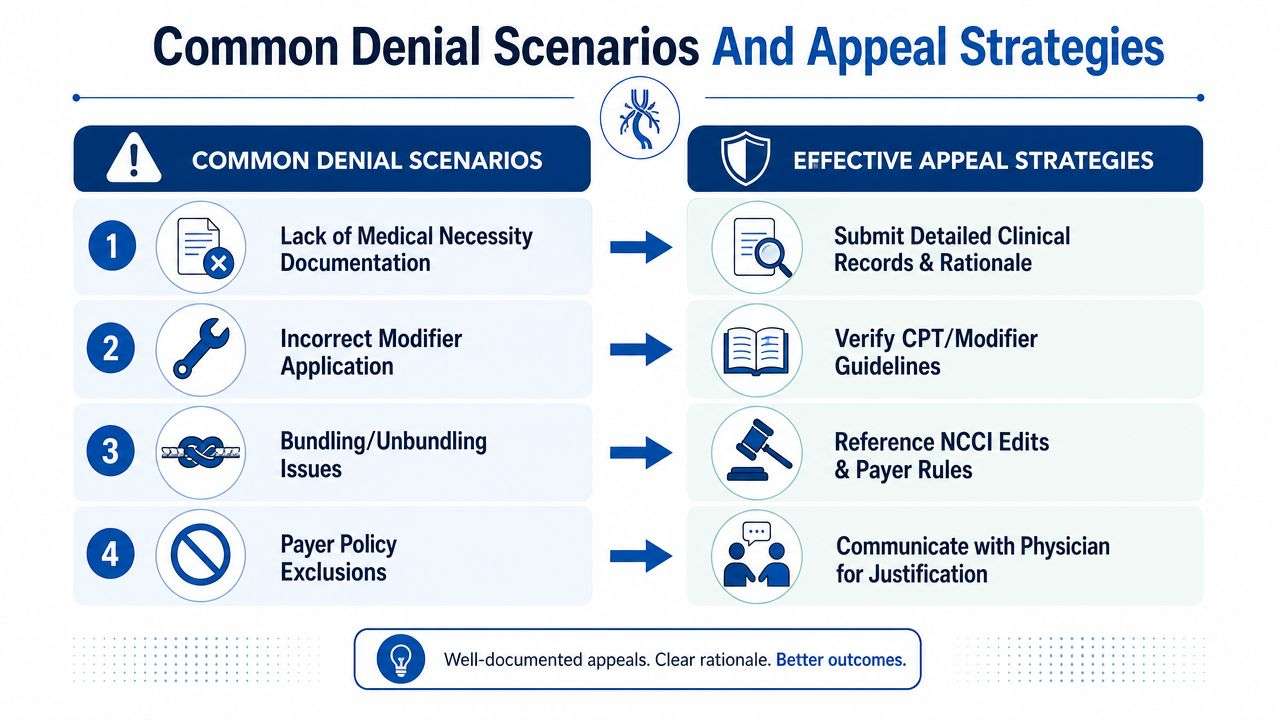
Common Denial Scenarios And Appeal Strategies
Arteriogram denials usually aren't random. They follow repeat patterns, and each pattern calls for a different appeal approach.
The teams that recover payment consistently don't send generic reconsideration letters. They answer the payer's exact logic with documentation, CPT hierarchy support, and a clear statement of what was and wasn't billed.
Denial Pattern One
Bundling denial
This often happens when the payer reads multiple billed lines as included work rather than separate services.
A stronger appeal says:
The submitted claim reflects the highest supported service based on documented catheter position and imaged territory. Please reprocess the claim using the submitted angiographic report, which identifies the final catheter location and distinguishes the diagnostic imaging performed.
Avoid saying only that the service was “separate and distinct.” That phrase alone doesn't explain anything.
Denial Pattern Two
Lack of medical necessity
These denials often trace back to a weak ICD-10 pairing, an unclear indication, or a report that describes imaging but not the clinical reason it was needed.
Your appeal should point to:
- The ordering diagnosis
- The physician's indication
- The findings that justified the angiographic study
- Any documentation showing that the exam answered a diagnostic question relevant to care
Denial Pattern Three
Modifier-related rejection
This includes missing modifier logic, incorrect component billing, or unsupported distinct-service billing.
The appeal should identify exactly why the modifier was appended and where that distinction appears in the chart. If the modifier cannot be defended with the record, a corrected claim is often better than an aggressive appeal.
Denial Pattern Four
Mismatch between report and charge entry
This is an internal process issue more than a payer issue. The report may describe one service while the charge ticket suggests another.
A practical response is to audit:
- Charge entry source
- Coder abstraction
- Final physician documentation
- Claim scrubber edits
The fastest denial prevention strategy isn't writing better appeals. It's eliminating vague charge capture upstream.
Quick Reference Arteriogram Coding Cheat Sheet
Use this as a desk-side reference, not as a substitute for the report. The point isn't to memorize a single CPT code for arteriogram. The point is to connect the code to the exact anatomy and catheter scenario documented.
Arteriogram CPT Code Cheat Sheet
| CPT Code | Brief Description | Key Coding Consideration |
|---|---|---|
| 75625 | Abdominal aortography without runoff | Use when the study documents the abdominal aorta itself, not lower-extremity runoff |
| 75630 | Abdominal aortography with bilateral iliofemoral lower-extremity runoff from one catheter location | Report when runoff imaging is documented from that access point |
| 75710 | Unilateral extremity angiography | Review the vascular territory studied and whether the exam is extremity-focused rather than aortography |
| 75716 | Bilateral extremity angiography | Confirm bilateral extremity imaging and avoid confusing this with aortography with runoff |
| 36221 | Non-selective arch study in head and neck angiography hierarchy | Only one code per side is typically reported in this hierarchy |
| 36222 | More selective head and neck angiography level | Higher-level hierarchy logic applies, so don't stack lower included codes on the same side |
| 36223 | More selective head and neck angiography with added included work | Verify side and highest documented level |
| 36224 | Highest selective level in the cited head and neck hierarchy | Report the highest supported code per side, not every step performed |
| 36251–36254 | Renal diagnostic angiography family | Code depends on laterality and selectivity |
| 75774 | Additional vessel study after a basic exam in limited circumstances | Use only when documentation supports a second vessel studied after the basic exam |
How To Use The Cheat Sheet Correctly
This reference works best when paired with a short review checklist:
- Read the final catheter position
- Identify the imaged territory
- Check whether the code family is hierarchical
- Look for bundled components before adding extra lines
If your staff uses a cheat sheet without reading the findings section, the sheet becomes a liability. If they use it after reading the report, it becomes a speed tool.
Frequently Asked Questions About Arteriogram Billing
Some of the hardest arteriogram questions show up when the study happens during the same session as treatment. That's where billers need to separate habit from rule.
Can You Bill A Diagnostic Arteriogram With An Intervention
Sometimes, yes. Not always.
Guidance states that separately reporting diagnostic angiography during the same session as an intervention is allowed only when specific medical-necessity criteria are met, and in those cases modifier 59 or XU may be needed. Otherwise, the diagnostic study is not separately billable, according to this vascular roadmapping and correct coding guidance.
That means your team should check for three things before billing both:
- Was there a true diagnostic study?
- Was it medically necessary and not merely part of the intervention?
- Did the documentation show why it was separate?
If prior catheter-based imaging already answered the diagnostic question, separate reporting becomes harder to support.
What If The Study Was Only Partially Repeated
Partially repeated vascular imaging can attract duplicate-service denials. In some situations, reduced-service logic may be appropriate if the repeated study was medically reasonable but not fully performed. The record must explain the reason clearly.
Can The Physician Note Be Short If The Images Exist
No. Images alone rarely solve a weak claim. The report must tie together indication, catheter location, vascular territory, and findings in words a reviewer can follow.
A payer can deny a technically accurate code when the documentation never proves that level of service occurred.
What's The Best Operational Fix For Recurring Arteriogram Denials
Standardize the physician template. Require these fields:
- Indication
- Final catheter position
- Selected vessel
- Territory imaged
- Runoff or intracranial imaging, when applicable
- Findings that support the billed scope
That doesn't make coding simplistic. It makes coding auditable.
If your practice is tired of arteriogram denials, modifier confusion, and claims that stall because the report doesn't support the code path, One For All Medical Billing can help tighten the entire workflow, from coding review and claim submission to denial follow-up and payer-facing appeals. Their team supports practices that need cleaner vascular claims, stronger documentation alignment, and less revenue leakage across multi-site operations.

