
table of contents
Some mornings start with a simple dashboard check and end with a finance meeting nobody wanted. A/R is drifting older, denial workqueues keep refilling, front-desk staff are fielding patient calls about coverage surprises, and your billing team is spending more time correcting preventable errors than moving money through the system. If you run a multi-site group or a specialty practice, that pressure multiplies fast because small process gaps get repeated across every location, payer mix, and provider schedule.
That's usually the point where administrators stop asking, “Why can't the team just work harder?” and start asking the better question: “Where is the process failing, and who can fix it without disrupting operations?” Healthcare revenue cycle consulting matters in that moment because the problem usually isn't one bad employee or one bad week. It's a chain of operational decisions that no longer fits the scale, complexity, or payer reality of the practice.
When Your Revenue Cycle Becomes A Hurdle Not A Help
A practice administrator at a growing specialty group often sees the same pattern. Payments are slower than they should be. Managers at different sites follow different registration habits. Coders are cleaning up documentation gaps after the visit instead of preventing them before claim submission. Nobody feels in control, even though everybody is busy.
That doesn't mean the organization is poorly run. It usually means the revenue cycle has become too complex to manage by instinct.
The Pressure Builds Quietly
Multi-site groups are especially vulnerable because variation hides inside normal operations. One office verifies eligibility thoroughly. Another rushes intake to keep the waiting room moving. One biller knows a payer's authorization quirks. Another posts denials and moves on because the follow-up queue is already overloaded.
Those issues don't stay isolated. They show up as rework, avoidable write-offs, staff frustration, and slower cash.
Problems in the revenue cycle rarely begin in the billing office. They often start at scheduling, registration, or documentation and only become visible after reimbursement slows down.
If that sounds familiar, the first step is usually an honest review of your revenue cycle management challenges. Not because every practice needs a full overhaul, but because most practices need someone to identify which breakdowns are costing the most money.
Why More Organizations Bring In Outside Help
This isn't a niche decision anymore. The healthcare revenue cycle management outsourcing market surpassed $34 billion in 2025 and is projected to nearly double to $67 billion within four years, with 97% of healthcare entities outsourcing at least one RCM function, according to Auxis' 2026 healthcare revenue cycle management trends. That matters because it shows a broader shift in how organizations handle financial operations under pressure.
Administrators aren't turning to consultants because outsourcing sounds fashionable. They're doing it because payer rules change, staffing is inconsistent, compliance pressure is higher, and manual fixes don't scale.
What A Consultant Changes
A capable consultant doesn't just “look at billing.” They trace the full path from patient access to final payment and identify where cash is getting delayed, reduced, or lost. In complex organizations, that outside view matters because internal teams are often too close to the workflow to see where one department's workaround is creating another department's backlog.
The goal isn't to replace your staff. It's to give them a process they can execute consistently.
What Healthcare Revenue Cycle Consulting Really Means
Healthcare revenue cycle consulting works a lot like bringing in a financial personal trainer for your practice. Your team may already know the basics. They know claims have to go out clean, denials have to be worked, and patient balances have to be collected. But knowing the rules isn't the same as having a repeatable system that performs under pressure.
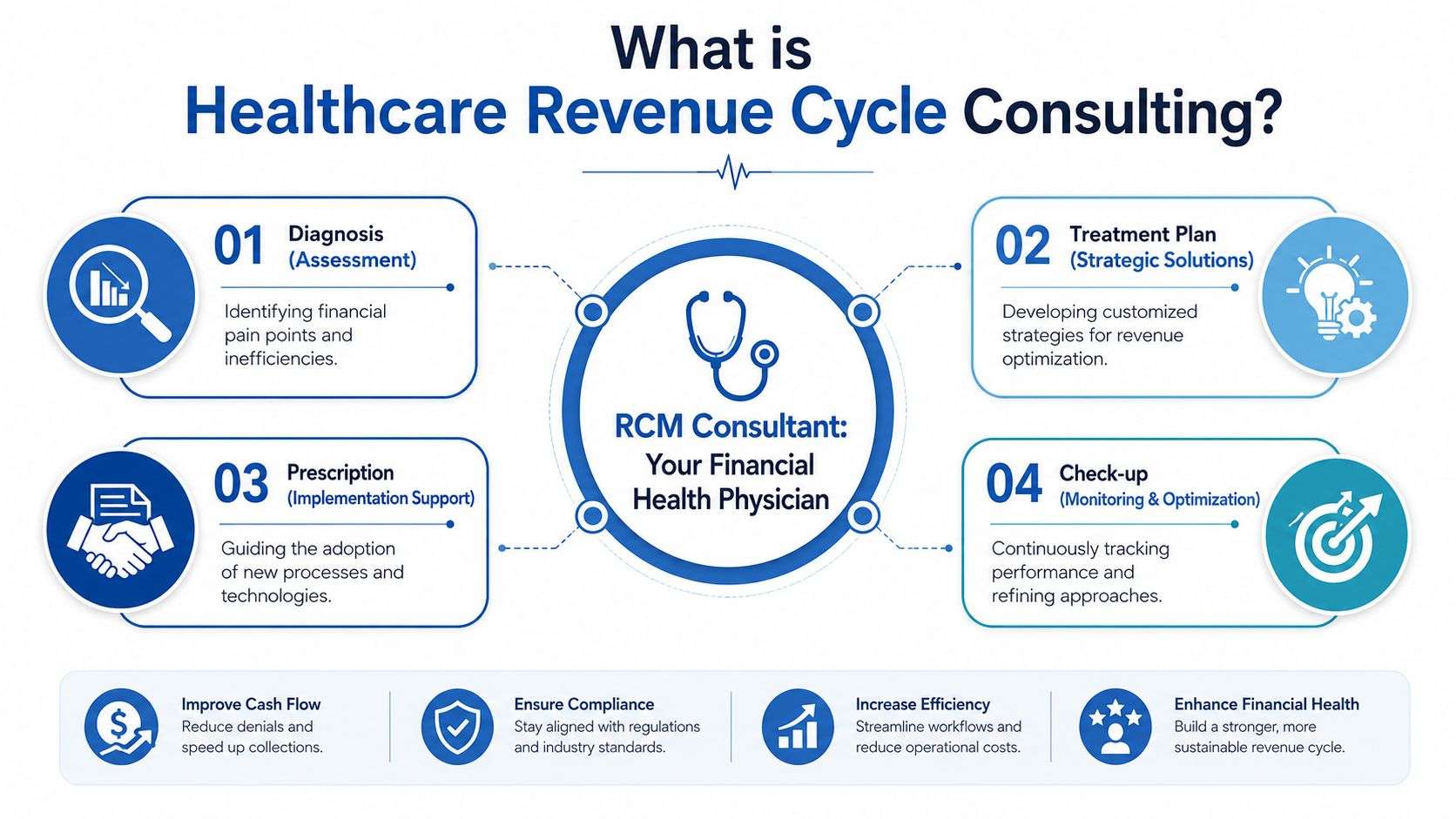
A consultant's real value is structure. They diagnose where the process is breaking, build a practical improvement plan, help your team implement it, and keep measuring whether it's working.
Diagnosis Before Advice
Good consulting starts with an end-to-end assessment. That means reviewing how appointments are scheduled, how benefits are checked, how authorizations are obtained, how charges are captured, how coding decisions are made, how claims are scrubbed, and how denials and patient balances are handled after adjudication.
The practical point is simple. If you don't know where the leakage starts, every fix becomes guesswork.
A consultant should be able to map the entire workflow and show where operational friction turns into financial loss. For a useful overview of the full process, this guide to healthcare revenue cycle management is worth reviewing alongside any consulting conversation.
A Useful Engagement Follows Four Moves
Not every engagement needs the same intensity, but the strongest ones usually include these elements:
Assessment of the full cycle
The consultant reviews workflows, payer behavior, staff handoffs, reporting gaps, and denial patterns.Prioritized recommendations
The best plans don't dump fifty ideas on your team. They rank issues by financial impact and implementation effort.Operational support
Some practices need policy changes. Others need payer rule edits, charge capture redesign, or training for front-desk and billing staff.Ongoing performance review
The work isn't done when the slide deck is delivered. Results need monitoring, especially in multi-site settings where drift returns quickly.
Practical rule: If a consultant can't explain the root cause of your cash flow problem in plain language, they probably can't fix it.
What It Is Not
Healthcare revenue cycle consulting is not a generic audit and it isn't just temporary labor. If the engagement only gives you observations without accountability, it won't change much. If it only adds people to chase old A/R without addressing front-end errors, the same problems will keep feeding the backlog.
The right engagement improves how the organization works, not just how hard people push.
The Core Services That Drive Financial Improvement
The most effective consulting work doesn't live in one department. Financial improvement comes from fixing the handoffs between departments. That's why the strongest engagements focus on a handful of services that connect patient access, coding, claims, follow-up, and reporting into one operating model.

Front-End Work That Prevents Back-End Pain
The highest-impact consulting work usually starts before the visit. According to BRG's revenue cycle performance guidance, 70% of revenue leakage originates from front-end errors, and improving scheduling, pre-registration, and authorization workflows can increase the clean claim submission rate to 90% or higher.
That should change how administrators think about priorities. If your team is spending most of its energy on old denials while eligibility and authorization processes remain loose, you're treating symptoms instead of the source.
A consultant typically reviews:
- Eligibility verification workflows to make sure staff confirm active coverage, plan details, and patient responsibility before service
- Authorization controls so specialty visits, procedures, imaging, and recurring services don't move forward with missing approvals
- Registration quality checks that catch demographic mismatches before they trigger payer rejections
For many organizations, the biggest avoidable losses are found within the revenue cycle. Detailed revenue cycle management services often begin here because downstream cleanup is expensive.
Mid-Cycle Controls That Protect Reimbursement
Once front-end intake improves, consultants usually turn to charge capture and coding. In specialty groups, that often means reconciling what was documented, what was billed, and what payer edits will accept.
This part of the work can include coding audits, modifier review, missed charge analysis, and claim scrubber configuration. The goal isn't abstract compliance. The goal is to submit claims that are supportable, accurate, and less likely to come back.
A weak claim editing setup creates two kinds of waste. First, claims reject before reaching the payer. Second, claims reach the payer with preventable defects and return as denials that staff now have to research and appeal.
Back-End Recovery And Visibility
The final layer is denial management, A/R follow-up, and reporting. Here, consultants separate noise from signal.
Some denied claims are one-off issues. Others point to a broken workflow upstream. Strong consultants look for patterns by payer, site, service line, provider, and denial category so the team isn't just working queues blindly.
A useful service mix often includes:
- Denial root-cause analysis that links denial types back to registration, coding, authorization, or documentation failures
- A/R prioritization rules that focus staff on balances with the highest recovery potential
- Reporting cadence that gives managers a short, readable view of operational and financial trends
If your reports only tell you what happened last month, they aren't helping you manage today's revenue cycle.
One practical option in this category is One For All Medical Billing, which offers revenue cycle management consulting built around workflow mapping across scheduling, eligibility, authorization, coding, claims, payment posting, denials, and patient collections. That kind of full-cycle view matters more than isolated fixes when multiple sites and specialties share the same financial engine.
How To Measure The ROI Of A Consulting Partnership
Administrators don't need a consultant who sounds informed. They need a consultant who moves measurable financial outcomes. That means defining success before the engagement begins and reviewing the same indicators on a fixed cadence after implementation starts.
If the only proof of progress is that staff feel less overwhelmed, the engagement is incomplete. Better workflows should show up in cash, speed, and fewer losses.
The Benchmarks That Matter Most
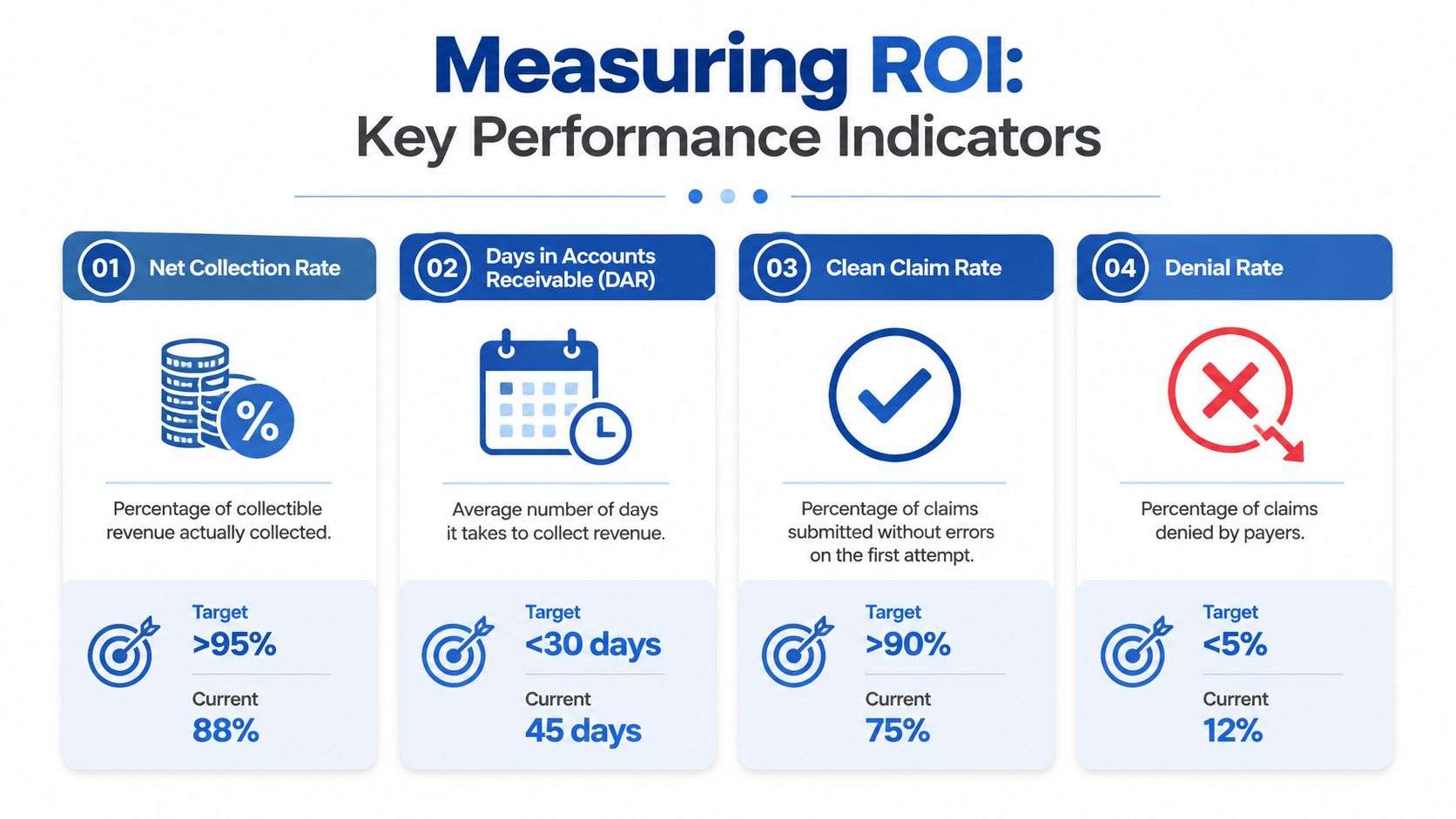
Experienced consultants usually start with a small KPI set that leadership can review without drowning in data. According to Medwave's overview of revenue cycle management consulting, engaging an experienced consultant typically yields a 10–20% increase in collected revenue and a 60–80% reduction in A/R days outstanding. The same source notes that top-tier performance targets include net days in A/R under 30 days and denial write-offs below 1.5% of patient revenues.
Those numbers matter because they translate consulting from a soft operational project into a financial decision.
A Practical KPI Stack For Administrators
The most useful scorecard usually includes a mix of speed, quality, and recovery measures. A working revenue cycle management dashboard should make these visible by site, payer, and provider where possible.
Focus on indicators such as:
Net days in A/R
This shows how quickly the organization turns charges into cash. If it remains high, the cause is often broader than collections alone.Denial write-offs
This tells you how much revenue is not just delayed but lost. It's one of the clearest indicators of preventable leakage.Collected revenue
This is the clearest bottom-line measure for leadership. It reflects whether process changes are improving reimbursement.Queue behavior and aging trend
These help managers see whether old balances are being resolved or carried forward under new labels.
Benchmarked thinking beats anecdotal thinking. If a consultant can't tie recommendations to target metrics, the practice can't judge whether the work paid off.
How To Judge ROI Honestly
Not every metric will move at the same pace. Front-end fixes can improve clean submission quality relatively quickly. Contract issues, coding retraining, and long-tail denial recovery can take longer to show through the numbers.
That's why the best way to measure ROI is to separate early indicators from lagging outcomes.
Early signs include fewer registration errors, fewer eligibility-related denials, and more consistent charge capture. Financial lagging outcomes include lower A/R days, reduced write-offs, and stronger collections. A serious partner should define both from the start and document who owns each action, deadline, and metric.
Real-World Results For Specialty And Multi-Site Groups
The value of consulting becomes obvious when you look at how problems appear in the field. Multi-site and specialty organizations don't struggle in generic ways. They struggle in patterns tied to their service mix, payer rules, and operational sprawl.
Multi-Site Urgent Care With Inconsistent Intake
One common scenario is an urgent care group with several locations using the same practice management system but not the same front-desk habits. Insurance data is entered differently from site to site. Some teams verify thoroughly. Others rely on old cards in the chart. Billing ends up spending its week correcting preventable front-end mistakes.
In that case, consulting usually centers on standardization. The work isn't glamorous. It involves registration scripts, eligibility checkpoints, authorization escalation rules, and site-level accountability. Once those basics are aligned, managers can compare sites fairly and coach to the same standard.
For groups like this, the clean claims ratio becomes a strong reality check. The HFMA KPI guidance on clean claims says providers should aim for a 98% clean claims rate, while 80% is the minimum target for operational stability. If a multi-site group is barely staying above the minimum, leadership usually has a process consistency problem, not just a billing problem.
Specialty Practice With High-Value Denials
A different pattern shows up in specialty care. Think of a pain management, rheumatology, or endocrinology practice where individual claims carry more reimbursement weight and denials are harder to fix after the fact. Here, consulting often reveals a mix of medical necessity documentation gaps, authorization misses, and payer-specific coding edits that front-line teams were handling inconsistently.
The right response isn't “work denials harder.” It's to redesign the upstream workflow so those claims go out with better support and fewer avoidable defects.
Large Group With Too Much Data And Too Little Clarity
Another familiar situation is the organization that already has reports, but none of them drive action. Executives see totals. Site managers see fragments. Billing leaders have queue data but not root causes. Everyone has numbers, yet nobody can answer why cash is slowing.
That's where consultant-led reporting design helps. Good reporting doesn't just summarize activity. It tells operators what to fix next.
If you're comparing support models for a growing organization, a review of revenue cycle management company options can help clarify what kind of partner is built for multi-location complexity versus basic claim processing.
Selecting The Right Consulting Partner For Your Practice
Choosing a consulting partner is less about promises and more about fit. A partner can sound polished in a sales call and still fail once your real payer mix, specialty rules, and site-level variation enter the picture.
The mistake I see most often is hiring for presentation quality instead of execution quality.
What Multi-Site And Specialty Practices Should Treat As Non-Negotiable
Start with specialty fluency. A consultant who understands general physician billing but not your documentation patterns, authorization burden, or payer edits will spend too much of the engagement learning at your expense.
Then look at operational scale. Multi-site groups need a partner who can handle variation across locations without imposing a rigid process that ignores local realities. Standardization matters, but so does knowing where a specialty clinic, urgent care site, or hospital-owned outpatient office differs.
Use these filters early:
Specialty-specific experience
Ask how they review coding, documentation, and authorization workflows in your exact service line.Scalability across locations
Ask how they compare performance by site and prevent workflow drift after rollout.System compatibility
They should be comfortable working with your EHR, practice management platform, clearinghouse, and reporting environment.Transparent reporting
If they can't show you how they will document baseline performance, action items, owners, and outcomes, you'll struggle to govern the engagement.
What Usually Fails In Practice
General advice without workflow detail fails. So does consultant dependence. If the partner's method only works while their team is hovering over yours, the gains won't last.
Another weak point is communication. Multi-site work creates operational friction by default. Site managers need practical guidance, not abstract recommendations. Billing leads need queue logic. Executives need a concise view of risk, progress, and unresolved blockers.
The right consultant should make your operation easier to run, not harder to interpret.
Questions Worth Asking Before You Sign
A strong evaluation conversation should sound operational, not promotional. Ask:
- How do you assess the full patient-to-payment workflow in a complex organization?
- How do you separate front-end, mid-cycle, and back-end causes of revenue leakage?
- What reporting will leadership receive each month?
- How do you support implementation, not just recommendations?
- How do you handle training and accountability across multiple sites?
A U.S.-based team can also make a practical difference, especially when payer follow-up, coding discussion, and issue escalation require fast communication and familiarity with local billing expectations.
Your Actionable Checklist To Vet RCM Consultants
The safest way to evaluate a consulting partner is to use the same checklist for every conversation. That keeps polished sales language from overshadowing execution details.
The Shortlist Questions That Matter
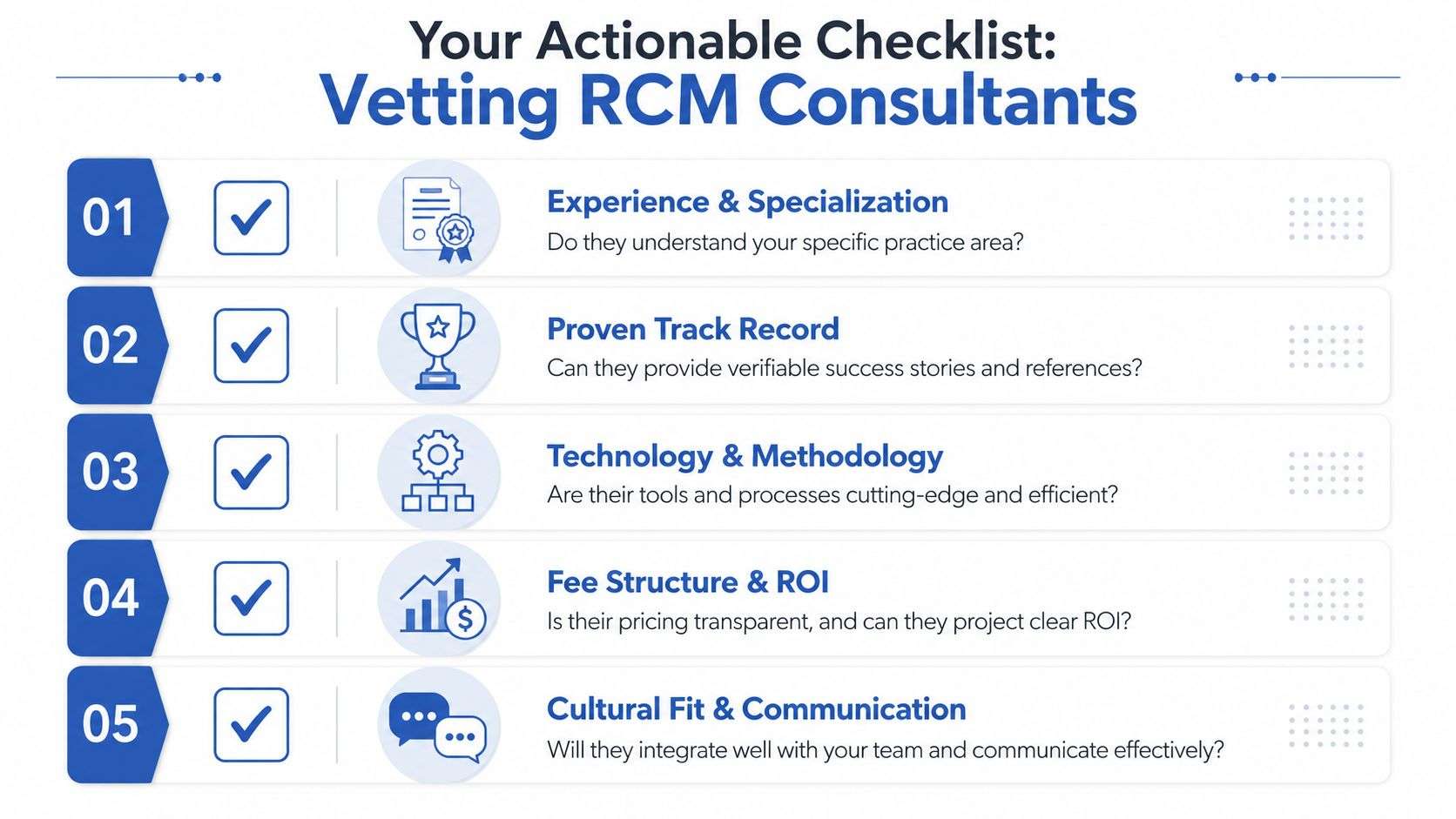
Use this checklist during interviews:
Experience and specialization
Confirm they understand your specialty's documentation, coding, authorization, and denial patterns.Track record you can verify
Ask for references, sample reporting, and examples of how they identified root causes and implemented fixes.Technology and methodology
Review how they work with your EHR, PM system, clearinghouse, and reporting tools. Their process should fit your operation, not force unnecessary disruption.Fee structure and ROI model
Ask how they define success, which KPIs they track, and when leadership should expect to review progress.Communication and cultural fit
Find out who will do the work, how often they meet with your team, and how site-level issues are escalated.
Vendor oversight matters too, especially if your consulting partner will touch systems, patient data, or outsourced workflows. This third-party risk management guide is a useful framework for thinking through due diligence, accountability, and operational risk before you sign an agreement.
A strong consultant should leave you with more visibility, better process control, and a team that can sustain the gains after the engagement ends. If their answers are vague, if reporting is unclear, or if they can't explain how they'll work across multiple sites, keep looking.
If you're ready to review your current revenue cycle and identify where cash is slowing down, One For All Medical Billing offers healthcare revenue cycle consulting for practices that need clearer workflows, stronger reporting, and support across scheduling, eligibility, coding, claims, denials, and collections.

