

table of contents
Monday closes strong. Tuesday cash posting looks normal. By Friday, your collections report is off, a payer has denied a batch of claims for a policy detail nobody on the front end saw coming, and several remits don't match what your team thought the contract allowed. The numbers feel inconsistent, but the underlying problem isn't randomness. It's that the contract is running the practice while nobody is actively managing it.
That's where payer contract management changes the conversation. It's not just negotiating rates once and filing the agreement away. It's the ongoing work of turning payer contracts into operating rules your billing, coding, credentialing, and follow-up teams can effectively use.
When that work is missing, practices blame denials, staffing, or payer behavior in general. In reality, many of the biggest revenue problems come from contract terms that were never abstracted, payment variances that were never reconciled, and administrative burdens that were never priced into the relationship. If your monthly revenue feels harder to predict than it should, your contracts deserve a closer look.
A strong revenue cycle already depends on connected workflows, and contract oversight has to live inside that broader system. Practices that want a cleaner view of how contract terms affect collections usually benefit from aligning contract management with the rest of their revenue cycle management strategy.
Your Practice Deserves Predictable Revenue
A practice administrator usually notices the problem before anyone else does. The posted payments look close enough at a glance. The denial team is busy every day. Appeals keep aging. Nobody can say with confidence whether the payer is paying according to contract, or whether the contract itself is still worth keeping.
That's a hard way to run a medical group.
What Payer Contracts Really Control
Payer contracts aren't passive legal files. They determine how your services are priced, how quickly you get paid, what documentation standards apply, which edits trigger denials, how disputes move, and when you lose your advantage because a renewal notice was missed. Every one of those items touches revenue.
In practical terms, payer contract management means doing five things well:
- Understanding the agreement: Pulling reimbursement terms, filing limits, policy references, and operational requirements out of dense contract language.
- Making those terms usable: Translating the contract into rules your billing and follow-up teams can act on every day.
- Checking payer performance: Comparing expected reimbursement to remits and identifying variances worth pursuing.
- Preparing before renewal pressure hits: Reviewing the relationship early enough to negotiate from data instead of frustration.
- Managing the payer relationship as a business asset: Looking beyond rates to the total burden the payer creates for your staff.
Why So Many Practices Feel Trapped
Most groups don't struggle because they're careless. They struggle because payer contracts sit between departments. Operations owns parts of it. Billing owns parts of it. Leadership gets involved only when revenue slips or a renewal lands on the calendar.
Practical rule: If your team can't answer, by payer, “Are we being paid correctly, and what is this payer costing us to manage?” then the contract is still controlling your margins.
Predictable revenue starts when contracts stop living in PDFs and start living in your workflow. Once that shift happens, denials become easier to trace, underpayments become easier to prove, and renegotiation stops being a once-a-year scramble.
The Five Core Components Of Payer Contract Management
Monday starts with a payer call about a denial trend your team has been fighting for weeks. By Tuesday, finance is asking why collections missed target on a service line that looked profitable on paper. By Friday, someone finds the answer buried in a contract amendment nobody translated into workflow. That is payer contract management in real life. The problem usually is not one bad rate. It is the administrative hassle factor that keeps turning contract terms into rework, delays, and missed dollars.
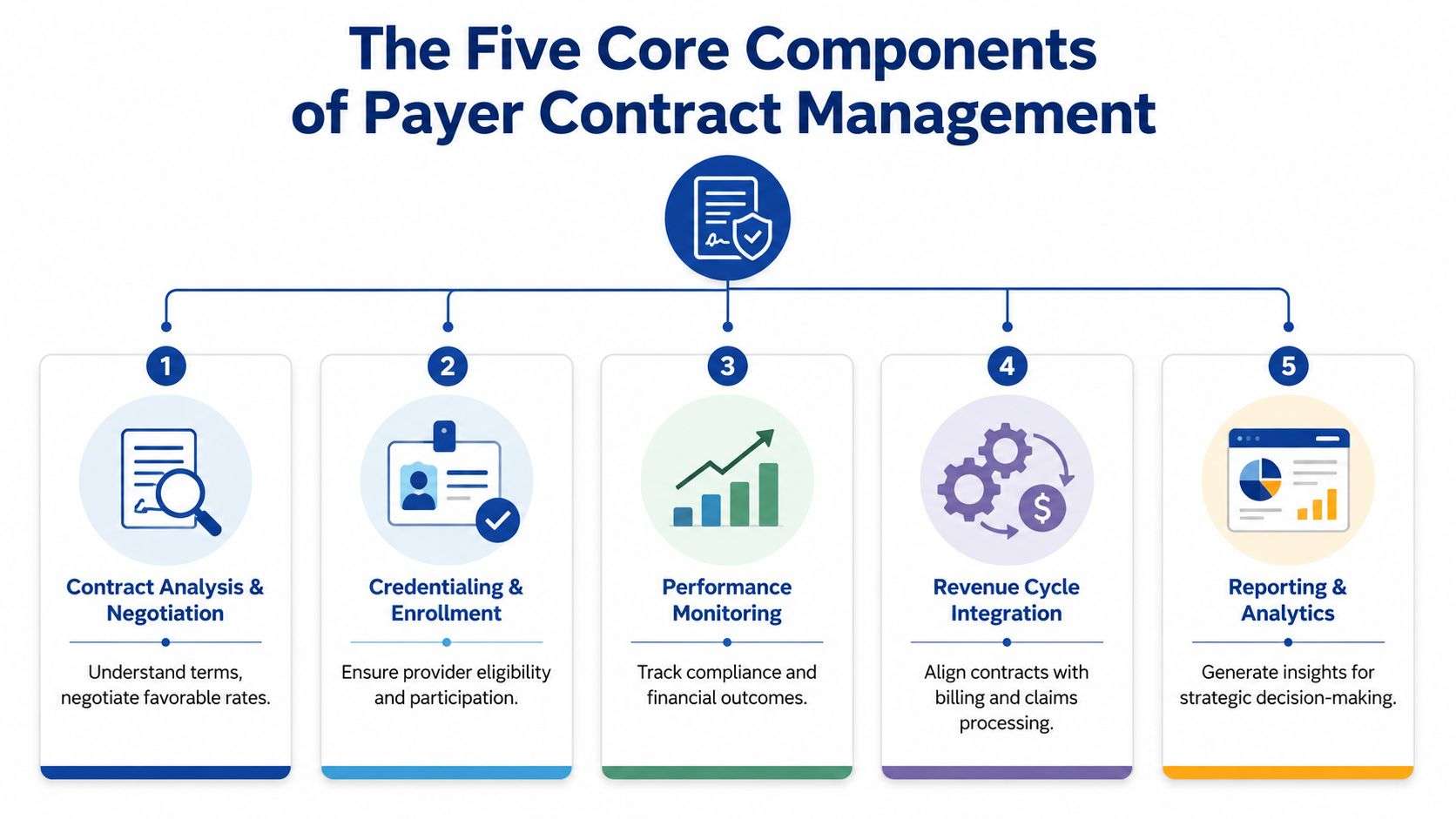
A practice that manages contracts well does five things consistently. Each component protects margin in a different way.
Contract Abstraction
Start here. If the contract stays trapped in legal language, nobody can apply it correctly at the point of billing, follow-up, or appeal.
Contract abstraction means pulling out the terms that drive payment and staff work. That includes fee schedules, carve-outs, timely filing limits, lesser-of provisions, authorization requirements, appeal windows, and any policy references incorporated by the agreement. The goal is not a summary for leadership. The goal is usable rules for the people touching claims every day.
This is also where many groups underestimate administrative burden. A payer with average rates and complicated rules can cost more than a payer with slightly lower rates and cleaner operations.
Reimbursement Reconciliation
Abstracted terms have to be tested against what the payer pays.
The strongest teams reconcile at the CPT or service-line level, not just against total claim dollars. That is how they catch partial underpayments, inconsistent application of multiple procedure rules, and recurring edits that never show up as obvious denials. A claim can look closed in the billing system and still be paid below contract.
I have seen practices focus only on negotiated rates and miss the bigger problem. Staff were spending hours chasing small variances across high-volume codes. The rate sheet was not the main issue. The payer's payment behavior was.
Rate Modeling
Rate modeling gives leadership a financial forecast before anyone signs an amendment or enters renewal talks.
A proposed increase only matters if it affects the codes and places of service your practice bills. If the payer improves reimbursement on low-volume services while holding the rest flat, the contract may sound better than it performs. Good modeling tests proposed terms against your own utilization, payer mix, and service mix so you can see the impact.
It also helps quantify trade-offs. A modest rate concession may be acceptable if the payer reduces prior authorization friction, cleans up edit logic, or shortens payment turnaround. That is part of the contract's value too.
Payer Policy Monitoring
Contracts do not operate in isolation. Payer policies can change payment behavior long before the agreement itself is renegotiated.
Bundling updates, medical necessity edits, prior authorization rules, documentation requirements, and portal submission changes all affect how hard your staff has to work to get paid correctly. If nobody is monitoring those shifts, denials increase, appeals take longer, and front-end teams keep using outdated rules.
This component matters just as much operationally as financially. It also connects to payer participation and enrollment status. If records are inaccurate or lagging, claims can fail for reasons that have nothing to do with fee schedules. That is why the provider credentialing process needs to stay aligned with contract oversight.
Workflow And System Integration
Contract management fails when the information lives in one place and the work happens somewhere else.
Terms should feed the systems your teams already use, including billing workflows, denial workqueues, expected reimbursement logic, and reporting tools. If staff have to search old PDFs, shared drives, and email threads to verify a rule, consistency breaks down fast. So does accountability.
Integration also helps expose the hidden hassle factor. You can see which payers generate more touches per claim, more preventable denials, more appeal labor, and more delays tied to manual processes. That visibility changes contract strategy. It shifts the conversation from "What is the rate?" to "What does it cost us to do business with this payer?"
A practical operating model usually includes these five habits:
- Abstract contracts into plain operational rules: Include payment terms and administrative requirements.
- Reconcile payments at a detailed level: Review patterns by code, modifier, and denial reason.
- Model proposed changes before signing: Use your own volumes, not payer assumptions.
- Track policy updates between renewals: Catch workflow changes before they hit cash.
- Connect contract terms to daily systems: Put the rules where staff work.
That is what turns payer contract management from a filing task into margin control.
How Poor Contract Management Silently Drains Your Revenue
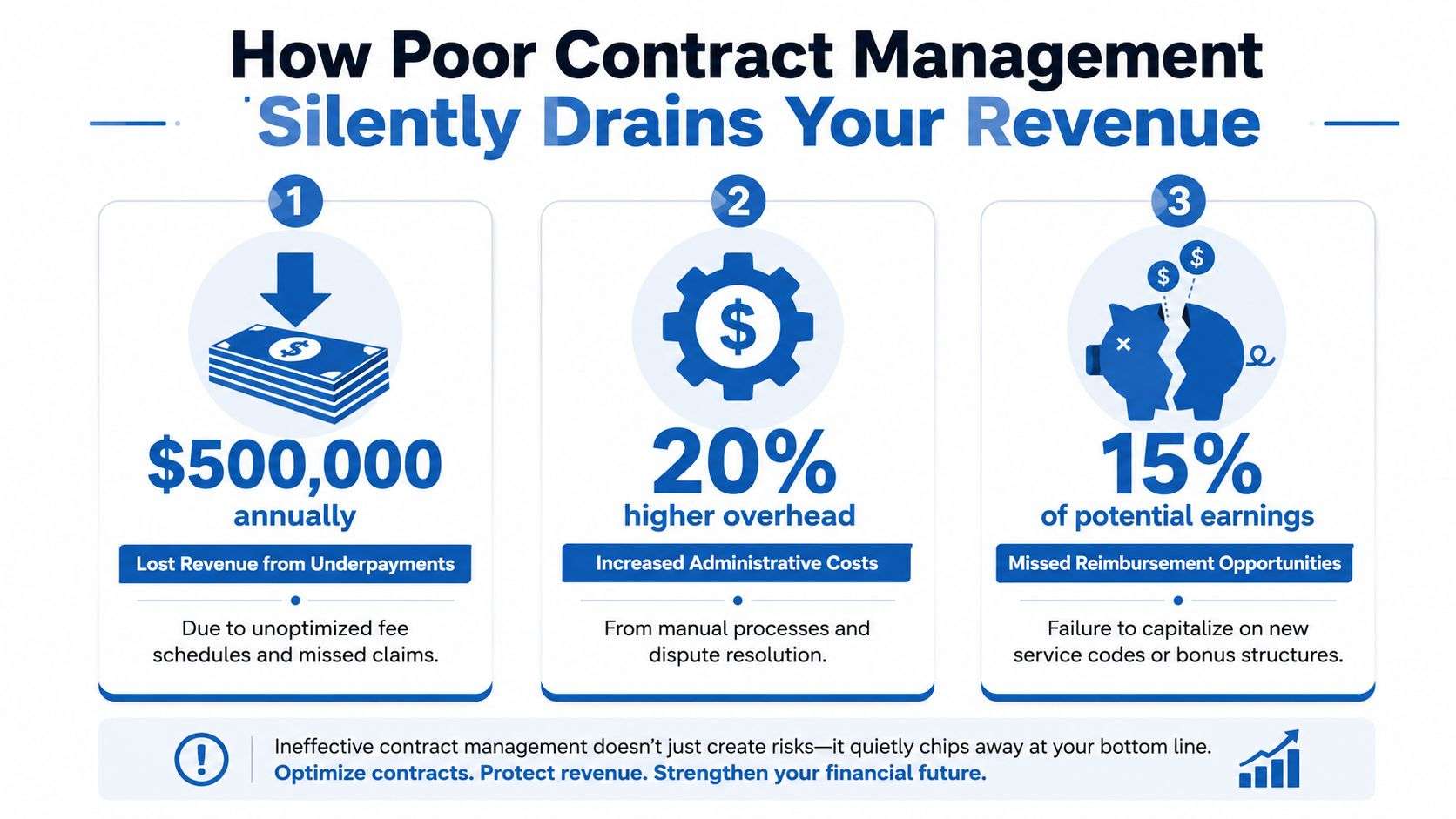
Poor payer contract management rarely creates one dramatic failure. It creates a steady stream of small misses that staff normalize over time. A claim pays a little light. A denial reason starts appearing more often. Appeals take longer. A contract renews without a hard review. Each issue seems manageable on its own. Together, they pull margin out of the practice.
Manual Oversight Is Expensive
The financial inefficiency of outdated processes is not a minor back-office annoyance. A Black Book Market Research study revealed that health providers spend nearly $157 billion annually on manual contract management, underscoring how costly fragmented oversight can become across the industry, as summarized by Contract Logix's review of healthcare contract management.
That spend shows up in labor, rework, delayed follow-up, missed renewal preparation, and weak visibility into payer performance. Teams end up paying for the same problem twice. First through administrative time, then through lost reimbursement.
The Three Revenue Drains That Hurt Most
The pattern usually falls into three buckets:
- Underpayments that nobody escalates: If posted payments aren't checked against contract logic, a variance can go unnoticed.
- Denials tied to payer-specific rules: The claim may be coded correctly and still fail because the payer changed an edit or policy requirement.
- Cash flow delays from avoidable friction: When disputes drag, payment timing becomes another hidden cost of the payer relationship.
The practices hit hardest are often the ones trying to manage contracts through spreadsheets, inboxes, and institutional memory. That setup doesn't scale well across multiple providers, specialties, or locations. It also makes it harder to see where contract terms are creating downstream billing problems, which is why many groups find that broader revenue cycle management challenges are really contract management problems in disguise.
A payer doesn't need to cut your rates to hurt profitability. It only has to create enough friction that your team spends more time chasing dollars than collecting them.
The Cost Of Looking Only At Rates
Many organizations often miss the bigger issue. They focus on headline reimbursement and ignore the administrative burden attached to a payer. But if one payer generates more prior authorization work, more avoidable denials, and slower appeals, the relationship can underperform even when its fee schedule looks acceptable on paper.
That hidden burden is often the difference between stable margins and constant revenue leakage.
A Step-By-Step Roadmap To Implementing Contract Management
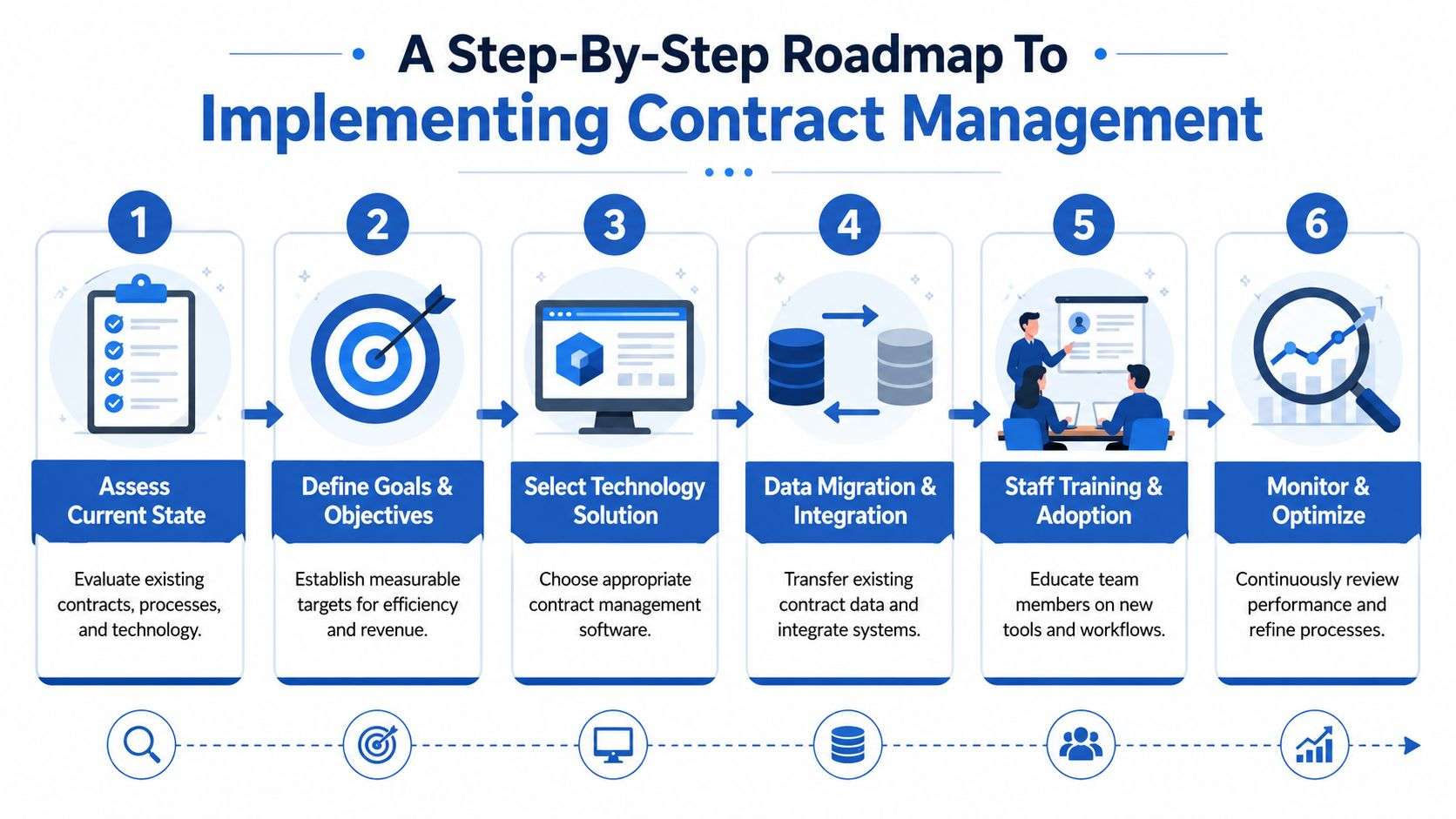
A practice usually realizes it has a contract management problem after a painful month closes. Collections miss target. Denials climb with one payer. Staff spend hours hunting down an amendment that nobody can find. The fee schedule may not even be the main issue. More often, the true loss comes from payer friction, rework, and slow correction cycles that never show up in the negotiated rate.
Start With One Repository
Gather every active contract, amendment, fee schedule, policy addendum, and notice letter into one repository. If terms are scattered across email, shared drives, desktops, and paper files, the team cannot enforce anything consistently.
This is not just a filing exercise. It is the base layer for payment review, renewal tracking, and dispute escalation. If an underpayment analyst, manager, and biller all reference different versions of the agreement, the payer wins that confusion every time.
Include metadata from the start. Track effective dates, renewal terms, notice periods, product lines, escalation contacts, and where fee schedules are stored. Those details save time later.
Prioritize Payers By Financial Impact And Hassle Factor
Do not review every payer with the same intensity. Start with the contracts that have the biggest effect on revenue and staff workload. Rivet Health recommends focusing first on the payers that matter most to the business, rather than spreading effort across the full portfolio, in its strategic payer contracting guidance.
Revenue should guide the list, but revenue alone is not enough.
A payer with acceptable rates can still be one of your least profitable relationships if it creates excessive prior authorization work, frequent policy edits, repeated medical necessity denials, or long appeal cycles. That is the administrative hassle factor, and it belongs in your prioritization model.
Use a short triage list:
- Highest-volume payer: The fastest place to find material payment variance.
- Payer with the most rework: Denials, reconsiderations, and manual follow-up consume staff capacity.
- Slowest-paying payer: Delayed cash has an operating cost.
- Recently amended contract: Early monitoring catches loading errors and misapplied terms.
- Payer with the most rule changes: Frequent policy shifts often create downstream billing friction.
Translate Contract Terms Into Operational Rules
A signed agreement does not help the business until the billing team can use it. Convert key terms into working rules for reimbursement, edits, filing limits, authorization requirements, appeal timelines, and carve-outs.
This step is where many implementations stall. The contract sits in legal or leadership files, while front-end and back-end teams keep working from payer habits and old assumptions. That gap creates avoidable denials and missed recovery opportunities.
Map each major contract term to the workflow it affects. If your organization is evaluating whether its current systems and staffing can support that level of control, an operational due diligence list helps identify the weak points before they become revenue problems.
Build Variance Reporting Into Daily Work
Set up a process that compares expected reimbursement to actual payment and flags exceptions quickly. The tool can be simple or complex. What matters is consistency and follow-through.
Keep the review tied to payment posting and denial management. If variance reporting lives in a separate report that nobody owns, underpayments age out and payer loading errors stay in production longer than they should.
At this stage, measure more than fee schedule variance. Track where staff time is going. A payer that pays close to contracted rates but generates repeated touchpoints may be costing more than a lower-friction payer with slightly weaker rates.
Monitor New Terms After Go-Live
New contract language means very little until claims are paid correctly under the new terms. Review early claims line by line after implementation and confirm that rates, modifiers, multiple procedure reductions, and carve-outs are loading as expected.
This review should continue long enough to catch lagging claims and setup mistakes. In practice, that often means watching a meaningful post-go-live window and assigning clear ownership for corrections, payer outreach, and retroactive recovery.
Operational checkpoint: Audit the first wave of paid claims under a new agreement before underpayments pile up into a larger appeals project.
Assign Ownership And Create An Escalation Path
Contract management fails when everyone touches it and no one owns it. Give one leader responsibility for repository integrity, payer prioritization, variance review, and escalation tracking. That person does not need to do every task, but the accountability needs to be clear.
Also define when routine follow-up becomes executive intervention. Some issues belong with billing. Others require provider relations, contracting, or legal review. If the team has no escalation path, payer friction becomes the default operating condition.
A workable roadmap is straightforward. Centralize the documents. Rank payers by both revenue value and administrative burden. Turn contract terms into workflow rules. Review payment variance as part of daily operations. Audit new agreements after go-live. Assign ownership. That is how contract management shifts from a static file cabinet function to an active revenue protection process.
Key Performance Indicators To Measure Your Success
A contract is not performing because rates look good in a spreadsheet. It is performing when expected reimbursement arrives, staff are not spending hours fixing avoidable payer issues, and cash reaches the bank on time.
That means your KPI set has to measure both reimbursement and friction. Many practices, however, overlook critical financial erosion. A payer with average rates and low administrative drag can outperform a payer with stronger rates that generates constant denials, edits, and rework.
Payment Accuracy At The Code Level
Start with paid amount variance at the CPT and HCPCS line level. Posting a claim as paid does not confirm the payer followed the contract. Underpayments often hide inside multi-line claims, modifier reductions, bilateral logic, or carve-out services that no one checked after adjudication.
Track expected versus actual reimbursement by code, payer, and place of service. Then separate one-off errors from repeat patterns. Repeat variance points to one of three problems. The payer loaded the contract incorrectly, your system logic is wrong, or the contract language leaves room for interpretation.
This KPI protects more revenue than many teams expect because line-level underpayments are easy to miss and hard to recover once they age.
Denial Patterns By Payer And Reason
Overall denial rate is too blunt to run a contract strategy. Break denials down by payer and reason category so the team can see what the contract relationship costs to maintain.
Focus on questions such as:
- Which payer creates the most avoidable rework per 100 claims?
- Which denial categories are trending up month over month?
- Which issues are operational, such as eligibility or authorization gaps?
- Which issues stem from payer policy edits, documentation rules, or inconsistent medical necessity reviews?
- Which denials are overturned on appeal, but only after multiple staff touches?
That last point matters. A denial that is eventually paid still carries a cost. If one payer requires repeated follow-up to get to the same reimbursement another payer issues cleanly, the lower-friction payer may be worth more to the practice even at a similar fee schedule.
Payment Velocity And Net Collections
Payment timing affects staffing, cash forecasting, and physician confidence in the revenue cycle. Measure days to pay, days in A/R by payer, and net collection rate against allowed amounts, not just charges.
Use these KPIs together. A payer may reimburse correctly but delay payment long enough to create cash pressure. Another payer may pay quickly on clean claims but stall every corrected claim or appeal. Both patterns weaken contract value.
I look for consistency here. One bad month may reflect a system issue or a temporary payer backlog. A payer that repeatedly pays late or slows reconsiderations is showing you how the relationship will operate.
Administrative Burden Per Payer
This is the KPI section too many articles leave out.
Measure the administrative hassle factor directly. Track touches per claim, appeal volume, reconsideration turnaround, authorization overturn rate, portal dependency, and staff hours spent resolving payer-specific issues. If your team cannot capture hours precisely, start with proxy measures such as claims requiring manual intervention, average follow-up touches, and volume of corrected claims by payer.
These metrics show the hidden cost of doing business with a payer. A contract can look acceptable on reimbursement and still lose margin because your staff has to fight for payment on too many claims.
A practical dashboard should help leadership answer four questions quickly:
- Are we getting paid according to contract?
- How long does it take to get paid?
- How much staff effort does this payer consume?
- Is payer performance improving, holding steady, or getting worse?
Underpayment Variance By Payer
If I could choose one executive KPI, this would be near the top. Underpayment variance by payer shows the gap between expected and actual reimbursement often enough to justify escalation, system correction, or formal contract review.
It also connects finance and operations. Finance sees missed dollars. Operations sees where those dollars are leaking through configuration errors, payer adjudication issues, unclear contract terms, or chronic follow-up burden.
Leadership teams that monitor denial trends without underpayment variance are only seeing part of payer performance. The fuller view comes from pairing reimbursement accuracy with the cost of collecting it.
Best Practices And Common Pitfalls To Avoid
Strong contract management gets sharper when the organization stops treating all payer problems as rate problems. Some payers underperform because the fee schedule is weak. Others underperform because they create so much friction that the net value of the relationship drops.

Best Practices That Actually Hold Up
The basics still matter. According to MGMA, 75% of healthcare practices review their payer contracts at least once a year, and the standard operational discipline is to centralize agreements and prepare renewal strategy at least 90 days before expiration, as discussed in HyperStart's payer contract management overview.
That timing matters because rushed renewals result in a diminished negotiating position. Teams need enough runway to compare actual performance against contract terms, identify underpayments, and decide what they'll ask for before the notice window closes.
The best-performing organizations also do these things consistently:
- Review the total payer relationship: Don't isolate reimbursement from denials, payment timing, and policy burden.
- Track amendments and notice provisions carefully: Evergreen clauses and renewal windows can lock in bad terms.
- Model difficult language before accepting it: Lesser-of provisions and policy-based payment references can erode expected value.
- Push payer intelligence back to operations: Front-end and billing teams need updated guidance, not just executives.
Quantify The Administrative Hassle Factor
Advanced payer contract management separates itself from basic contract filing.
MGMA reports that 48% of medical group leaders cite denials and appeals as their biggest revenue cycle leak, yet many negotiation frameworks still don't assign a monetary value to payer friction. That's a missed opportunity. If one payer drives excessive prior authorizations, more appeal work, or repeated documentation demands, your team is absorbing labor cost and cash flow delay whether the fee schedule reflects it or not.
A practical hassle factor review should include:
- Staff touch volume: Which payer forces the most repeat work on the same claim family.
- Prior authorization burden: Which plans add front-end labor before care is even delivered.
- Appeal drag: Which payer takes the longest path from denial to payment.
- Policy instability: Which payer changes operational rules often enough to create rework.
Turn those findings into negotiating power. If the payer won't reduce friction, the contract should compensate for it.
Common Mistakes That Keep Practices Reactive
Some errors show up over and over:
- Treating contracts as legal documents only
- Waiting until renewal season to investigate performance
- Assuming acceptable rates offset bad payer behavior
- Failing to test whether new terms were loaded correctly
- Letting operational pain live outside negotiation strategy
When leaders start pricing administrative drag alongside reimbursement, negotiations become much more honest.
How A Billing Partner Strengthens Your Contract Strategy
A common pattern shows up after a difficult quarter. Payments are inconsistent, denial rework keeps growing, and leadership assumes the contracts need to be renegotiated. Then a closer review shows something else. The rates may be acceptable, but the practice is losing margin to manual follow-up, inconsistent payer edits, missed underpayments, and slow appeals. That administrative hassle factor is where a billing partner can change the economics.
An internal team can build a disciplined contract management process, but it takes protected time and tight execution. Someone has to abstract terms, compare expected versus actual reimbursement, watch for payer policy changes, test loaded fee schedules, and flag contract provisions that create extra staff work. In many practices, those tasks get split across billing, front office, and leadership. The result is partial visibility.
A good billing partner closes those gaps with repeatable controls. The value is not just better reporting. It is faster underpayment detection, cleaner variance reviews, stronger denial follow-up, and a clearer picture of which payers cost the practice too much to work. That last point matters. A payer with decent rates can still be unprofitable if its authorization rules, documentation demands, and appeal behavior consume too many staff hours.
Technology plays a role here, but only if it supports daily operations. Practices that are reviewing billing infrastructure may also look at tools such as Odoo integrated billing solutions to see how billing workflows connect with the rest of the practice. The system matters less than the discipline behind it. If expected reimbursement is not being compared to actual payment, contract terms are not being monitored in production.
Outside support also creates focus. Instead of asking one internal team to be contract analyst, payment auditor, denial specialist, and negotiator at the same time, a billing partner can take ownership of the day-to-day controls that keep contracts from drifting. That is one reason practices often review the benefits of outsourcing medical billing when payer behavior is creating more operational drag than the team can absorb.
The best partnerships improve negotiating position before renewal talks even start. They give the practice evidence. Which payer underpays most often. Which one changes rules without enough notice. Which one creates avoidable touches that raise cost to collect. With that information, contract strategy stops being a rate discussion alone and becomes a margin discussion.
If your practice is tired of unpredictable payments, growing denial work, and payer contracts that never seem to perform the way they should, One For All Medical Billing can help you regain control. Their team supports providers with billing, reconciliation, denial follow-up, reporting, and revenue cycle workflows that make contract performance easier to monitor and improve.

