

table of contents
When you boil it down, the real benefits of outsourcing medical billing are pretty straightforward: you bring in more revenue, cut down on operational headaches, and get far fewer claim denials. Most importantly, it gives you and your staff more time to actually focus on patient care.
It’s about turning a frustrating administrative chore into one of your practice’s biggest strengths.
What Are The Real Benefits Of Outsourcing Medical Billing?
Trying to manage billing in-house can feel like you’re lost in a maze. Every wrong turn with a payer, every coding error, and every missed follow-up costs you real money and valuable time. Think of an outsourced billing partner as your expert guide—someone who already knows the fastest, most effective route to get you paid correctly and on time.
This isn't just a cost-cutting measure. It's a strategic decision that strengthens the financial health of your entire practice.
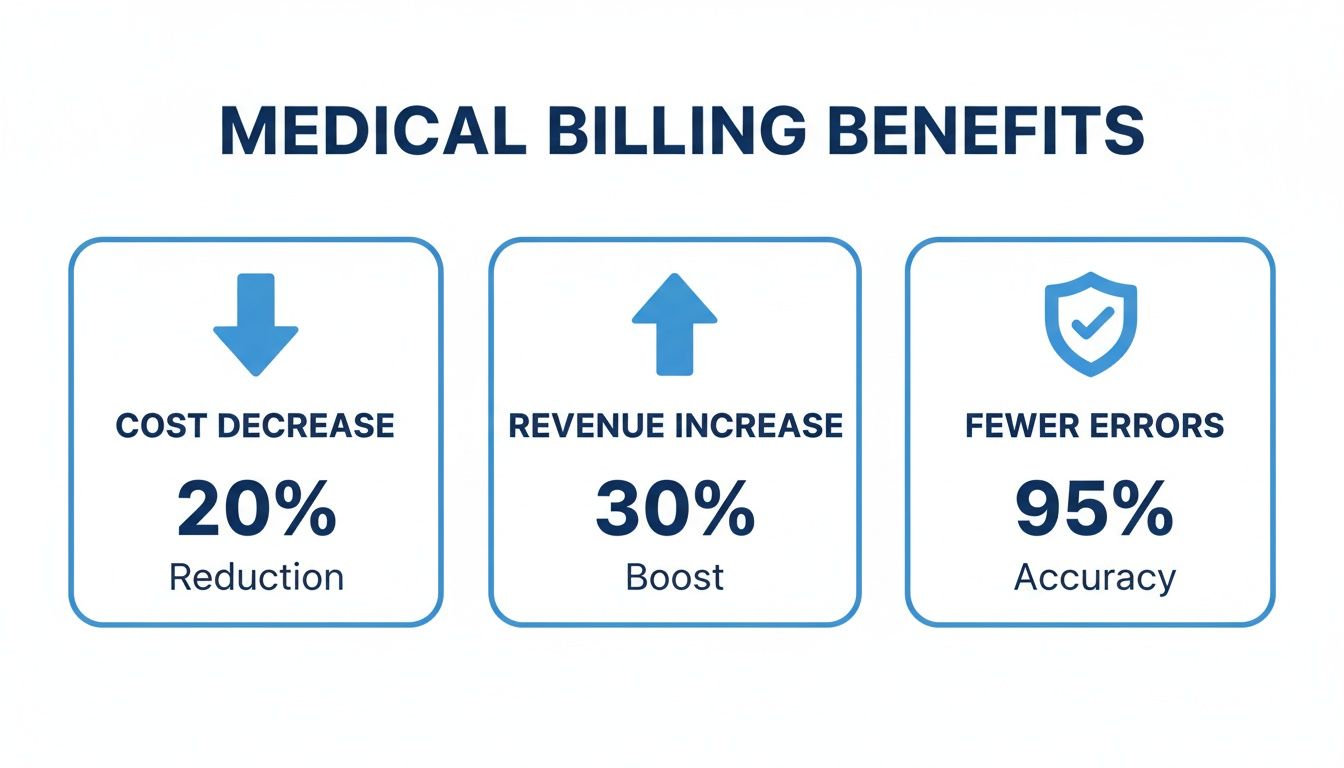
As the numbers show, partnering with a billing expert delivers a powerful one-two punch—it lowers your overhead while simultaneously boosting the income you work so hard to earn.
1. Increased Revenue And Improved Cash Flow
Outsourcing medical billing has become a go-to strategy for a reason: it works. For starters, it’s one of the fastest ways to improve profitability.
A 2023 report found that U.S. practices that switched to an outsourced service saw their billing-related expenses drop by an average of 16.9%. But it’s not just about saving money. That same study showed an average revenue increase of 11.6%, simply because a dedicated team was catching errors and fighting for every dollar.
The real win with outsourcing is that you take a necessary but distracting administrative task and turn it into a well-oiled machine that actively improves your bottom line. It lets you refocus your team and resources on what you do best—caring for patients.
2. Fewer Denials And Faster Payments
Let’s be honest: claim denials are a huge source of frustration and lost revenue. A professional billing team lives and breathes payer rules, coding updates, and submission requirements. Their entire job is to get your claims paid on the first pass.
Here’s how they make it happen:
- Expert Coders: Certified coders ensure claims use the correct CPT, ICD-10, and modifier codes to support medical necessity.
- Proactive Error Checking: Before a claim even goes out the door, their systems and specialists scrub it for common mistakes that trigger denials.
- Dedicated Follow-Up: When a denial does happen, they have a team ready to immediately investigate, appeal, and get it resolved. You’re no longer the one stuck on hold with the insurance company.
This direct-to-expert approach has a massive impact on your entire revenue cycle. If you’re interested in the bigger picture, you might want to read our guide on the core benefits of revenue cycle management.
3. Reduced Administrative Burden On Your Staff
This shift does more than just help your finances. It takes the high-stress, repetitive work of claim management off your team’s plate. Instead of chasing down payments or wrestling with confusing EOBs, your in-house staff can focus on higher-value activities that improve the patient experience right in your office.
In-House Versus Outsourced Billing At A Glance
To make the comparison clearer, let's look at how the two models stack up on key metrics that matter to any practice.
Overhead Costs:
- In-House: High (salaries, benefits, software, training)
- Outsourced: Lower (predictable monthly fee, no overhead)
Claim Denial Rate:
- In-House: Typically 5-10% or higher
- Outsourced: Often below 5% due to specialized focus
Staffing:
- In-House: Dependent on 1-2 key people; risk of turnover
- Outsourced: Access to a full team of experts; no turnover risk
Technology:
- In-House: Requires investment in software & updates
- Outsourced: Uses advanced, industry-leading software
Focus:
- In-House: Staff is pulled in multiple directions
- Outsourced: Singular focus on maximizing your collections
Scalability:
- In-House: Difficult to scale as your practice grows
- Outsourced: Easily scales with your practice's growth
This comparison highlights the core trade-offs. While in-house billing offers direct control, it comes with significant operational costs and risks that a dedicated outsourced partner is built to absorb.
Increase Revenue And Accelerate Your Cash Flow

This is where outsourcing really proves its worth—right on your practice’s bottom line. A specialized billing partner isn’t just a vendor; they act as a financial engine, actively working to boost your income and shorten the time it takes to get paid. After all, their entire business is built around maximizing your collections.
Think of your revenue cycle as a pipeline. When handled in-house, that pipeline can easily get clogged with denied claims, coding errors, and slow insurance payments. Outsourcing brings in experts who are masters at clearing those blockages, ensuring a smooth, predictable flow of cash right back into your practice.
Achieving Higher Clean Claim Rates
The foundation of a healthy revenue cycle is getting claims right the first time. This is where outsourced billing teams are laser-focused, often achieving clean claim rates above 95%. A clean claim gets processed and paid without any frustrating delays or rework.
So, how do they do it? It comes down to a few key tactics:
- Proactive Insurance Verification: Before a patient even walks through the door, the billing partner confirms active coverage and benefits. This simple front-end step prevents a huge number of denials tied to eligibility.
- Expert Coding and Auditing: Certified coders who live and breathe your specialty review every single claim. They make sure all services are coded for maximum appropriate reimbursement, leaving no money on the table.
This meticulous, multi-step process means fewer rejections, which translates directly to faster payments. Most practices feel the financial impact almost immediately as their days in accounts receivable (A/R) start to drop.
By focusing on claim accuracy from the start, an outsourced partner fundamentally shifts your billing from a reactive, problem-solving chore to a proactive, revenue-generating one. This change is key to accelerating cash flow.
One of the most powerful benefits is the overall improvement in healthcare revenue cycle management, which minimizes denials and ensures you get paid faster. Specialized partners routinely hit clean claim rates well above 90%, a stark contrast to the high denial rates that can cripple in-house operations. It’s no surprise the global market for these services is projected to grow significantly, driven by billing complexity and rising denials.
Relentless Pursuit Of Aged Claims
Even with a sky-high clean claim rate, some denials are inevitable. The real difference is how they’re handled. Your busy front-office staff likely doesn't have the time to chase down every unpaid claim, which often leads to painful, unnecessary write-offs.
An outsourced team, on the other hand, has dedicated specialists for accounts receivable (A/R) follow-up. It’s their entire job to persistently pursue aged and underpaid claims. They investigate the root cause of each denial and systematically appeal it until you get paid.
This relentless follow-up recovers revenue that would have otherwise been lost forever, giving a measurable and immediate boost to your monthly collections.
Reduce Costly Claim Denials And Administrative Headaches

Claim denials are one of the biggest headaches in any practice. They aren’t just a hit to your bottom line; each one kicks off a frustrating, time-sucking cycle of investigating, correcting, and resubmitting claims. This administrative churn pulls your staff away from what they should be doing—helping patients.
This is where one of the clearest benefits of outsourcing medical billing comes into play: operational relief and real cost savings.
Think of an outsourced team as your practice’s financial defense line. Their job isn’t just to react to problems as they happen, but to stop them from ever occurring. It’s a lot like preventative care for your revenue cycle—addressing the root causes of denials before they can lead to a rejection.
A Proactive Defense Against Common Denial Triggers
A dedicated billing partner has one job: submitting clean claims that get paid the first time. Their specialists are trained to catch the small mistakes and inconsistencies that an in-house team, juggling a dozen other tasks, can easily miss.
This "financial defense" includes a few key moves:
- Preventing Coding Errors: Certified coders make sure every claim is accurate and fully compliant, heading off one of the top reasons for denials.
- Managing Prior Authorizations: They proactively track and secure pre-approvals so you don’t get hit with a retroactive denial for an unauthorized service.
- Meeting Filing Deadlines: Outsourced teams use dedicated systems to guarantee every claim is submitted well within a payer’s timely filing limits.
And when a denial does slip through? A professional partner already has a team in place ready to tackle it. You can see how experts handle this process in our guide on effective medical billing denial management.
By entrusting billing to specialists, you transform a reactive, fire-fighting activity into a strategic, preventative function. This shift not only protects revenue but also frees your internal team to focus on creating a better patient experience.
Uncovering The Hidden Costs Of In-House Billing
Many practices don't realize the true cost of managing billing internally. The expenses pile up far beyond just salaries. When you actually add up all the overhead, the financial weight often becomes much heavier than the perceived benefit of keeping it all in-house.
The hidden costs of an in-house billing team include:
- Staff Salaries and Benefits: Competitive pay, health insurance, retirement contributions, and paid time off for one or more full-time employees.
- Continuous Training: The non-stop expense of keeping your team educated on constantly changing payer rules and coding updates.
- Software Subscriptions: Pricey licenses for billing software, clearinghouse access, and coding tools—plus the fees for every update.
- Productivity Gaps: Lost revenue during staff vacations, sick leave, or the long, slow period of recruiting and training a replacement after someone leaves.
Handing these responsibilities off to an outsourced partner gets rid of these direct and indirect costs. You swap a long list of unpredictable expenses for a single, predictable fee, which simplifies your budget and lets your staff get back to what they do best.
Navigate Compliance And Minimize Audit Risks
The world of healthcare regulations is a constantly moving target. With frequent updates to billing codes, payer policies, and HIPAA rules, just keeping your practice compliant can feel like a full-time job. A single misstep can lead to denied claims, costly penalties, and even legal trouble down the road.
This is where one of the most critical benefits of outsourcing medical billing really shines. A dedicated billing partner acts as your compliance shield, expertly navigating the turbulent skies of healthcare regulations so you can focus on what matters most—patient care. They invest heavily in ongoing training and advanced technology to stay far ahead of these complex changes.
Staying Ahead Of Regulatory Changes
Reputable outsourcing partners employ teams of certified experts whose primary job is to stay current with every new rule. This isn't a side task for them; it's their core function. Their expertise protects your practice from the very real financial risks that come with non-compliance.
This proactive approach ensures that your billing operations are always audit-ready. Key areas where they provide a safety net include:
- HIPAA Compliance: Safeguarding patient data with robust security measures, from fully encrypted systems to certified staff.
- Coding Accuracy: Making sure all claims adhere to the latest ICD-10, CPT, and HCPCS coding guidelines to prevent audit red flags.
- Payer-Specific Rules: Tracking the individual policy changes of dozens of insurance carriers, a task that is nearly impossible for most in-house teams to manage effectively.
By partnering with a compliance-focused team, you gain invaluable peace of mind. You can be confident that your billing processes are not only efficient but also fully aligned with current industry standards, minimizing your exposure to audits and penalties.
The Value Of An Audit-Ready Partner
This constant vigilance is a huge advantage. Practices that manage billing internally often struggle to keep up, as their staff are pulled in many different directions. An outsourced partner, however, is built for this. Their entire system is designed to enforce compliance at every single step of the billing cycle.
This means that if an auditor ever does come knocking, your records are clean, organized, and completely defensible. Maintaining that level of preparation in-house is difficult and expensive, but it's a standard feature of a quality outsourcing service. Understanding what goes into this preparation is key; for more detail, you can check out our guide on preparing for a HIPAA compliance audit.
Ultimately, this peace of mind allows you and your providers to concentrate on patient outcomes, knowing your financial operations are secure.
Scale Your Practice And Empower Your Staff

As your practice gets busier, the last thing you want is for administrative headaches to slow you down. This is where outsourcing medical billing really shines—it gives you the ability to scale up without the usual growing pains.
Think about it: adding a new provider, opening another clinic, or launching a new service line can create a logistical mess for your in-house team. Suddenly, you need more billers, more training, and more office space.
With an outsourced partner, that chaos disappears. Their teams and systems are already built to absorb a higher claim volume. You just let them know you're expanding, and they handle the rest. No hiring freezes, no frantic training sessions—just smooth, predictable growth.
Empower Your Team To Focus On Patients
Beyond making growth easier, outsourcing gives your current staff a massive morale boost. Let’s be honest, medical billing is a tough, repetitive job that can quickly lead to burnout. Taking claim submissions, denial follow-ups, and payment posting off their plate frees them up to do what they’re truly great at.
This shift allows your team to focus on high-impact work that directly improves the patient experience. Instead of being buried in paperwork, your front-office staff can dedicate their energy to greeting patients warmly, streamlining check-in, and answering questions with a smile.
When your staff is no longer bogged down by billing complexities, they can provide the kind of attentive, personalized care that builds patient loyalty and satisfaction. This not only reduces burnout but also fosters a more positive and productive work environment for everyone.
You're essentially changing their job description from administrative firefighter to patient advocate. The result is a more efficient office and a happier, more engaged team.
From Administrative Burden To Strategic Advantage
At the end of the day, outsourcing isn’t about replacing your people; it’s about putting their talents to better use. It turns a back-office necessity into a real strategic advantage that supports both your growth goals and your team’s well-being.
Key advantages for your staff include:
- Reduced Stress and Burnout: Offloading complex billing tasks removes one of the biggest sources of administrative stress.
- Greater Job Satisfaction: Employees get to focus on more fulfilling work, like interacting with patients and improving front-office flow.
- Improved Productivity: With fewer billing distractions, your team can operate more efficiently and provide better support for providers.
This approach ensures that as your practice scales, your team feels empowered rather than overwhelmed. It’s a crucial step toward building a sustainable, patient-centered, and financially healthy practice.
So, you see the value in outsourcing your medical billing. That's the easy part. The real challenge is picking the right partner—a decision that will directly shape your practice's financial future.
This isn't just about comparing prices on a spreadsheet. It's about finding an extension of your team, a group of experts who will actively work to improve your collections, slash denial rates, and make your operations run smoother.
Think of it this way: you wouldn't hire a new provider without rigorously checking their credentials, experience, and references. You should apply that same level of diligence here. Your goal is to find a partner whose expertise and processes fit your practice like a glove.
Evaluate Specialty-Specific Experience
Not all medical billing is created equal. A partner with deep experience in your specific field—whether it’s pediatrics, urgent care, or pain management—already knows the unique coding challenges and payer rules that trip up generalists.
This specialized knowledge is what separates an average biller from a great one. They can spot opportunities to maximize reimbursement and catch denial trends before they become major problems.
Ask potential partners for case studies or references from practices just like yours. If they can speak fluently about your most common procedures and diagnoses, that’s a very good sign.
The right partner doesn’t just process claims; they optimize them. Their specialty-specific insight allows them to spot coding opportunities and denial trends that a generalist might miss, directly impacting your bottom line.
Demand Transparency And Actionable Reporting
Outsourcing should give you more visibility into your financials, not less. You should never feel like your revenue cycle is a black box. A quality billing partner will offer total transparency with detailed, on-demand reporting.
Look for companies that provide clear dashboards and analytics covering your key performance indicators (KPIs). At a minimum, you need consistent access to these reports:
- Clean Claim Rate: The percentage of claims paid correctly on the first try.
- Denial Rate: A breakdown of exactly why claims are being rejected.
- Days in A/R: How quickly your practice is getting paid.
- Collection Rate: The ultimate measure of your financial performance.
This data empowers you to make smart, informed decisions based on real numbers. And to truly evaluate the value a partner brings, it helps to understand how their fees are structured. Learning more about medical billing services pricing gives you the context to calculate the real return on your investment.
A Checklist For Choosing Your Partner
Finding the right fit requires asking the right questions. This isn't just a discovery call; it's an interview for a critical role in your practice. Use this checklist to guide your conversations and compare potential partners head-to-head.
Vendor Selection Checklist
Specialty Expertise
- Question: Do you have experience with my specialty? Can you provide references or case studies from similar practices?
Technology & Integration
- Question: What billing software do you use? How will it integrate with our current EHR/PM system? Can we see a demo?
Reporting & Transparency
- Question: What KPIs do you track? How often will we receive reports? Do we have 24/7 access to a dashboard?
Denial Management
- Question: What is your process for handling denied claims? What is your average appeal success rate?
Pricing & ROI
- Question: What is your pricing model? Are there any hidden fees? What is the average collection increase you see for new clients?
Onboarding & Support
- Question: What does your onboarding process look like? Who will be our dedicated point of contact?
Compliance & Security
- Question: How do you ensure HIPAA compliance? Can you provide details on your data security measures?
By systematically vetting each potential partner, you move beyond sales pitches and get to the core of what matters: their ability to deliver real, measurable results for your practice. The time you invest upfront will pay dividends for years to come.
Answering Your Questions About Outsourcing Medical Billing
It’s completely normal to have questions before handing over the keys to your revenue cycle. It's a big decision, and you should feel confident about it. Let's walk through the three biggest concerns we hear from practices and get you the clear, straightforward answers you need.
How Is The Cost Of Outsourcing Determined?
Most expert billing services charge a percentage of what they actually collect for you. This fee typically falls between 4% and 8% of monthly collections. The model is simple: if you don’t get paid, neither do they. Their success is directly tied to yours.
But focusing only on that percentage fee is a mistake. The real question is about the net financial gain. A strong partner will always deliver an ROI that more than covers their fee by increasing your total collections and getting rid of the hidden costs of in-house billing—like salaries, benefits, software fees, and ongoing training.
The key is to shift your focus from the service fee to the net financial return. A great partner will deliver an ROI that far outweighs their cost by boosting revenue and cutting operational expenses.
Will I Lose Control Over My Practice's Financials?
This is probably the most common myth we hear, but the reality is just the opposite. A reputable billing partner gives you more financial visibility than most in-house teams can ever provide. You aren't giving up control; you're gaining data-driven oversight.
Professional billing companies give you total transparency through on-demand reports and analytics dashboards. You get 24/7 access to your practice’s most important numbers, including:
- Real-time clean claim rates
- Detailed denial analysis
- Days in A/R trends
- Overall collection performance
This level of insight shows you exactly where your revenue stands at all times. It empowers you to spot issues instantly and make strategic decisions, giving you more meaningful control over your financials, not less.
How Is My Patient Data Kept Secure?
In healthcare, data security isn't just important—it's non-negotiable. That's exactly why you should only consider a fully HIPAA-compliant partner. Professional billing companies live and breathe these regulations and invest heavily in security measures to protect both your practice and your patients.
These safeguards are usually far more advanced than what a single practice can afford to build on its own. They often include multi-layered protections like fully encrypted data centers, secure file transfer protocols, and intensive, ongoing security training for every certified team member. Your partner’s entire business relies on flawless security, which means your data is protected by expert-level protocols around the clock.
Ready to transform your revenue cycle with a partner you can trust? The team at One For All Medical Billing combines specialty-specific expertise with robust, HIPAA-compliant processes to deliver faster payments and fewer denials. Learn how we can help your practice thrive by visiting https://oneforallmed.com and scheduling a free consultation today.

