
table of contents
The revenue cycle is the complete financial journey of a patient account, from eligibility checks and authorization before the visit through charge capture, claim submission, payment posting, denials, appeals, and final collections. That journey matters because claim denials are common, with broader estimates showing 5% to 10% of claims are denied annually, and those breakdowns contribute to as much as $262 billion in lost revenue each year for U.S. providers.
If your practice is busy but cash still feels uneven, the problem often isn't patient volume. It's that money is getting slowed, diverted, or lost somewhere along the path from appointment to payment.
A useful way to define revenue cycle is to think of it as the financial circulatory system of a healthcare practice. Patients are the reason care begins, but accurate data, clean documentation, correct coding, and disciplined follow-up are what keep cash moving. If one early step fails, the problem usually shows up later as a denial, delayed payment, or patient balance that becomes harder to collect.
What Does The Healthcare Revenue Cycle Define
When people ask you to define revenue cycle, they're usually asking one of two things. They either want the basic meaning, or they want to know why their billing operation feels harder than it should.
The basic meaning is straightforward. In healthcare, the revenue cycle is the end-to-end process that follows a patient encounter from pre-service eligibility checks and prior authorization through charge capture, claim submission, payment posting, denials, appeals, and collections, as outlined in Stripe's healthcare revenue cycle overview.
That sounds like a billing definition, but it's broader than billing alone. It includes front-desk intake, insurance verification, provider documentation, coding, payer communication, and patient collections.
Why This Definition Matters In Daily Operations
A practice manager sees the revenue cycle most clearly when something goes wrong.
A patient gets scheduled with outdated insurance. A prior auth requirement gets missed. A coder has to work from incomplete documentation. The claim goes out late or incorrect. Payment posting reveals a short pay. Then someone has to rework the account. What looked like one small issue at check-in becomes a multi-step cash problem weeks later.
Practical rule: If your front end is sloppy, your back end gets expensive.
That's why the revenue cycle isn't just a back-office concept. It's an operating system for how a practice turns care into cash.
If you want a broader operational view, this guide to healthcare revenue cycle services shows how the full workflow connects across teams. For a busy clinic, that connection is the whole point. The cycle starts before the visit, touches nearly every department, and only ends when the account is fully resolved.
The Seven Stages Of The Healthcare Revenue Cycle
The easiest way to understand the cycle is to follow the patient account as it moves forward, like a relay race. Each handoff has to be clean. If one runner drops the baton, the rest of the race gets harder.
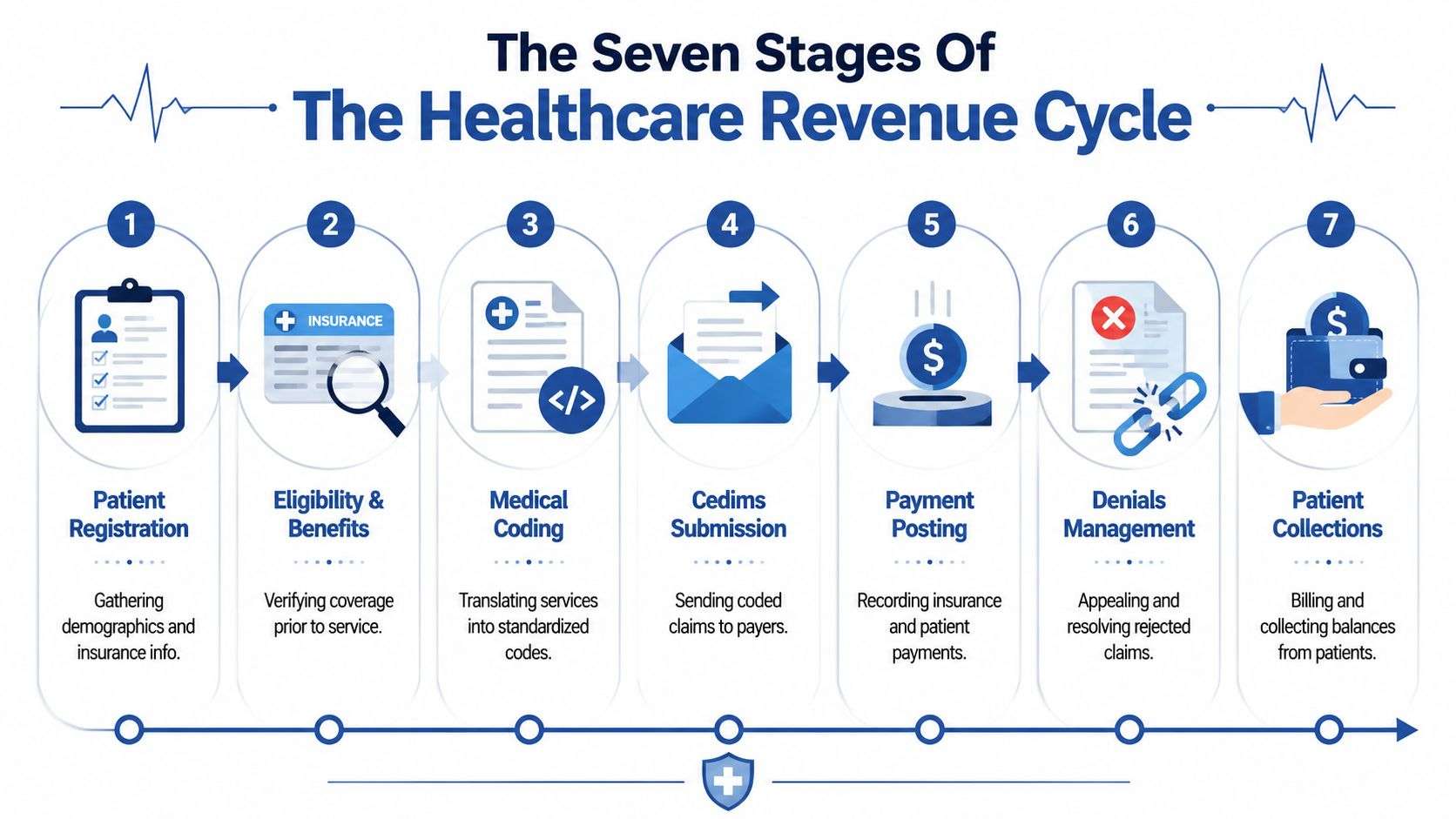
Pre Registration
This stage starts before the patient arrives. Staff collect demographics, insurance details, referral information, and appointment data.
Good pre-registration does two things. It gives the practice accurate information to work from, and it reduces surprises later. If the wrong plan is entered or a subscriber ID is missing, the claim problem has already started even though no claim exists yet.
Eligibility And Authorization
Here, staff verify whether the patient is covered for the scheduled service and whether prior authorization is required.
Many practices save or lose time depending on how certain processes are managed. A service can be clinically appropriate and still become a billing issue if the payer needed authorization first. The patient may also have cost-sharing responsibilities that should be discussed before the visit, not after a confusing bill arrives.
Patient Check In And Charge Capture
At check-in, the practice confirms that the information on file is still accurate. During and after the visit, the clinical team documents what happened and the practice captures the services provided.
This step sounds routine, but it's where the financial record starts taking shape. If a provider performs a service that never gets captured, it never reaches the claim correctly.
The fastest way to create downstream rework is to assume the information collected last visit is still correct today.
Medical Coding
Coding turns clinical documentation into standardized billing language. That includes diagnosis and procedure coding aligned with payer rules and the documented encounter.
Coding quality depends heavily on the chart. If the documentation is vague, the coder is forced to stop, query, or code conservatively. That can slow submission or affect reimbursement.
A common misunderstanding is that coding errors only happen in the billing office. In practice, many coding issues begin with incomplete provider notes.
Claims Submission
Once charges and codes are ready, the claim goes to the payer. This step includes claim scrubbing, edits, and transmission.
The goal here is simple. Send a clean claim the first time. Every preventable error at submission creates rework, delay, and pressure on cash flow.
Three common submission problems are:
- Missing Data: Subscriber details, modifiers, rendering provider information, or authorization numbers are incomplete.
- Payer Rule Mismatch: The claim format doesn't align with the payer's filing or coverage rules.
- Timing Delays: The claim sits in a work queue instead of going out promptly.
Payment Posting
When payers and patients make payments, staff post them to the account and reconcile what was paid versus what was expected.
This stage gives you visibility into reality. It shows whether the payer paid correctly, reduced the claim, denied it, or shifted responsibility to the patient. Without accurate posting, managers can't trust A/R reports or spot payer patterns.
Denial Management And A R Follow Up
This is the recovery stage. Denied or underpaid claims are reviewed, corrected, appealed when appropriate, and followed until the account reaches resolution.
A disciplined A/R team doesn't just work accounts. They also identify why claims are breaking in the first place. If denials cluster around one payer, one location, one service line, or one registration habit, the fix should happen upstream.
Think of the cycle like a circulatory system. Registration is the intake valve. Documentation and coding are the heart pumping data forward. Claims submission carries value to the payer. Payment posting and follow-up return cash to the practice. If one vessel is blocked, the whole system strains.
Key Performance Indicators For Revenue Cycle Health
A practice can stay busy all week and still feel a cash squeeze by Friday. That usually means the clinical side is working, but the financial circulatory system is not moving cash back fast enough. KPIs help you see where the flow is slowing.
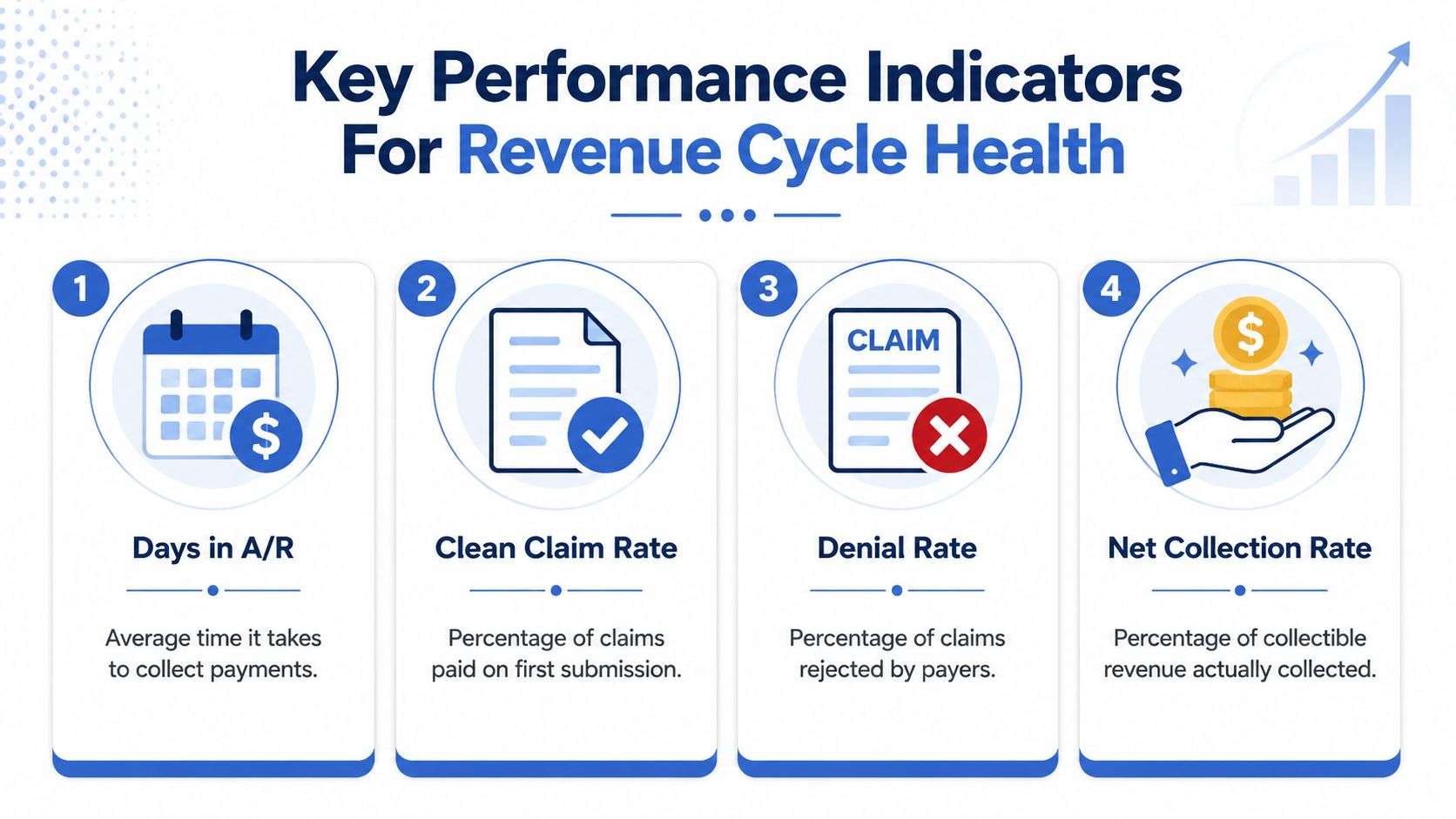
These measures are also where many managers mix up the terms revenue cycle and revenue cycle management. The revenue cycle is the path a dollar follows from scheduling to final payment. Revenue cycle management is the work of monitoring that path, finding blockages, and fixing them before they spread downstream.
Days In Accounts Receivable
Days in A/R measures how long it takes for billed services to turn into cash. HFMA guidance commonly places healthy performance in the roughly 30 to 40 day range, with many organizations working to keep A/R under 45 days, according to HFMA revenue cycle guidance.
This number matters because it exposes delay in a form a manager can act on. If Days in A/R climbs, cash is circulating more slowly. The slowdown might come from payer lag, slow patient collections, unresolved denials, or weak follow-up on older balances.
An aging report helps separate a temporary delay from a structural problem. If you want a practical cross-industry refresher on aging logic, this article on how to improve collections for Australian SMEs is useful because the discipline is the same. Older balances need active follow-up, assigned ownership, and clear escalation rules.
Clean Claim Rate
Clean claim rate shows how often claims leave your practice without errors that trigger rejection, edits, or avoidable rework. CAQH discusses the value of measuring electronic claim quality and reducing manual rework across the revenue cycle in its Index findings on administrative waste and automation.
For a practice manager, this KPI works like an early warning light. A drop in clean claim rate usually points to upstream defects, such as eligibility mistakes, missing authorization details, coding mismatches, or claim edits that staff are overriding instead of fixing. By the time the problem appears in A/R, it has already traveled through several stages of the cycle.
Denial Rate And Net Collection Rate
Denial rate tracks how often payers refuse or reject claims. Net collection rate measures how much of the revenue you were entitled to collect that you brought in after contractual adjustments.
These two KPIs make more sense together than alone.
- High denial rate with weak net collection rate: Money is leaking before payment reaches the practice, and the recovery process is not closing the gap.
- Low denial rate with rising Days in A/R: Claims may be getting accepted, but payment posting, patient collections, or account follow-up may be too slow.
- Strong net collection rate with poor clean claim performance: Staff may be working hard to recover revenue, but the process is consuming unnecessary labor because errors are entering early.
A good manager reads these measures as a chain of cause and effect. Early-stage defects rarely stay contained. They show up later as rework, aged balances, and missed cash.
For a day-to-day operating view, a revenue cycle management dashboard for tracking A/R, denials, and collections helps connect each KPI to the teams and work queues behind it.
Common Causes Of Revenue Leakage In Your Practice
A patient is seen on Tuesday. The visit goes well, the claim goes out on Friday, and three weeks later the practice learns it will not be paid. At that point, the problem looks like a billing failure. In reality, the leak may have started at scheduling, check-in, documentation, or charge entry.
That is why the revenue cycle works like the financial circulatory system of a practice. If the flow is interrupted early, the strain shows up later in places that seem unrelated. Revenue cycle is the path money follows from appointment to final payment. Revenue cycle management is the work of monitoring, correcting, and improving that path so cash keeps moving.
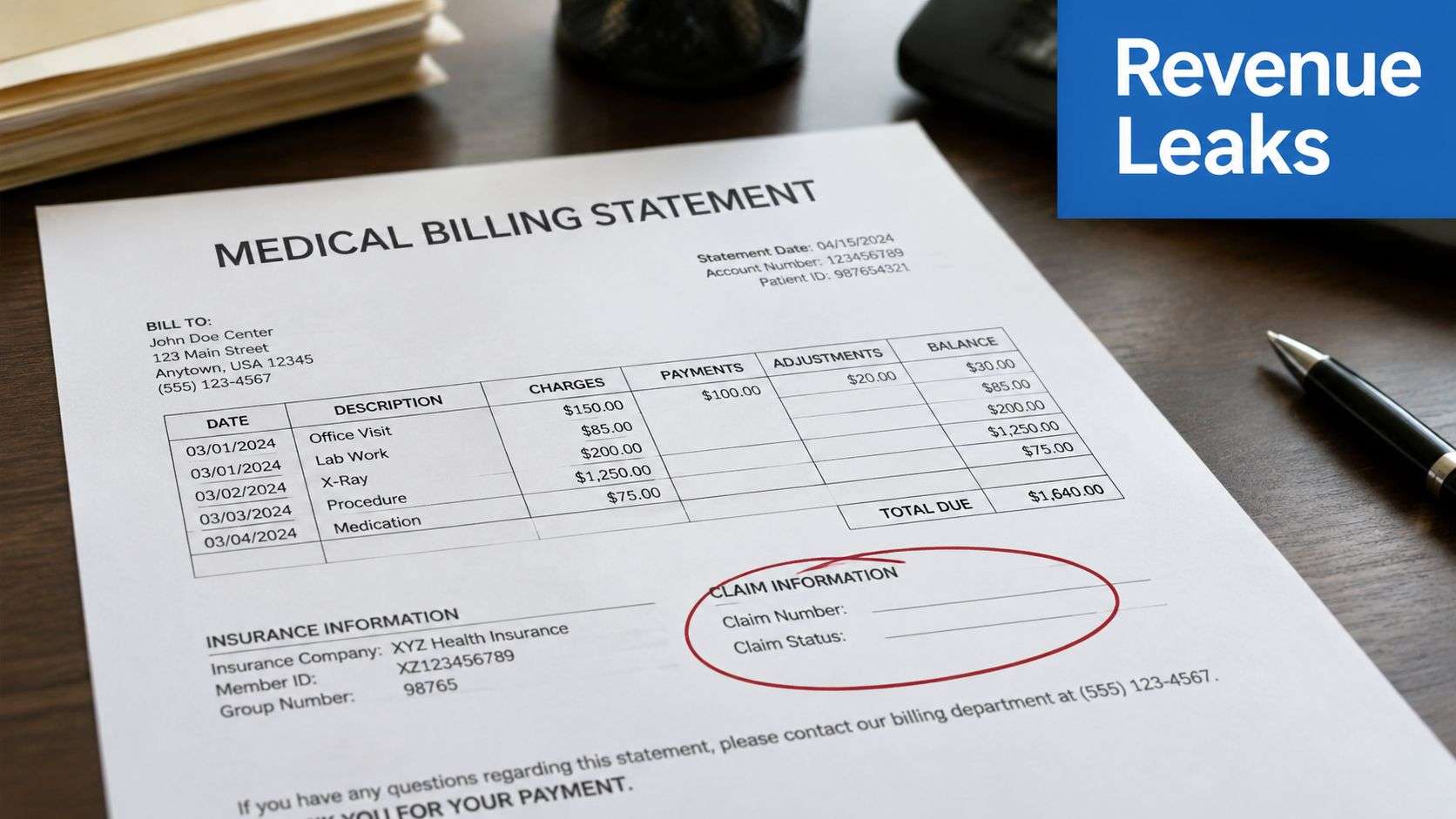
In a busy practice, leakage rarely comes from one dramatic mistake. It usually comes from small breaks that repeat every day. One inaccurate field, one missing authorization, one unsigned note, one untouched denial. Over time, those misses turn earned revenue into delayed cash, extra labor, or preventable write-offs.
Front End Errors That Trigger Back End Problems
The front end sets the financial terms of the visit. If that setup is wrong, the rest of the cycle has to work around bad information.
A wrong member ID can cause a rejection before the claim is even reviewed. An eligibility check that was skipped can leave the practice chasing a balance the payer never owed. A missing authorization can turn a medically necessary service into a noncovered one on paper.
Common front-end leaks include:
- Incomplete demographics: Name mismatches, wrong dates of birth, or outdated insurance details
- Benefits not confirmed before service: Active coverage, copay, deductible status, and payer rules are left unchecked
- Authorization gaps: Required approvals are not obtained, expired, or poorly documented
Practices that tighten this step often start with a consistent eligibility and benefits verification process for each visit, especially for new patients, high-cost services, and plans with strict authorization rules.
Mid Cycle And Back End Leaks
After the visit, the risk shifts but does not go away. The chart has to support the service. The code set has to match the documentation. Charges have to move out quickly. Denials have to be worked while they are still recoverable.
A denial is often the last visible symptom, not the first failure.
Back-end leakage often shows up in four places:
- Coding based on incomplete documentation: The note does not fully support the billed service, modifier, or diagnosis linkage.
- Claim holds and submission delays: Charges sit in queues, edits are not cleared quickly, or claims miss filing windows.
- Weak A/R follow-up: Staff post denials but do not correct, appeal, or escalate them within a useful timeframe.
- Poor patient balance collection: Statements go out late, estimates were unclear, or follow-up is too inconsistent to collect while the balance is still fresh.
The pattern matters here. A front-desk error creates a claim problem. A claim problem creates rework. Rework slows cash and pulls staff time into cleanup instead of prevention. That is how an early-stage defect travels through the full life cycle of the account and weakens the financial pulse of the practice.
Best Practices For Improving Your Revenue Cycle
Most practices don't need a dramatic overhaul first. They need tighter habits at the points where accounts commonly break.
Fix The Front End Like It's A Financial Control Point
Treat scheduling, registration, and check-in as revenue protection work, not just admin work.
Use standard scripts and checklists so staff verify the same critical items every time. Confirm subscriber details, verify coverage before service, review authorization requirements, and collect patient responsibility with clear language.
A few operational habits help immediately:
- Use Registration Checklists: Give staff a fixed list for demographics, insurance, referral, and authorization fields.
- Reconfirm At Every Visit: Don't rely on last visit's insurance card or address.
- Flag High Risk Encounters Early: New patients, specialty procedures, and out-of-network visits need extra review.
Strengthen The Middle Of The Cycle
Clinical documentation and coding need a tighter handshake. Providers should know what coders need, and coders should have a reliable way to query incomplete charts quickly.
Small practices often improve this stage by running short internal chart reviews, tracking recurring coding edits, and giving providers feedback tied to actual missed or vague documentation patterns.
Manager move: Review denial reasons with both the front desk and clinical staff. Revenue cycle fixes stick faster when the whole workflow sees the cause and effect.
Build A Faster Back End Response
Claims should go out promptly. Payments should be posted accurately. Denials should be worked while the account is still fresh.
Set internal rules for who owns each denial category, how quickly corrected claims are resubmitted, and when an appeal needs escalation. Also make patient balances easier to resolve with clear statements, payment options, and timely reminders.
Good financial hygiene usually looks like consistency, not complexity. A practice that verifies early, documents clearly, codes accurately, and follows up quickly will collect more cleanly than one that tries to rescue broken accounts later.
The Role Of RCM Partners And Technology
Every practice has a revenue cycle. Not every practice performs revenue cycle management well.
That distinction matters. The revenue cycle is the payment journey itself. Revenue cycle management, or RCM, is the active work of improving that journey through better workflows, analytics, accountability, and expertise. HealthStream highlights this exact gap in understanding and notes that RCM is a performance-improvement discipline shaped by clinical documentation, coding accuracy, and denial management expertise in its overview of what revenue cycle means in healthcare.
What Technology Actually Changes
Technology helps when it removes friction from repetitive work and makes weak spots visible sooner.
Examples include claim edit tools, eligibility verification tools, reporting dashboards, payment posting automation, and denial tracking workflows. These tools don't replace judgment. They give staff cleaner inputs and faster feedback.
When A Partner Makes Sense
An RCM partner becomes useful when the practice has complexity that internal staff can't easily absorb. That might mean multi-site operations, specialty coding requirements, payer variation, or an A/R backlog that needs focused attention.
Some groups also use outside support for specific functions rather than the whole cycle. For example, they may keep front-desk intake in-house but use revenue cycle management automation support for claims, follow-up, and reporting workflows.
One option in that category is One For All Medical Billing, which provides end-to-end billing support including eligibility verification, coding, claim submission, payment posting, and A/R follow-up. The practical question isn't whether a partner sounds impressive. It's whether that partner helps your team reduce rework and gain control of the metrics you already watch.
How One For All Medical Billing Strengthens Your Revenue Cycle
A practice usually starts looking for outside help after the same pattern repeats. Claims go out, too many come back with issues, staff spend their day reacting, and managers still don't have a reliable picture of collections.

One For All Medical Billing addresses that pattern by covering the full workflow rather than only one task in isolation. Its services include eligibility verification, ICD-10/CPT/HCPCS coding, claims submission, payment posting and reconciliation, denial follow-up, reporting, credentialing assistance, and compliance support.
Where The Operational Support Shows Up
The value is easiest to see by matching the service to the leak:
- Before The Visit: Eligibility verification helps catch coverage issues and missing payer requirements early.
- After Documentation: Certified coders translate the encounter into billable codes with attention to payer rules and chart support.
- At Submission: Claims move through a managed process rather than sitting in a loose queue.
- After Payer Response: Posting, denial review, and A/R follow-up keep accounts from aging unchecked.
The company states that it delivers a 90% clean claim rate and supports practices nationwide across family medicine, urgent care, pediatrics, OB/GYN, surgery, chronic care specialties, and multi-site groups. That matters most for managers who need repeatable workflows, not just occasional billing help.
Why This Matters To A Busy Practice Manager
You don't need a vendor that gives you more noise. You need one that helps your team keep the financial circulatory system moving.
If your front desk is overloaded, coding is inconsistent, or old balances keep lingering, the right billing partner creates structure. It clarifies who is checking eligibility, who is correcting denials, what gets reported, and how fast accounts move after each payer response.
For groups comparing internal staffing with outsourcing, this overview of the benefits of outsourcing medical billing gives a practical framework for deciding where outside support can reduce operational strain.
The core idea is simple. A strong revenue cycle doesn't happen because claims eventually get worked. It happens because every step, from intake through follow-up, is handled with enough discipline that fewer accounts need rescue later.
If you want help tightening the full payment journey from eligibility through A/R follow-up, One For All Medical Billing offers a practical next step. You can review your current workflow, identify where revenue is leaking, and get support that fits your practice model without adding more strain to your internal team.

