

table of contents
Think of healthcare revenue cycle management solutions as the financial engine of your practice. It's not just about sending out bills and hoping for the best. RCM covers the entire financial journey of a patient visit—from the moment they book an appointment until the last dollar is collected.
What Is Healthcare Revenue Cycle Management
At its core, Revenue Cycle Management (RCM) is the process that ensures you actually get paid for the services you provide. It’s a system for navigating the complex path from patient care to payment, helping you steer clear of common financial roadblocks like claim denials, billing mistakes, and slow reimbursements. Getting this right is no longer optional—it's essential for survival and growth, especially as administrative burdens keep piling up.
The financial stakes here are enormous. The global market for RCM solutions is expected to hit USD 169.69 billion in 2025 and balloon to USD 451.29 billion by 2034. This growth is a direct response to a massive problem: U.S. hospitals lose billions to denied claims every year, with initial denial rates often sitting between 10-15% because of preventable errors like a simple coding mistake or missing information.
The Purpose Of An RCM Solution
The whole point of a dedicated RCM solution is to make this winding financial journey as smooth and predictable as possible. By systematically addressing every single step, these systems work to secure full and timely payment for your services. This ultimately frees your team from chasing paperwork so they can focus on what they do best—caring for patients. You can see how this applies across various healthcare use cases and specialties.
A strong RCM strategy isn't a luxury anymore; it's a fundamental part of a healthy practice. It shifts your billing from a reactive, fire-fighting chore into a proactive system that protects and grows your revenue.
How It Works From Start To Finish
Instead of treating billing like a series of separate, disjointed tasks, a true RCM solution pulls everything together into one cohesive workflow. It manages the entire process from the first patient phone call to the final account zero-out.
The different stages fit together to form a complete cycle, and each stage directly impacts your revenue.
Core Stages Of The Healthcare Revenue Cycle
- Front-End: This stage includes key activities like patient scheduling, pre-registration, and insurance eligibility verification. Its impact on revenue is preventing denials by ensuring patient data and coverage are accurate from the start.
- Mid-Cycle: This stage focuses on clinical documentation, medical coding, and charge capture. Its impact on revenue is ensuring services are documented and coded correctly for clean claim submission.
- Back-End: This final stage involves claim submission, payment posting, denial management, and A/R follow-up. Its impact on revenue is maximizing reimbursement by managing claims, resolving denials, and collecting payments.
This integrated approach is what makes an RCM solution so different from basic medical billing services. By managing the entire lifecycle, it makes sure revenue is captured correctly at every turn. For a deeper dive, check out our guide on understanding revenue cycle management.
The Core Components Of A Modern RCM Workflow
To really get a grip on healthcare revenue cycle management solutions, you have to look under the hood at all the moving parts. A modern RCM workflow isn't just a list of tasks. It’s a continuous loop where every single step directly impacts the next one. An error at the beginning can trigger a costly domino effect all the way down the line.
Think of it as an assembly line for your revenue. Each station has to do its job perfectly to produce the final product—a fully paid claim. If one station messes up, the whole line gets backed up, leading to delays, rework, and lost income. Solid RCM is all about making sure every station runs with precision.
This infographic breaks down the high-level flow, simplifying the complex journey from appointment to payment into three main phases.
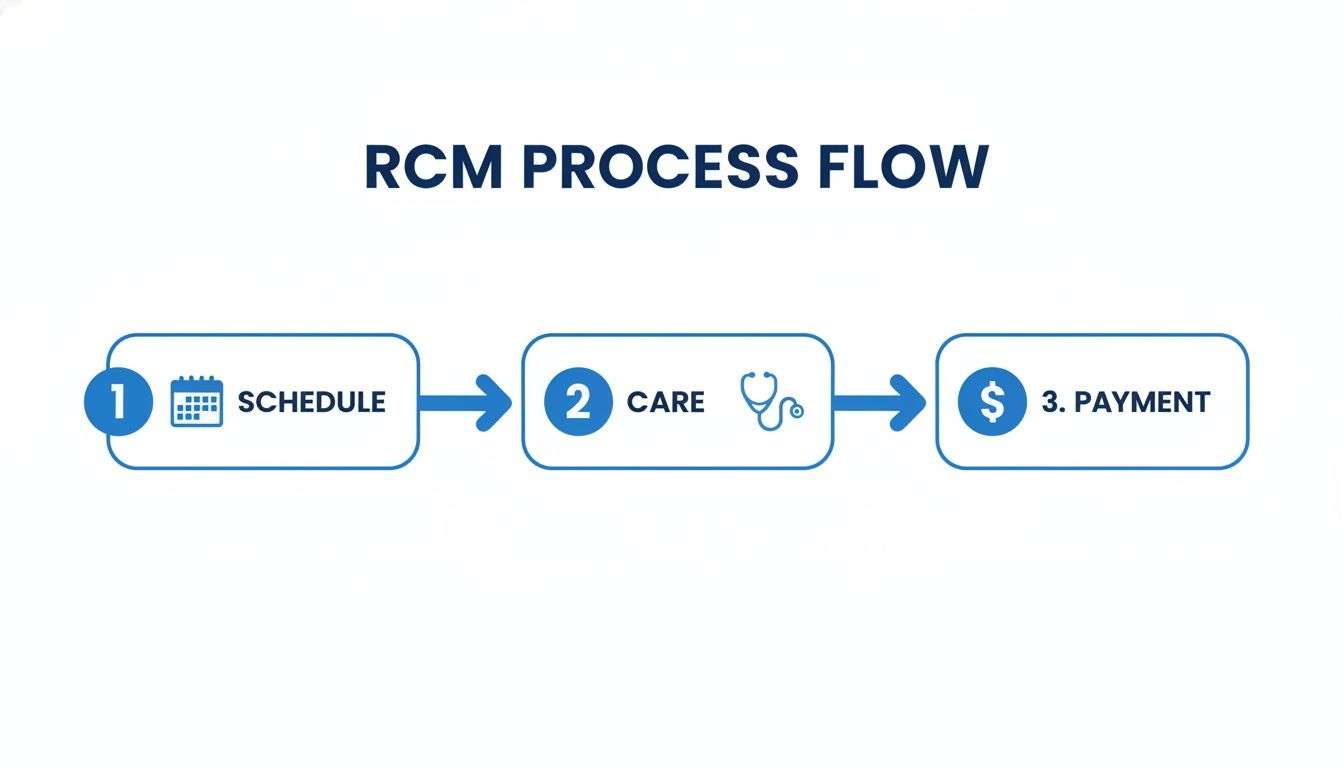
As you can see, the process starts long before a patient is even seen and continues well after they’ve left. This highlights just how important it is to manage the entire cycle from end to end. Let's dig into the critical gears that keep this financial engine running.
Front-End Processes: The First Line Of Defense
The front-end is where a healthy revenue cycle is often won or lost. These initial steps are all about being proactive and stopping denials before they even have a chance to happen. Get this stage right, and you set the foundation for a clean claim.
Key front-end components include:
- Patient Pre-Registration And Scheduling: This is your first touchpoint for data collection. Grabbing accurate demographic and insurance information right from the start is absolutely essential for preventing simple administrative denials.
- Insurance Eligibility And Benefits Verification: This might be the single most important preventive step. Before the patient even walks in the door, a strong RCM solution confirms they have active coverage, checks their benefits, and identifies what the patient will owe (copays, deductibles). This stops you from providing services to patients with an inactive policy.
A little prevention here is worth a ton of cure later. A claim denied for “no active coverage” is a clear sign of failure at this very first stage.
Middle Processes: Documenting And Coding For Value
Once the patient has been treated, the focus shifts to translating the clinical services into a billable claim. This middle stage demands both accuracy and specialty-specific knowledge to make sure the claim reflects the full value of the care you delivered.
A high medical billing collection rate, which averages around 80% to 95% for many practices, is a great start, but it doesn't tell the whole story. True financial health depends on the accuracy and efficiency of the steps that lead to that collection.
These middle processes are the bridge between clinical work and financial submission. If you want to take a deeper dive into this area, you can learn more about the detailed medical billing process steps in our other guide.
Key middle components include:
- Charge Capture: This is where you record every single service and procedure performed during the visit. Any missed charges mean you’ve just provided care for free.
- Medical Coding: Certified coders are tasked with translating the clinical notes into standardized codes (ICD-10, CPT, HCPCS). This requires deep expertise, since incorrect coding is a top reason for both denials and audits.
Back-End Processes: Securing And Analyzing Revenue
The back-end is all about getting the money in the door. This stage involves submitting the claim, managing payments, and aggressively pursuing any and all unpaid balances. It’s the reactive part of the cycle, focused on fixing problems and making sure every dollar you’re owed is collected.
Key back-end components include:
- Claims Submission and Scrubbing: Before a claim goes out, it’s “scrubbed” by software that hunts for potential errors. This final check dramatically boosts the clean claim rate—the percentage of claims that get paid on the very first try.
- Payment Posting: As payments come in from payers, they are posted to the correct accounts. This gives you a crystal-clear picture of what's been paid versus what’s still outstanding.
- Denial Management and A/R Follow-Up: This work is relentless. When a claim gets denied, a dedicated team has to dig into the reason, fix the mistake, and appeal the decision. They also actively follow up on all aged accounts receivable (A/R) to keep write-offs to a minimum.
The Measurable Benefits Of Optimizing Your RCM
Talking about the RCM process is one thing, but what really matters are the results. A modern healthcare revenue cycle management solution isn’t just another line item on your budget; it’s a direct investment in your practice’s financial health and long-term stability. The return on that investment shows up in real, measurable improvements to your bottom line.
Think of it like swapping out old, leaky plumbing for a brand-new system. An optimized RCM plugs the countless small leaks—like coding mistakes, missed charges, and eligibility problems—that quietly drain revenue from your practice every single day. The most immediate effect you'll see is a much stronger, more reliable cash flow.
Driving Financial Performance With Precision
The most tangible benefit is a dramatic improvement in your core financial metrics. When your RCM process is fine-tuned, it directly targets the inefficiencies that cause lost revenue and payment delays, giving your practice a much healthier financial outlook.
These aren't small, incremental gains. We're talking about a fundamental shift in how your practice captures revenue. Key financial benefits include:
- Accelerated Payment Velocity: With cleaner claims and fewer errors, payments from insurance companies simply arrive faster. This shortens your revenue cycle and puts more cash on hand for day-to-day operations.
- Significant Reduction in Claim Denials: A proactive approach to verifying insurance and scrubbing claims means far fewer rejections from payers. This frees your staff from the frustrating, time-sucking loop of reworking and appealing denials.
- Increased Clean Claim Rate: Most top-tier RCM partners aim for a clean claim rate of over 90%. This means the vast majority of your claims get accepted and paid on the first try, cutting out costly rework.
When your revenue cycle is optimized, you stop leaving money on the table. Every percentage point increase in your collection rate translates directly into more funds to invest back into patient care, technology, and staff development.
To dig deeper into how you can maximize efficiency and profitability, it's worth exploring resources like this guide on Optimizing Medical Practice Revenue Cycle Management.
Unlocking Operational Efficiency And Reducing Burnout
Beyond the hard numbers, a well-run RCM workflow brings crucial "soft" benefits that are just as valuable. When your administrative team isn't buried under a mountain of paperwork and denial follow-ups, their focus can shift to higher-value activities.
This creates a more positive and productive environment for everyone. You’ll notice a visible drop in administrative burnout as frustrating, repetitive tasks are automated or handled by experts. In turn, your team can dedicate more time and energy to patient-facing responsibilities, which improves the entire patient experience.
The Strategic Power Of Automation And Expertise
The future of RCM is all about smart technology and specialized knowledge. Projections show that AI and automation could generate up to USD 360 billion in annual savings across the revenue cycle. As the outsourced RCM market prepares to nearly double in size, a significant 70% of health systems are expanding their partnerships to fight labor shortages and rising complexities. This translates to real wins for specialty practices, where expert RCM support can dramatically lower denial rates.
Ultimately, optimizing your RCM buys you peace of mind. Knowing you are compliant with ever-changing payer rules and that your revenue is being managed effectively lets you get back to your primary mission: providing excellent patient care. These benefits of revenue cycle management ripple through every corner of your practice.
Essential KPIs To Track Your RCM Success

You can't fix what you don't measure. When it comes to your practice's financial health, tracking the right Key Performance Indicators (KPIs) is the only way to know if your healthcare revenue cycle management solutions are actually delivering results. These metrics are more than just numbers on a dashboard; they’re the vital signs of your revenue cycle.
Think of KPIs as your practice's financial health checkup. They give you a data-driven story of what’s working, where money is leaking, and which bottlenecks are slowing down your cash flow. This information empowers you to have productive, fact-based conversations with your billing team and make smart decisions that plug revenue gaps for good.
Net Collection Rate
If you only track one metric, make it this one. The Net Collection Rate reveals the percentage of money you’re actually collecting out of the total amount you’re contractually owed by payers. It cuts through the noise of gross charges and adjustments to show how effective your team is at turning services into cash.
A healthy, well-run practice should be hitting a Net Collection Rate of 95% or higher. If your rate is dipping below that, it’s a clear sign that money is being left on the table, likely due to issues with patient collections or A/R follow-up.
Clean Claim Rate
The Clean Claim Rate measures how many of your claims get accepted and paid on the first try. It’s a fantastic indicator of your front-end efficiency—how well your team handles patient registration, insurance verification, and initial coding.
A high Clean Claim Rate is a sign of a proactive and efficient RCM process. Top-performing practices consistently achieve a rate of 90% or higher, which drastically reduces the time and cost associated with reworking denied claims.
A low rate signals that you have recurring problems with data accuracy or coding that need to be addressed immediately. Fixing these front-end issues is one of the quickest ways to accelerate your revenue cycle.
Days in Accounts Receivable
Days in Accounts Receivable (A/R) tells you the average number of days it takes your practice to get paid after providing a service. This KPI is a direct measure of your payment velocity—the speed at which you convert care into cash. The lower the number, the better your cash flow.
An industry benchmark for a healthy practice is generally under 40 days. A high or climbing Days in A/R number is a red flag. It means claims are getting stuck somewhere in the process, denials are piling up, or your follow-up efforts aren’t aggressive enough. Keeping a close eye on this figure is a fundamental part of effective benchmarking in healthcare.
Denial Rate
Finally, your Denial Rate tracks the percentage of claims that payers reject. While a 0% denial rate is the dream, it's not realistic. The real goal is to keep this number as low as humanly possible—ideally, under 5%.
Every denial is a roadblock. It represents delayed payment, wasted staff time, and lost revenue. By tracking this KPI, you can spot negative trends with specific payers, procedures, or coding habits, allowing you to fix the root cause before it costs you more.
Monitoring these four metrics gives you a powerful, at-a-glance view of your practice's financial performance. To make it easier, here's a quick summary of what to watch.
Essential RCM Key Performance Indicators (KPIs)
To keep your RCM performance on track, consistently monitor these key metrics against industry benchmarks:
- Net Collection Rate: This KPI measures the percentage of earned reimbursement you actually collect. The industry benchmark is 95% or higher.
- Clean Claim Rate: This measures the percentage of claims paid on the first submission. The industry benchmark is 90% or higher.
- Days in A/R: This shows the average time it takes to collect payments. The industry benchmark is under 40 days.
- Denial Rate: This tracks the percentage of claims denied by payers. The industry benchmark is under 5%.
By consistently tracking these KPIs, you can move from guessing about your financial health to knowing exactly where you stand—and what steps to take next.
How To Choose The Right RCM Partner
Picking a partner for your healthcare revenue cycle management solutions is one of the biggest financial decisions your practice will make. This isn't just about comparing price lists; you’re entrusting a core part of your business to an outside team.
The right partner becomes a true extension of your practice, one who is genuinely invested in your financial health. The wrong one? They can create more headaches than they solve, leaving you with frustrated staff, confused patients, and a cash flow that’s going nowhere. To make the right call, you have to look past the sales pitch and zero in on what makes an RCM partner truly effective.
Look For Deep Specialty-Specific Expertise
General medical billing knowledge just won’t cut it. The financial rules and coding requirements for a pediatric clinic are worlds apart from those for a multi-site urgent care group or a specialty pain management practice. A partner with proven chops in your specific field will already know the common procedures, necessary modifiers, and payer quirks that lead to getting paid what you're owed.
This specialized knowledge translates directly into fewer denials and a much higher clean claim rate. A vendor who mainly works with family practices will probably stumble over the complexities of billing for specialty drug infusions or complex surgical procedures.
When you're vetting a potential partner, don't just ask if they have experience in your specialty. Ask them to prove it. Request case studies or performance data from practices similar to yours to see real, tangible evidence of their success.
Prioritize Transparent Reporting And Communication
You should never feel like your financial data is locked away in a black box. A quality RCM partner operates with total transparency, giving you regular, easy-to-understand reports on the key performance indicators (KPIs) that actually matter—like your net collection rate, denial rate, and days in A/R.
Clear communication is just as vital. Your partner needs to be proactive, letting you know about negative trends and working with you to fix them. A great partner doesn’t just email you reports; they help you read between the lines and make smart decisions to improve your practice’s bottom line. It's also a good idea to check out a list of the best revenue cycle management companies to see what the top providers are offering.
Insist On Robust Technology Integration
Your RCM solution has to play nicely with your current Electronic Health Record (EHR) or Practice Management (PM) system. Forcing your clinical staff to ditch the software they use all day, every day is a recipe for chaos and burnout. A top-tier RCM partner is technology-agnostic, meaning they have the expertise to integrate securely with all sorts of platforms.
This integration is the foundation of an efficient workflow. It allows demographic, clinical, and billing data to flow smoothly between systems. Without it, you're stuck with clunky manual processes and a much higher risk of data entry errors.
Ask The Right Questions During The Vetting Process
To really understand what a potential partner can do, you need to ask sharp, operational questions that go beyond their surface-level promises. The answers you get will show you how they actually operate day-to-day.
Here are some essential questions to have in your back pocket:
- Denial Management: What is your exact process for finding, appealing, and fixing denied claims? How do you track denial trends to stop them from happening again?
- Coding Compliance: How do you make sure your coders are always up-to-date with the constant changes to ICD-10, CPT, and payer-specific rules? Are all of your coders certified?
- Patient Responsibility: What's your approach to communicating with patients about their balances and collecting payments effectively but also compassionately?
- Reporting: What specific reports will I get, and how often? Can I log into a real-time dashboard to see how my practice is doing at any moment?
Choosing the right RCM partner comes down to finding a dedicated team that lines up with your practice’s unique needs and financial goals. By focusing on specialty expertise, transparency, and solid processes, you can find a partner that will help your practice not just survive, but thrive.
Implementing Your New RCM Solution Smoothly

So you've chosen a partner. Now comes the big question: what happens next? The thought of overhauling a core business process can feel overwhelming, but a smooth transition is completely possible with the right plan. A great onboarding process for healthcare revenue cycle management solutions shouldn’t disrupt your practice—it should build confidence from day one.
Think of it like a well-planned home renovation. A good contractor doesn’t just show up with a sledgehammer. They start with a detailed blueprint, protect what’s already there, and work in phases to keep your daily life running. A quality RCM implementation is no different, guiding your practice through a proven process that sets you up for long-term financial health.
Phase One: The Discovery And Planning Stage
The journey always begins with a deep-dive discovery phase. This is where your new RCM team gets to know the unique DNA of your practice. They’ll dig into your current workflows, review historical billing data, and pinpoint your biggest financial headaches.
This initial analysis is the most important step. It lets your partner build a custom implementation roadmap that targets your specific goals, whether that’s slashing denials from a difficult payer or finally getting a handle on patient collections. It’s all about creating a shared blueprint before a single technical change is made.
A successful implementation is built on a foundation of open communication and teamwork. The goal of this first phase is to make sure your practice and the RCM team are perfectly aligned on the objectives, timeline, and what success looks like.
Phase Two: System Integration And Workflow Setup
With a solid plan in place, the next step is all about the technical setup. This is where a secure, HIPAA-compliant connection is built between your existing EHR or Practice Management system and the RCM partner’s platform. A top-tier partner will handle all the heavy lifting here, making sure data flows seamlessly without interrupting your day-to-day clinical work.
During this stage, your RCM team will also configure their systems to fit your practice’s specific needs. This typically includes:
- Payer Enrollment: Making sure all your providers are correctly enrolled with every insurance payer to submit claims electronically.
- Workflow Configuration: Setting up the custom rules engines and claim scrubbing protocols designed for your specialty and payer mix.
- Team Access: Granting secure logins and setting up clear communication channels between your staff and their new RCM counterparts.
This methodical approach is what prevents chaos during the switch. It ensures all the financial plumbing is connected properly before you turn on the water.
Phase Three: Training And Go-Live
The final phase before launch is focused on getting your team ready. Your RCM partner should provide straightforward training on any new processes or communication tools. This ensures your front-desk and clinical staff know exactly what their roles are in the new workflow, like how to best verify patient info or get a quick answer from the billing team.
When it’s time to "go-live," it should feel like a non-event. Thanks to all the careful planning and setup, the switch to the new system should feel smooth and natural. Your partner will be watching the first batches of claims like a hawk, managing the initial payment posting, and providing extra support to handle any questions that pop up. This ensures a steady, successful start to a more profitable future.
Frequently Asked Questions About RCM
Even after getting a handle on the big picture, practical questions always come up when you start looking at healthcare revenue cycle management solutions. We've answered some of the most common ones we hear from providers to help you move forward with confidence.
What Is The Difference Between Medical Billing And RCM?
Think of it this way: medical billing is a single, crucial task, but Revenue Cycle Management (RCM) is the entire financial game plan. Medical billing is mostly about creating and sending claims to insurance companies and posting the payments that come back. It’s absolutely vital, but it’s a narrow slice of the pie.
A true RCM solution, on the other hand, covers the whole financial journey from start to finish. It begins before the patient even walks in the door with pre-registration and insurance verification (the front-end). It continues through coding and claim submission (the middle), and finishes with aggressive denial management, accounts receivable follow-up, and deep-dive analytics (the back-end). The goal of RCM is to prevent revenue from leaking out at every step, not just to chase money after the fact.
RCM is about proactively managing the entire financial journey to maximize what you collect. Traditional medical billing is often reactive, dealing only with the claim itself. A comprehensive RCM solution turns billing from a chore into a strategic asset for your practice.
Can I Outsource RCM If I Have My Own EHR System?
Yes, absolutely. This is not only possible but also one of the most common and successful ways to do it. You don't have to get rid of the clinical software your team already knows and relies on every day.
Top-tier RCM partners are experts at integrating with dozens of different Electronic Health Record (EHR) and Practice Management (PM) systems. A key part of the onboarding process is setting up a secure, seamless link to your current platform. This gives the RCM team the access they need to pull the necessary data and manage your revenue cycle without disrupting your clinical workflow.
How Long Does It Take To See Results From A New RCM Solution?
While every practice is different, you can expect to see improvements roll out in stages. It’s a process of steady gains, not flipping a switch.
Here’s a general timeline of what to expect:
- First 30-60 Days: You should see a quick jump in your clean claim rate. This happens almost immediately as the new, tougher claim scrubbing and verification processes kick in before claims go out the door. A drop in initial denials usually follows right behind.
- Within 90-120 Days: This is when the bigger financial impacts become clear. You’ll see a measurable drop in your Days in A/R as cash starts flowing in faster. Your net collection rate will also start to climb as the team tackles old, aged accounts and fine-tunes collection strategies.
A good partner will give you transparent reports from day one, so you can track this progress yourself and watch the value of your investment grow over time.
Ready to see how a dedicated RCM partner can strengthen your practice's financial health? At One For All Medical Billing, we combine specialty-specific expertise with proven processes to help you get paid faster, reduce denials, and regain focus on patient care. Schedule your free, no-obligation consultation today to get started.

