
table of contents
CPT code 99212 is for a Level 2 office or outpatient visit with an established patient. Think of it as the go-to code for quick, straightforward follow-up appointments—the express lane of E/M services.
Decoding The 99212 CPT Code
In the world of medical billing, Evaluation and Management (E/M) codes are how we describe the complexity of a patient visit. The 99212 CPT code is a vital part of the 99211-99215 series, which is reserved specifically for established patients.
An established patient is simply someone who has received professional services from you—or another provider of the same specialty in your practice—within the last three years.
Think of the established patient E/M codes as a ladder. If 99211 is the bottom rung for a minimal, often nurse-driven visit, then 99212 is the first step up that requires a physician or qualified healthcare professional's direct input for a straightforward problem. It’s the perfect fit for the uncomplicated, bread-and-butter encounters that fill the schedules of busy primary care, urgent care, and specialty clinics.
Defining The Scope Of A 99212 Visit
So, when is it appropriate to bill a 99212? Since the 2021 E/M guideline updates, you have two clear paths to justify the code:
- Total Time: The entire encounter, from pre-charting to final documentation, must take between 10-19 minutes on the day of the visit.
- Medical Decision Making (MDM): The visit must involve straightforward MDM. This means the problem, the data reviewed, and the risk of complications are all minimal.
This flexibility is a game-changer. A quick but focused visit that hits the 12-minute mark qualifies on time alone. On the other hand, a shorter visit where you make a clear, straightforward clinical decision can also qualify based on MDM, regardless of the exact time spent.
A great analogy is to think of it like a quick car service. A 99212 visit is the equivalent of a tire pressure check. It's a necessary, professional service, but it's brief and solves a single, uncomplicated issue. A higher-level code, like 99214, would be the full diagnostic workup to figure out that strange noise coming from the engine.
Its Role In Everyday Practice
The 99212 code is a true workhorse. In fact, it’s the second most frequently billed E/M code for established patient visits across family medicine, internal medicine, and pediatrics.
Its popularity skyrocketed after the 2021 guideline changes, which allowed for time-based billing between 10-19 minutes. This carved out a clear and defensible niche for those common follow-ups, like medication checks or single-system problems.
It also draws a sharp line between a 99212 and the next level up. As you can see in our guide on the 99213 CPT code, just one extra minute or a slight increase in complexity can push a visit into the next category, justifying a higher reimbursement.
Choosing Between Time And MDM For 99212
Since the big E/M guideline updates in 2021, you now have two ways to bill for a 99212 CPT code: total time or Medical Decision Making (MDM). Getting this right is a core skill for staying compliant and ensuring you’re paid accurately for your work. Think of it like having two different tools to measure the same visit—you just need to pick the one that best captures the effort involved.
The first path is billing based on total time. For many clinics, especially in fast-paced settings, this is the most straightforward and defensible way to justify a 99212. To qualify, you must document a total of 10 to 19 minutes spent on the patient's care on the day of the encounter.
This isn’t just the face-to-face time in the exam room. It’s a full accounting of all the professional work you do for that specific visit.
This decision tree helps visualize the two main paths to billing for a 99212 encounter with an established patient.
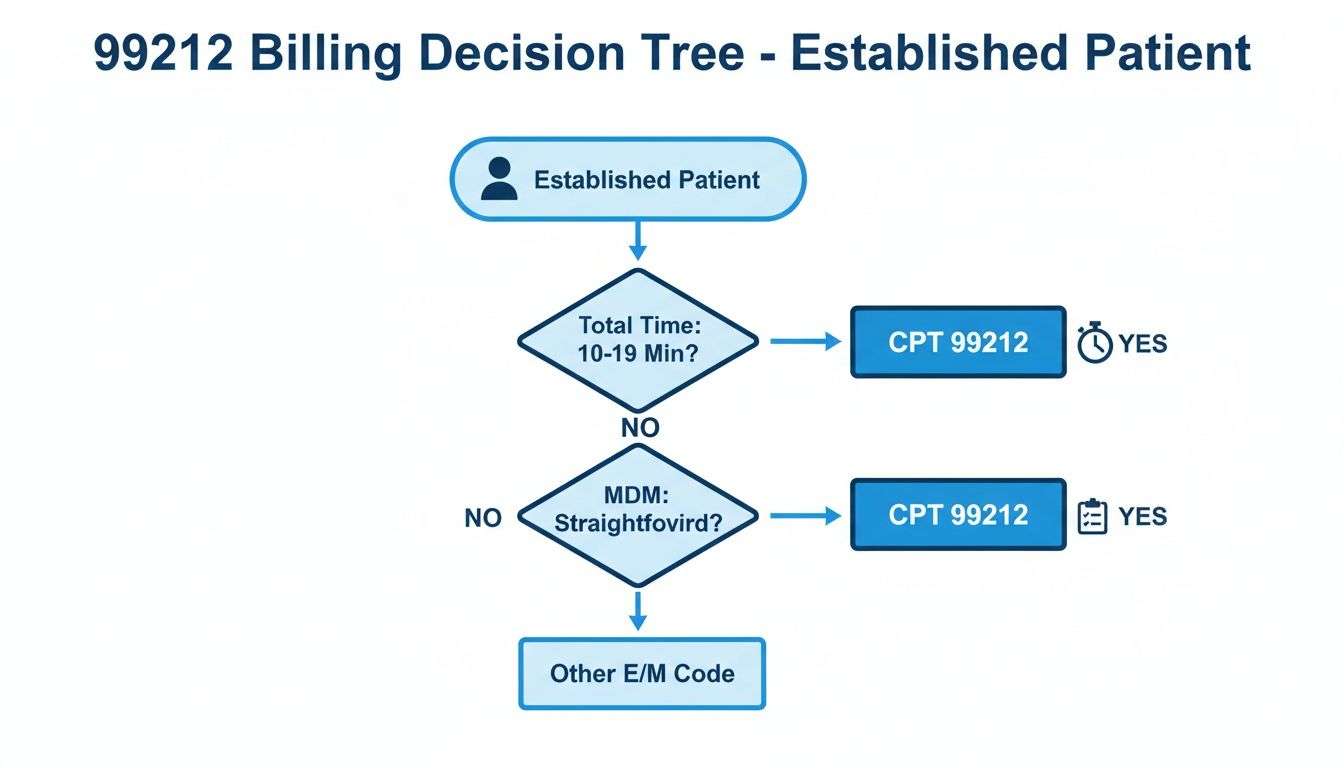
The key is that you have the flexibility to bill based on the 10-19 minute time window or by meeting the criteria for straightforward MDM. You choose what fits best.
Documenting Based On Total Time
When you use time as your guide, you need to be clear on what activities actually count. The American Medical Association (AMA) has laid it all out: total time includes a wide range of tasks performed by the billing provider on the day of the visit.
Here’s a quick rundown of what you can include in your time calculation:
- Pre-Visit Work: Reviewing the patient’s chart, recent lab results, or diagnostic tests before you even walk in the room.
- Patient Interaction: Taking a history, performing a medically appropriate exam, and counseling the patient or their family.
- Care Coordination: Ordering medications, tests, or procedures and talking with other healthcare professionals (as long as it’s not separately billed).
- Documentation: Charting the encounter in the EHR and completing related administrative tasks.
Let’s say you spend 5 minutes reviewing labs, 8 minutes with the patient, and 3 more minutes documenting the note and e-prescribing a refill. Your total time is 16 minutes. That securely lands the visit in the 99212 range. Your note should then include a simple attestation like, "I spent a total of 16 minutes on this patient's care today."
The Straightforward MDM Pathway
The other route to a 99212 is by meeting the criteria for straightforward Medical Decision Making. This path is perfect for those visits that don’t quite hit the 10-minute mark but still require your professional expertise. MDM is really a measure of the cognitive lift—the brainpower—an encounter requires.
To qualify for straightforward MDM, the visit has to check specific boxes across three key elements.
For a 99212, "straightforward" is the operative word. Your decision-making process should be simple and direct, reflecting a minimal level of complexity in the problem, the data, and the patient's overall risk.
So, what does "straightforward" look like in practice?
- Problems Addressed: One self-limited or minor problem. Think of a follow-up for a simple UTI where symptoms have resolved, or a quick check of an uncomplicated insect bite.
- Data Reviewed: The data component is minimal or even none. This could mean you glanced at a single, simple test result or didn’t need to review any data at all.
- Risk of Complications: The risk here is minimal. You might recommend over-the-counter drugs, rest, or basic wound care—treatments with very little chance of adverse outcomes.
For example, a patient comes in for a follow-up on their stable hypertension. You confirm they have no new symptoms, and their home blood pressure log looks good. You refill their current medication with no changes. This scenario is a textbook example of a straightforward problem with minimal data and minimal risk, making it a perfect fit for 99212 based on MDM.
While this visit might also fall into the time-based criteria, knowing the MDM pathway gives you another compliant billing option. As you start evaluating more complex situations, you might find our guide on the 99204 CPT code for new patients helpful for telling the different levels of MDM apart.
How 99212 Billing Impacts Your Bottom Line
Getting your coding right isn't just about ticking compliance boxes—it's the foundation of your practice's financial stability. While the 99212 CPT code might not look like a high-value service on its own, its real financial power comes from sheer volume. For any practice manager or revenue cycle leader, understanding how this code translates into real dollars is a must.

The journey from a patient encounter to a deposit in your bank account is paved with Relative Value Units, or RVUs. Every CPT code, including 99212, has a total RVU value assigned to it, which represents all the resources that went into that service. It’s broken down into three key parts.
- Work RVUs (wRVU): This is the provider’s "cognitive lift"—the time, skill, and mental effort the visit required.
- Practice Expense RVUs (peRVU): Think of this as your overhead. It covers the costs of keeping the lights on, from rent and supplies to your front desk staff's salaries.
- Malpractice RVUs (mpRVU): This component accounts for the cost of professional liability insurance.
So when you bill a 99212, you're not just getting paid for the doctor's time. You’re getting reimbursed for the entire support system that makes that visit possible. It’s a simple but powerful concept for running a profitable clinic.
From RVUs To Real Dollars
To turn these abstract RVU points into actual payment, they get multiplied by a conversion factor. This is a dollar amount set each year by the Centers for Medicare & Medicaid Services (CMS), and it often becomes the baseline for what commercial payers will pay, too.
Total Payment = (Total RVUs) x (CMS Conversion Factor)
This simple formula is the engine that drives your fee-for-service revenue. And while a single 99212 visit has a lower RVU total than a complex one like 99214, its constant use in high-volume settings like primary care and urgent care makes it a true workhorse for your practice's income.
A single 99212 visit might only bring in around $50-$75, depending on your geography and payer contracts. But multiply that by hundreds—or even thousands—of quick follow-ups each year, and the financial impact becomes massive. It's the steady drip that fills the bucket. This is exactly why mastering your billing workflow is non-negotiable for a healthy healthcare revenue cycle.
The High Cost Of Under-Coding
In a busy clinic, it can be tempting to default to a minimal code like 99211 for quick check-ins, thinking it's the "safe" way to avoid an audit. But this habit leads to significant revenue leakage over time. You're leaving money on the table that your practice has legitimately earned.
The difference between billing a supported 99212 and an unsupported 99211 is not small.
The data backs this up. Research on time-based E/M billing showed just how vital the 99212 code is. For a practice with an average of 5,934 return visits a year, correctly billing 99212 for 15-minute appointments generated $337,537 in annual revenue. In stark contrast, when those same visits were under-coded as 99211, revenue plummeted to a mere $2,236.
Choosing 99212 when your documentation supports it isn’t aggressive—it’s accurate. It ensures you’re fairly compensated for your provider’s expertise, the use of your facility, and the clinical risk you assume, even on the most straightforward of days.
Clinical Scenarios And ICD-10 Pairings For 99212
Knowing the textbook definition of the 99212 CPT code is just the first step. The real challenge is applying it confidently during a packed clinic day. Let's connect the dots between the rulebook and what actually happens on the ground with a few common scenarios that fit a 99212 service perfectly.
Think of these examples as your go-to playbook. Each one includes a typical ICD-10 pairing and sample documentation language to help you justify the code, whether you're billing based on time or straightforward Medical Decision Making (MDM). The goal is to help you build documentation that sails through audits and gets you paid without hassle.
Family Practice Stable Hypertension Refill
A 68-year-old established patient arrives for their scheduled follow-up for stable essential hypertension. They report zero new symptoms, confirm they’re taking their medication as prescribed, and their home blood pressure log shows readings are right where they should be.
- ICD-10 Code: I10 (Essential (primary) hypertension)
- Documentation Method: This encounter can easily be justified by either time or MDM.
The provider does a quick, problem-focused check, confirms the patient is stable, and sends an electronic refill for their lisinopril. The visit is efficient and focused, with a simple, clear-cut management plan.
Sample Documentation Note (MDM-Based):
S: Patient here for routine follow-up of stable HTN. Reports good medication adherence, no new complaints like headaches or dizziness. Home BP log reviewed, shows consistent readings around 125/75 mmHg.
O: BP 128/76, P 68. CV exam is unremarkable.
A: I10 – Essential hypertension, well-controlled.
P: Continue current lisinopril dose. Refill for 90 days sent to pharmacy. RTC in 3 months. The problem is stable and minimal. No data reviewed beyond the patient's log, and risk is minimal. This represents straightforward MDM.
Urgent Care Uncomplicated Insect Bite
A 25-year-old established patient walks into your urgent care clinic. They were bitten by a mosquito on their forearm two days ago and are worried about some minor, localized itching and redness. Critically, they have no signs of a systemic reaction—no fever, breathing trouble, or spreading rash.
- ICD-10 Code: S50.362A (Insect bite (nonvenomous) of left forearm, initial encounter)
- Documentation Method: In a fast-paced urgent care setting, time is often the simplest way to document this.
The provider examines the bite, confirms there are no signs of infection or a serious allergic reaction, and reassures the patient. The advice is simple: use an over-the-counter hydrocortisone cream and apply cold compresses.
Sample Documentation Note (Time-Based):
S: Patient presents with a chief complaint of an itchy, red bump on the left forearm from a mosquito bite 2 days ago. Denies fever, pain, or any other symptoms.
O: Exam reveals a 1 cm erythematous papule on the left forearm. No warmth, streaking, or purulence.
A: S50.362A – Insect bite, nonvenomous, of left forearm.
P: Advised to use OTC 1% hydrocortisone cream and cool compresses for symptomatic relief. Instructed to return if signs of infection develop. I spent a total of 12 minutes on this patient's care today, which included reviewing history, the examination, counseling, and documenting the visit.
Pediatric Follow-Up For Otitis Media
An 8-year-old established patient is back for a two-week follow-up after being diagnosed with acute otitis media. The child's mom reports the ear pain went away within a few days of starting antibiotics, and he’s been symptom-free ever since.
- ICD-10 Code: H66.91 (Otitis media, unspecified, right ear)
- Documentation Method: This visit is a classic case of straightforward MDM.
The pediatrician performs an otoscopic exam and sees that the inflammation has resolved, confirming the infection is gone. The plan couldn't be simpler: finish the antibiotic course, and no further follow-up is needed unless symptoms pop up again.
To really get your billing process humming and secure your practice's financial health, looking into advancements like artificial intelligence in medical coding can make a huge difference. These modern tools help ensure accuracy and efficiency for all your E/M claims.
Billing 99212 With Modifiers And For Telehealth

Getting the 99212 CPT code paid isn’t always as simple as submitting the claim. Certain clinical situations demand special handling, from tacking on the right modifiers to following specific rules for telehealth.
Mastering these nuances is the secret to a higher clean claim rate. It’s what separates practices that get paid quickly from those stuck chasing down preventable denials. One of the most common tripwires is billing a 99212 on the same day as another procedure—a scenario that often leads to frustrating bundling denials if you don't know the rules.
Navigating Modifier 25 For Same-Day Services
When you perform both an E/M service and a minor procedure in the same visit, your most important tool is Modifier 25. Think of it as a signal to the payer, telling them: "Yes, we did a procedure, but there was also a significant, separately identifiable E/M service that deserves its own payment."
Without this modifier, payers almost always assume the E/M work was just part of the routine prep for the procedure. They’ll bundle the 99212 into the procedure’s payment, and you’ll lose that revenue. Modifier 25 is how you break that assumption and get paid for both.
Here’s when you should append it to a 99212:
- A Different Problem: The E/M service addresses an issue completely unrelated to the procedure. For example, a patient comes in for a scheduled wart removal but also complains of new back pain that you need to evaluate.
- A Worsening Condition: The patient’s condition has acutely worsened or a new problem has come up, forcing an evaluation that goes well beyond the standard pre-procedure work. For instance, a patient is there for a flu shot but reports their normally controlled hypertension is suddenly spiking, requiring a full workup.
You have to be able to prove the E/M service stands on its own. Your documentation must clearly show a separate history, exam, and medical decision-making process for the problem, distinct from the work tied to the minor procedure.
Getting this right is absolutely vital for your practice's financial health. For a deeper dive, check out our dedicated guide on how to use CPT Modifier 25 with detailed examples and documentation tips.
Billing 99212 For Telehealth Encounters
The explosion in virtual care has turned CPT code 99212 into a telehealth workhorse. It’s the perfect fit for those quick, straightforward virtual follow-ups that fall into the 10-19 minute time frame or meet the straightforward MDM criteria.
But billing for telehealth isn't business as usual; it requires a few extra steps on the claim.
- Place of Service (POS) Code: You have to tell the payer where the service happened. Use POS 02 if the patient was at a location like their office, but not their home. Use POS 10 if the patient was at home during the virtual visit.
- Telehealth Modifier: Most payers also want a modifier to flag the service as telehealth. Modifier 95 is the standard for most, but be aware that some commercial plans might still use the older GT modifier. When in doubt, always check the payer’s specific policy.
There’s no denying how critical 99212 has become for remote care. California's April 2024 Biennial Telehealth Utilization Report found that in 2020, at the height of the pandemic-driven telehealth boom, 99212 was the third most-billed virtual care code, used over 1.6 million times. You can see just how integrated this code has become in the full DHCS telehealth report.
How To Prevent Denials And Audits For 99212
Getting paid for a 99212 CPT code isn't just about picking the right code—it's about building a claim that can withstand scrutiny. Think of it as being proactive. A little extra effort upfront is your best defense against the headaches of claim denials and the stress of payer audits.
The most common reason a 99212 claim gets kicked back is surprisingly simple: the documentation just wasn't strong enough. Payers will often deny claims due to a lack of clear medical necessity or because the service was bundled incorrectly with another procedure. If your note doesn't immediately show why the patient needed to be seen, a payer might assume it was an unnecessary or purely administrative visit.
Strengthen Your Documentation And Justify The Visit
Your clinical note is your first and best line of defense. For a 99212 visit, the note needs to tell a short, clear story that answers a payer's main question: was this encounter truly medically necessary?
This doesn't mean you need to write a novel for a simple follow-up. It means being smart and strategic with your documentation.
- Explain the "Why": Don't just write "HTN follow-up." A much stronger note would say, "Follow-up for stable HTN to confirm medication tolerance and review home BP log." That one sentence shows purpose.
- Defend Modifier 25: If you're billing 99212 with a minor procedure, your note must physically separate the two services. Use clear headings like "E/M Service" and "Procedure" to prove the evaluation was significant and distinct from the other work performed.
- Map to MDM: If you're billing based on Medical Decision Making, make it obvious. A simple line like, "Problem is self-limited, no data was reviewed, and risk is minimal," directly ties your work to the "straightforward" MDM criteria.
Think of your documentation as pre-emptive evidence for an audit you hope never comes. A well-structured note that justifies the time spent or the straightforward decision-making is your best shield against payer pushback.
Side-Stepping Payer Audits
Beyond individual denials, practices also have to worry about the bigger threat of payer audits. These are often triggered by data-mining algorithms that flag your billing patterns as unusual when compared to your peers.
For example, Medicare contractors use Comparative Billing Reports (CBRs) to spot providers who bill codes like 99212 way more often than others in their same specialty and region. An odd-looking distribution of E/M codes can be a red flag for upcoding or downcoding, inviting auditors to take a closer look. The best way to avoid this is to maintain a defensible "bell curve" of E/M codes that genuinely reflects the complexity of your patient mix.
Of course, to get this right, you have to know the rules. Staying on top of diverse payer-specific policies is non-negotiable for preventing denials and keeping auditors away.
Running your own regular internal reviews is a great way to manage this risk. By analyzing your billing data, you can catch coding anomalies before they attract the wrong kind of attention. Sometimes, bringing in an expert can make all the difference. For more on this, you can explore professional medical billing denial management to build a more resilient revenue cycle. This not only protects your practice but often uncovers opportunities to fix under-coding and capture revenue you rightfully earned.
Frequently Asked Questions About CPT Code 99212
Even the most straightforward codes have gray areas, and 99212 is no exception. Let's tackle some of the common questions we hear from practices to clear up confusion and help you bill with confidence.
Can I Bill 99212 For A Prescription Refill?
This is a classic question. The short answer is: it depends. You can't bill an E/M code if a patient simply swings by to pick up a pre-written script, but you absolutely can if a medically necessary evaluation is part of the visit.
If the provider needs to assess the patient's condition—even briefly—to justify the refill, then 99212 is often appropriate. This might involve checking blood pressure for an antihypertensive medication or asking about side effects for an antidepressant. The key is that your documentation must clearly reflect that an evaluation took place, not just a simple refill request.
What Happens If My Time Is Exactly 19 Minutes?
You’re in the clear. The time-based requirement for CPT code 99212 is 10-19 minutes. So, if your total documented time lands right at 19 minutes, you've met the criteria perfectly.
Keep in mind that every minute counts. To level up to CPT code 99213, you need to meet or exceed a total time of 20 minutes on the date of the encounter. Precise time-tracking is non-negotiable.
Can I Use 99212 For A Telehealth Visit?
Yes, absolutely. CPT code 99212 is a workhorse for low-complexity telehealth visits. However, getting it paid correctly means following the specific rules of the patient’s insurance plan.
This usually involves two simple steps:
- Using the right Place of Service (POS) code, like POS 02 (Telehealth Provided Other than in Patient’s Home) or POS 10 (Telehealth Provided in Patient’s Home).
- Appending the correct modifier, which is most often modifier 95 but can sometimes be GT, depending on the payer.
At One For All Medical Billing, we help practices navigate these complexities to ensure you're paid correctly for every service. Get in touch to see how our expertise can reduce denials and strengthen your revenue cycle. Learn more about our services.

