

table of contents
Think of the 99213 CPT code as the bread and butter of your practice. For primary care, specialty clinics, and urgent care centers, this is one of the most common codes you'll bill for established patient office visits. Getting it right is non-negotiable for both compliance and the financial health of your practice.
What Is The 99213 CPT Code And Why Does It Matter?
The CPT code 99213 is for an office or outpatient visit with an established patient that involves a low level of Medical Decision Making (MDM). You can also bill it based on time, specifically for encounters lasting between 20 and 29 minutes on the day of the visit.
But don't mistake it for just any follow-up. The 99213 code fits a very specific—and very common—scenario that requires clean documentation to back it up. Because it's used so often, you can bet payers are watching it closely.
The Role Of 99213 In Daily Practice
In a busy clinic, 99213 is your go-to for straightforward follow-up appointments. It sits right between a simple check-in (a 99212) and a more complex visit where you're making significant changes to a treatment plan (a 99214). Nailing this distinction is key to avoiding both under-billing and the red flags that come with upcoding.
So, when does 99213 fit the bill? Here are a few classic examples:
- Managing Stable Chronic Conditions: A patient with well-controlled hypertension stops in for a routine check and a refill. You review their blood pressure logs, confirm the current medication is working, and send a new prescription to their pharmacy.
- Addressing Simple Acute Problems: An established patient comes in with classic UTI symptoms. After a focused exam, you order a urinalysis and prescribe a standard antibiotic.
- Routine Follow-Up After Treatment: A patient returns for a post-procedure check. Everything is healing as expected, there are no complications, and the assessment is minimal.
The key takeaway? 99213 signals a low-complexity encounter. The patient might have a chronic condition, but on this day, it's stable. The visit isn't about deep diagnostic dives or high-risk management plans.
Mastering the 99213 CPT code isn't just about billing; it's about accurately capturing the value of the essential, everyday care you provide. It’s how you get paid correctly for the work that keeps your patients healthy and your practice running smoothly.
Choosing Your Path: MDM Vs. Time-Based Billing
When it’s time to bill for a 99213 encounter, you come to a fork in the road. You get to choose one of two distinct paths to justify the service: Medical Decision Making (MDM) or the total time you spent with the patient. Knowing when to use each path is absolutely fundamental to accurate, compliant billing.
Think of MDM as the “why” behind the visit—it’s a measure of the clinical complexity, the sheer cognitive effort you put into the encounter. For a 99213 visit, the MDM level is defined as low complexity. This path is perfect for those appointments where the thought process is more significant than the minutes spent.
The other route is billing based on total time. This method is refreshingly straightforward. It simply accounts for every minute the provider dedicates to the patient on the day of the encounter. For the 99213 CPT code, this means a total time of 20 to 29 minutes.
This quick flowchart helps visualize the first few steps in determining if 99213 is the right code for an encounter.
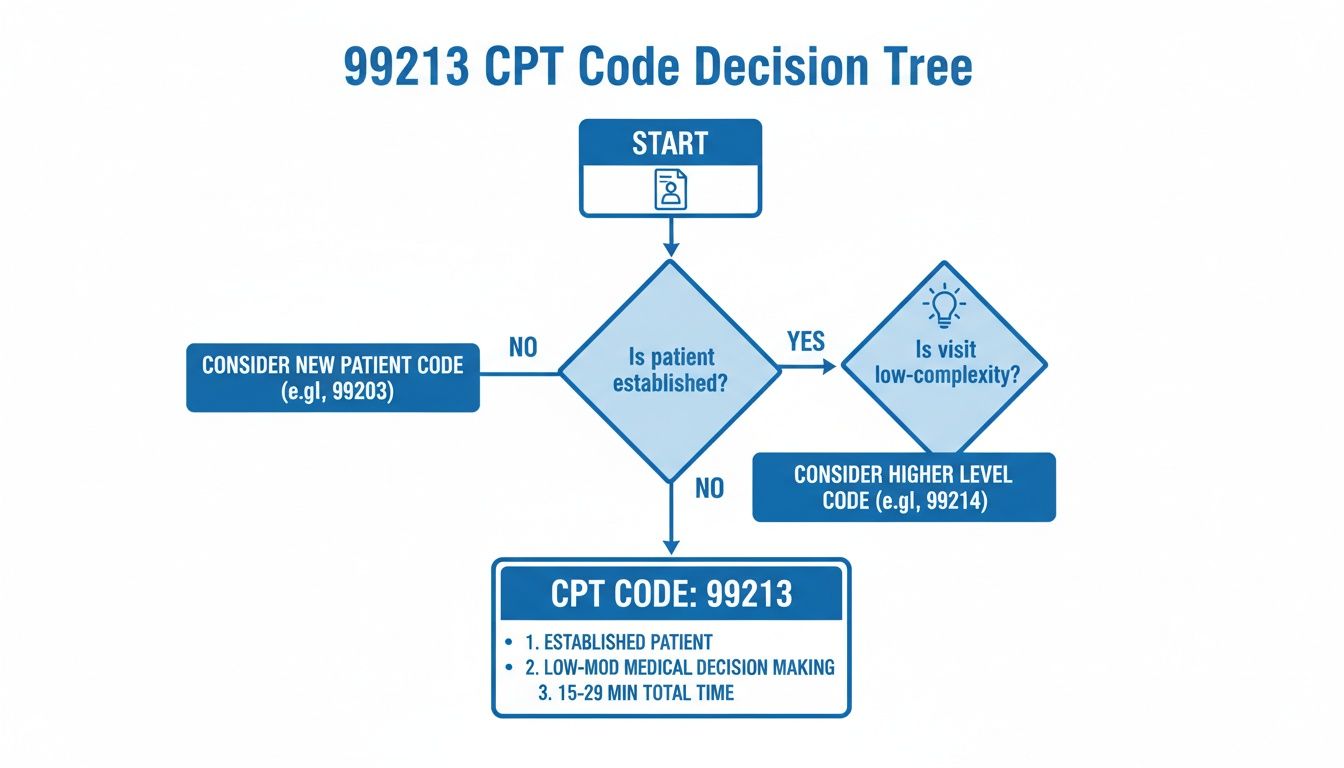
As the chart shows, 99213 is strictly for established patients with low-complexity needs, which you can define by either MDM or total time.
To help you decide which path makes the most sense for any given visit, here's a quick side-by-side look.
99213 Billing Pathways: MDM Vs. Total Time
Medical Decision Making (MDM)
- Core Focus: Clinical complexity and cognitive work.
- When to Use: When the clinical puzzle is the main driver, regardless of time.
- Key Requirement: Meet 2 of 3 MDM elements for "Low Complexity."
- Documentation Must-Haves: Notes supporting the problems, data, and risk.
Total Time
- Core Focus: Clock time spent on patient care.
- When to Use: When the visit involves extensive counseling or coordination.
- Key Requirement: Total time must be between 20-29 minutes.
- Documentation Must-Haves: Document total time spent and activities performed.
Ultimately, choosing between MDM and time gives you the flexibility to bill accurately for the work you actually performed, whether it was brainpower or minutes on the clock.
Decoding Medical Decision Making
Billing with MDM means your documentation needs to support a specific level of clinical complexity. It’s far less about the clock and much more about the clinical puzzle you’re solving for the patient.
To qualify for 99213 using MDM, your notes must clearly support a low level of complexity. This usually looks like one of these common scenarios:
- Two or more self-limited or minor problems: Think of a patient who comes in with a common cold and a minor skin rash.
- One stable chronic illness: A routine follow-up for a patient whose hypertension or type 2 diabetes is well-controlled fits perfectly here.
- One acute, uncomplicated illness or injury: This could be a straightforward case of cystitis or a simple ankle sprain.
The 99213 code has become a true backbone of modern outpatient care, especially since the 2021 E/M changes shifted the focus away from bean-counting history and exam elements. Now, it's all about MDM or time. Defined by the AMA as an 'office or other outpatient visit for established patients' with low MDM or 20-29 minutes of total time, it's the go-to for stable chronic care and routine follow-ups, making it one of the most billed E/M codes out there. For the official nitty-gritty, you can always check the guidelines from the American Medical Association.
The Simplicity Of Time-Based Billing
The time-based path offers a much more direct calculation. If the total time you, as the provider, spend on all patient care activities for a single encounter on a single day falls between 20 and 29 minutes, you can bill 99213.
It’s critical to remember that "total time" isn't just the face-to-face portion of the visit. It’s a comprehensive measure that includes a whole range of activities.
Total Time Encompasses: Reviewing patient charts before the visit, obtaining a history, performing the exam, counseling the patient, ordering tests or medications, and completing your documentation—all on the same day.
This makes time-based billing particularly useful for visits that involve extensive counseling or care coordination, even if the medical decision-making itself isn't terribly complex.
Just be mindful of the clock. If a visit starts pushing past the 29-minute mark, you may be stepping into a higher level of service. For those more complex encounters, you might be interested in our guide on CPT code 99214. To audit-proof any time-based claim, just make sure you document the total minutes spent.
Creating Audit-Proof Documentation For 99213
Think of your clinical notes as the story that justifies your billing choices. When it comes to the 99213 CPT code, solid documentation is your single best defense against audits and denials. This story needs to be clear, concise, and compelling enough to satisfy any payer who might come knocking.
The goal is to paint a clinical picture that leaves zero room for doubt. For every 99213 claim, your documentation must clearly support either a low level of Medical Decision Making (MDM) or a total encounter time between 20-29 minutes. Vague language and cookie-cutter templates are immediate red flags for auditors.
Your notes should walk the reader through your thought process without any unnecessary fluff. It’s all about quality, not quantity. A well-written note for a 99213 visit clearly answers the "why" behind the encounter, proving medical necessity through a logical narrative.

Core Components Of A Strong 99213 Note
To build a truly audit-proof record, every note needs a few key elements that line up with the low-complexity nature of a 99213 service. It doesn't matter if you use a classic SOAP (Subjective, Objective, Assessment, Plan) format or another structure—these components are non-negotiable.
- Chief Complaint (CC): This is the patient’s reason for the visit, ideally in their own words. It sets the stage for everything that follows.
- History of Present Illness (HPI): This is where you tell the story of the chief complaint. For a 99213 visit, keep it focused and targeted, not an exhaustive life history.
- Assessment and Plan: Here lies the heart of your MDM. You need to clearly link your diagnosis to your treatment plan. What did you rule out? What are the next steps?
A classic documentation mistake is just listing a diagnosis without explaining the management plan. An auditor needs to see your thinking: "Hypertension, stable. Continue current medication. Recheck in 3 months." That simple statement justifies the visit.
Focusing on these key areas ensures your documentation is a direct match for the billing code. Getting your team to consistently capture this information is a huge step forward. You can dive deeper into this topic by learning more about the principles of Clinical Documentation Improvement in our detailed guide.
Example 1: Follow-Up For Well-Controlled Hypertension
Let’s walk through a real-world scenario that’s a perfect fit for the 99213 CPT code. This example shows how to document a routine follow-up for a stable chronic condition.
Scenario: A 65-year-old established patient is back for their 3-month hypertension check-up.
- Subjective: Patient feels well and reports taking their Lisinopril 10 mg daily as prescribed. Denies chest pain, shortness of breath, dizziness, or headaches. We reviewed their home blood pressure log, which shows average readings of 125/80 mmHg.
- Objective: Vitals: BP 128/82, P 72, Wt 185 lbs. Exam is unremarkable. Heart shows a regular rate and rhythm, no murmurs. Lungs are clear.
- Assessment: Hypertension, essential, well-controlled on current medication.
- Plan:
- Continue Lisinopril 10 mg daily.
- Refill prescription for a 90-day supply.
- Encourage continued home BP monitoring and adherence to a low-sodium diet.
- Return to the clinic in 3 months.
This note is short, sweet, and complete. It addresses one stable chronic illness, reviews limited data (the BP log), and presents a low risk of complications—hitting the criteria for low MDM right on the nose.
Example 2: Acute Uncomplicated Illness
Now, let's switch gears to an acute issue. This example demonstrates how to document a straightforward problem that is easily managed.
Scenario: A 34-year-old established patient comes in with classic UTI symptoms.
- Subjective: Patient reports a 2-day history of urinary frequency and dysuria. She denies any fever, chills, or back pain.
- Objective: Vitals are stable. Abdominal exam reveals mild suprapubic tenderness. No costovertebral angle (CVA) tenderness. A urine dipstick test is positive for both nitrites and leukocyte esterase.
- Assessment: Cystitis, acute, uncomplicated.
- Plan:
- Prescribed Trimethoprim/sulfamethoxazole (Bactrim) DS, one tablet twice daily for 3 days.
- Advised patient to increase fluid intake and to call if symptoms get worse or don't resolve after finishing the antibiotic course.
- Follow-up as needed.
This documentation tackles one acute, uncomplicated illness. The data reviewed is limited to a single lab test, and the management plan is straightforward with low risk to the patient. This is another textbook case where 99213 is the right call. Following these kinds of templates will help you build a consistent and defensible documentation habit.
The Financial Impact Of Accurate 99213 Coding
Let's talk dollars and cents. CPT code 99213 might seem like a simple, everyday code, but its sheer frequency makes it one of the most important pillars of your practice's revenue. When you understand the math behind it, you can start making small changes that have a huge impact on your bottom line.
The whole system is built on Relative Value Units (RVUs). Think of RVUs as a universal price tag for medical services, factoring in the provider's work, the cost of running the practice, and malpractice insurance. Every CPT code gets an RVU value, which gets multiplied by a conversion factor to spit out the final payment.
For 99213, this system creates a steady, predictable stream of income that literally keeps the lights on.
Unpacking RVUs And Reimbursement Rates
When you look at the numbers, you see why 99213 is so critical for keeping cash flow healthy and denials low. For Medicare, this code—covering an established patient visit with low-level medical decision-making or 20-29 minutes of total time—brings in around $93-$95 per claim.
That payment is based on approximately 2.2 total RVUs, with about 1.3 of those being work RVUs. While commercial payers have their own fee schedules, they typically follow a similar pattern. A single $95 claim might not sound like much, but multiply that by the hundreds of times you bill it each month, and its true value becomes crystal clear.
The Hidden Costs Of Undercoding
The biggest financial leak in most practices isn't denials—it's the money you never even ask for. Undercoding happens when a provider documents a service that clearly meets the criteria for a higher-level code but bills a lower one, usually out of habit or a fear of audits.
Billing a 99214 visit as a 99213 is the classic example of this quiet but costly mistake.
Let’s run the numbers on a single error:
- CPT Code 99213 Reimbursement: ~$94
- CPT Code 99214 Reimbursement: ~$132
- Revenue Difference Per Visit: $38
If just one provider undercodes one visit per day, the practice loses $38. That doesn’t sound like much, but over a year, that single daily slip-up adds up to more than $9,500 in lost revenue. From just one person.
Imagine this multiplied across a multi-provider practice. Consistently undercoding by just one level can easily result in tens of thousands of dollars in lost revenue annually, directly impacting cash flow and profitability.
This is why proper coding education and internal chart audits have such a clear return on investment. Making sure every claim is coded to the highest defensible level isn’t aggressive—it’s just getting paid fairly for the work you actually did. For more ways to tighten up your practice's finances, check out our guide on revenue cycle management strategies.
Maximizing Revenue Through Coding Accuracy
Accurate coding isn't just a passive administrative chore; it's an active strategy for building a financially healthy practice. It requires a real commitment to ongoing education, clear documentation, and a team-wide focus on getting it right every time.
When providers and billers work together to ensure every 99213 claim is correct, they aren’t just following the rules. They’re protecting the financial future of the entire practice.
Often, the difference between a practice that’s thriving and one that’s just getting by comes down to these small, consistent details. By mastering the financial side of high-volume codes like 99213, you empower your team to capture every dollar earned, reduce compliance headaches, and build a much more resilient operation.
How To Navigate Payer Rules And Prevent Denials
Successfully billing the 99213 CPT code is about more than just accurate documentation—it’s also about mastering the tricky and often unique rules of different insurance payers. Even though the code’s definition is standard, how payers interpret and reimburse it can vary wildly. Learning to navigate these nuances is the secret to preventing denials and keeping your revenue cycle healthy.
Getting claims paid isn't always a straight shot. Each payer plays by its own set of rules, and what works for Medicare might get you an instant rejection from a commercial insurer. A one-size-fits-all approach is a recipe for payment delays and mounting accounts receivable.
This is exactly why you need a proactive game plan. By anticipating the common denial traps and understanding specific payer rules ahead of time, your billing team can dramatically boost your clean claim rate and keep your practice financially strong.

Top Reasons For 99213 Denials
Denials for the 99213 CPT code almost always come down to a few common, preventable mistakes. Understanding these pitfalls is the first step toward building a denial-proof billing process. Think of it as knowing your opponent before the game even starts.
Here are the most frequent culprits behind 99213 denials:
- Lack of Medical Necessity: This is a big one. The documentation simply fails to tell a clear story of why the visit was needed. The note might list a diagnosis, but it doesn't explain how the provider actually assessed or managed the condition, leaving the payer to question the service.
- Incorrect Use of Modifiers: Modifiers can feel like a minefield. This is a huge issue when a procedure is performed during the same visit as the E/M service. Forgetting to append Modifier 25 to the 99213 code basically tells the payer that the visit wasn't a "significant, separately identifiable" service, which leads to an immediate bundling denial.
- Coding Mismatches: The diagnosis code (ICD-10) and the procedure code (CPT 99213) don't logically connect. For example, billing a 99213 for a condition that usually requires much more (or less) intensive management will definitely raise a red flag with payers.
Focusing your team’s energy on avoiding these specific errors can slash the time you spend on rework and claim resubmissions.
A Proactive Strategy To Prevent Denials
Fixing denials after they happen is a time-consuming, expensive grind. A far better strategy is to stop them from happening in the first place. This requires a systematic process that starts long before a claim is ever sent out the door.
The most effective denial management is denial prevention. By building strong front-end processes—like verifying eligibility and ensuring documentation is complete before submission—practices can stop most denials in their tracks.
A solid prevention plan comes down to a few key actions:
- Verify Eligibility and Benefits: This seems basic, but it's crucial. Always confirm the patient's coverage before the encounter. This simple step catches problems like inactive policies or services that aren't covered, saving you countless headaches down the line.
- Conduct Internal Audits: On a regular basis, pull a sample of your 99213 claims and review them internally. Does the documentation truly support the code you billed? This helps you spot provider-specific patterns or knowledge gaps that can be fixed with targeted training.
- Stay Current on Payer Policies: Designate someone on your team to be the "payer watchdog" and monitor updates from your top insurance companies. Payers are constantly changing their rules for modifiers, medical necessity, and documentation.
Handling Bundling And Modifier 25
One of the trickiest situations involves billing a 99213 on the same day as a minor procedure, like a joint injection or a simple lesion removal. Payers often bundle the E/M service into the procedure payment, assuming the visit was just part of the routine pre-procedure work.
To get paid for both services, you have to prove the E/M service was a distinct and separate piece of work. This is where Modifier 25 comes into play. By adding it to the 99213 code, you're officially stating that the patient’s condition required a significant, separately identifiable evaluation and management service above and beyond the usual care tied to the procedure.
Of course, your documentation must back this up completely. The note needs to clearly describe the thought process and work that went into the E/M portion, totally separate from the procedure note. Without that crystal-clear distinction, you can expect a denial. Navigating these complexities is central to effective medical billing denial management, which aims to both resolve and prevent these very issues.
Staying Compliant And Avoiding Costly Audits
Given how frequently 99213 shows up on claims, it’s no surprise that it’s a constant target for payer audits. This isn’t a coincidence—its high volume makes any systematic mistakes, even tiny ones, stick out like a sore thumb to their algorithms. A proactive compliance strategy isn't just a "nice-to-have"; it's essential for protecting your practice from painful recoupments and stressful investigations.
Auditors are trained to spot patterns that scream non-compliance. Building a solid defense means knowing what they look for and making sure your internal processes can withstand the scrutiny. Think of it as preventative care for your revenue cycle.
The 99213 CPT code is the undisputed heavyweight champion in U.S. healthcare. CMS data reveals it was billed a staggering 103 million times in a single year. That sheer volume makes it the workhorse of outpatient care, but it also explains why payers watch it like a hawk. You can find more insights on this topic at most commonly used CPT codes on medwave.io.
Major Red Flags Auditors Look For
Payers use sophisticated software to flag claims that fall outside of their expected norms. Knowing what triggers these alerts allows you to fix potential issues before they become liabilities. Getting ahead of these red flags is the key to keeping a clean billing record.
Here are the top issues that can put you on an auditor’s radar:
- Cloned or Copied Notes: This is a big one. When documentation for different patients or separate visits looks almost identical, it tells an auditor that the provider isn't creating a unique record for each encounter. This can get an entire batch of claims thrown out.
- Inconsistent Billing Logic: Jumping back and forth between time-based and MDM-based billing for similar types of visits without a clear reason looks suspicious. Auditors want to see a logical, consistent approach to how you select your codes.
- Unsupported Upcoding: Are you billing a high number of 99213s when your patient population's complexity might suggest more 99212s? This pattern can signal potential upcoding. Your billing data should tell a story that aligns with your specialty and patient demographics.
A strong compliance posture is built on one thing: consistency. Make sure every provider understands and applies the same clear, defensible logic to every claim, every single day. That consistency is your best defense.
Performing Proactive Internal Audits
The absolute best way to find and fix problems is to look for them yourself—before an external auditor does it for you. Regular internal audits are a powerful tool for managing risk and driving continuous improvement. It’s the perfect way to identify knowledge gaps and reinforce best practices across your team.
A simple but effective internal audit checklist should include these steps:
- Review a Random Sample: Pull 10-15 charts per provider that were coded with 99213.
- Verify Documentation Support: Does the note clearly back up either low MDM or 20-29 minutes of total time spent?
- Check for Signatures and Dates: A simple but crucial step. Ensure all documentation is properly signed, dated, and locked.
- Provide Feedback: Use what you find to give specific, constructive feedback and education to your providers.
By regularly running these self-checks, you can correct your course and strengthen both your documentation and coding accuracy. To get a better handle on where mistakes often hide, check out our guide on common medical coding errors. This proactive approach is fundamental to safeguarding your practice’s financial and regulatory health.
Have Questions About 99213? We’ve Got Answers.
When it comes to the nitty-gritty of CPT codes, it’s normal for questions to pop up, especially when you’re dealing with unique patient scenarios day in and day out. Here are some straightforward answers to the most common questions we hear about billing for a 99213.
Can 99213 Be Used For Telehealth Visits?
Absolutely. CPT code 99213 is one of the most common codes used for telehealth appointments today. Payers, including Medicare, have widely adopted its use for virtual visits, but there’s one important catch: the encounter has to meet the exact same criteria as an in-person visit.
That means your documentation needs to clearly support either a low level of medical decision-making (MDM) or a total time of 20-29 minutes spent on the patient's care that day. The bottom line is the standard of care—and the documentation to prove it—doesn't change just because you’re seeing the patient through a screen.
Who Can Bill For A 99213 Service?
This code isn't just for physicians. The 99213 CPT code can be billed by other qualified healthcare professionals, as long as the service falls squarely within their scope of practice and is properly documented.
This includes practitioners like:
- Nurse Practitioners (NPs)
- Physician Assistants (PAs)
- Other licensed clinicians providing evaluation and management services
No matter who the provider is, the same rules around medical necessity, solid documentation, and billing logic (MDM or time) always apply.
What Is The Difference Between 99213 And 99214?
The main distinction between 99213 and the next level up, 99214, really comes down to the complexity of the visit. Think of it as the difference between managing a straightforward issue versus navigating a more complicated clinical picture.
CPT code 99213 is for low complexity MDM or 20-29 minutes of total time. In contrast, 99214 represents a moderate complexity MDM or a total time of 30-39 minutes.
A 99213 visit might be perfect for managing a stable chronic illness or a simple follow-up. A 99214, on the other hand, is better suited for a patient dealing with an unexpected flare-up of a chronic condition or a new problem where the diagnosis isn’t quite clear yet.
Getting the nuances of codes like 99213 right is key to keeping your revenue cycle healthy. At One For All Medical Billing, we dive into the complexities of coding, billing, and denial management so you can get back to focusing on your patients. Let us help you get paid faster and with fewer errors. Schedule your free consultation today!

