

table of contents
Let's be honest: staring down a mountain of rising denial rates and never-ending coding updates can feel like you're fighting a losing battle. For many practice administrators I talk to, the decision to outsource medical coding services has shifted from a simple cost-cutting tactic to a full-blown strategic move for financial stability and growth.
This shift is about more than just offloading tasks. It’s about plugging into specialized expertise, minimizing compliance risks, and fortifying your entire revenue cycle from the ground up.
Why Smart Practices Outsource Medical Coding

The administrative weight of modern healthcare is crushing. It pulls your team's focus away from what truly matters—patient care—and stretches your internal resources to the breaking point. In-house teams are often trying to juggle patient calls while keeping up with a dizzying number of ICD-10, CPT, and payer-specific rule changes.
In that kind of environment, maintaining the high level of accuracy needed for a healthy revenue stream is next to impossible.
This is exactly why so many top-performing practices are rethinking their approach. They see outsourcing as a sustainable solution to these persistent headaches, allowing them to operate more efficiently and, ultimately, more profitably.
Access To Certified Expertise And Scalability
One of the biggest wins when partnering with an external team is getting immediate access to a deep bench of certified specialists. These are people who live and breathe medical coding every single day.
- Specialty-Specific Knowledge: A reputable partner will have coders with deep experience across a range of specialties, from pain management to OB/GYN. This ensures your complex procedures are coded correctly, not just given a best guess.
- Operational Flexibility: Outsourcing gives you the power to scale coding support up or down based on patient volume. This is a game-changer for managing seasonal spikes or practice growth without the fixed overhead of hiring more full-time staff.
Mitigating Compliance Risks And Reducing Burdens
Staying compliant is a full-time job in itself. With regulations constantly shifting, the risk of an audit—and the penalties that come with it—is a very real concern for any practice.
Outsourcing transfers a huge chunk of this compliance burden to a partner whose entire job is to stay current with HIPAA, OIG, and other payer rules. This move not only minimizes your risk but also frees your own admin staff from the pressure of constant training and policy updates.
This strategic offloading is a major reason the market is booming. The global medical coding market is projected to jump from USD 38.58 billion in 2024 to USD 89.49 billion by 2033. This growth is fueled by practices chasing higher accuracy and efficiency. In fact, providers who outsource often report clean-claim rates above 95%, which has a massive impact on cash flow.
If you're curious, you can dive into the full research on medical coding market trends to see where the industry is headed. This approach directly strengthens your bottom line and is one of the key benefits of revenue cycle management we explore in our related guide.
Assessing Your Practice's Readiness For Outsourcing

Before you even start Googling "outsource medical coding services," it’s time to look inward. Seriously. The most successful partnerships I've seen begin with a brutally honest look at a practice's current performance, tech setup, and biggest headaches. Without a solid baseline, you can't actually measure if a new partner is making a difference.
This self-audit isn't about finding fault. It’s about arming yourself with data. The whole point is to move beyond vague feelings like "we're just not efficient enough" and pinpoint the exact areas where an expert coding team can deliver a measurable boost to your bottom line.
Establish Your Performance Baseline
First things first: you need to quantify the health of your revenue cycle. Gut feelings and statements like "our denials are too high" won't cut it. You need hard numbers. These figures will set clear expectations and, down the road, hold your chosen partner accountable for results.
Pull your data from the last six to twelve months and calculate these critical metrics:
- Clean Claim Rate (CCR): This is the percentage of claims paid on the very first submission. If your CCR is below 90%, it's a huge red flag signaling underlying coding or billing issues that need fixing, fast.
- Average Days in Accounts Receivable (A/R): How long does it take you to get paid? Your goal should be under 30 days. When this number starts creeping over 45 or 50 days, you’ve got a serious cash flow bottleneck.
- Denial Rate: What percentage of your claims are getting kicked back by payers? A rate between 5-10% might seem normal, but every single percentage point represents lost revenue and a ton of extra administrative work.
By establishing these benchmarks, you create a clear "before" picture. This data will be your most powerful tool for evaluating proposals and measuring the ROI of your new partnership down the line.
Evaluate Your Technology And Workflows
Your current technology stack—especially your Electronic Health Record (EHR) and Practice Management (PM) system—plays a massive role in how smoothly this transition will go. Can your system even support a remote team securely and efficiently?
You have to ask if your platform allows for secure, role-based remote access. If you're working with an outdated system that requires manual data dumps or clunky workarounds, you’re just trading one set of problems for another and killing the efficiency you're trying to gain.
Beyond the tech, take some time to map out your existing workflow, from the moment a patient checks in to when the claim is submitted. Where are the handoffs? Who’s responsible for reviewing documentation? Identifying these bottlenecks now helps you define exactly what you expect an outsourced partner to solve. A pain management clinic, for example, might be struggling to code complex, multi-faceted procedures, while an OB/GYN practice is pulling its hair out over global billing packages.
Understanding your specific needs is the most important first step. To get a bigger picture, it's also smart to explore the different pricing models out there. Take a look at our guide on the costs of medical billing services to get a better handle on the financial side of things.
How To Find The Right Medical Coding Partner
Alright, you've mapped out exactly what your practice needs. Now comes the hard part: finding a partner who can actually deliver. Choosing to outsource medical coding services is a big deal. It's not about finding the cheapest option—it’s about bringing in a strategic ally who will directly impact your revenue and keep you compliant. This means you have to look beyond the price sheet.
Your first step should be to vet the people who will be handling your charts. The quality of your coding is only as good as the coders themselves. Insist on proof that their team holds current certifications from reputable bodies like AAPC (like a CPC) or AHIMA (like a CCS).
Just as important, confirm their coders are U.S.-based. This isn’t about patriotism; it's a practical necessity for staying on top of complex U.S. payer rules and maintaining bulletproof HIPAA compliance.
Digging Into Specialty-Specific Experience
Let's be clear: generic coding experience is not enough, especially if you run a specialty clinic. The coding nuances for a cardiology practice are worlds away from those of an orthopedic surgery center. You need a partner who lives and breathes your specific field to maximize reimbursements and steer clear of compliance traps.
Don't be afraid to ask for case studies or anonymized performance data from practices just like yours. Even better, ask for references from clients in your specialty. There is no substitute for speaking directly with a peer who has firsthand experience with their service. It’s the single most reliable way to gauge their real-world expertise.
Vetting a potential partner is a crucial step that sets the tone for the entire relationship. Focus on verifiable expertise, transparent processes, and a proven track record within your medical specialty. A thorough evaluation upfront prevents costly mistakes later.
Decoding Common Pricing Models
Getting a handle on how a coding company structures its fees is fundamental. Most vendors lean on one of three common models, and each comes with its own set of pros and cons. Understanding them will help you compare apples to apples when the proposals start rolling in.
Here's a breakdown of the most common pricing structures you'll encounter.
Per-Chart or Per-Claim Fee
- How It Works: You pay a fixed rate for each chart coded.
- Best For: Practices with stable patient volumes or those needing predictable monthly costs.
- Potential Downside: Can become expensive if your patient volume suddenly spikes.
Percentage of Collections
- How It Works: The partner takes a percentage of the revenue they help you collect.
- Best For: Practices focused on maximizing revenue recovery, as the partner's success is tied to yours.
- Potential Downside: The percentage can vary, and it might be less predictable for budgeting.
Dedicated FTE
- How It Works: You pay a fixed monthly fee for a remote coder who works exclusively for you.
- Best For: High-volume, multi-site practices needing consistent, dedicated support.
- Potential Downside: The highest fixed cost, which might not be justifiable for smaller practices.
Knowing these options will help you see which model truly aligns with your practice's financial goals. For a broader perspective on how different partners structure their services, you can explore our guide on the top revenue cycle management companies.
Red Flags To Watch For In A Coding Partner
While you're sizing up potential vendors, keep your eyes peeled for warning signs. A few red flags should give you serious pause—or convince you to walk away entirely.
Be wary of vague compliance policies, a flat-out refusal to provide specialty-specific references, or a lack of transparent reporting. High-pressure sales tactics designed to rush you into a decision are another major concern.
The right partner will be transparent, knowledgeable, and ready to prove their value. They get it. They know that top-tier specialized firms often hit clean-claim rates north of 95%, a huge jump from the typical in-house average. This level of precision is exactly why outsourced services are booming, holding a 65.64% revenue share in 2023 by delivering cost-effective, audit-ready workflows. You can discover more insights about these medical coding outsourcing trends to see where the industry is headed.
Diving Into Contracts And HIPAA Compliance
Let's talk about the legal side of things. Bringing on an outsourced coding partner can feel overwhelming, especially when the contracts land on your desk. But this is where you lay the foundation for a successful partnership.
When you outsource medical coding, you’re handing over the keys to your revenue cycle and trusting a third party with sensitive patient data (PHI). That’s why the contracts you sign are more than just a formality—they’re your practice’s shield against financial loss and regulatory nightmares.
Think of it this way: two documents are absolutely non-negotiable. The Service Level Agreement (SLA) and the Business Associate Agreement (BAA). Get these right, and you're set up for success.
The Anatomy Of A Strong Service Level Agreement
The SLA is your operational playbook. It translates a vendor’s sales pitch into concrete, legally binding promises. A vague or flimsy SLA is a recipe for disaster, leaving you with zero leverage if performance starts to slip.
A solid SLA needs to get specific. It should clearly define:
- Guaranteed Coding Accuracy: Don't settle for less than a 95% accuracy rate, stated in black and white. This is the industry benchmark for quality.
- Turnaround Times: The agreement must specify the maximum time allowed from when a chart is received to when the codes are ready for submission. A 24 to 48-hour window is standard.
- Denial Management Protocols: What happens when a claim is denied due to a coding error? The SLA should detail the exact process for appeals, including response times and how issues get escalated.
Without these metrics, you’re just hoping for the best. You need measurable standards to hold your partner accountable.
Why The Business Associate Agreement Is Non-Negotiable
If the SLA outlines how the work gets done, the Business Associate Agreement (BAA) is your compliance armor. Under federal HIPAA law, any vendor that handles your PHI is considered a "Business Associate," and a signed BAA is a legal requirement. No exceptions.
This document contractually obligates your coding partner to uphold the same stringent HIPAA privacy and security rules your own practice follows. It covers everything from safeguarding data and reporting breaches to properly handling and destroying PHI.
Here’s a major red flag: if a potential partner tries to downplay the BAA or hands you a generic, one-page template, walk away. It’s a clear sign they don’t grasp their legal responsibilities, which puts your practice at massive risk for violations and six-figure fines.
Beyond the BAA, dig into their security practices. Ask about data encryption, their access control policies, and how often they conduct security audits. For a closer look at what to expect from a compliant vendor, our guide on third-party medical billing dives deeper into the responsibilities they must uphold to protect you and your patients.
Your Onboarding And Integration Plan
Signing the contract is a big step, but the real work starts now. The success of your decision to outsource medical coding services truly hinges on a well-thought-out onboarding and integration plan.
A smooth transition is everything. It minimizes disruption to your cash flow and sets clear expectations from day one, ensuring your new partner starts adding value right away. The goal is to move from contract to full operational capacity without missing a beat—making them a seamless extension of your own team.
Laying The Technical Groundwork
First things first: technology. Your new coding team needs secure, efficient access to your systems to do their job. This part is foundational for everything that follows.
- Granting Secure EHR Access: Your IT team and your new partner need to work together to set up secure, role-based access to your EHR and PM systems. This is non-negotiable and is usually handled via a secure VPN or a dedicated portal to maintain strict HIPAA compliance.
- Aligning on Workflows: You need to map out the exact process for chart hand-offs. Will the coders pull charts directly from a queue in the EHR? Or will your staff flag charts as "ready for coding"? Defining this workflow prevents charts from getting stuck in limbo.
- Establishing Communication Channels: Designate a primary point of contact on both sides—one person who owns the relationship. Then, set up a secure messaging channel or schedule regular check-in calls to handle documentation questions, coding queries, and feedback.
The contract vetting process, which should be completed long before this stage, lays the groundwork for this technical setup.
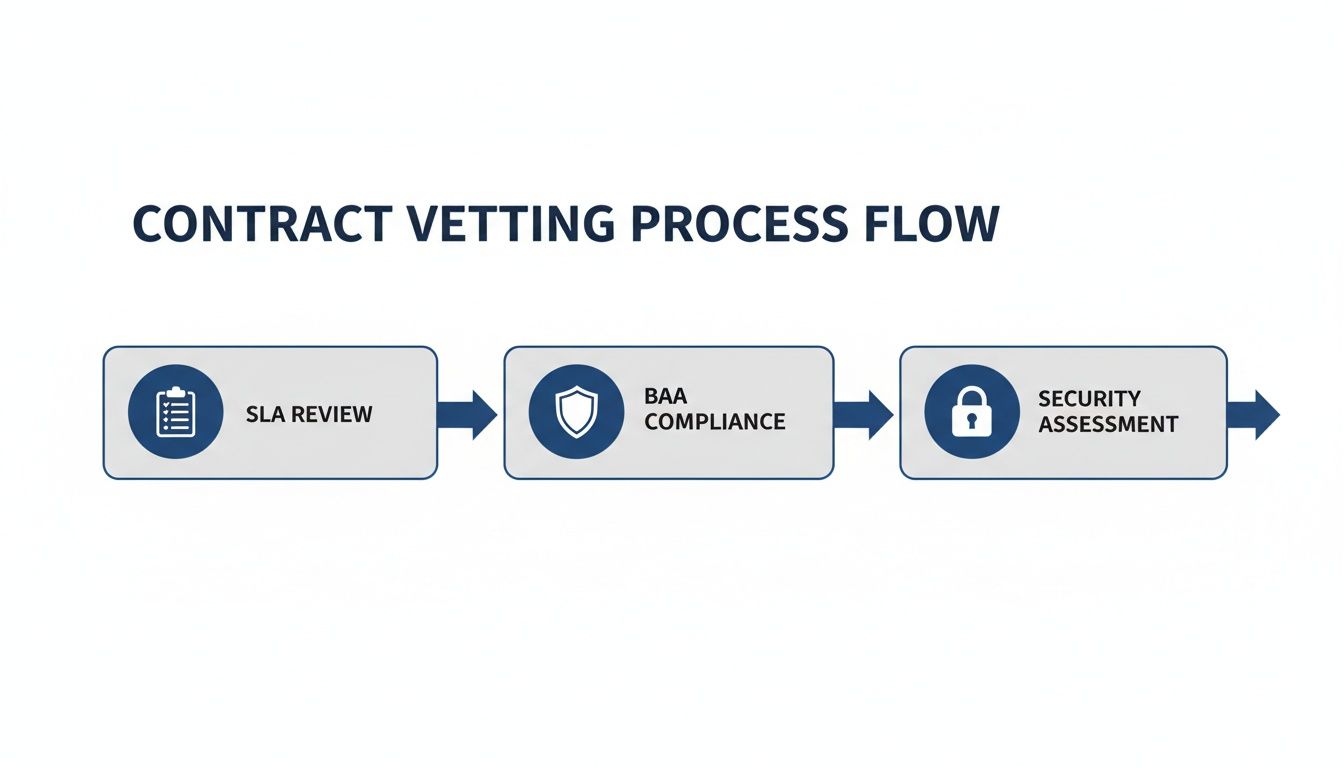
As this shows, a solid partnership is built on clear agreements covering everything from service levels (SLA) and data protection (BAA) to security protocols.
Defining And Tracking Key Performance Indicators
Once the systems are connected, your focus must shift to performance. You can't manage what you don't measure. Tracking the right Key Performance Indicators (KPIs) from the very beginning gives you an objective view of your partner's impact on your revenue cycle.
A common mistake I see practices make is waiting too long to track performance. You need to start monitoring KPIs from the first week. This allows you to spot trends, address issues early, and confirm that your new partner is meeting the benchmarks laid out in your SLA.
Your performance dashboard should include a few core metrics:
- Coding Accuracy Rate: This is the big one. Aim for 95% or higher, and make sure it's verified through regular internal or third-party audits.
- Clean Claim Rate: This measures the percentage of claims accepted on the first pass. It's a direct reflection of coding quality and directly impacts your cash flow.
- Claim Turnaround Time: Track the time from when a chart is available to when the claim is submitted. This should stay within the agreed-upon 24-48 hour window.
For multi-site practices, standardizing these KPIs and workflows across all locations is essential for consistent, predictable performance. This approach ensures every clinic benefits equally from the partnership.
And if you want to better understand where your claims go after they're coded, check out our guide on what a clearinghouse is in medical billing. This knowledge helps put the importance of clean, accurate claims from your coding team into perspective.
Have Questions About Outsourcing Medical Coding? We Have Answers.
Deciding to outsource medical coding services is a big step, and it’s natural to have questions. Practice administrators and physicians always want to know about cost, technology, and quality control before they hand over such a critical part of their revenue cycle.
Let's walk through the most common concerns we hear from practices just like yours.
How Much Does It Cost To Outsource Medical Coding Services?
The cost really depends on your practice's size, specialty, and claim volume. Most coding partners structure their pricing in one of three ways:
- Percentage of Collections: Typically between 3-8%, this model aligns the coding company's success directly with yours. They get paid when you get paid.
- Flat Fee Per Chart: This offers predictable monthly costs, which is great for budgeting. You know exactly what you'll spend, regardless of collection fluctuations.
- Dedicated Coder (FTE): For larger practices, you can pay a flat rate for a full-time equivalent coder who works exclusively on your accounts.
When you're weighing the options, don't just look at the direct cost. Think about the hidden savings—reduced overhead from salaries and benefits, fewer costly denials, and the massive boost to your cash flow when claims are paid correctly the first time. That's where the real ROI comes from.
Will An Outsourced Service Work With My Existing EHR System?
Yes, almost certainly. Any reputable outsourced coding company has seen it all when it comes to technology. They're built to integrate with major EHR and Practice Management (PM) systems like Epic, Cerner, and eClinicalWorks.
During your evaluation, make sure to ask about their specific experience with your platform. Access is typically handled via a secure, HIPAA-compliant VPN or web portal, so the entire process is seamless and doesn't interrupt your clinical team's workflow. Here's a pro tip: ask for a reference from another practice that uses the same EHR you do.
A key part of your due diligence is confirming seamless technological integration. The right partner will feel like an extension of your team, not an obstacle to your existing processes.
How Do I Maintain Quality Control With An External Team?
This is probably the most important question, and the answer lies in clear agreements and total transparency. Your Service Level Agreement (SLA) is your best friend here. It should spell out a guaranteed coding accuracy rate of 95% or higher. No exceptions.
Your partner should also provide you with regular performance reports. You'll want to see KPIs like your clean claim rate, denial trends (broken down by reason code), and coding turnaround times. For extra peace of mind, many practices conduct their own random spot-checks on a small batch of charts to independently verify accuracy. It keeps everyone sharp and aligned.
What Is The Typical Onboarding Timeline?
A smooth, well-organized onboarding process usually takes between two and six weeks. The exact timeline depends on the size of your practice, how many providers you have, and the technical lift required for EHR integration.
A typical implementation involves a kickoff meeting to set goals, system access setup and testing, workflow customization to match your needs, and a short trial period to work out any kinks. A good partner will give you a detailed project plan with clear milestones, making the transition predictable and minimally disruptive to your revenue.
Ready to reduce denials, improve collections, and free your team to focus on patient care? One For All Medical Billing provides expert, U.S.-based medical coding and billing services designed for your practice's unique needs. Schedule your free consultation today to see how we can strengthen your revenue cycle.

