

table of contents
Are you constantly staring at rising claim denials and unpredictable cash flow? You're not alone. Many practice managers feel like they're drowning in the administrative weight of billing, collections, and ever-changing compliance rules.
This constant struggle pulls time and resources away from what really matters: providing excellent patient care.
Think of Revenue Cycle Management (RCM) less as a back-office chore and more as the financial heartbeat of your practice. It’s the entire journey a patient's account takes, from the second they book an appointment to the moment their final payment is posted. When that cycle is broken or inefficient, the financial health of your entire practice suffers. You can dive deeper into the basics in our complete guide to understanding revenue cycle management.
Unlocking Your Practice's Financial Potential
A well-oiled RCM process directly tackles the biggest financial headaches healthcare providers face. For multi-site groups, it builds consistency and makes growth possible. For specialty practices, it ensures complex coding and billing rules are followed to the letter. And for high-volume urgent care centers, it gets you paid faster.
An optimized RCM system isn't just about getting paid; it's about getting paid correctly and on time, every single time. That predictability is the foundation of any financially resilient and scalable healthcare practice.
By moving beyond basic billing and collections, a smart RCM strategy paves a clear path to financial stability. The core benefits we'll explore in this guide are game-changers:
- Accelerated Cash Flow: By shrinking the time between providing a service and getting paid for it, you stabilize your revenue and free up critical resources.
- Reduced Claim Denials: Proactive steps like solid coding and upfront eligibility verification stop revenue leaks before they even start.
- Enhanced Operational Efficiency: When workflows are smooth, your team can focus more on patient-facing activities and less on chasing down payments.
This guide will break down exactly how each of these benefits transforms your operations, using concrete examples and real data to show you the impact.
Accelerate Cash Flow And Boost Your Bottom Line
Slow payments and unpredictable revenue streams can cripple even the most successful healthcare practice. Let's be honest, cash flow is king. One of the biggest wins from a well-oiled RCM system is getting paid faster and more consistently, turning that erratic income into a predictable financial asset.
This isn't just a vague promise; it's the direct result of tightening up the entire financial process. It starts with precise patient eligibility verification upfront, moves to submitting clean claims the first time, and finishes with a team that proactively follows up on every dollar you're owed. All these pieces work together to slash the time it takes to get reimbursed.
For a growing multi-site practice, this is the difference between struggling month-to-month and having the predictable cash flow needed to actually support expansion. The goal is simple: dramatically reduce the days your claims sit in accounts receivable (A/R).
The Foundation Of Financial Stability
An optimized RCM strategy is the bedrock of a practice's financial health. It directly tackles the most common pain points that keep practice managers up at night: denials, cash flow delays, and operational chaos.
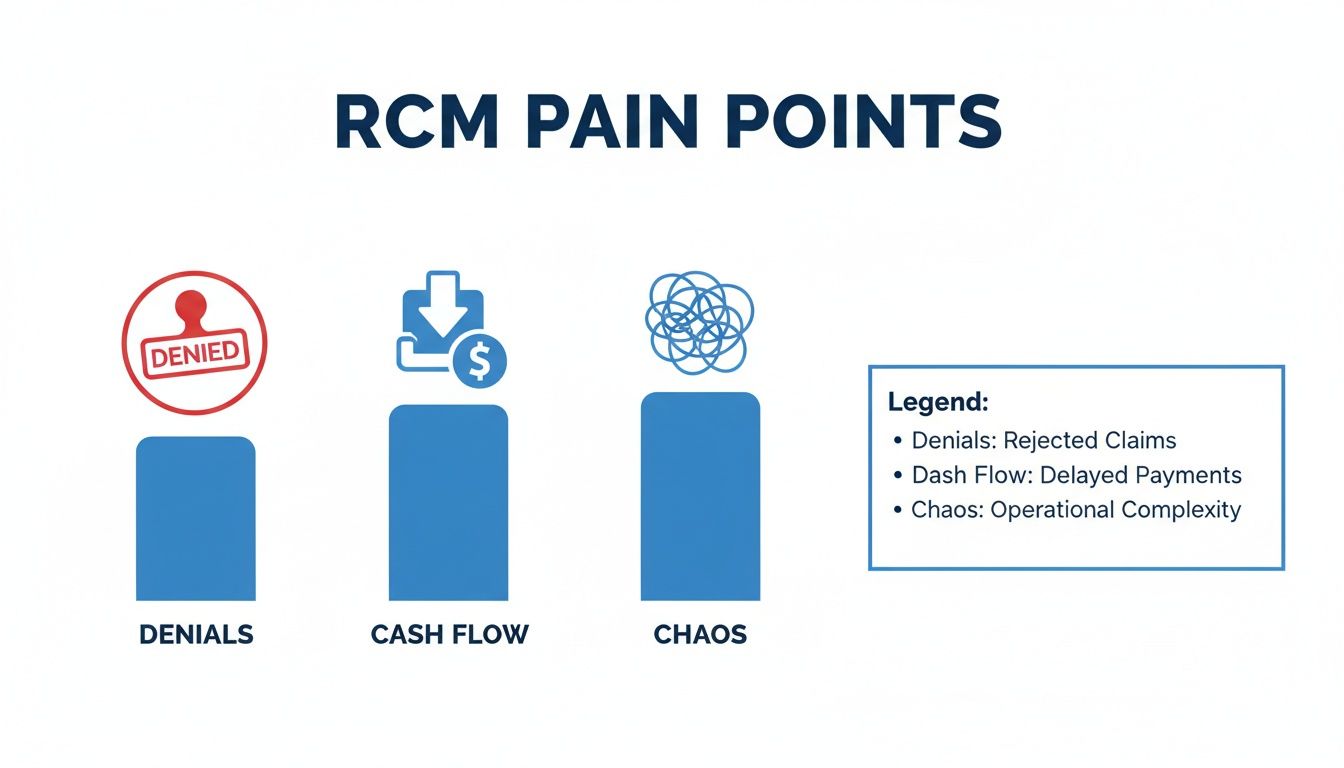
As the infographic shows, these aren't minor inconveniences. They are direct threats to your bottom line, which is why a strategic approach to billing and collections is no longer optional.
The demand for these solutions is exploding for a reason. In the U.S. alone, the RCM market hit an incredible USD 172.24 billion in 2024. It’s projected to grow at a healthy 10.1% annually through 2030, driven by the urgent need for providers to get a handle on their finances. This makes sense, especially when you consider that over 40% of providers are waiting two months or longer just to get paid.
The data below gives you a clear, numbers-driven look at what this shift actually means for a practice's finances.
Financial Impact Of Inefficient Vs Optimized RCM
Here's a comparison of key performance indicators (KPIs) before and after implementing an optimized RCM system:
First-Pass Clean Claim Rate
- Before Optimized RCM (Industry Averages): 75%–85%
- After Optimized RCM (Achievable Results): 95% or higher
Claim Denial Rate
- Before Optimized RCM (Industry Averages): 10%–20%
- After Optimized RCM (Achievable Results): Under 5%
Days in A/R
- Before Optimized RCM (Industry Averages): 45+ days
- After Optimized RCM (Achievable Results): 25–30 days
Net Collection Rate
- Before Optimized RCM (Industry Averages): 85%–90%
- After Optimized RCM (Achievable Results): 96% or higher
Cost to Collect
- Before Optimized RCM (Industry Averages): 5%–7% of net revenue
- After Optimized RCM (Achievable Results): 2%–4% of net revenue
The takeaway is clear: optimizing your revenue cycle isn't just about efficiency—it's about fundamentally improving your practice's financial health and unlocking significant revenue that was previously lost to delays and write-offs.
Turning Proactive Follow-Up Into Revenue
A core part of getting paid faster is mastering A/R management. Instead of waiting for denials to pile up or for claims to age out, an expert RCM partner is on the offense. They proactively follow up on unpaid claims, spot bottlenecks with certain payers, and fix issues before they can hurt your revenue stream.
This proactive stance ensures that small discrepancies don't turn into major write-offs. It's about maintaining constant communication with payers to keep the payment cycle moving smoothly and efficiently.
This isn't a passive process. It involves:
- Systematic Claim Tracking: Keeping eyes on every single claim, from the moment it's submitted to the moment it's paid.
- Prompt Denial Resolution: Moving fast to address and appeal any rejected claims with solid documentation.
- Payer Trend Analysis: Looking for patterns in payment delays or denials from specific insurance companies to get to the root cause.
By mastering this part of the process, you can dramatically shorten your payment cycles. If you want to dig deeper, you might find our guide on effective medical billing A/R follow-up strategies helpful. This consistent effort is what strengthens your practice's financial performance and builds a more resilient bottom line.
Significantly Reduce Costly Claim Denials
Claim denials are more than just an administrative headache—they're a direct leak in your practice's revenue stream. A huge benefit of strong revenue cycle management is making the switch from a reactive mindset (chasing denials after they happen) to a proactive one that stops them before they start. The real goal isn’t just getting better at appeals; it’s making sure you don't need to file them in the first place.
This kind of financial defense is built on deep expertise. It starts with certified, U.S.-based coders who live and breathe the rules for your specific specialty. They know the intricate, always-changing guidelines for different payers, making sure every single claim is coded accurately and meets compliance standards right from the get-go. That level of precision is what drives a high first-pass acceptance rate.

From Financial Drain To Predictable Revenue
Picture a multi-site specialty practice that’s constantly fighting denials for complex procedures. Their in-house team is stretched thin, struggling to keep up with unique payer rules. The result? A denial rate that eats away at their profits and makes cash flow completely unpredictable.
By partnering with an RCM expert, they bring in a team whose entire job is to get it right the first time.
This proactive approach hinges on a few critical steps:
- Thorough Claim Scrubbing: Before a claim ever goes out the door, it’s reviewed both automatically and by human experts to catch errors, missing information, or coding mistakes.
- Payer Rule Adherence: Using a combination of smart technology and expert knowledge to ensure every claim is tailored to the specific payer’s requirements.
- Root Cause Analysis: Digging into the data to spot recurring denial patterns, which allows the practice to fix the underlying issue for good.
This process turns a major financial leak into a predictable, secure revenue stream. This focus on prevention is one of the most powerful revenue cycle management benefits because it directly protects your bottom line. To get a deeper look at this process, check out our guide on effective medical billing denial management.
The Growing Importance Of Expert RCM
It’s not just us—the entire industry is waking up to the value of this expertise. With denial volumes recently jumping by 18-22%, having a solid RCM strategy has become a critical financial defense.
In fact, the healthcare RCM outsourcing market is expected to nearly double to $67 billion in the next four years, as 70% of hospitals plan to expand these partnerships. Providers who outsource simply see fewer first-pass denials and collect more effectively by using predictive tools and specialized knowledge. You can find more insights about 2026 RCM trends on auxis.com.
By treating denial management as a preventative measure rather than a clean-up task, practices can safeguard their revenue and build a more resilient financial foundation for long-term growth and stability.
Boost Your Operational Efficiency And Scalability
Administrative overload is one of the biggest roadblocks to growth. It ties up your most valuable staff members in the tangled mess of medical billing and collections, pulling them away from what truly matters. One of the greatest benefits of a solid revenue cycle management strategy is its power to liberate your team from these repetitive, time-consuming tasks.
When you outsource RCM, you're not just offloading paperwork; you're empowering your staff to refocus their energy on high-value, patient-facing activities. Think scheduling, care coordination, and creating a positive in-office experience. When your team has more time for patients, those patients feel more valued and supported, which is the bedrock of loyalty.
Scale Your Practice Without Scaling Your Headaches
For growing multi-site groups and ambitious specialty practices, the scalability an RCM partner offers is a game-changer. It’s like plugging your practice directly into an expert-built infrastructure. Instead of bearing the immense cost and effort of building your own specialized billing department from the ground up, you gain immediate access to a proven system ready to go on day one.
This lets you expand your operations without the usual growing pains that come with scaling an in-house team.
Partnering with an RCM expert means you can add a new location or provider without worrying about hiring, training, and managing more billing staff. The infrastructure is already in place to support your growth seamlessly.
This model is so effective because it delivers a few key things right out of the box:
- Instant Expertise: You get a team of certified coders and billing specialists who are already experts in your specialty and know the specific rules of your payers inside and out.
- Advanced Technology: An established RCM partner brings sophisticated billing software and analytics tools that might otherwise be too expensive for a single practice to acquire and maintain.
- Regulatory Compliance: The RCM team stays on top of the ever-changing healthcare regulations, ensuring your billing practices remain compliant and reducing your audit risk as you grow.
This freedom allows practice managers and owners to concentrate on strategic initiatives—like marketing or patient outreach—instead of getting bogged down in daily billing fires. For more on this, you might be interested in the benefits of automating your medical billing workflow, which often goes hand-in-hand with outsourcing.
Ultimately, this boost in operational efficiency ensures your practice can grow smoothly and sustainably, backed by a financial engine built for performance.
Gain Actionable Insights With Financial Transparency
Effective revenue cycle management shouldn’t feel like a black box. It’s all about delivering clarity—turning raw data into a clear roadmap that helps you make smarter business decisions. This financial transparency is one of the most powerful revenue cycle management benefits, and it's what separates guessing about your practice's financial health from knowing its exact condition.
An expert RCM partner provides clear, easy-to-digest reports on the Key Performance Indicators (KPIs) that actually matter. These aren't just numbers on a spreadsheet; they're the vital signs that show you how your revenue cycle is truly performing.

Uncovering The Story Behind The Numbers
Consistent and transparent reporting allows you to stop reacting to problems and start getting ahead of them. Instead of waiting for issues to hit your bottom line, you can spot negative trends early and fix them before they escalate. This is where actionable insights are born.
Financial transparency is about more than just seeing your revenue; it's about understanding the "why" behind your financial performance, allowing you to make informed decisions that drive profitability and resilience.
Key metrics give you a clear window into your operations. Think of them as your dashboard:
- Days in A/R: This tells you how long it takes to get paid, quickly highlighting bottlenecks with specific payers or procedures.
- Claim Denial Rate: A rising denial rate is a huge red flag. Pinpointing the percentage of rejected claims helps you find the root cause, like coding errors or missing information.
- Net Collection Rate: This shows the actual percentage of revenue you successfully collect, giving you a real-world measure of your RCM effectiveness.
- Payer Performance Trends: Are certain insurance companies consistently slow to pay? This metric lets you analyze which payers are great partners and which ones cause delays.
Putting Insights Into Action
Let's look at a real-world example. A practice manager for a multi-site urgent care group is reviewing her monthly RCM report. She immediately notices that the denial rate for one specific CPT code has spiked, but only with a single major insurance provider. The detailed report allows her to dig deeper.
She quickly discovers this payer recently updated its documentation requirements for that particular service. Armed with this crucial insight, her RCM partner helps retrain the front-desk staff to collect the necessary information upfront.
The result? The denial rate for that code plummets the very next month. A significant financial leak was plugged before it could cause serious damage. That’s the power of financial transparency in action.
How To Choose The Right RCM Partner
Picking a partner to manage your revenue cycle is one of the most important financial decisions your practice will ever make. This isn’t just about comparing price tags; it’s about finding a true partner who is invested in your long-term success, not just another vendor processing transactions.
The right fit can unlock serious financial growth and operational freedom. The wrong one? It can create more problems than it solves, leaving you with headaches and lost revenue. Think of this process like a thorough diagnostic workup—you need to look past the flashy marketing and dig into the core competencies that actually impact your bottom line.
Core Criteria For Your Evaluation
When you start your search, your focus should be on value and expertise, not just the lowest price. A cheaper service that delivers a low clean claim rate will cost you far more in the long run through denied claims and endless administrative fires.
To find the right fit, you have to ask pointed questions about the things that truly drive results. Here’s what to look for:
- Proven Specialty-Specific Expertise: Does the company have a deep, demonstrable understanding of your medical specialty? Ask them for case studies or references from practices just like yours. A cardiology practice has vastly different billing needs than an urgent care clinic.
- U.S.-Based Support: Clear, timely communication is non-negotiable, especially when you’re dealing with a complex billing issue on a tight deadline. Make sure their support and coding teams are based in the U.S. so you can get real answers when you need them.
- A Track Record of High Clean Claim Rates: This is a direct measure of their effectiveness. A high first-pass acceptance rate—ideally 95% or higher—is one of the most critical indicators of a quality partner. It means they get it right the first time.
Questions To Guide Your Decision
Beyond the basics, a true partner will be an open book about their processes and performance. They should be able to give you clear, straightforward answers about how they'll integrate with your practice and what specific improvements you can expect.
Your RCM partner should function as an extension of your own team. They need to provide the transparency and expertise to help you make informed financial decisions and proactively solve problems before they ever hit your revenue stream.
Arm yourself with these critical questions during your evaluation calls:
- How do you ensure seamless EHR integration? A clunky connection is a recipe for disaster, leading to data entry errors and workflow disruptions that frustrate your staff.
- What does your denial management process look like? You're looking for a proactive approach. Do they just reactively file appeals, or do they perform root cause analysis to stop the same denials from happening again and again?
- Can you provide sample reports? The data they provide should be clear, actionable, and focused on the KPIs that matter most to your practice's financial health, not just vanity metrics.
For additional guidance on vetting potential partners, you might find it helpful to check out our guide on the top revenue cycle management companies and what sets them apart. Making an informed choice is the first step toward building a more profitable and resilient practice.
Even after seeing all the benefits of a strong revenue cycle management partner, it's natural for practice managers to have a few practical questions. How disruptive will this be? Is our data safe? How will we know it's working?
Getting clear answers to these questions is the final step before you can feel confident making such an important decision for your practice's financial health. Here are straightforward answers to the questions we hear most often.
How Long Does Implementation Take?
The biggest fear is always disruption. No one wants their daily operations turned upside down during a transition. A good RCM partner gets this, and a well-planned onboarding process should feel almost invisible to your team. The RCM provider does the heavy lifting, working behind the scenes to integrate with your current EHR.
Typically, the process kicks off with a discovery call, moves into system integration, and finishes with team training. While the exact timeline depends on your practice's size and the complexity of your setup, most practices are fully up and running with their new partner in just a few weeks, not months. The whole point is a swift, seamless handover.
Is My Patient Data Secure?
In healthcare, data security isn't just a feature—it's everything. Any reputable RCM partner operates under strict, HIPAA-compliant protocols that protect sensitive patient information at every single step. This is a non-negotiable you must verify.
Think of your RCM partner as a secure extension of your own practice. They should be using encrypted systems, secure data centers, and tight access controls to guard all Protected Health Information (PHI). This commitment is a cornerstone of professional RCM.
Before you sign anything, ask for clear proof of their security measures and compliance certifications. If they can't provide it instantly, walk away.
How Do We Measure The ROI?
Measuring your return on investment (ROI) is the only way to know for sure that you made the right move. The best way to track this is by focusing on the same Key Performance Indicators (KPIs) we've been talking about. Your RCM partner should give you transparent, regular reports that make it incredibly easy to see the progress.
Here are the key metrics to watch:
- A higher clean claim rate: This is the first signal that accuracy has improved.
- A lower claim denial rate: This translates directly to less lost revenue.
- Reduced days in A/R: This tells you cash is coming in the door faster.
- An improved net collection rate: This is the ultimate scorecard for your financial performance.
By tracking these KPIs from a baseline before you start, you’ll be able to see the clear, positive financial impact within the first few quarters.
Ready to unlock these benefits for your practice? The team at One For All Medical Billing combines specialty-specific expertise with a commitment to transparency, helping you get paid faster with fewer denials. Schedule your free consultation today and see how we can strengthen your financial health.

