

table of contents
Third-party billing is when a healthcare practice partners with an external, specialized company to manage its entire billing and collections process. Instead of handling claims, coding, and patient invoices with an in-house team, you entrust these complex tasks to a dedicated partner. This frees up your clinicians to focus on what they do best: patient care.
What Is 3rd Party Billing In Healthcare
Think of a third-party billing service as the expert financial coaching staff for your medical practice. Your clinicians are the star players, focused on delivering exceptional patient care on the field. Meanwhile, your billing partner works behind the scenes, managing the intricate financial game of claims, codes, and payer negotiations. This strategic move transforms billing from a reactive, administrative chore into a proactive financial strategy.
The main job of a 3rd party billing company is to make sure you get paid fully and promptly for the services you provide. They become the crucial link between your practice, your patients, and the insurance companies, working to maximize your revenue while minimizing the administrative weight on your staff.
Core Functions And Responsibilities
A common worry is that outsourcing billing means losing control. The reality is quite the opposite—it means gaining a dedicated team of experts focused solely on your practice's financial health. Their responsibilities are comprehensive, covering the entire payment lifecycle. For a deeper look at all the moving parts, it helps to start by understanding revenue cycle management.
These specialized partners handle a wide range of critical tasks, including:
- Medical Coding: Certified coders translate diagnoses and procedures into the correct ICD-10, CPT, and HCPCS codes—a non-negotiable step for getting claims approved.
- Claim Submission: They prepare and submit "clean claims" (claims free of errors) to insurance payers electronically, which dramatically speeds up the reimbursement process.
- Denial Management: If a claim gets denied, the billing partner investigates why, fixes any issues, and aggressively pursues the appeal to recover revenue that would otherwise be lost.
- Patient Billing and Support: The company manages sending statements to patients, processing their payments, and fielding any billing-related questions they might have.
The ultimate goal of a 3rd party billing service isn’t just to file claims. It’s to optimize the entire financial workflow of a medical practice, creating a system where claims are paid faster, denials are reduced, and cash flow becomes predictable and stable.
By handing these duties over to a specialist, your practice gets more than just an administrative arm. You gain a strategic ally dedicated to improving your bottom line and operational efficiency, ensuring financial stability in a healthcare landscape that’s anything but predictable.
The Medical Billing Journey From Patient To Payment
When you partner with a third-party billing expert, the medical billing process isn't just a straight line from A to B. It's more like a continuous loop, always optimizing itself to protect your practice's financial health every step of the way. This journey starts long before a patient walks through your door and continues well after the final payment is posted.
This flow shows how a clinic that's laser-focused on patient care can achieve real revenue growth when a dedicated billing partner handles the financial heavy lifting.
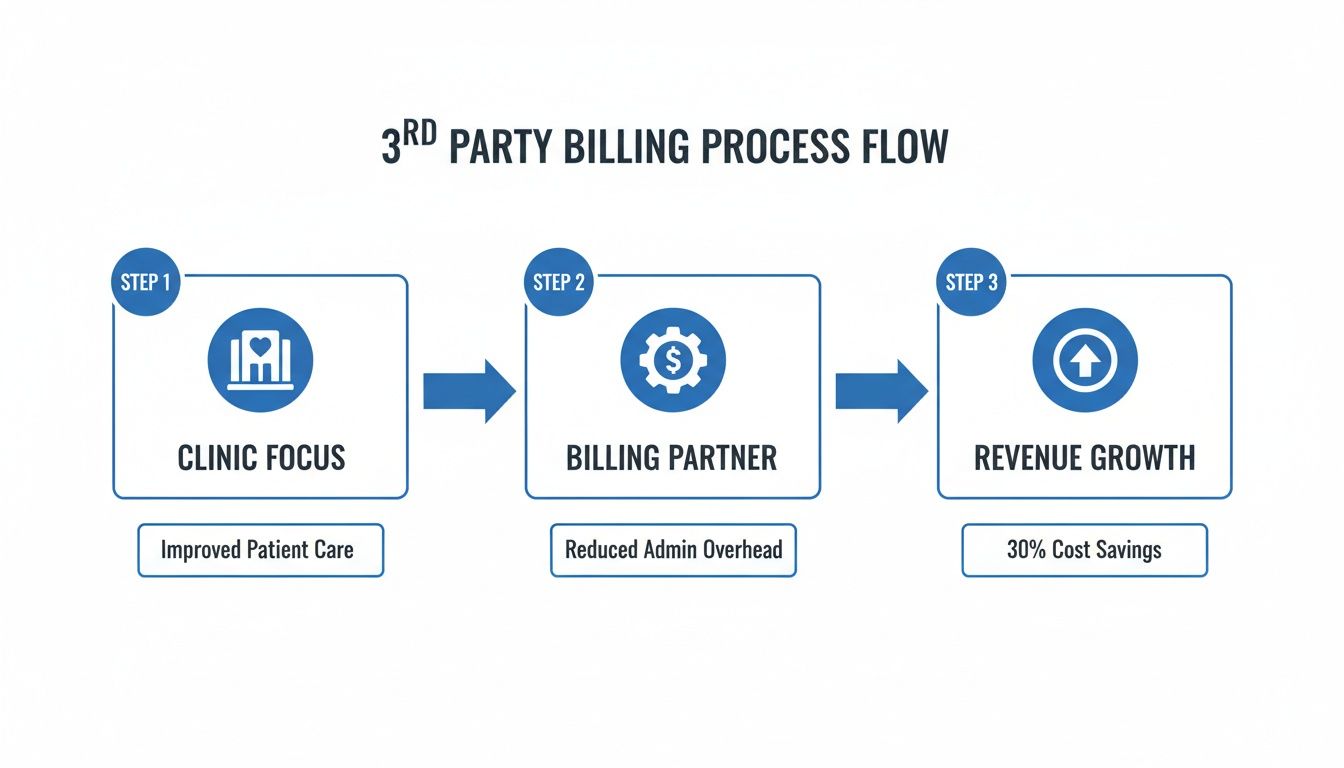
The value is clear: your team stays dedicated to patient outcomes while your billing partner manages the complex financial machinery, driving sustainable growth for your practice.
The Proactive First Step: Patient Eligibility Verification
The journey kicks off with a crucial, proactive check: patient eligibility and benefits verification. Before the appointment even takes place, your billing partner confirms the patient’s insurance coverage is active and gets the specifics of their plan.
Think of this as a powerful preventative measure. It catches potential snags like lapsed coverage, unmet deductibles, or services needing prior authorization right from the start. This single step prevents a huge percentage of common claim denials before they can even happen, paving the way for a smooth payment process.
Translating Care Into Claims: Charge Entry And Coding
After the patient visit is documented, the next phase is to translate those clinical services into a billable claim. It starts with charge entry, where every single service and procedure is recorded with precision. This isn't just data entry; it’s a detail-oriented process to ensure nothing falls through the cracks.
Next comes the highly skilled task of medical coding. Certified coders step in to assign the correct CPT (Current Procedural Terminology) and ICD-10 (International Classification of Diseases) codes that accurately represent the patient's diagnosis and the care they received.
Precise coding is the foundation of a "clean claim." Getting this right is non-negotiable, as incorrect or mismatched codes are one of the fastest ways to trigger an immediate denial from an insurance payer.
Submitting Clean Claims And Managing Payers
With all the data double-checked and accurately coded, the claim is ready to fly. Your partner submits the claim electronically to the right insurance payer, usually through a specialized service. You can get a deeper dive into how these work by reading our guide on what is a clearinghouse in medical billing.
This digital workflow is now the industry standard. Today, about 96% of non-federal acute care hospitals and 78% of office-based physicians have implemented certified electronic health record (EHR) systems. This tech backbone lets billing partners submit claims faster and with far greater accuracy.
Aggressive Follow-Up And Denial Resolution
Hitting "submit" on a claim is just the beginning. A top-tier third-party billing service immediately starts tracking its status. This is where two critical functions come into play:
- Accounts Receivable (A/R) Follow-Up: This is the relentless pursuit of unpaid claims. Your partner’s team actively communicates with insurance companies to make sure claims are processed and paid on time, preventing them from getting old and becoming uncollectible.
- Denial Management: If a claim gets denied, a dedicated team immediately investigates why, fixes any errors, and resubmits it with the necessary documentation or appeals. This strategic approach is all about recovering revenue that would otherwise be lost.
This persistent follow-up is a key differentiator, turning potential write-offs into successful payments.
Closing The Loop: Payment Posting And Reporting
Finally, when payment arrives from the insurer and the patient, it's meticulously posted to the correct account. This payment posting process ensures your financial records are always accurate and balanced.
The lifecycle finishes with comprehensive, data-driven reporting. Your partner delivers clear analytics on key metrics like your clean claim rate, denial rate, and average collection times. This transparency gives you a crystal-clear view of your practice's financial performance and provides the insights needed to make smart business decisions, completing the loop and starting the cycle all over again with the next patient.
How Outsourcing Medical Billing Boosts Your Bottom Line
Partnering with a dedicated 3rd party billing service isn’t just about handing off administrative work—it's a strategic move that directly strengthens your practice's bottom line. Beyond simply filing claims, a specialized partner delivers real financial and operational advantages that reinforce your entire practice from the ground up.
Think of the benefits in three core areas: direct financial gains, a major boost in operational efficiency, and a powerful strategic edge. When you bring them all together, they create a clear path to a healthier, more resilient practice.
Driving Financial Optimization
The most immediate impact you'll see from expert third-party billing is on your cash flow. A skilled billing partner is laser-focused on one thing: submitting “clean claims”—claims that are error-free and correctly coded—on the very first try. This single action dramatically speeds up your reimbursement timeline and boosts net collections.
By catching and correcting errors before they happen, you sidestep the expensive and frustrating cycle of denials and appeals. Instead of waiting weeks or even months for corrected claims to be processed, your practice gets paid faster. This creates a much more predictable and stable stream of revenue.
A higher clean claim rate is the fastest route to improved cash flow. By eliminating the friction caused by coding mistakes and submission errors, a 3rd party billing partner ensures revenue is captured efficiently, preventing it from getting trapped in administrative limbo.
This proactive approach is fundamental to your financial health. It lets you focus on growing your practice instead of chasing down money you’ve already earned.
Creating Operational Efficiency
Outsourcing the headaches of medical billing also frees your in-house staff from some of their most burdensome tasks. Imagine your team no longer spending hours on the phone with insurance companies, trying to decipher complex coding rules, or fielding patient billing questions. Instead, they can pour that energy back into high-value, patient-facing activities.
This shift has a massive ripple effect on your practice’s workflow and, more importantly, on patient satisfaction. When your staff can give their full attention to scheduling, patient communication, and creating a positive experience in the clinic, the quality of care goes up, and patient loyalty follows.
- Reduced Administrative Overhead: You save on the costs tied to hiring, training, and retaining a specialized in-house billing team.
- Improved Staff Morale: Employees are less bogged down by frustrating billing issues, which leads to higher job satisfaction and lower turnover.
- Enhanced Patient Focus: Your team can deliver the exceptional service that builds a strong reputation and keeps patients coming back.
Deciding between in-house and outsourced billing involves weighing these factors carefully. To make it easier, we've put together a simple comparison.
In-House Vs Outsourced Billing A Head-To-Head Comparison
Here is a clear comparison of managing billing in-house versus partnering with a third-party specialist, helping you weigh the pros and cons across key operational areas.
Cost & Overhead
- In-House Billing: High fixed costs (salaries, benefits, training, software).
- 3rd Party Partner: Variable costs often tied to collections; lower overhead.
Expertise & Compliance
- In-House Billing: Dependent on the knowledge of a small team; risk of knowledge loss with turnover.
- 3rd Party Partner: Access to a team of certified specialists who stay current on regulations.
Efficiency & Speed
- In-House Billing: Prone to delays from staff absences, vacations, or high workloads.
- 3rd Party Partner: Consistent, dedicated focus ensures timely claim submission and follow-up.
Scalability
- In-House Billing: Difficult to scale; hiring new staff is slow and expensive.
- 3rd Party Partner: Easily scales with your practice's growth without disruption.
Focus
- In-House Billing: Diverts staff attention from patient-facing roles.
- 3rd Party Partner: Allows your team to focus entirely on patient care and experience.
Ultimately, the right choice depends on your practice's size, specialty, and growth goals, but outsourcing often provides a more flexible and expert-driven solution.
For a clearer picture of how these costs stack up, explore our guide on medical billing services cost and what to expect.
Gaining A Strategic Advantage
When you partner with a 3rd party billing service, you get immediate access to a team of certified coding experts and compliance specialists—without the hefty price tag of hiring them directly. This gives you a critical strategic edge, especially if your practice is growing. You gain deep expertise in your specific medical specialty, ensuring your coding is always accurate and optimized for the highest possible reimbursement.
What's more, a dedicated partner lives and breathes the ever-changing world of payer policies and government regulations. This dramatically lowers your compliance risks, reduces the odds of a costly audit, and allows your practice to scale efficiently without ever worrying that you'll outgrow your billing capabilities.
The trend toward outsourcing is accelerating for a reason. The global medical billing outsourcing market was valued at approximately USD 17.15 billion and is projected to hit USD 54.17 billion by 2034. This explosive growth reflects the undeniable value that practices get from specialized partnerships. This strategic move positions your practice not just to survive, but to truly thrive in a competitive healthcare environment.
Protecting Patient Data And Ensuring Compliance
Handing over sensitive patient information can feel like a huge leap of faith. But here’s the reality: partnering with a reputable third-party billing service doesn't just add a layer of security—it often makes your data safer than it is in-house. Why? Because for them, protecting Protected Health Information (PHI) isn’t just another task; it's their entire business.
They transform a potential vulnerability into one of your practice's most secure assets.

The cornerstone of this trust is the Business Associate Agreement (BAA). This is a legally binding contract that clearly defines the billing partner’s responsibilities for protecting your data according to the Health Insurance Portability and Accountability Act (HIPAA).
Think of it as your practice's insurance policy for data security. It’s absolutely non-negotiable. If a potential vendor won’t sign a BAA, walk away.
The Pillars Of Robust Data Security
Beyond the legal paperwork, a top-tier billing partner builds multiple layers of security into their daily operations. This isn't about simply checking boxes on a compliance form; it's about creating a culture of security that shields your practice and your patients from constant threats.
A partner you can trust will have these protocols firmly in place:
- End-to-End Data Encryption: All patient data, whether it’s sitting on a server or being sent to a payer, should be fully encrypted. This scrambles the information, making it completely unreadable and useless to anyone who might gain unauthorized access.
- Secure Access Controls: Not everyone on the billing team needs to see everything. Access to PHI should be granted on a strict, need-to-know basis using role-based permissions, which minimizes the risk of internal exposure.
- Regular Staff Training: The human element is often the weakest link in any security chain. Reputable firms know this and conduct ongoing HIPAA and security training to keep their teams sharp and vigilant against phishing, social engineering, and other common cyberattacks.
A dedicated third-party billing company doesn’t view data security as an expense—it’s a core business function. Their entire operation and reputation depend on it, making them far more focused on security than a typical in-house team juggling multiple priorities.
This singular focus means your data is often in better hands with a specialized partner, where expertise and resources are dedicated solely to its protection.
Staying Ahead Of Regulatory Changes
Compliance is a moving target. The rules set by insurance payers and federal bodies like the Centers for Medicare & Medicaid Services (CMS) are anything but static. One minor coding update or a new payer policy can have a massive impact on your reimbursements and audit risk.
A specialized billing partner has teams dedicated to tracking these complex changes. They’re continuously educated on the latest updates to ensure your claims are always submitted correctly and compliantly. This proactive approach is a huge advantage of outsourcing.
It ensures your practice not only protects sensitive patient information but also stays compliant in a constantly shifting healthcare landscape. Ultimately, this diligence lowers your risk of audits, costly penalties, and lost revenue—giving you the peace of mind to focus on what matters most: your patients.
Choosing The Right 3rd Party Billing Partner
Picking a third-party billing partner is easily one of the most critical financial decisions your practice will ever make. This choice goes way beyond just finding the lowest price—it's about finding a true partner who will act as a dedicated extension of your team, protecting your revenue and supporting your long-term growth.
The right partner becomes a core part of your financial success. The wrong one? It can lead to lost revenue, compliance nightmares, and endless administrative headaches. Making a smart decision requires a structured approach to vetting potential vendors, zeroing in on expertise, transparency, and a proven track record.

Look For Deep Specialty Expertise
Let's be clear: not all medical billing is the same. The coding rules, payer policies, and reimbursement quirks for an orthopedic practice are worlds apart from those for a mental health clinic. A generic, one-size-fits-all approach to billing is a surefire recipe for denials and underpayments.
Your first filter should always be specialty-specific experience. A partner with deep expertise in your field will already know the specific codes, modifiers, and documentation needed to maximize your reimbursements. They're familiar with the common traps and payer tendencies unique to your services, which means they can submit cleaner claims and fight denials far more effectively.
Demand Unwavering Transparency And Reporting
When you hand over your billing, you should gain clarity, not lose it. A trustworthy partner will provide complete transparency into your financial performance with robust reporting and analytics. You should never feel like your data is locked away in some black box.
Before you sign anything, make sure you'll have 24/7 access to a dashboard or portal showing real-time data on your key performance indicators (KPIs). At a bare minimum, this must include:
- Clean Claim Rate: The percentage of claims accepted by payers on the first try.
- Denial Rate: The percentage of claims that get kicked back.
- Days in Accounts Receivable (A/R): How long it takes you to get paid.
- Net Collection Rate: The percentage of collectible revenue that actually makes it into your bank account.
A partnership built on transparency means you always know exactly where your money is. Vague answers or a lack of accessible, detailed reporting are major red flags that suggest a vendor may not be confident in their performance.
This level of insight empowers you to hold your partner accountable and make informed strategic decisions for your practice. It’s also important to understand how they stack up against others. For additional context, you can explore our guide on top revenue cycle management companies.
Ask The Right Questions During The Vetting Process
Once you’ve shortlisted potential partners based on their specialty and reporting chops, it’s time to dig deeper with specific, pointed questions. How they answer will tell you everything you need to know about the quality of their operation and their commitment to your success.
Prepare a list of questions to ask every single vendor. This way, you can compare their responses apples-to-apples and find the best fit.
Here are a few essential questions to get you started:
- What is your first-pass clean claim rate? A high rate (ideally over 90%) shows they have strong coding accuracy and pay attention to detail.
- How do you integrate with our existing EHR system? You need seamless integration to avoid disrupting your workflow and to ensure data is accurate.
- What is your process for denial management and A/R follow-up? Look for a proactive, aggressive strategy for chasing down unpaid claims, not a passive one.
- Are your billers and coders certified and based in the U.S.? This is key for ensuring they're up-to-date on U.S.-specific coding guidelines and payer rules.
- How do you measure and report on ROI? A true partner should be able to prove the value they bring to your bottom line.
The sheer scale of healthcare spending underscores just how important it is to get this right. Total National Health Expenditure (NHE) in the United States recently hit $4.5 trillion—that’s about $13,493 per person and 17.3% of the GDP. With that much money flowing through the system, choosing a partner who can manage your revenue cycle with precision is non-negotiable. This framework will help you move beyond surface-level chatter and find a genuine partner who aligns with your goals.
Common Questions About Outsourcing Medical Billing
Deciding to bring on a third-party billing partner is a big move, and it’s completely natural to have questions. Getting clear, straightforward answers to the most common concerns can demystify the process and give you the confidence to choose the right partner for your practice.
Let’s tackle some of the most frequent questions we hear from providers just like you.
Will I Lose Control Over My Finances?
This is probably the number one fear we hear, but the reality is just the opposite. A reputable billing partner actually enhances your financial control through transparency and data. Instead of losing sight of your money, you gain access to powerful reporting dashboards that give you a crystal-clear, real-time view of your entire revenue cycle.
You’ll have key performance indicators (KPIs) like your clean claim rate, denial trends, and accounts receivable aging right at your fingertips. This data-driven approach gives you more strategic oversight than ever before, letting you monitor performance and make smart business decisions without getting lost in the day-to-day grind.
What Are The Common Pricing Models?
Pricing for third-party billing services usually falls into a few standard models. Understanding them helps you find a partner whose financial incentives are lined up perfectly with your own.
- Percentage-Based Model: This is the most common setup. The billing company charges a percentage (typically 4-10%) of the total revenue they collect for you. It’s popular for a reason—it directly ties their success to yours. They only get paid when you get paid.
- Fee-Per-Claim Model: Some companies charge a flat fee for every single claim they submit, no matter the dollar amount. This can be predictable, but it might not motivate them to fight for those tough-to-collect claims.
- Hybrid Model: A mix of the two, this might involve a lower percentage fee combined with a flat rate per claim.
The percentage-based model is often the best choice because it creates a true partnership. Your billing company is highly motivated to maximize your collections and chase down every single dollar you’ve earned.
How Disruptive Is The Onboarding Process?
A professional third-party billing company has a refined, structured onboarding process designed to be as seamless as possible. The goal is to cause minimal disruption to your practice’s daily workflow. The transition usually involves connecting their software to your existing Electronic Health Record (EHR) system, which is a standard procedure for them.
Your new partner's team will handle the heavy lifting of data migration and system integration. While your staff will need a little training on new ways to communicate or view reports, a good partner manages the switch efficiently, often getting you fully up and running within a few weeks. When you're trying to find the right fit, it's wise to explore all your options. For more information, check out our guide on finding medical billing services near me.
Ready to see how a dedicated partner can transform your revenue cycle? One For All Medical Billing combines specialty-specific expertise with a commitment to transparency, helping you get paid faster with less stress. Schedule your free consultation today and discover a better way to manage your billing. Learn more at https://oneforallmed.com.

