

table of contents
When you type "medical billing services near me" into a search bar, you're not just looking for a vendor. You're looking for a partner—someone who can finally get a handle on your practice's financial health. The best services aren't necessarily down the street; they’re the ones staffed with U.S.-based, certified billers who actually understand the nuances of regional payer rules.
That’s what really matters. Finding that specific expertise is what directly impacts your bottom line, boosting clean claim rates and getting you paid faster.
Why The 'Near Me' Search For Medical Billing Is So Important
Let's be real—navigating the world of medical billing feels more complicated every year. Between the constant ICD-10 and CPT code updates and the slow, steady drain from claim denials, the pressure on practices is immense. Your search for local expertise isn't just about handing off a task; it’s a critical decision for the long-term survival of your practice.
This isn't just a hunch; it's a massive industry trend. The U.S. medical billing outsourcing market hit USD 6.28 billion in 2024 and is expected to nearly double to USD 12.26 billion by 2030. Why the boom? It’s a direct response to skyrocketing coding complexity and the recent explosion in telehealth. You can dive deeper into these medical billing outsourcing trends and projections to see what's coming next.
The Advantage Of Local And National Expertise
While "near me" might make you think of a company in your zip code, its real value is finding a team that gets the unique headaches of your specific region. Different states, and even different cities, have their own payer rules and network quirks. A billing service with boots-on-the-ground experience navigating these local minefields can stop common denials that a generic, out-of-touch provider would miss completely.
For example, a billing company that intimately knows Oklahoma's Medicaid guidelines or the latest Blue Cross Blue Shield network requirements can push claims through with a much higher first-pass acceptance rate. That local knowledge translates directly into faster cash flow and a much healthier revenue cycle.
This is especially true for certain practice types:
- Multi-site groups: If you have locations across different regions, you need a partner who can juggle diverse payer contracts and state regulations without dropping the ball.
- Specialty practices: Fields like pain management or mental health live and die by unique coding and prior authorization rules that demand true specialized expertise.
- Urgent care centers: These high-volume clinics need a ridiculously efficient process to manage a constant flood of claims quickly and without errors.
The real win with a great billing partner isn't just offloading paperwork. It's gaining a strategic ally who is obsessed with maximizing your revenue, crushing your denial rate, and giving you back the time to actually focus on your patients.
Moving Beyond A Simple Search
Finding the right service means going beyond a quick Google search and digging into a serious vetting process. A truly great partner acts like an extension of your own team—they should be completely committed to your financial success. That means total transparency, clear reporting you can actually understand, and consistent, proactive communication.
Ultimately, your goal is to find that perfect blend: a team with national-level capabilities but a deep, nuanced understanding of local payer behavior. This guide will walk you through exactly how to do that, so you can confidently pick a partner who will strengthen your financial foundation and help your practice thrive.
A Practical Vetting Process For Potential Billing Partners
Once you've got a short list of potential medical billing services, the real work starts. You have to move past the slick marketing on their websites and dig into a real vetting process. This isn't just about finding a company that can push claims out the door—it's about finding a true partner who acts as an extension of your practice, genuinely invested in your bottom line.
The process is pretty straightforward: you search for providers, evaluate their fit, and ultimately land on a partner that brings financial stability to your practice.
This journey, from a simple search to long-term revenue health, is all about finding the right fit, not just any fit.
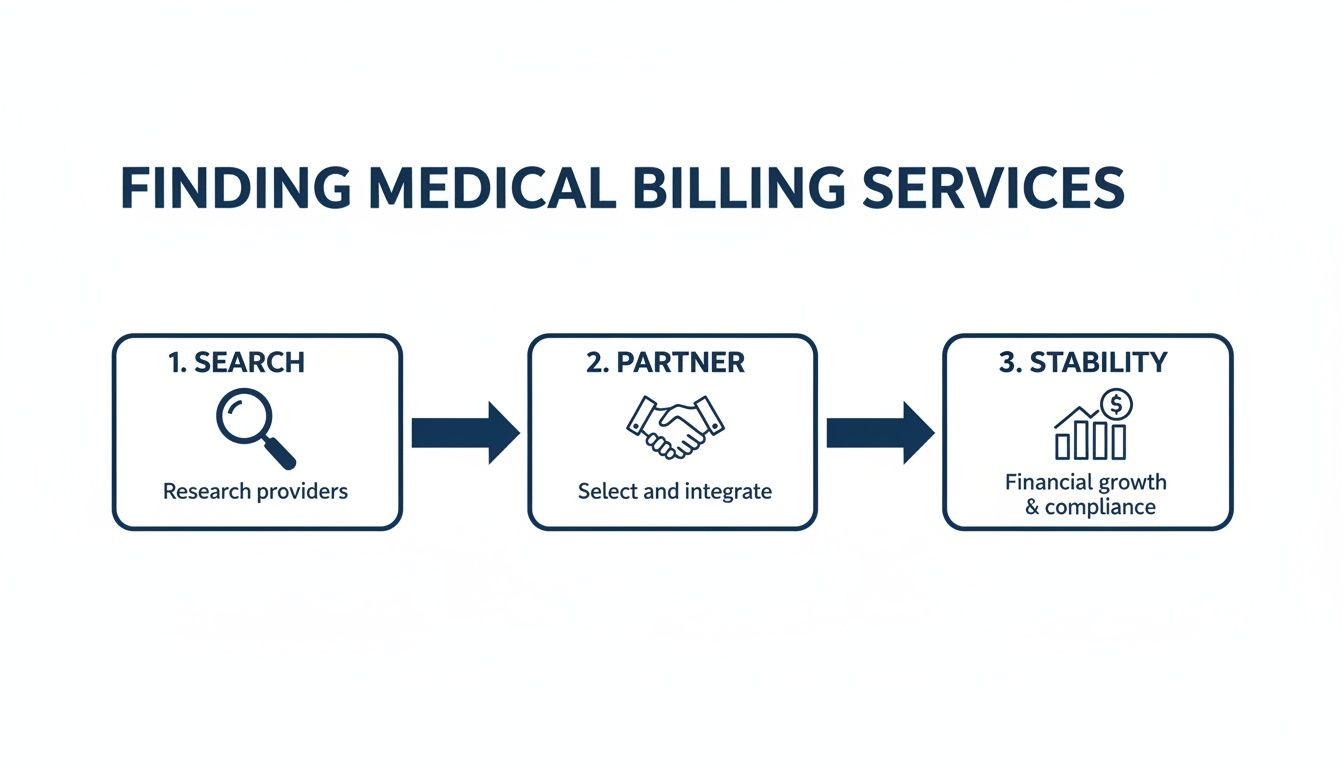
This visual is a great reminder that the goal isn't just to offload a task. It's to secure a partnership that leads to measurable financial improvement.
Start With Their Specialty And Experience
The very first filter should always be specialty. A billing company that's a rockstar for a dermatology clinic might completely fumble the complex coding for a high-volume orthopedic practice or a mental health group. Look for clear, undeniable evidence on their website and in their materials that they live and breathe your specific field.
And I don't mean just a quick name-drop on their "Industries Served" page. True specialty expertise means they know the common denial traps, payer-specific rules for your CPT codes, and the prior authorization headaches that can absolutely tank your revenue.
For example, a pain management practice needs a partner who’s an expert in billing for injections and medical devices. An urgent care center, on the other hand, needs a team that can process a massive volume of lower-value claims with brutal efficiency. Don’t be shy about asking for case studies or references from practices that look just like yours.
The Key Questions To Ask During Your Consultation
The consultation call is where you get to cut through the sales pitch. This is your chance to separate the real contenders from the pretenders. Walking into that call with a prepared list of questions is the only way to make an informed decision and compare companies apples-to-apples.
This checklist is your secret weapon for consultation calls. It helps you compare services effectively and uncover the details that truly matter.
- Performance Metrics: Ask, "What is your average first-pass clean claim rate?" A strong answer is 90% or higher. Anything less suggests their claim scrubbing process is weak, which means more denials and delays for you.
- Denial Management: Ask, "Can you walk me through your denial management and appeals process?" You want a proactive, multi-step process. Do they just resubmit, or do they investigate the root cause, get on the phone with the payer, and file formal appeals?
- Team & Communication: Ask, "Who will be my dedicated point of contact?" A specific account manager, not a generic support line. This creates accountability and builds a relationship with someone who actually knows your practice.
- Compliance & Staffing: Ask, "Are your billers and coders U.S.-based and certified?" This is non-negotiable. You need HIPAA compliance and experts who understand domestic payer systems, without language or time zone barriers.
A potential partner’s hesitation or inability to give you clear, data-backed answers to these questions is a massive red flag. Transparency is the bedrock of a good billing partnership.
Evaluate Their Team And Reporting Capabilities
Beyond the numbers, you need to size up the human element. The expertise of their team is your single greatest asset. Ask about their training processes and how they keep up with the constant flood of coding and regulatory changes. Certified professionals from organizations like the AAPC are a must.
Just as important is their reporting. You should expect regular, easy-to-digest reports that give you a crystal-clear view of your practice's financial health. If you're curious about the financial upside, you can learn about how outsourcing medical billing can save your practice time and money in our detailed guide.
Look for a provider that offers detailed analytics on key performance indicators (KPIs) like:
- Days in Accounts Receivable (A/R): This shows how long it takes you to get paid. A low number is a great sign of an efficient process.
- Denial Rate by Payer: This pinpoints which insurance companies are creating the most friction so you can target improvement efforts.
- Collection Rate: This is the bottom line—what percentage of the money you're owed are they actually collecting?
A great billing partner doesn’t just dump data in your lap; they help you understand what it means. They should be able to walk you through your monthly reports, explain the trends they're seeing, and suggest strategies for improvement. That collaborative approach is what turns a simple vendor into a strategic advisor.
Decoding Pricing Models And Understanding The True Cost
Let's talk about the bottom line. When you're searching for a local medical billing service, financial clarity is non-negotiable. While the price tag is a huge factor, the way a company structures its fees says a lot about its philosophy and whether its goals will align with yours.
The cheapest quote you get is rarely the most profitable choice in the long run. A rock-bottom price can easily be wiped out by hidden fees, sloppy performance, and a climbing denial rate that quietly drains your practice's bank account. Your goal isn't to find the lowest bid; it's to find the best value.
The Three Main Pricing Structures
Most billing services operate on one of three common models. Each has its own rhythm, with pros and cons that make it a better or worse fit depending on how your practice operates. Getting a handle on these is the first step toward a smart decision.
Here’s a quick breakdown of what you'll run into:
- Percentage-Based Fees: This is the industry standard. The billing company takes a percentage of the money they successfully collect for you, usually somewhere between 4% and 10%. The beauty of this model is that your incentives are perfectly aligned—they only make money when you do.
- Flat-Fee Per Claim: With this setup, you pay a set dollar amount for every single claim filed, no matter the value or outcome. It seems predictable, but it can get expensive fast if your practice has a high volume of lower-value claims.
- Monthly Flat-Fee: Some companies charge a fixed monthly rate for all their services. This is great for budgeting, but it can feel inefficient. You’re paying the same amount whether it’s a crazy busy month or a slow one, meaning their motivation isn't directly tied to your collections.
Matching The Model To Your Practice
So, which one is right for you? It completely depends on the nuts and bolts of your practice. A bustling primary care clinic has a totally different billing flow than a specialized surgical practice, and their ideal pricing structure will reflect that.
For example, a high-volume urgent care clinic might thrive with a percentage-based model because it motivates their billing partner to chase down every last dollar. On the other hand, a specialist who submits fewer but much higher-value claims might find a flat-fee-per-claim model more cost-effective, especially if their reimbursement rates are already consistently high.
The best pricing model isn't about what's cheapest upfront. It's about what creates a true partnership, where your billing service is financially motivated to fight for every cent you've earned.
Uncovering The Hidden Costs
The sticker price is just the start of the conversation. Many billing companies tuck additional fees into the fine print of their contracts, and these can seriously inflate your total cost. You have to ask about these directly to avoid any nasty surprises.
Be on the lookout for charges that might be hiding in the details:
- Setup and Onboarding Fees: Is there a one-time cost just to get started and integrate your practice?
- Software and EHR Integration Charges: Will they charge you extra to connect to the EHR you already use?
- Custom Reporting Fees: Are standard reports included, or do you have to pay more for the detailed analytics you need?
- Clearinghouse Fees: Are the fees for the claim clearinghouse baked into their main rate, or is that a separate line item?
Getting a full, transparent picture of all potential expenses is critical. For a deeper dive into this, you can check out the factors that influence how much medical billing services cost in our detailed FAQ. This kind of financial transparency is the hallmark of a partner you can trust. Once you calculate a realistic return on investment—factoring in gains from faster payments and lower denials—you'll see why the cheapest service is often the most expensive mistake.
Technology Integration And Compliance Red Flags To Avoid
In today's healthcare world, technology and compliance aren't just boxes to check—they're the foundation of any good medical billing partnership. A potential partner’s tech stack and security protocols can either supercharge your revenue cycle or drag it down with costly errors and workflow nightmares.
Choosing the right service means you have to look under the hood at how they'll handle your data. When you're evaluating "medical billing services near me," their tech is just as important as their billing expertise. A clunky system creates friction, while a modern, integrated one should feel like a seamless extension of your own practice.

Demand Seamless EHR And System Integration
The first technical hurdle is always Electronic Health Record (EHR) integration. A poor connection between your system and their billing software is a recipe for disaster. It forces manual data entry, skyrockets the risk of human error, and creates frustrating delays that directly hit your cash flow.
A top-tier billing service should connect with your existing EHR smoothly, creating a secure, automated flow of information. This isn't just a convenience; it's a must-have for accurate and efficient billing.
When you're talking to them, ask for the gritty details on their integration process. If the answers are vague or they suggest awkward workarounds, that's a major red flag. They need a clear, proven method for connecting systems without blowing up your daily operations.
The Power Of Advanced Billing Technology
Modern billing services go far beyond just pushing claims out the door. The best providers use advanced tools to stop problems before they even start. This proactive approach is a game-changer for cutting down denials and getting you paid faster.
Leading firms are now using tools like:
- AI-Powered Claim Scrubbing: This tech automatically scans claims for common errors, missing information, and potential payer rejections before they're submitted. Think of it as an expert reviewer checking every single claim in real time.
- Predictive Denial Analysis: Sophisticated software can analyze historical data to predict which claims are at high risk of being denied. This allows the billing team to step in, get more information, or fix the coding to make sure the claim sails through on the first try.
This kind of tech is having a massive impact. AI and automation are slashing claim errors by up to 40% and speeding up processing times by 50%. Top firms use these tools to hit clean claim rates over 90%, even as coding gets more complex.
A partner that invests in modern technology is investing in your financial success. They aren't just reacting to denials; they're actively working to prevent them from ever happening.
Unmistakable Compliance And Security Red Flags
While technology drives efficiency, compliance protects your practice and your patients. Genuine HIPAA compliance is non-negotiable, and you need to know how to spot a provider who is truly committed to security versus one who just pays it lip service.
Vague answers about data security are a clear sign to walk away. Ask direct questions and expect specific, confident answers. Our guide on how to ensure compliance and data security offers more detail on this critical topic.
Here are some of the biggest red flags to watch for:
- Use of Offshore Teams Without Safeguards: Be extremely cautious if a company uses offshore staff. Handling Protected Health Information (PHI) outside the U.S. creates huge HIPAA risks unless they have ironclad security protocols and Business Associate Agreements (BAAs) in place.
- Lack of Transparent Reporting: A secure partner will give you clear, accessible reports on their performance. If they’re cagey about giving you full visibility into their process, it might be because they have something to hide.
- Inadequate Staff Training: Ask about their HIPAA training program. Compliance is an ongoing effort, not a one-time webinar. Their team should get regular, updated training on security best practices and regulatory changes.
Choosing a partner who is both technologically sharp and deeply committed to security is the only way to protect your practice from both financial and legal risks.
How To Ensure A Smooth Onboarding Process
You’ve signed the contract, and you’re ready for a fresh start with your new billing partner. But the work isn't over—in fact, the most critical phase is just beginning. A clunky, disorganized onboarding process can torpedo your cash flow, frustrate your staff, and poison the partnership from day one.
This isn’t about just flipping a switch. A truly great partner will have a clear, methodical plan to integrate their team and systems into your practice. It’s a process that, when done right, sets the stage for a profitable, long-term relationship and proves your search for "medical billing services near me" was worth it.

Mapping Out The Key Transition Stages
A professional onboarding process isn't a single event; it's a series of carefully planned stages. It kicks off with a deep dive into your practice’s unique workflows, moves into the technical setup, and finishes with comprehensive staff training. Each step is designed to prevent disruptions and get everyone on the same page.
Here’s what that process should look like:
- Initial Data Migration: This is where they securely pull all necessary patient demographics, insurance info, and existing accounts receivable data from your current system into theirs.
- System and EHR Integration: The new service will build a secure bridge to your EHR or practice management software. They should test it relentlessly to ensure a perfect, uninterrupted flow of information.
- Workflow Training: Your partner should provide hands-on training for your front desk and clinical staff, clearly outlining any new procedures for patient registration, eligibility checks, and charge entry.
Communication is the glue that holds all this together. You absolutely need a dedicated onboarding specialist—one person who serves as your single point of contact, provides regular updates, and can answer questions on the fly.
Establishing Communication And Setting Expectations
From the moment you sign, you need to establish clear, open lines of communication. This means knowing exactly who to call for what and setting up a regular meeting—maybe weekly during the transition—to track progress and tackle any hiccups. This proactive approach stops small issues from becoming big headaches.
Just as important is defining what success looks like right from the start. Together, you should agree on the Key Performance Indicators (KPIs) that will be used to measure their effectiveness. These metrics give you an objective way to grade their performance and ensure you’re both working toward the same goals.
A strong onboarding plan isn't just a courtesy; it's a critical component of risk management. It ensures that the transition from your old system to your new partner happens without a catastrophic drop in cash flow, protecting your practice's financial stability.
Defining And Tracking Critical KPIs
Tracking the right KPIs is how you hold your new partner accountable and prove their value. While every practice is different, you can learn more about how long onboarding typically takes to set realistic expectations. During this initial period, you should be laser-focused on a few core metrics that tell the story of your financial health.
Three of the most important KPIs to watch are:
- Days in Accounts Receivable (A/R): This shows you the average number of days it takes to get paid. If that number is consistently dropping, their collections process is working.
- First Pass Resolution Rate (FPRR): Also called the clean claim rate, this is the percentage of claims paid correctly the first time they’re submitted. A high FPRR—ideally 90% or more—is a direct sign of accurate coding and solid claim scrubbing.
- Overall Denial Rate: This is the percentage of claims that get rejected by payers. A top-tier billing service will fight to keep this number as low as possible, ideally below 5%, and have a rock-solid strategy for appealing every single denial.
Frequently Asked Questions About Choosing A Billing Service
Picking a partner to handle your revenue cycle is a huge decision. To help you nail down the final details, we’ve put together answers to the most common questions we hear from practice managers when they’re searching for "medical billing services near me." Think of this as your quick-reference guide to make sure you’re asking the right things and can move forward with confidence.
What Is A Realistic Clean Claim Rate To Expect?
You should be looking for a first-pass clean claim rate of 90% or higher. Anything less is a red flag.
If a potential partner tells you their rate is lower, it’s a sign that their claim scrubbing and review processes aren't as tight as they should be. That translates directly into more denials, more appeals, and longer waits for your money. This single metric tells you a lot about their attention to detail and coding accuracy.
A high clean claim rate is the bedrock of a healthy revenue cycle—it’s what creates consistent, predictable cash flow.
How Does Outsourcing Actually Reduce Claim Denials?
Outsourcing slashes denials by bringing in specialized expertise and better technology. Your in-house team is probably juggling a dozen different tasks, but a dedicated billing company lives and breathes claims. It's all they do. They use advanced software to scrub every claim for errors before it goes out the door and have certified coders who know the ins and outs of every payer's rulebook.
The results are pretty dramatic. The average initial claim denial rate in the U.S. hovers between 10-15%. A good outsourced partner can chop that down significantly. In fact, industry data shows that outsourcing can lead to a 25-40% drop in denials, push collection rates over 95%, and cut Accounts Receivable days from 60 down to 30. You can dig into more of the numbers on medical billing market performance and trends to see the full picture.
The real value of an outsourced partner is that they're proactive, not reactive. Their entire system is designed to prevent denials from ever happening, protecting your revenue stream from the start.
What Happens If A Payer Denies A Claim Anyway?
Even the best get hit with a denial now and then. It happens. The true test of a great billing partner is what they do next. Their response should be immediate, aggressive, and go way beyond just resubmitting the same claim and hoping for a different result.
A solid denial management strategy should include:
- Root Cause Analysis: First, they dig in to figure out why the claim was denied. Was it a simple coding error? Missing documentation? A credentialing issue? You can't fix a problem you don't understand.
- Payer Communication: They get on the phone with the insurance company to challenge the denial, provide the necessary proof, and escalate the issue up the chain if they have to.
- Formal Appeals: They file formal, evidence-based written appeals and track them relentlessly until the claim is resolved and paid.
How Do I Know If The Service Is HIPAA Compliant?
This one is non-negotiable, and you have to ask about it directly. A trustworthy company will be completely transparent about its security. Ask them to walk you through their staff training, their data encryption methods, and whether they use secure, U.S.-based servers and staff to handle Protected Health Information (PHI).
If they hesitate to sign a Business Associate Agreement (BAA), run. That’s a legally required contract for any vendor that touches PHI. They should also be able to hand you clear documentation of their compliance policies without any fuss. For a longer list of questions, check out our main Frequently Asked Questions page. True compliance is an active, daily commitment—not just a checkbox on a sales flyer.
Ready to stop revenue leaks and get paid what you've earned? The U.S.-based, certified experts at One For All Medical Billing are ready to help. We combine specialty-specific knowledge with a proven process to deliver a 90% clean claim rate, reduce denials, and accelerate your cash flow. Schedule your free consultation today and discover how a true partnership can transform your practice's financial health.

