

table of contents
Your front desk is busy, the schedule is full, and providers are seeing patients all day. But the bank balance doesn't reflect how hard the practice is working. Claims sit unresolved, explanation of benefits pile up, patient balances linger, and no one is fully sure whether the problem started at registration, coding, payer edits, or follow-up.
That's usually when practice leaders start asking what is accounts receivable management, and in healthcare, the generic business answer isn't enough. A medical practice doesn't just send one clean invoice and wait for payment. It deals with eligibility checks, prior authorizations, coding rules, payer adjudication, denials, secondary billing, patient responsibility, write-offs, and reconciliation. If any part breaks, cash slows down.
The practical way to think about AR management is simple. It's the system that turns completed patient care into collected revenue. When that system is tight, cash flow is steadier, staff spend less time reworking claims, and the practice has more control over its financial future.
Why Managing Accounts Receivable Is Unique In Healthcare
A retail company can usually look at one invoice, one customer, and one due date. Healthcare rarely works that way. A single patient encounter can involve a primary payer, a secondary payer, a copay, coinsurance, a deductible balance, coding edits, medical necessity questions, and an appeal if the payer denies the claim.
That's why practice managers often feel like they're doing everything right and still getting paid late. The volume of patient visits may be strong, but the revenue cycle is fragmented. The work doesn't end when the claim goes out. In many cases, that's where the primary AR effort starts.
General business definitions miss the point for medical groups. In healthcare, effective AR management often depends on pre-claim work, denial prevention, and post-payment reconciliation, not just collections after the fact, as noted in this overview of healthcare-focused accounts receivable management. If eligibility was wrong at check-in or authorization was missed before the visit, your billing team is already working from behind.
Why Standard AR Advice Falls Short
Healthcare AR is shaped by payer behavior as much as internal billing discipline. A family practice may fight small patient balances and preventive service edits. A specialty clinic may battle authorization rules and high-dollar denials. An urgent care may face volume pressure, front-desk registration errors, and shifting payer rules around walk-in visits.
That's why a practice that wants to optimize AR collections has to look beyond statements and phone calls. It needs tighter intake, cleaner documentation, faster claim correction, and disciplined follow-up rules by payer and by balance type.
Healthcare AR problems usually show up in collections, but they often start much earlier.
Many practices also discover that their software setup is part of the problem. If your team is working from disconnected schedules, billing screens, and payer portals, basic revenue tasks take too long. A stronger operational foundation often starts with understanding how practice management software supports daily workflows, because AR performance depends heavily on what gets captured before a claim ever leaves the office.
Understanding The Core Of Healthcare AR Management
Monday morning starts with a full schedule, but last week's deposits are short. Two claims are sitting in edit because the subscriber ID was entered wrong. A high-value procedure is pending because authorization never attached. Forty patient balances are aging because the estimate at check-in missed the deductible. That is healthcare AR management in practical terms. It determines how much of the care you already delivered turns into cash.
Accounts receivable management in a medical practice is the process of turning completed visits into collected dollars, with the least possible delay and rework. In healthcare, the bill rarely travels through one simple path. A claim may go to the payer first, then come back with a patient balance. It may deny, partially pay, or suspend for records. Each outcome affects cash flow, staff time, and the accuracy of your books.
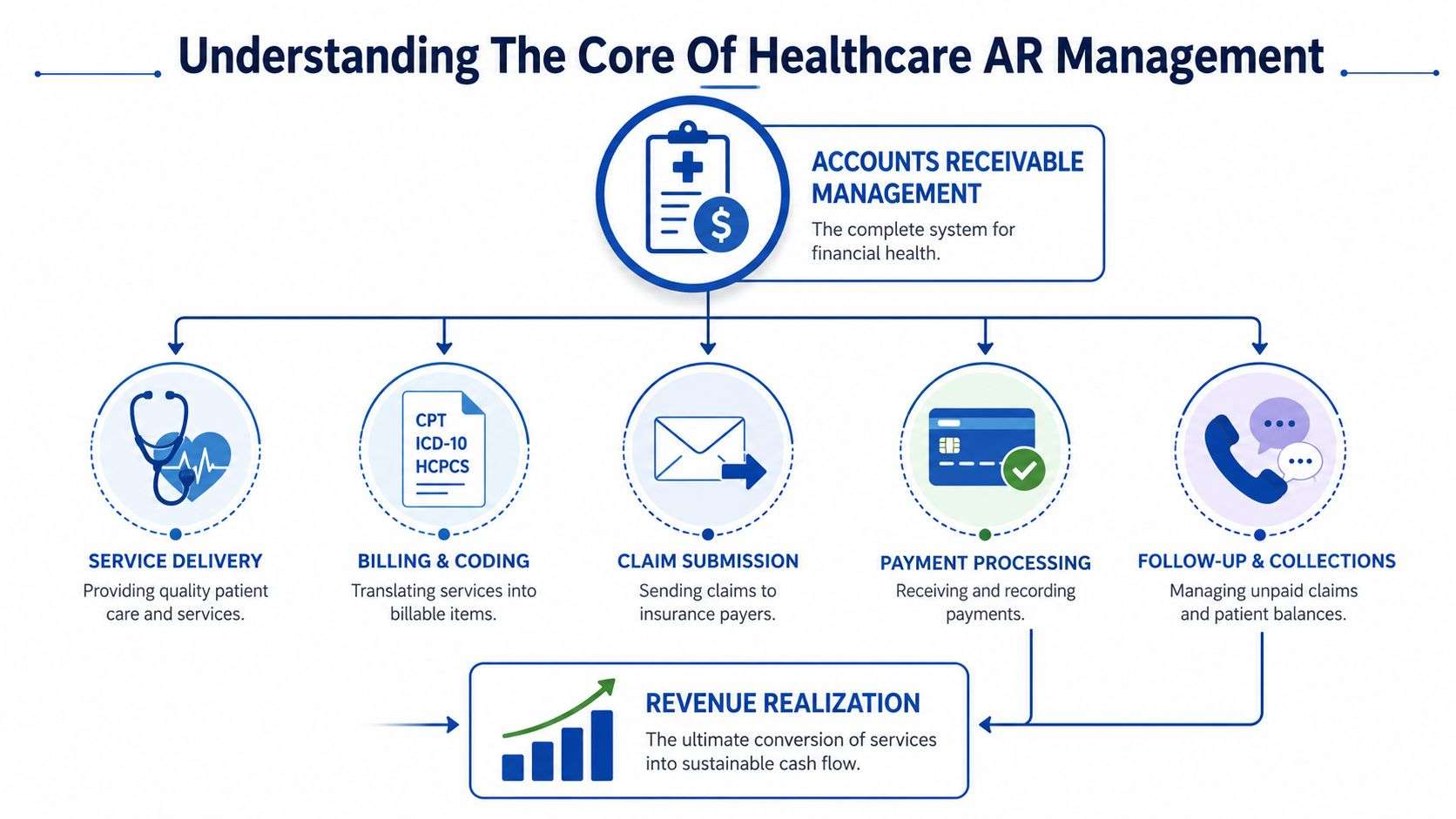
The process works like a chain of handoffs, and weak handoffs create aging AR. A missed referral in a specialty clinic can hold up a large claim for weeks. In urgent care, one front-desk registration error repeated across high volume can create a pile of small denials that still add up to real money. In a multi-site group, payment posting delays at one location can hide payer issues until month-end closes are already off.
That is why AR management is not just billing and collections. It includes front-end accuracy, clean claim production, payer follow-up, patient balance resolution, and reconciliation. Practices that treat AR as a back-office cleanup function usually collect later and write off more.
A useful way to explain it to managers is to break it into three operating areas:
Pre-claim control
This includes demographics, eligibility, authorization, referrals, and patient financial responsibility. Errors here are expensive because they are preventable and often discovered after the visit, when options are limited.Claim production and submission
This covers charge capture, coding, claim edits, and timely filing. Teams that understand the full medical billing process steps usually spot where claims are slowing down before AR gets out of range.Post-claim follow-up and cash posting
This includes adjudication review, denial correction, underpayment appeal, patient statements, call campaigns, payment plans, and account reconciliation. A practice can submit claims quickly and still struggle if this part is weak.
Each area has a trade-off. Tight front-end controls slow check-in if the workflow is poorly designed, but they prevent far more expensive rework later. Fast claim submission helps cash, but rushing charges out without documentation support creates denials and refund risk. Aggressive patient collections can improve short-term receipts, but poor communication can damage retention, especially in primary care and pediatrics.
The practical goal is simple. Reduce the time between date of service and final payment, while keeping denials, write-offs, and staff rework under control.
That is the core of healthcare AR management. It is an operating discipline that connects registration, coding, billing, and collections to payroll, physician compensation, supply purchases, and growth.
The AR Management Workflow From Patient To Payment
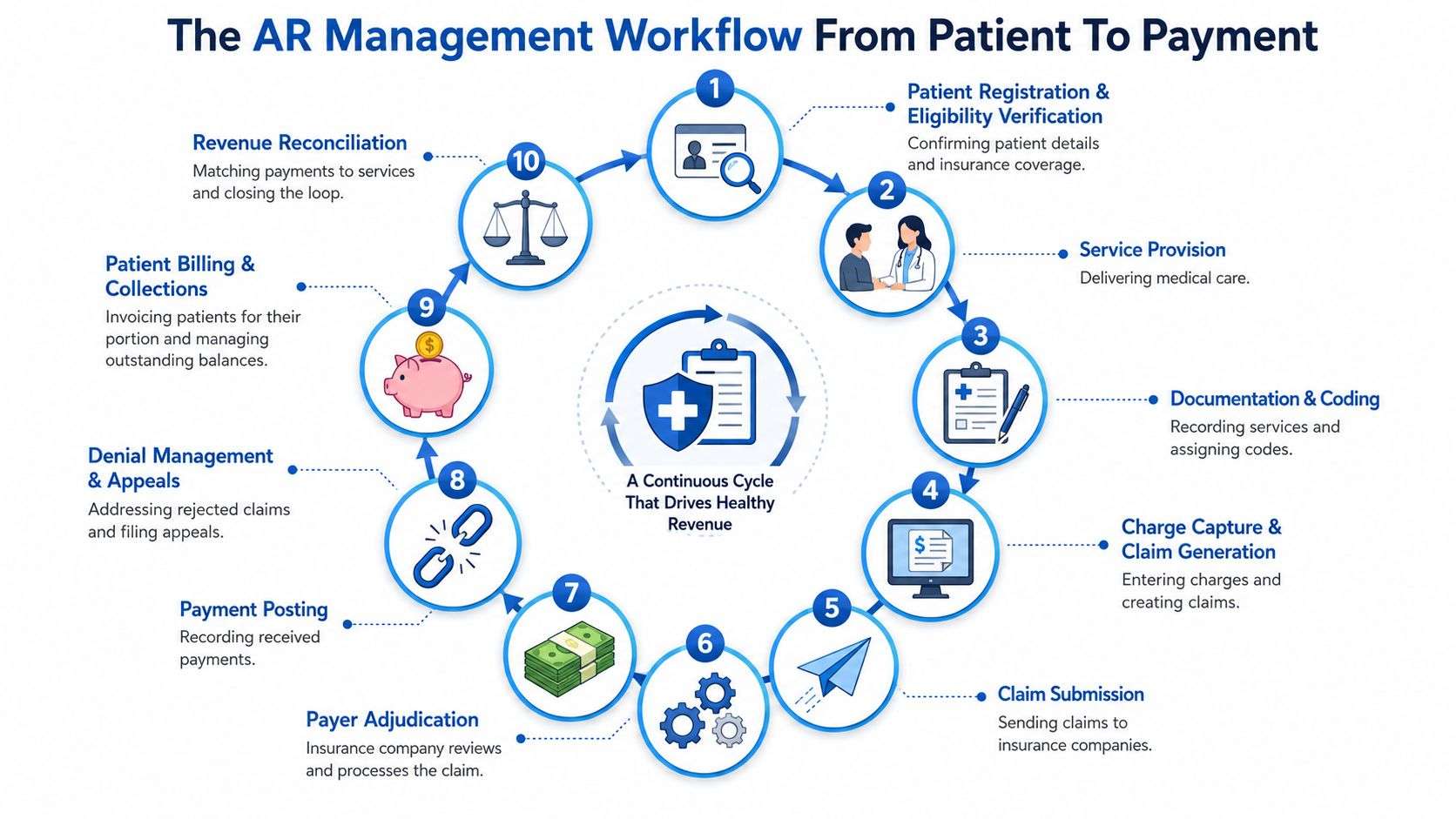
A healthy AR workflow doesn't move in a straight line. It loops. Problems discovered at payment posting often trace back to registration. Denials often expose coding gaps. Patient collection issues often start with poor estimates or weak communication before the visit.
This visual shows the full cycle in a medical setting.
Front-End Steps That Protect Cash
The first checkpoint is patient registration and eligibility verification. Staff need the correct spelling of the patient name, date of birth, member ID, group number, payer, and subscriber details. They also need to confirm active coverage, benefits, referral rules, and authorization requirements when applicable.
A common mistake is treating eligibility as a quick checkbox. It isn't. If the plan is inactive or the service needs prior authorization, the claim may never become collectible without manual rescue work later.
Next comes documentation and coding. Providers document what happened clinically. Coders or billers translate that into billable services and diagnoses. In urgent care, speed matters because volume is high. In specialty care, complexity matters more because rules around medical necessity, modifiers, and procedure support can be stricter.
Mid-Cycle Steps That Create Or Kill A Clean Claim
Once documentation is complete, the practice moves into charge capture and claim generation. In this stage, services entered into the system become claims. A missed charge means lost revenue. A duplicate charge creates audit and refund risk. A wrong place-of-service code can slow the claim or trigger a denial.
Then comes claim scrubbing and submission. Good scrubbing tools catch basic edits before the claim leaves your system. They won't fix every payer-specific rule, but they reduce preventable rejections. Many practices benefit from mapping this stage carefully against the broader medical billing process steps, because submission quality depends on the discipline of the earlier workflow.
Send a flawed claim quickly and you get paid slowly. Hold a claim briefly to correct it and you often collect faster.
After submission, the payer performs adjudication. That means the payer reviews the claim, applies policy and contract rules, and decides what to pay, deny, pend, or transfer to patient responsibility. At this stage, health systems and multi-site groups often see variation by payer, location, and specialty.
Back-End Steps That Recover Revenue
Once payment arrives, the team handles payment posting and reconciliation. This part gets underestimated. If ERA and manual payments aren't posted accurately, the aging report becomes unreliable. Underpayments hide. Secondary claims don't drop correctly. Patient balances become distorted.
Then comes denial management and AR follow-up. Teams work claim edits, rejections, denials, missing records requests, and appeal submissions. Strong follow-up is organized by payer, denial reason, dollar value, and filing deadline. Weak follow-up is reactive and usually based on whoever is shouting the loudest.
The last piece is patient billing and collections. In primary care and behavioral health, this often means many smaller balances. In specialty practice, it may involve larger responsibility tied to deductibles or coinsurance. Either way, clear statements, accessible payment options, and early communication outperform vague bills sent weeks later.
Key KPIs For Measuring Your AR Health
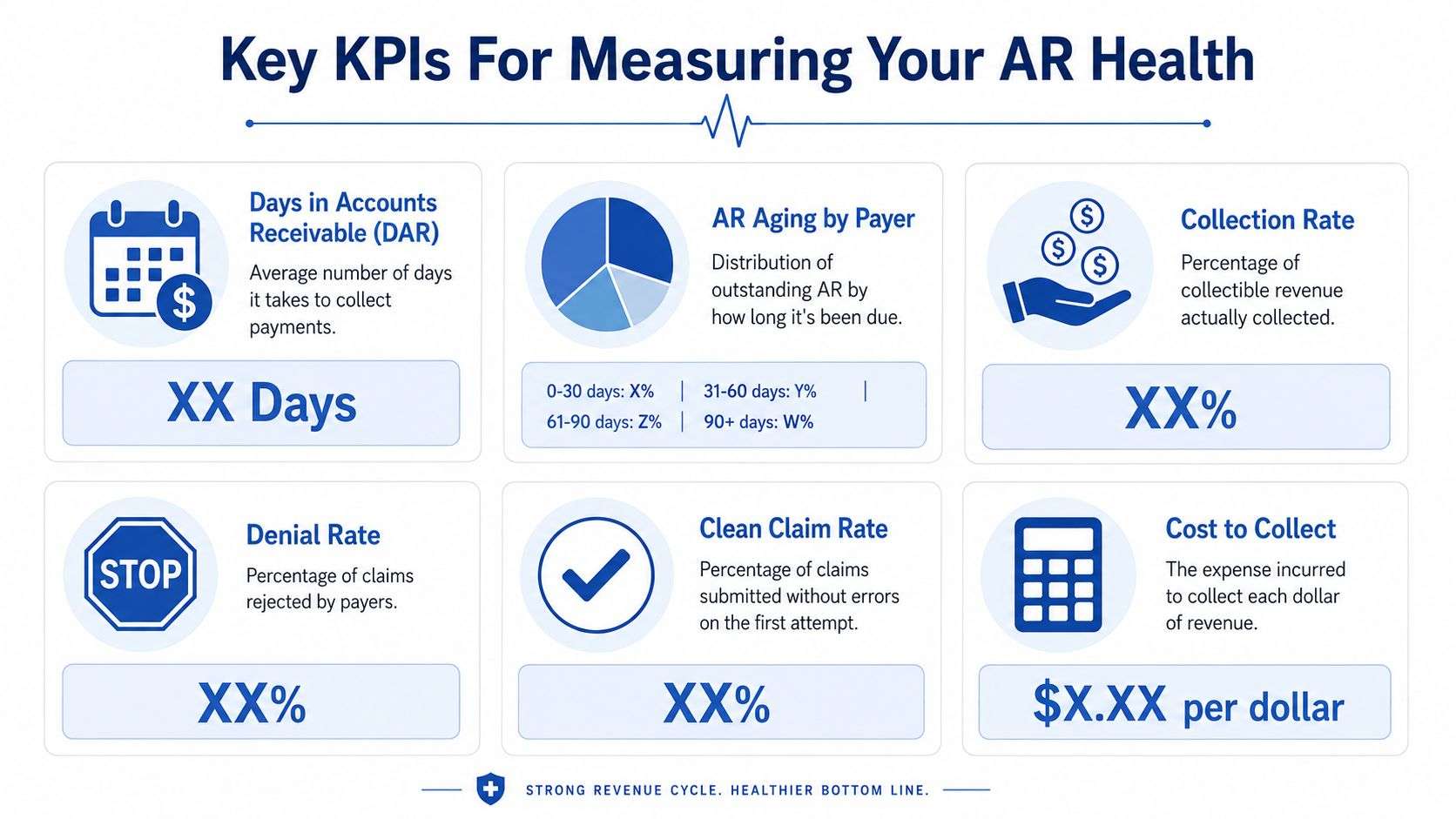
If you can't see AR clearly, you can't manage it. The most reliable practices review a small group of KPIs consistently and use them to diagnose where cash is getting stuck.
Industry guidance stresses that AR quality is visible in Days Sales Outstanding and aging buckets, because those measures show whether customers are breaching terms and whether the invoice-to-cash system is converting credit sales into working capital efficiently, as explained in this review of AR metrics and working-capital control.
The Metrics That Matter Most
Here are the KPIs I'd put in front of any practice manager first:
Days In AR
This shows how long it takes, on average, to turn billed services into cash. If this drifts upward, cash is slowing somewhere in the cycle.AR Aging Buckets
Aging tells you how much of your receivables sit in current, mid-age, and old buckets. Old AR usually means unresolved denials, weak patient follow-up, posting problems, or payer issues that no one has attacked systematically.Clean Claim Rate
This measures how many claims go out correctly the first time. It's one of the clearest signs of front-end and coding discipline.Denial Rate
A rising denial rate points to breakdowns in eligibility, authorization, coding, documentation, or payer-specific edits.Net Collection Performance
This helps answer the practical question: are you collecting the money you should collect after contractual adjustments?
How To Read The Story Behind The Numbers
No KPI should be read alone. A practice can have acceptable days in AR and still carry a dangerous pile of unresolved old balances. Another can have a decent clean claim rate but poor collections because underpayments and patient balances aren't being worked well.
That's why dashboards matter. A useful revenue cycle management dashboard lets managers review KPIs by payer, provider, location, and aging category instead of staring at one blended number that hides the underlying problem.
Good AR reporting doesn't just tell you that cash is late. It tells you where the delay started.
If you want a finance-side complement to healthcare AR reporting, this explanation of how to improve your AR turnover helps frame receivables as an efficiency issue, not just a collections issue. That perspective is useful for multi-site groups that need to connect billing performance to broader financial management.
Common Problems Plaguing Practice AR And Their Causes
Most AR problems don't begin in the AR department. They show up there. By the time a balance lands in follow-up, the original mistake may be weeks old and buried in registration, coding, authorization, or payment posting.
That's one reason AR has become a leadership issue rather than just a billing issue. 75% of finance leaders say accounts receivable has become more strategic over the past 12 to 24 months, and 62% of companies planned to upgrade AR-related technology in 2024, according to this summary of AR benchmarks and technology priorities. The push toward better systems makes sense because manual cleanup is expensive and slow.
Symptom And Root Cause
A practical troubleshooting view looks like this:
High Days In AR
Usually tied to slow claim submission, inconsistent follow-up, delayed coding, or a backlog in payment posting.Frequent Eligibility Denials
Often caused by rushed registration, outdated insurance data, or staff who rely on old cards without real-time verification.Authorization Denials
Common in specialty practices where scheduling, clinical documentation, and payer requirements aren't tightly coordinated.Large Unapplied Cash Balances
Usually a posting and reconciliation problem. The money may be in the bank, but the system can't match it correctly to the account.Low Patient Collections
Often caused by unclear estimates, weak front-desk collection habits, delayed statements, or confusing patient communication.
What This Looks Like By Practice Type
An urgent care usually struggles with speed-related errors. Registration shortcuts, same-day coding pressure, and payer variation create rework fast.
A specialty clinic tends to feel the impact of authorization complexity, documentation gaps, and higher-value claim denials. One unresolved claim can sit for a long time if the team doesn't escalate quickly.
A multi-site group often faces consistency issues. One location verifies benefits well and another doesn't. One team posts payments cleanly and another leaves unapplied cash unresolved. The AR report becomes a mix of local habits rather than one controlled process.
When the same denial reason keeps appearing, don't coach collectors to chase harder. Fix the upstream workflow that keeps creating it.
If your team is dealing with recurring payer pushback, a focused approach to medical billing denial management usually reveals whether the issue is front-end accuracy, coding support, or weak appeal discipline.
One side note is worth making for smaller practices with independent contractors or 1099 clinicians. Administrative disorder often spills from bookkeeping into billing operations. Even a general guide on how to stay tax-ready as a freelancer can be a useful reminder that clean financial records support cleaner AR follow-up, especially in practices with fragmented back-office processes.
Improving In-House AR Vs Partnering With Experts
A practice manager usually reaches this decision after a familiar month. Claims are going out, payments are coming in, but cash still feels late. The aging report stays heavy, managers keep stepping into billing issues, and no one can say with confidence whether staffing, payer pressure, or weak follow-up is the problem.
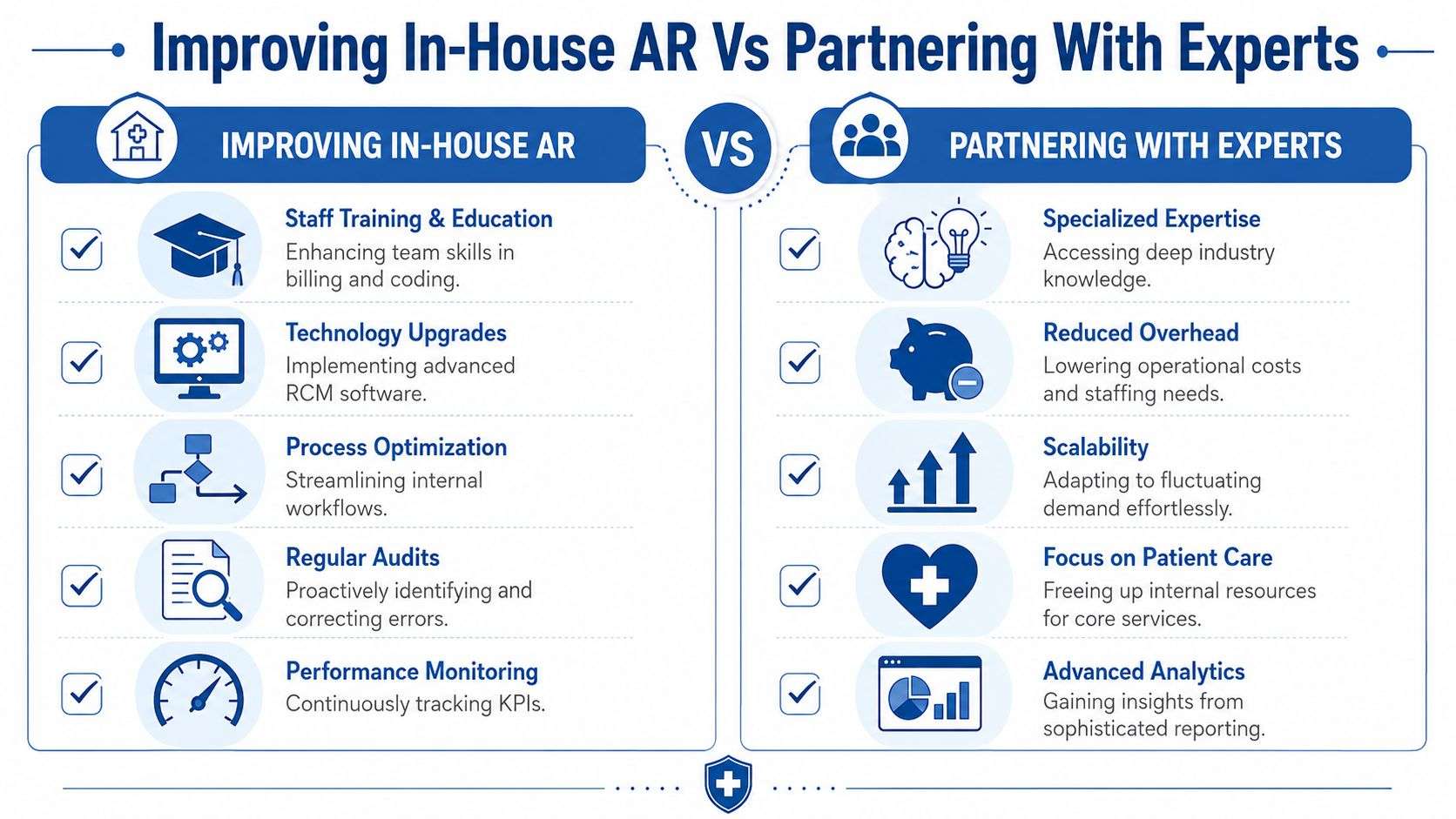
At that point, the question is not whether AR needs attention. The question is whether your team can fix it with tighter internal execution or whether outside support will produce a faster, cleaner recovery.
When Improving In-House Makes Sense
Keeping AR in-house works best when the practice already has stable staff, a manager who reviews performance consistently, and enough payer knowledge to correct problems without outside escalation. That is often realistic for a smaller primary care group, a well-run specialty office with low turnover, or a multi-site organization that already has standard workflows and just needs tighter accountability.
Start with the areas that change cash flow fastest:
- Front-End Controls: Standardize eligibility checks, authorization steps, and point-of-service collection scripts so bad claims do not enter the system in the first place.
- Billing Technology: Use claim scrubbers, ERA automation, task queues, and payer-specific worklists to reduce missed edits and help staff work the right balances first.
- Role Clarity: Assign clear ownership for claim edits, denial follow-up, payment posting quality, and manager review. Shared responsibility usually turns into delayed responsibility.
- Targeted Audits: Review small samples of denials, underpayments, and old AR by payer and provider every week. Repeating errors show up quickly when someone is looking for patterns.
For groups deciding whether internal improvement is enough, this overview of the benefits of outsourcing medical billing helps frame the decision around reporting, control, and performance, not just headcount.
When A Partner Is Usually The Better Option
Outside help makes more sense when the practice is spending too much management time holding the billing process together. I usually see this in urgent care groups with constant volume swings, specialty practices facing complicated denials and authorizations, or multi-site groups where each location handles follow-up differently.
A partner is often the better choice when:
- Turnover keeps interrupting billing continuity
- Your team lacks experience with your payer mix or specialty rules
- Reporting is too limited to show AR by payer, site, denial category, and aging bucket
- Older AR keeps growing even after internal cleanup efforts
- Operations leaders are spending their week supervising billing rework instead of running the practice
A good AR partner does more than call on old balances. The partner should show where claims fail, which payer edits are recurring, how quickly denials are being touched, and whether patient balance follow-up is producing cash or just activity.
How To Vet An AR Partner Carefully
Do not buy a sales promise. Review the operating model.
Use this checklist before signing:
- Specialty Fit: Ask for examples from your practice type. Cardiology, behavioral health, urgent care, and surgical specialties do not fail in AR for the same reasons.
- Reporting Quality: Require clear reporting on aging, denials, payment posting, follow-up activity, and recovery trends.
- Workflow Visibility: Confirm that your team can see what has been worked, what is pending with the payer, and what needs escalation.
- Communication And Support: Fast answers matter when a provider is asking about delayed claims or a payer issue is spreading across the week's submissions.
- Coding And Compliance Depth: The partner should understand payer rules, coding updates, modifier use, and documentation risk.
- Technology Compatibility: Make sure they can work inside your EHR and practice management system without creating extra manual work for your staff.
The best outsourcing relationships give the practice better visibility and stronger process control. If a vendor cannot explain who touches the account, how follow-up is prioritized, and what reporting you will receive, the practice is not gaining support. It is giving up oversight.
Taking Control Of Your Practice's Financial Future
Healthcare AR management isn't about chasing old balances harder. It's about building a system that prevents revenue leakage early, resolves payer friction quickly, and converts completed care into cash with fewer delays.
That's the practical answer to what is accounts receivable management in a medical practice. It's registration accuracy, payer readiness, coding precision, claim discipline, payment reconciliation, denial recovery, and patient balance follow-up working as one connected process. When those pieces operate together, the practice gains cash-flow stability and fewer financial surprises.
For practice managers, the biggest shift is mental. AR isn't a back-office cleanup task. It's an operating function that affects staffing, growth, provider satisfaction, and the ability to invest in the practice.
If your team feels buried in denials, aging reports, or inconsistent collections, don't treat that as normal. Start by identifying where the breakdown begins, what your current workflow hides, and which problems need process fixes versus outside support. Clarity comes before improvement, and improvement comes before stronger cash flow.
If your practice needs a clearer picture of why revenue is slowing down, One For All Medical Billing can help you evaluate your current AR process, identify denial and follow-up gaps, and build a more reliable path from patient care to payment. A focused review can show where cash is getting stuck and whether an in-house fix or an outsourced model makes more sense for your organization.

