

table of contents
TL;DR:
- Urgent care coding relies on proper use of E/M codes 99202–99215 based on Medical Decision Making or provider time. Accurate documentation, timely charge capture, and correct application of modifiers like 25 are essential to prevent denials and maximize reimbursement. Staying updated with 2026 CPT changes and regularly auditing workflows help maintain revenue cycle efficiency.
For urgent care visits, use Office or Other Outpatient E/M codes in the ranges for new and established patients, selecting the level by Medical Decision Making or total provider time per 2021/2023 E/M guidelines. That is the authoritative rule confirmed by ACEP, the AMA CPT framework, and CMS guidance. Three checks every coder and front-desk team should run on every encounter:
- Confirm patient status (new vs. established) before the visit closes. A new patient who saw any provider of the same specialty in your group within the past three years is established, which changes the code family.
- Capture point-of-care procedures separately with their own CPT codes. Wound repairs, I&D, injections, and on-site lab tests are not bundled into the E/M unless the procedure is the only service.
- Add modifier 25 when a significant, separately identifiable E/M service is performed on the same day as a procedure. Missing this modifier is one of the most common denial triggers in urgent care.
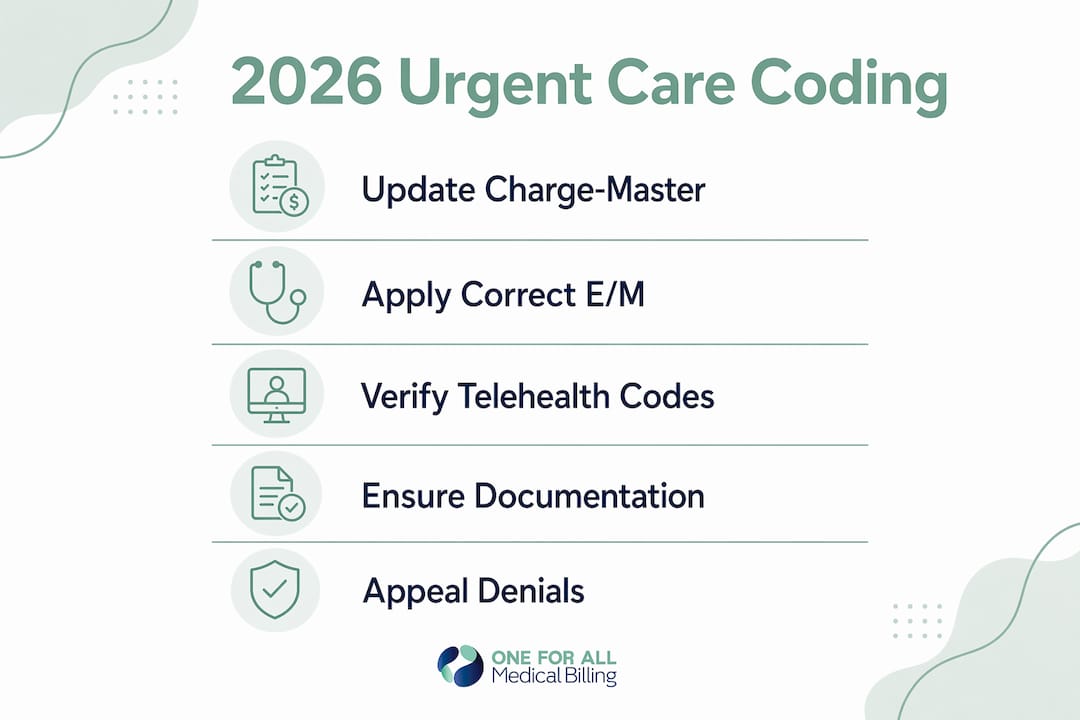
Pro Tip: Update your charge master and EHR test-code mappings before January 1 each year. New 2026 CPT codes for multiplex lab tests and telehealth services will generate denials the moment a claim goes out with a legacy code.
Authoritative sources for urgent care coding practices: the AMA CPT code set, CMS E/M guidance and MLN publications, the ACEP urgent care E/M FAQ, and One For All Medical Billing for operational implementation support.
How to select the correct E/M level in urgent care
The 2021 and 2023 CPT E/M revisions changed the rules for every outpatient and urgent care visit. You no longer need to document a specific number of history elements or exam bullets to justify a code level; instead, you choose the level using one of two methods: Medical Decision Making or total provider time on the date of the encounter.

MDM in urgent care. The MDM framework has three components: the number and complexity of problems addressed, the amount and complexity of data reviewed or ordered, and the risk of complications or morbidity. In urgent care, a patient presenting with a laceration requiring repair plus a new prescription for antibiotics will typically meet the criteria for moderate-complexity MDM, supporting 99213 or 99214 for an established patient. A patient with chest pain requiring an EKG, labs, and a decision about transfer reaches high-complexity MDM, supporting 99215. The key documentation move is to name the problem, describe what data you reviewed, and state the management option you chose, including why.
Time-based coding. When a provider spends significant time on counseling, coordination, or complex documentation, time can be the better selection method. Total time includes face-to-face time plus time spent on the same calendar date reviewing records, ordering tests, and documenting. CPT 99214 covers 30–39 minutes; 99215 covers 40–54 minutes. For new patients, 99204 covers 45–59 minutes and 99205 covers 60–74 minutes.
Two short case examples:
Case 1 (MDM-driven): An established patient presents with a painful abscess. The provider performs an I&D, reviews prior allergy history, and prescribes oral antibiotics. MDM: one acute illness with treatment options, prescription drug management. Code: 99213 with modifier 25, plus 10060 for the I&D. Documentation line: “Moderate-complexity decision: I&D performed, oral antibiotic prescribed, patient instructed on wound care and return precautions.”
Case 2 (Time-driven): A new patient presents with a complex medication reconciliation issue following a recent hospitalization. No procedure is performed. The provider spends 52 minutes total, including chart review and coordination with the discharging hospital. Code: 99205. Documentation line: “Total time 52 minutes on 01/15/2026, including 20 minutes reviewing discharge records and coordinating follow-up care.”
Prolonged services apply when a visit exceeds the upper time threshold for 99205 or 99215. CMS MLN guidance includes specific time tables for reporting HCPCS add-on code G2212 under Medicare. CPT 99417 is the AMA equivalent, but payer acceptance varies. Always verify whether your payer accepts G2212 or 99417 before billing prolonged services.
Pro Tip: Document the specific MDM element that drove your level selection, not just the final code. A note that says “moderate MDM: new prescription, one acute problem” is far more defensible on audit than a note that simply lists exam findings.
Which CPT categories do urgent care billers use most?
Urgent care encounters generate claims across five distinct CPT categories. Knowing the common pitfalls in each one protects your revenue and keeps your denial rate in check.
E/M codes (99202–99205; 99212–99215). These are the anchor of every urgent care claim. The level drives the bulk of reimbursement, so MDM documentation must be specific and tied to the presenting problem.
Wound repair and minor procedures. Simple wound repairs fall under 12001–12018; intermediate repairs under 12031–12057. I&D codes 10060 (simple) and 10061 (complicated) are frequently used. Foreign body removal codes (20525–20553 for deep tissue; 10120–10121 for subcutaneous) require documentation of depth and technique. Watch global period rules: if a payer applies a 10-day global to a wound repair, a follow-up visit within that window may not be separately billable unless a new problem is addressed with modifier 24.
On-site diagnostic testing. Rapid antigen tests, strep screens, urinalysis, and point-of-care blood tests each have their own CPT. 2026 CPT updates added new multiplex lab codes including 87812 (COVID-19 plus Influenza A/B) and 87494 (Chlamydia/Gonorrhea). If your EHR still maps these tests to legacy codes, every claim will deny. Charge-master mapping is not a one-time task.
Medication administration and infusions. Therapeutic injections use 96372 (subcutaneous or intramuscular). IV push codes start at 96374. Hydration infusions use 96360 for the first hour. Each drug administered also requires a HCPCS J-code for the drug itself. Missing the J-code is a common revenue leak.
Vaccine administration. The primary administration code is 90471 for the first vaccine; 90472 is the add-on for each additional vaccine in the same encounter. The 2026 CPT update added 90481 as a new add-on for multi-component vaccine administration. For a detailed breakdown of vaccine billing, the 90471 CPT code guide covers administration coding and common payer-specific rules.
HCPCS S-codes. Some payers, particularly Medicaid managed care plans and certain commercial insurers, accept S9083 (global fee for urgent care center visit) or S9088 (services rendered in an urgent care center). These are not universally accepted. Before billing an S-code, verify the payer’s policy. Submitting S9083 to a payer that does not accept it will result in a denial, and the underlying E/M code may not be on the same claim.
How do telehealth and audio-only visits work in urgent care coding?
Telehealth expanded significantly during and after the public health emergency, and 2026 CPT updates continued that trajectory with new audio-only and virtual visit codes. For urgent care, the core rule is straightforward: telehealth visits that replicate an in-person encounter use the same E/M code family (99202–99215), but the claim must carry the correct place-of-service code and modifier.

For Medicare, POS 02 applies to telehealth where the patient is not at home; POS 10 applies when the patient is at their home. Modifier 95 signals a synchronous telemedicine service. Audio-only visits (telephone only, no video) use modifier 93 for Medicare and some commercial payers, but acceptance is not universal. The 2026 updates expanded the list of covered audio-only services, so your payer-policy table needs to reflect those additions before you submit.
Remote therapeutic monitoring codes were revised for 2026 as well. If your urgent care clinic initiates a remote monitoring device during a visit, such as a blood pressure cuff or a digital therapeutic tool, the setup, supply, and monitoring codes each have distinct CPT requirements. Documentation must capture the device type, the condition being monitored, and the clinical rationale for initiating monitoring.
Operational checklist for telehealth claims:
- Verify payer acceptance of audio-only codes before the visit closes.
- Confirm POS code (02 or 10) and required modifier (95 or 93) for each payer.
- Document patient consent for telehealth in the chart.
- Tag the visit as telehealth in the EHR at registration so claims scrubbing can apply edits automatically.
Pro Tip: Build a payer-specific telehealth policy table in your RCM system. Payers have local coverage determinations that differ from CMS national policy. A claim scrubber that applies payer-specific edits automatically catches modifier and POS mismatches before transmission, not after a denial.
Documentation checklist and modifier guidance for urgent care claims
Clean urgent care claims start with clean documentation. The following elements should be present in every chart before the claim is submitted.
- Chief complaint. A specific presenting problem, not a vague phrase like “not feeling well.” The chief complaint anchors the MDM problem complexity component.
- Problem-focused history. Duration, severity, associated symptoms, and relevant prior history. For time-based coding, note the start and end time of the encounter.
- Exam elements tied to MDM. Document the findings that informed your clinical decision, not a generic multi-system review. Payers audit for relevance.
- Tests ordered or interpreted. Name each test, state the result, and document how it affected your management decision. “Strep rapid antigen negative; viral pharyngitis, supportive care only” is a complete MDM data entry.
- Procedures performed and consent. Document the procedure, technique, materials used, and that informed consent was obtained. For wound repairs, include wound length and layer.
- Time, if used for coding. State total provider time on the date of service and what activities were included. A single sentence suffices: “Total provider time 35 minutes, including chart review, face-to-face evaluation, and documentation.”
- Aftercare instructions. Document that discharge instructions were given and that the patient understood them. This supports medical necessity and reduces liability.
Modifier guidance:
- Modifier 25 is required when a significant, separately identifiable E/M is performed on the same day as a procedure. The E/M must be documented independently of the procedure note.
- Modifier 59 (or its X-subset modifiers XS, XP, XE, XU) signals a distinct procedural service. Use when two procedures might otherwise be bundled by the NCCI edits.
- Modifier 95 / 93 for telehealth as described above.
- Modifier 24 for an E/M during a global period when a new or unrelated problem is addressed.
Place-of-service rules. Urgent care centers typically bill POS 20 (urgent care facility). Using POS 11 (office) instead of POS 20 can affect reimbursement rates under some fee schedules. Observation services billed from an urgent care setting require POS 22 and specific documentation of the observation order and time. Never default to POS 11 for urgent care encounters; confirm your facility’s correct POS with each payer.
Pro Tip: Create a short library of documentation snippets for your most common urgent care diagnoses, each one pre-mapped to the MDM element it supports. Providers can select and customize the snippet rather than writing from scratch, which speeds throughput without sacrificing specificity.
Top denial reasons in urgent care and how to appeal them
Denials in urgent care follow predictable patterns. Knowing the top causes lets you fix the process, not just the individual claim.
The most common denial triggers:
- Wrong patient status (new vs. established) leading to the wrong code family.
- E/M level not supported by documentation, typically because MDM elements are vague or missing.
- Procedure bundled with E/M without modifier 25.
- Incorrect POS code (POS 11 instead of POS 20).
- Telehealth modifier missing or payer does not accept audio-only.
- Legacy lab or test code submitted after a 2026 CPT update replaced it.
- HCPCS S-code submitted to a payer that does not accept it.
Step-by-step appeals checklist:
- Pull the remittance advice and identify the denial reason code (CARC/RARC).
- Retrieve the original claim and supporting documentation.
- Re-run the claim through your claims scrubbing tool with corrected codes or modifiers.
- Draft a payer-specific appeal rationale. Cite the CPT code definition (AMA), the CMS E/M guideline, or the ACEP urgent care FAQ as applicable.
- Attach the relevant chart documentation (the E/M note, the procedure note, or the lab result).
- Submit within the payer’s appeal window, typically 90–180 days from the remittance date.
- Log the appeal in your denial tracking system and assign a follow-up date.
Sample appeal rationale (modifier 25 denial): “CPT 99213 was billed with modifier 25 on [date] because a significant, separately identifiable evaluation and management service was performed on the same date as CPT 10060. Per AMA CPT guidelines and CMS policy, modifier 25 is appropriate when the E/M is above and beyond the pre/post-operative care associated with the procedure. The attached documentation supports a distinct E/M with independent MDM. We respectfully request reconsideration and payment of CPT 99213-25.”
For a broader framework on appealing denied claims, including payer-specific timelines and documentation requirements, that resource covers the full process.
Root-cause review. After resolving a denial, trace it back to the process step where it originated. Was it a documentation gap? A charge-master mapping error? A front-desk eligibility miss? Fix the upstream step, not just the downstream claim. A monthly audit of denied claims by denial reason code will show you where the pattern is.
Pro Tip: Keep a denial log sorted by CARC code and provider. When one provider generates a disproportionate share of E/M-level denials, that is a targeted retraining opportunity, not a billing department problem.
A practical billing workflow for urgent care, from charge capture to final appeal
Urgent care billing moves fast. A patient may be in and out in 30 minutes, but the revenue cycle work that follows can stretch weeks if the workflow is not tight. Here is a stepwise process that keeps claims clean and collections moving.
- Registration and eligibility verification. Verify insurance coverage and collect the copay before or at the time of service. Confirm the patient’s deductible status and any prior authorization requirements. A missed eligibility check at the front desk is a denial waiting to happen.
- Point-of-care charge capture. Providers or clinical staff should enter charges in real time, not at end of day. Delayed charge entry increases the risk of missed procedures and incorrect date-of-service coding.
- E/M and procedure code mapping. The coder reviews the chart, confirms the E/M level against MDM or time documentation, and maps each procedure and test to its correct CPT. This is where modifier 25 decisions are made.
- Claims scrubbing and payer edits. Run every claim through a scrubber that applies NCCI edits, payer-specific rules, and modifier logic. Claims that fail scrubbing go back to the coder for correction before submission.
- Electronic submission. Submit clean claims within 24–48 hours of the encounter. Timely filing limits vary by payer, typically 90 days to one year, but faster submission means faster payment.
- Payment posting and reconciliation. Post payments and contractual adjustments promptly. Unposted payments distort your A/R aging and make denial management harder. Strong accounts receivable practices keep your aging buckets accurate and your collections predictable.
- Denial triage. Review denials daily. Sort by CARC code, assign to the appropriate team member, and set a resolution deadline. Denials that age past 60 days are harder to appeal and harder to collect.
- Appeals and resubmission. Follow the appeals checklist above. Track appeal outcomes by denial reason to measure your appeal success rate.
Key metrics to track:
- Clean claim rate (target: 90% or higher on first submission)
- First-pass payment rate
- Denial rate by denial reason code
- Days in A/R (target: under 30 days for most urgent care payers)
- Appeal success rate
Pro Tip: Schedule a weekly 20-minute audit of 10–15 randomly selected urgent care charts. Compare the documented MDM to the billed E/M level. Drift happens gradually, and a weekly sample catches it before it becomes a payer audit.
2026 CPT updates your urgent care team must apply now
The 2026 CPT cycle brought several changes that directly affect urgent care charge masters and EHR order sets. These are not theoretical updates. Claims submitted with legacy codes after the effective date will deny.
- New multiplex lab codes. CPT 87812 covers a multiplex test for COVID-19 plus Influenza A/B detection. CPT 87494 covers Chlamydia/Gonorrhea combination testing. If your EHR still maps these tests to the older single-analyte codes, your claims will deny on the first submission of the year.
- Vaccine administration add-on 90481. This new add-on code covers the administration of an additional component in a multi-component vaccine. Update your vaccine administration charge master entries and train clinical staff on which vaccines trigger 90481 versus the standard 90472 add-on.
- Expanded telehealth and audio-only CPT ranges. The 2026 updates extended coverage for audio-only services and added new virtual visit codes. Update your payer-policy table to reflect which payers accept the new codes and which still require legacy codes or HCPCS equivalents.
- AI and remote therapeutic monitoring revisions. RTM device supply and monitoring codes were revised. If your clinic initiates remote monitoring at discharge, confirm that your RTM code set reflects the 2026 revisions.
Action checklist before January 1 (or immediately if already past):
- Pull your current charge master and compare every lab, vaccine, and telehealth code against the 2026 CPT code set.
- Update EHR orderables so test names map to the correct new CPT, not the legacy code.
- Retrain clinical and front-desk staff on the new test names and their corresponding codes.
- Flag payers that have not yet issued coverage policies for new codes and hold those claims until policy is confirmed.
- Set a calendar reminder for Q3 to begin the same review process for 2027 updates.
Cross-check vendor summaries from Experity and OmniMD against the AMA CPT announcements and CMS fee schedule updates. Vendor summaries are useful operational translations, but the AMA and CMS publications are the primary authority.
Key Takeaways
Accurate urgent care coding depends on applying 2021/2023 E/M rules correctly, keeping charge-master mappings current for 2026 CPT changes, and running a tight denial management workflow anchored by clean documentation.
| Point | Details |
|---|---|
| Use the right E/M family | Bill 99202–99215 for all urgent care encounters; select level by MDM or total provider time. |
| Document MDM specifically | Name the problem, the data reviewed, and the management decision; vague notes drive downcoding denials. |
| Modifier 25 is non-optional | Always attach modifier 25 when a separately identifiable E/M accompanies a same-day procedure. |
| Update charge master before January 1 | New 2026 codes (87812, 87494, 90481) will deny immediately if legacy codes remain in your EHR mappings. |
| One For All Medical Billing | Supports urgent care practices with CPT/ICD-10 coding, charge-master maintenance, and denial management targeting a 90% clean claim rate. |
The case for process-first coding in urgent care
Urgent care billing has a speed problem that most coding guides do not address directly. Providers see patients quickly, document under time pressure, and move to the next room. The temptation is to default to a mid-level code for every encounter and move on. That approach leaves revenue on the table when a visit genuinely supports a higher level, and it creates audit exposure when the documentation does not match the code.
The more durable approach is to build the documentation process around MDM elements from the start. When a provider’s note template prompts them to name the problem complexity, list the data they reviewed, and state the management risk, the E/M level selection becomes a byproduct of good clinical documentation rather than a separate billing judgment. That is the difference between a practice that codes defensibly and one that codes reactively.
Payer awareness matters just as much as code accuracy. A claim that is technically correct but submitted with the wrong POS code or a telehealth modifier the payer does not accept will deny just as surely as a miscoded claim. Treating payer-policy management as a continuous operational task, not a once-a-year update, is what separates practices with low denial rates from those perpetually working their A/R aging.
Quarterly charge-master reviews beat annual big-bang updates. The practices that struggle most with January denials are the ones that waited until December to check their code mappings. The ones that stay ahead run a brief review each quarter, catch mid-year payer policy changes, and enter the new year with a clean charge master.
One For All Medical Billing supports urgent care revenue cycle management
Urgent care practices that want to reduce denials and speed up collections need more than a code list. They need a billing partner who understands the specific pressures of high-volume, fast-turnaround urgent care encounters and knows how to build a workflow around them.
One For All Medical Billing delivers full-service revenue cycle management for urgent care clinics and multi-site health systems, with over 20 years of specialty-specific billing experience. The core services for urgent care include CPT and ICD-10 coding, charge-master maintenance and annual code updates, claims scrubbing with payer-specific edits, denial management and appeals, and RCM analytics that show you where revenue is leaking. The result is a 90% clean claim rate on first submission, faster reimbursements, and a denial rate that trends down rather than up.
If your urgent care practice is heading into a new code year with outdated charge-master mappings or a denial backlog that keeps growing, the right next step is a billing health check. Request an urgent care-specific due diligence review to identify where your current process is losing revenue and what it would take to fix it.
Authoritative references for urgent care coding rules
These are the primary sources you should bookmark and consult when coding questions arise. Primary authorities carry the most weight in payer disputes and audits.
Primary authorities (cite these in appeals and audits):
- CMS Physician Fee Schedule and MLN publications. The CMS MLN E/M guidance contains time thresholds, MDM tables, and prolonged services instructions. The CMS Physician Fee Schedule search tool shows current RVUs and payment rates by code and locality.
- AMA CPT code set and E/M guidelines. The AMA publishes the official CPT code definitions, time ranges, and E/M selection guidelines. The AMA CPT E/M page is the definitive reference for code-level documentation requirements.
- ACEP urgent care E/M FAQ. ACEP explicitly confirms that urgent care clinicians should use 99202–99215 and aligns with the 2021/2023 CPT rules. Many payers consult ACEP guidance when adjudicating specialty-specific claims.
Practical implementation summaries (useful for charge-master action lists):
- Experity 2026 CPT Code Changes for Urgent Care. A practical summary of new lab, vaccine, and telehealth codes with operational implications for urgent care charge masters.
- OmniMD 2026 Urgent Care CPT Code Guidelines. Covers common CPT categories, payer variability notes, and denial prevention guidance for urgent care billing teams.
Always cross-check vendor summaries against AMA and CMS primary sources before updating your charge master. Subscribe to AMA CPT update announcements and CMS fee schedule final rules each fall to catch changes before they take effect on January 1.
FAQ
What E/M codes are used for urgent care visits?
Urgent care visits use Office or Other Outpatient E/M codes 99202–99205 for new patients and 99212–99215 for established patients, with level selection based on MDM or total provider time per 2021/2023 CPT guidelines.
Is CPT 99213 used for urgent care?
Yes. CPT 99213 is an established-patient E/M code commonly used in urgent care for moderate-complexity encounters, typically involving a straightforward problem with a limited management decision.
What is CPT 99214 for urgent care?
CPT 99214 covers an established patient office or outpatient visit with moderate-complexity MDM or 30–39 minutes of total provider time; it is appropriate for urgent care encounters involving a new problem with uncertain prognosis or prescription drug management.
What is the ICD-10 place-of-occurrence code for an urgent care center?
Y92.532 is the ICD-10-CM code designating an urgent care center as the place of occurrence of an external cause, used when documenting injuries or conditions with a location-specific external cause code.
How does billing work for urgent care?
Urgent care billing follows the standard claims cycle: verify eligibility and collect the copay at registration, capture charges in real time, code the E/M and any procedures, scrub the claim for payer-specific edits, and submit electronically. Patients typically pay a copay at the visit, with remaining balances billed after the insurer processes the claim.
Recommended
- Bill Type Codes: A Guide to UB-04 and 837I Claims – One For All Medical Billing
- Choose Top Medical Coding and Billing Companies – One For All Medical Billing
- CPT Code for Office Visit: A Complete 2026 Guide – One For All Medical Billing
- Abnormal Kidney Function ICD 10 A Complete Coding Guide – One For All Medical Billing

