

table of contents
Evaluation and Management level now rides on medical decision making or total time, not on how much history or exam you document. That single shift drives most of what follows: watch your E/M code selection (99202–99215), stay careful with wound repair and diagnostic bundling, treat S-codes as high-risk, and apply modifier 25 only when your note proves a separately identifiable service. Run payer-specific edits before every claim leaves the building, and anchor your policies to CMS and ACEP guidance rather than habit.
TL;DR:
- Urgent care billing codes mainly include E/M 99202–99215, wound repair 12001–12018, and diagnostic imaging 71045, with specific codes flagged as common denial triggers.
- Accurate documentation of medical decision making and total time spent is essential for properly supporting the level of care and avoiding downcoding, especially for same-day billing scenarios.
- Payer-specific edits, diagnosis coding practices, and proper use of modifiers like 25 and 59 are critical to prevent denials related to bundling, medical necessity, and conflicting diagnoses.
- Verifying patient coverage in real time before services reduces downstream denial rates for coverage lapses or out-of-network issues, especially for walk-in urgent care.
- High baseline for claim accuracy is a 90% clean claim rate; regular audits and targeted remediation for common coding errors significantly improve revenue cycle performance.
Urgent Care Billing Guidelines: The CPT and HCPCS Codes That Drive Your Revenue
Urgent care coding lives in a narrower band than hospital or specialty billing, which is exactly why small errors repeat at scale. A handful of code families account for the overwhelming majority of urgent care claims, and knowing them cold is the first line of defense against denials.
The codes your billers touch every day:
- Office/outpatient E/M: new patients 99202–99205, established patients 99212–99215, selected by MDM or time under ACEP’s urgent care guidance.
- Wound repair: 12001–12018, tiered by repair complexity and wound length in centimeters.
- Incision and drainage: 10060–10180, differentiated by simple versus complex presentation.
- Foreign body removal: 20525–20553, varying by anatomic site and depth.
- Diagnostic imaging: chest x-ray 71045 and related radiology codes tied to the presenting symptom.
- Lab work: comprehensive panels under 80061, plus rapid strep testing at 87804.
- Medication and vaccine administration: 96372 for injections, 90471–90474 for vaccine administration.
Two HCPCS codes deserve special attention: S9083 and S9088, both flagged in industry coding updates as frequent denial triggers because Medicare and many commercial plans do not recognize them the way urgent care centers expect. Pair every procedure code with a diagnosis that supports medical necessity on its own, and decide up front whether you’re billing the facility component, the professional component, or both. Our breakdown of urgent care coding requirements covers the medical necessity standards payers check first.
How MDM and Time Actually Select Your E/M Level
Medical decision making has three components: the number and complexity of problems addressed, the amount and complexity of data reviewed, and the risk of complications or morbidity from management decisions. A note that lists findings without explaining the reasoning behind them reads as low-evidence to an automated payer audit, according to Journal of Urgent Care Medicine’s analysis of denial trends. Document not just what you found, but what you reviewed and why you chose the treatment path you did.
Time-based selection is the other legitimate path, and it requires documenting total time spent on the date of the encounter, not just face-to-face minutes. When a visit runs long, Medicare claims use G2212 for prolonged service reporting, while most non-Medicare payers accept 99417 instead, per CMS’s evaluation and management guidance.
Three quick applications:
- Simple laceration repair: straightforward MDM, minimal data review, low risk. Typically supports a lower-level E/M plus the repair code, billed separately with modifier 25.
- Chest pain triage with EKG: moderate to high MDM given the data reviewed (EKG interpretation, risk stratification) and the risk of an undiagnosed cardiac event.
- Respiratory illness with rapid testing: moderate MDM, with the ordered test itself counting as data reviewed, supporting a mid-tier E/M code.
Pro Tip: Write your MDM narrative the way you’d explain the case to another clinician: what you were worried about, what you ruled out, and why. That sentence alone often survives an audit that a bare findings list would not.
What Payer Audits Look For and How to Prevent Denials
Automated payer review has gotten sharper about parsing clinical notes for the two things that justify a code level: data reviewed and management risk. If your documentation skips the “why,” expect a downcode even when the care delivered was appropriate. Insight from JUCM’s coding denial analysis points to diagnosis-driven denials as a rising category, largely because clinicians code a confirmed diagnosis before test results return.
The fix is symptom-first coding: bill the presenting symptom (chest pain, cough, abdominal pain) for the encounter and testing order, then update to a confirmed diagnosis only once results support it. This single habit change resolves a large share of the diagnosis-conflict denials that hit urgent care claims.
Build these into your pre-bill process:
- Mutually exclusive diagnosis checks that flag a symptom code paired with a conflicting confirmed diagnosis.
- Missing modifier alerts, especially for modifier 25 on same-day E/M plus procedure claims.
- Medical necessity cross-checks between the ordered test and the linked diagnosis.
- A denial root-cause log that separates diagnosis errors from bundling errors from modifier errors, so remediation targets the category with the highest rework cost.
One documented benchmark: One For All Medical Billing maintains a 90% clean claim rate across its urgent care clients, a figure worth measuring your own center against when you build denial KPIs.
Track denial rate, days in accounts receivable, and rework cost per claim monthly. A spike in any one metric usually points to a specific root cause, not a general “billing problem.” Our guide to common medical coding errors walks through the audit findings behind most of these patterns.
Payer Rules That Trip Up Urgent Care Claims
Medicare’s stance on S-codes is the single biggest surprise for centers that built their fee schedule around commercial payers. Medicare generally does not recognize S9083 (global urgent care visit fee) or S9088, so claims built around those codes for Medicare beneficiaries need a standard E/M and procedure code structure instead.
Commercial payers bring their own friction points:
- Bundling logic that folds minor procedures into the E/M code unless modifier 59 or XU documents a distinct service.
- Preauthorization exceptions that vary by plan for advanced imaging ordered on an urgent basis.
- Medical necessity edits tied to diagnosis-procedure pairing, especially for diagnostic testing billed with a provisional diagnosis.
High-risk claim types worth extra review before submission: any diagnostic test billed against a symptom code pending confirmation, and any global visit fee billed to a payer that treats it as non-covered. Check modifiers 25 (significant, separately identifiable E/M), 59 (distinct procedural service), and FS (split/shared visit) on every claim where more than one billable service occurred the same day.
Same-Day Billing Scenarios: A Pre-Submission Checklist
Same-day E/M plus procedure billing is where urgent care claims most often stall. Run this before submission:
- Confirm the note documents a separately identifiable E/M service distinct from the procedure, supporting modifier 25.
- Verify aggregated time is documented correctly when billing based on time, including any prolonged service add-on (G2212 for Medicare, 99417 elsewhere).
- Check diagnosis-procedure alignment for every line item on the claim.
- Confirm modifier presence matches the service mix, and that facility and professional NPIs are both correct if billing both components.
Pro Tip: When a laceration repair and an E/M code hit the same claim, ask your provider whether the visit note actually separates “why I evaluated this patient” from “how I repaired the wound.” If it doesn’t, the modifier 25 defense falls apart under review.
Building an Audit-Ready Billing Operation
Low denial rates come from controls that run before the claim submits, not corrections after it bounces back. Real-time documentation prompts and payer-aware coding tools materially cut first-pass denials in high-volume urgent care settings, according to industry coding updates.
Core control set:
- Symptom-code prompts at the point of order entry for pending diagnostics.
- Diagnosis-conflict edits that catch confirmed-diagnosis claims still awaiting lab or imaging results.
- Monthly provider one-sheets that reinforce MDM documentation standards for your highest-volume visit types.
Retrospective audits work best on a quarterly cycle, paired with direct provider feedback rather than a generic memo. Our urgent care billing tips resource covers templates for that feedback loop.
Why Insurance Verification Makes or Breaks Your Claim
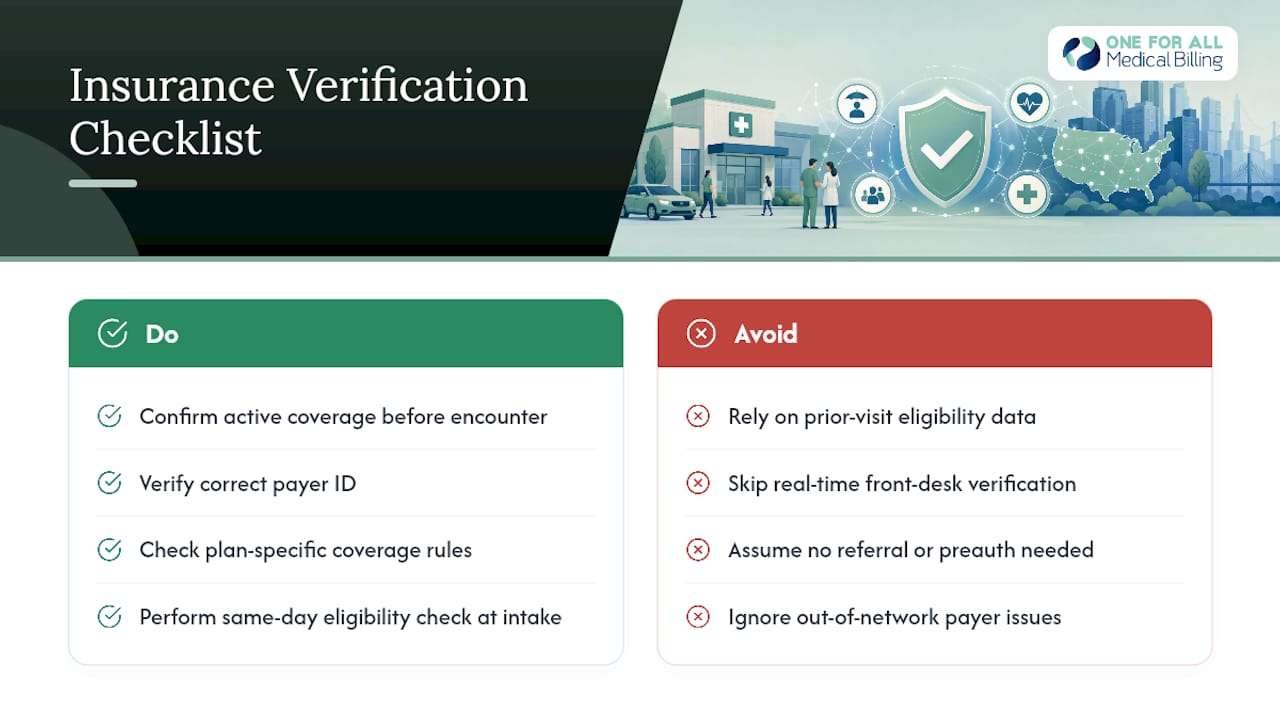
A claim built on unverified eligibility is a claim built to deny. Urgent care’s walk-in model makes real-time verification harder than scheduled specialty visits, but it’s also why front-desk verification carries outsized weight in your overall denial rate.
Confirm active coverage, correct payer ID, and plan-specific coverage rules before the encounter, not after. Urgent care visits frequently involve out-of-network scenarios, especially for patients traveling or using urgent care as an after-hours substitute for their primary care network. Verify whether the plan requires a referral or preauthorization for any anticipated imaging or specialist follow-up, since urgent care visits sometimes trigger those requirements even when the visit itself doesn’t.
Eligibility errors show up downstream as timely filing problems, coordination-of-benefits confusion, or flat denials for non-covered services. A patient’s coverage can also lapse between the date of service and the date you submit, particularly with Medicaid redetermination cycles that have tightened in recent years. Building a same-day eligibility check into your workflow, rather than relying on data from a prior visit, closes most of this gap. Centers that skip real-time verification tend to see their denial rate climb specifically in the “coverage terminated” and “not eligible on date of service” categories, both of which are preventable at intake rather than fixable after the fact.
Timely Filing Windows and How to Appeal a Denied Claim
Timely filing limits vary by payer, typically ranging from 90 days to one year from the date of service, and missing that window means an otherwise valid claim becomes unrecoverable. Medicare sets its timely filing limit at one year from the date of service, while commercial payers often set shorter windows, sometimes as tight as 90 days. Track filing deadlines per payer contract rather than assuming a uniform standard across your payer mix.
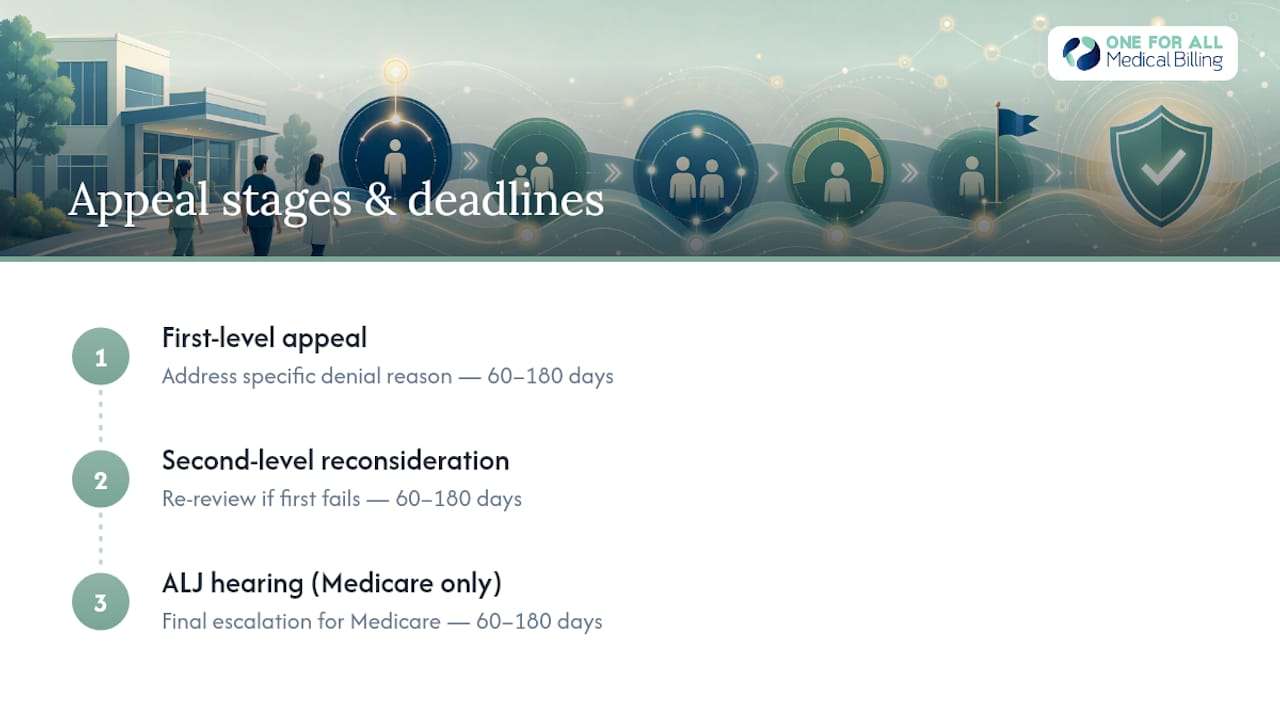
When a claim denies, the appeal process generally follows three stages: a first-level appeal addressing the specific denial reason, a second-level appeal (often called reconsideration) if the first fails, and, for Medicare claims, an administrative law judge hearing as a further escalation option. Each stage carries its own deadline, usually 60 to 180 days from the denial notice depending on the payer, so track appeal deadlines with the same discipline you apply to filing deadlines.
Build your appeal letter around the specific denial code, not a general dispute. Attach the clinical documentation that addresses the payer’s stated reason: MDM detail for a downcode denial, medical necessity language for a coverage denial, or corrected coordination-of-benefits information for a COB rejection. Appeals succeed more often when they respond directly to the payer’s cited reason rather than restating the original claim.
Coordination of Benefits: Getting the Payer Order Right
When a patient carries more than one insurance policy, coordination of benefits rules determine which payer pays first. Getting this sequence wrong is one of the most common reasons urgent care claims sit unresolved for months.
The birthday rule typically determines primary coverage for dependent children covered under both parents’ plans: whichever parent’s birthday falls earlier in the calendar year holds primary coverage. For patients with both employer coverage and Medicare, the size of the employer and the patient’s age determine which pays first. Workers’ compensation and auto insurance claims follow entirely separate sequencing rules and should be identified at intake, since urgent care visits for minor workplace or auto injuries are common enough to warrant a standard intake question.
Verify COB status at every visit, not just the first one, since coverage order can change year to year with employment or life events. Submitting to the wrong payer first doesn’t just delay payment. It often triggers a formal COB denial that requires resubmission with updated coordination information, adding weeks to your collection cycle. Front-desk staff should ask directly whether the patient has other coverage rather than relying on whatever payer information is on file from a previous visit.
The Billing Errors That Show Up Most in Urgent Care
A few error patterns recur across urgent care claims far more than in other outpatient settings, largely because of the walk-in, undifferentiated-symptom nature of the visits.
Coding a confirmed diagnosis before test results return tops the list, and it’s the same pattern JUCM’s analysis flags as a growing denial driver. The fix, again, is symptom-first coding until confirmation lands.
Missing or misapplied modifier 25 is second. Billing an E/M code alongside a procedure without documentation proving the E/M was separately identifiable invites an automatic bundling denial. Third: incomplete MDM documentation, where the note lists exam findings but never states what data was reviewed or why a treatment decision carried the risk level it did.
Facility versus professional component confusion rounds out the list, especially for centers billing under a hospital-based or multi-site structure where NPI mismatches are easy to miss under volume pressure. Our common coding errors guide breaks these down with specific audit examples. Prevention comes down to the same three levers repeatedly: pre-bill edits catching diagnosis conflicts, modifier presence checks before submission, and MDM documentation templates that prompt providers for the reasoning payers now expect to see.
Compliance Considerations Every Urgent Care Billing Team Should Track
Urgent care billing compliance sits at the intersection of coding accuracy, documentation standards, and payer contract terms, and falling short on any one of the three creates audit exposure. The AMA’s CPT and E/M resources remain the definitive authority for code definitions, and staying current with annual CPT updates is a compliance baseline, not an optional extra.
Regulatory scrutiny on urgent care has increased specifically around S-code usage, facility fee billing, and same-day E/M plus procedure claims, the same areas covered earlier in this guide. A compliance program worth the name includes a documented coding policy, regular internal audits against that policy, and a corrective action process when audits surface a pattern rather than an isolated error.
Credentialing accuracy also belongs under the compliance umbrella. A provider billing under an expired or mismatched credential creates claim exposure independent of how well the visit itself was coded. Multi-site urgent care operations carry extra complexity here, since each location may need separate payer enrollment even under one corporate entity. Keep your credentialing files current and cross-check them against your active payer contracts quarterly, not just at renewal time.
One For All Medical Billing’s Priority List for 2026
Our two decades in revenue cycle work point to three levers: payer-aware coding discipline, pre-bill edits that catch conflicts before submission, and consistent provider education on MDM documentation. We built our approach around maintaining a 90% clean claim rate, and if your center’s denial rate runs meaningfully above that benchmark, an audit is worth the conversation.
— One For All Medical Billing
Get an Urgent Care Billing Audit Before Your Denial Rate Tells You There’s a Problem
Some urgent care practices build their operations around specific coding and payer patterns rather than generic outpatient billing rules.
A typical engagement starts with a billing audit that maps your current denial patterns against root cause, moves into remediation of the specific coding or documentation gaps we find, and transitions into ongoing revenue cycle management once your clean claim rate stabilizes. Centers usually see the improvement first in denial rate and days in accounts receivable, since those two metrics respond fastest to corrected coding logic and cleaner front-end edits.
If your urgent care center’s denial rate has crept upward, or you’ve never benchmarked it against a 90% clean claim standard, start with a billing audit and see where the gaps actually sit before committing to a bigger operational change.
This article is general information, not a substitute for advice from a qualified financial advisor. Consult a qualified financial professional about your own circumstances before acting on anything here.
Sources
- Urgent Care E/M | ACEP
- A basic guide to coding denials and diagnosis compliance | Journal of Urgent Care Medicine
FAQ
What Are the Billing Codes for Urgent Care Services?
Urgent care relies primarily on office/outpatient E/M codes 99202–99215, wound repair codes 12001–12018, incision and drainage codes 10060–10180, and diagnostic codes like 71045 for chest x-ray and 87804 for rapid strep, selected by MDM or time under ACEP’s guidance.
What Is a Typical Urgent Care Bill Made Of?
A typical bill combines an E/M code reflecting visit complexity, any procedure codes for services performed (wound repair, foreign body removal), diagnostic codes for tests ordered, and medication or vaccine administration codes where applicable, each linked to a supporting diagnosis.
What Is the 72-Hour Rule in Medical Billing?
The rule requires hospitals to bundle outpatient services provided shortly before an inpatient admission into the inpatient claim when related to the admitting diagnosis; it generally applies to hospital-owned outpatient departments rather than independent urgent care centers, though hospital-affiliated urgent care sites should confirm applicability with their billing compliance team.
How Do Providers Choose Between Time and MDM for E/M Coding?
Providers select whichever method the encounter documentation best supports: MDM when the complexity of problems, data reviewed, and management risk clearly justify a level, or total time when the visit ran long and time was tracked and documented accurately, following CMS’s evaluation and management rules.
Why Do Medicare and Commercial Payers Handle S-Codes Differently?
Medicare generally does not recognize S9083 or S9088 for urgent care visit billing, while some commercial payers accept them under specific contract terms, which is why centers need payer-specific fee schedules rather than a single universal code set.

