

table of contents
A clean claim rate (CCR) is the percentage of claims that pass payer edits and get accepted for adjudication on the first submission, with no manual rework required. The formula:
- Clean Claim Rate = (Clean Claims ÷ Total Claims Submitted) × 100
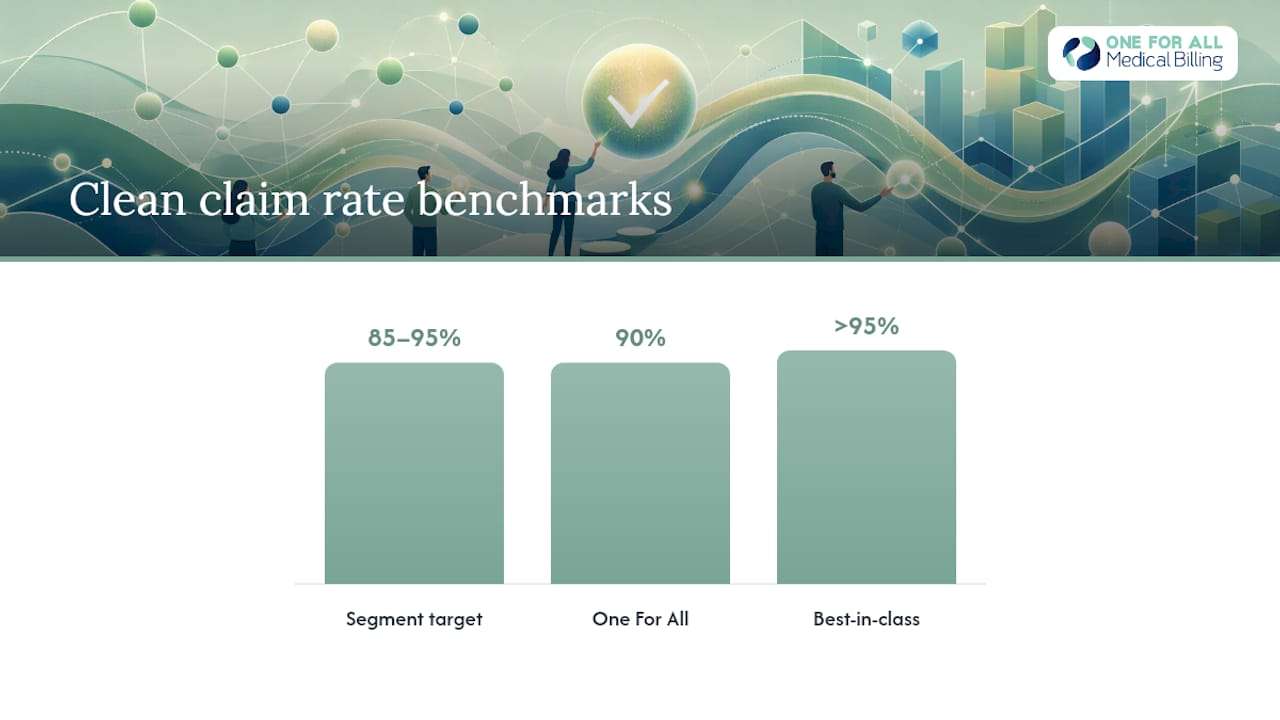
Most revenue cycle teams treat 85% to 95% as the healthy operating band, with best-in-class organizations pushing past 95%. Below the mid-80s, you are looking at real cash-flow drag.
Key Takeaways
Clean claim rate rises fastest when front-end fixes (eligibility, demographics, authorizations) are addressed before coding or scrubbing rules are touched.
| Point | Details |
|---|---|
| Know the formula | Clean claims divided by total claims submitted, multiplied by 100, tracked weekly or daily. |
| Aim for 85 to 95% | Best-in-class organizations push past 95%, but segment targets by payer and specialty. |
| Fix front-end issues first | Eligibility, demographics, and authorization gaps drive most low-CCR problems. |
| Track companion metrics | Denial rate, first-pass yield, and days in AR reveal what CCR alone can miss. |
| Consider outsourced RCM | One For All Medical Billing maintains a 90% clean claim rate through specialty-specific billing workflows. |
This article is general information, not a substitute for advice from a qualified financial advisor. Consult a qualified financial professional about your own circumstances before acting on anything here.
What Counts as a Clean Claim, and Why Clean Claim Rate Matters
A claim earns “clean” status only when every data element lines up before it leaves your building. That means:
- Complete, accurate patient demographics
- Eligibility verified for the actual date of service
- Correct procedure and diagnosis codes with matching modifiers
- Any required prior authorization already on file
- Documentation that supports medical necessity
AHIMA’s guidance on documentation makes a point that gets lost in daily claim-volume pressure: adjudication systems aren’t judging your care, they’re judging your paperwork. A payer’s system can’t approve a service it can’t verify was authorized, coded consistently, and tied to an eligible patient on that date.
When clinical documentation and administrative data don’t match, the claim doesn’t fail because the care was wrong. It fails because the story the claim tells doesn’t hold together.
This is why CCR functions as an early-warning gauge rather than a vanity metric. Every point of CCR lost translates directly into slower cash velocity, more staff hours spent on rework, and a wider window for denials to pile up in accounts receivable.
How Do You Calculate Clean Claim Rate?
The math is simple, but the definitions inside it are where teams get tripped up. Here’s the breakdown:
- Numerator: claims accepted by the payer without any staff intervention, edit, or resubmission.
- Denominator: total claims submitted in the measurement period, including electronic and paper.
- Exclusions to decide up front: whether corrected claims, split claims, and duplicate submissions count against you or get excluded entirely. Pick one rule and apply it consistently.
Worked example: your clinic submits 1,200 claims in a month. Of those, 1,080 are accepted on first pass with no edits. That’s 1,080 ÷ 1,200 × 100 = 90% CCR.
Tracking cadence matters more than most teams assume — a monthly view hides payer rule changes for weeks. Weekly or even daily monitoring catches a clearinghouse rejection spike before it becomes a quarter-long problem.
Clean Claim Rate vs. First-Pass Yield: What’s the Difference?
These two metrics get used interchangeably, and that’s a mistake. CCR measures whether a claim was technically accepted for adjudication; first-pass yield measures whether it was actually paid in full on that first submission.
- CCR tells you about front-end data quality: demographics, eligibility, coding accuracy.
- First-pass yield tells you about the whole payment outcome, including whether the payer agreed with your pricing and medical necessity argument.
- A claim can post a high CCR and still get denied later for medical necessity, meaning it was clean but not paid.
- Use CCR to diagnose registration and coding workflows. Use first-pass yield to diagnose contract, pricing, and payer-policy issues.
Track both, but don’t let a strong CCR convince you the revenue cycle is healthy. It only confirms the front door is working.
What Causes a Low Clean Claim Rate?
Most low-CCR practices are fighting the same handful of fires, not a mystery problem. In order of frequency:
- Inaccurate or incomplete patient demographics (wrong insurance ID, address mismatch)
- Eligibility not verified for the actual date of service
- Missing or expired prior authorizations
- Incorrect or mismatched CPT/HCPCS modifiers
- Payer-specific rules ignored (each payer has its own edit logic)
- Referral or NPI number gaps
- Date-of-service mismatches between scheduling and billing systems
Pro Tip: Before you touch your coding team’s workflow, check whether the majority of your rejections are demographic or eligibility related. Those are front-office problems, and fixing coding rules won’t move the needle if registration is the real leak.
A quick way to separate front-office from billing-department issues: pull your top ten rejection codes for the last 30 days. If most point to eligibility or demographics, the fix starts at check-in, not in the claim scrubbing queue.

How Can You Improve Your Clean Claim Rate?
Raising CCR is rarely about one big fix. It’s a sequence of smaller ones, applied in the right order:
- Pre-visit eligibility checks, run 24 to 48 hours before the appointment, not at check-in when there’s no time to correct a lapsed policy.
- Registration data validation, catching typos in insurance IDs and demographic fields before the claim is built.
- Real-time claim scrubbing against payer-specific edit rules, not just generic CPT/ICD-10 logic.
- Payer companion guides, since each major payer publishes its own submission quirks that generic scrubbers miss.
- Prior authorization workflows built into scheduling, so a missing auth is flagged before the visit happens.
- Coder-review rules for high-denial CPT families, applying extra scrutiny where the payer history shows repeat problems.
Technology helps here without requiring a platform overhaul: eligibility APIs, clearinghouse rulesets, and analytics dashboards that break out defect types by payer all reduce manual review time. Tools like Inovalon’s payer-edit infrastructure and analytics platforms such as MDClarity are commonly used to surface denial and defect patterns at scale.
The patient journey maps directly to your CCR opportunities: pre-visit eligibility check, registration validation, charge capture, claim scrub, submission, then ongoing monitoring. Each step is a chance to catch an error before it becomes a rejection.
Pro Tip: Fix the seven highest-frequency defect types first (demographics, eligibility mismatches, missing authorizations, incorrect modifiers, referral/NPI gaps, documentation mismatches, and service-date/auth window errors). Practices that target these systematically often see CCR climb from the high 80s into the mid-90s within weeks, not quarters.
What Is a Good Clean Claim Rate Benchmark for Your Organization?
Industry benchmarks put the healthy range at 85% to 95%, with top performers holding at or above 95%. But a single organization-wide number can hide serious variance.
- Segment CCR by payer. A small number of payer relationships often account for the bulk of your rework.
- Segment by provider and specialty, since surgical and procedural claims carry more coding complexity than routine office visits.
- Segment by CPT family, especially where prior authorization or medical necessity documentation requirements differ.
- Segment by claim channel (electronic vs. paper), since paper claims typically show worse first-pass results.
Setting a single target for the whole practice ignores where your actual leverage sits.
Where Clean Claim Rate Can Mislead You
CCR isn’t a complete picture, and treating it as one creates false confidence. A few blind spots to watch:
- Vendor definitions of “clean” vary. Some count electronic acceptance as clean even when warnings attached to that acceptance later produce a denial.
- A high CCR paired with a high denial rate for medical necessity means claims are technically clean but not actually getting paid.
- Excluding resubmissions from your denominator can inflate the number without reflecting real operational health.
Track denial rate, first-pass yield, and days in accounts receivable alongside CCR. Together they tell you whether clean claims are also becoming paid claims.
Where Should Revenue Cycle Managers Start?
If you take one thing from this, start at registration and eligibility, not coding. Most CCR problems I see traced back to what happens before the visit, not after the claim is coded.
This week: pull your top rejection codes and run a payer breakdown. Practices we’ve worked with typically find that two or three payer relationships account for most of their rework, which makes the fix far more targeted than a practice-wide overhaul.
How One For All Medical Billing Helps You Close the Gap
Most practices don’t need a new billing philosophy. They need someone checking eligibility before the visit, scrubbing claims against payer-specific rules before submission, and chasing denials before they age into write-offs.

One For All Medical Billing runs eligibility verification, claim scrubbing, denial management, and reporting analytics as one connected workflow, built around specialty-specific billing practices rather than generic templates. If your current CCR is stuck below that mark, reach out to One For All Medical Billing for a billing audit and see exactly where your first-submission claims are breaking down.
Sources
- AHIMA resource (document)
- 4 Common Causes of Low Clean Claim Rates (and How to Fix Them) | Intelichart
- KPI: Clean Claim Rate | Dexur
FAQ
What Is a Good Clean Claim Rate?
A healthy clean claim rate sits between 85% and 95%, with best-in-class organizations achieving 95% or higher.
What Is Considered a Clean Claim?
A clean claim has complete demographics, verified eligibility for the date of service, accurate codes and modifiers, and any required authorizations already on file before submission.
What Is the Clean Claim Ratio?
The clean claim ratio is another name for clean claim rate: the percentage of submitted claims accepted for adjudication without edits or rework on the first attempt.
How Do You Calculate Clean Claim Rate in Medical Billing?
Divide the number of claims accepted without rework by total claims submitted, then multiply by 100.
Does a High Clean Claim Rate Guarantee Payment?
No. A claim can be technically clean and still get denied later for medical necessity, which is why tracking first-pass yield and denial rate alongside CCR matters.

