

table of contents
Cash is coming in slower. Your billing team says they're working denials. Providers keep asking why production looks strong but deposits don't match. A/R is aging, payer edits keep changing, and every month feels like cleanup instead of control.
That's the point where many practices make the wrong move. They either blame staff, buy another piece of software, or outsource a narrow billing task and hope the problem goes away. It usually doesn't. When cash flow problems start at registration, authorization, charge capture, coding, or claim editing, you won't fix them by chasing unpaid claims harder.
That's where Revenue Cycle Management Consulting earns its keep. Done right, it's not a billing add-on. It's an operational intervention tied directly to reimbursement, throughput, and margin.
Why Your Practice Is Leaving Money On The Table
Most practices don't lose money in one dramatic failure. They lose it in small, repeated misses. Eligibility isn't verified early enough. Authorization rules aren't checked before the visit. Claims go out with preventable edits. Denials get appealed too late. Patient balances sit because front-desk collection workflows are weak.
None of that looks catastrophic on a single day. Over a quarter, it becomes a financial drag that leadership can feel but often can't isolate cleanly.
The reason this matters so much now is simple. Revenue cycle management is no longer a minor back-office function. It's a major operating category. One industry estimate put the global RCM market at about $102.16 billion in 2024, while another forecast projected $156.03 billion in 2025 and $313.8 billion by 2030. In the U.S., a separate estimate valued the market at $172.24 billion in 2024 and projected $308.2 billion by 2030 according to revenue cycle management market statistics.
The Real Problem Isn't Volume
A lot of administrators assume their issue is workload. It's usually workflow.
If your team spends most of its time fixing claim defects after submission, you're paying people to rework preventable mistakes. That's expensive. It also buries managers in noise, because they're reacting to symptoms instead of finding the source of leakage.
A good starting point is tightening your receivables discipline. If you need a practical reference on that side of the operation, review these accounts receivable best practices for medical billing teams. It helps frame where aging balances usually reflect upstream process failure.
You don't have a collections problem if claims should never have gone out dirty in the first place.
What Consulting Changes
Strong RCM consulting changes the conversation from “How hard is the team working?” to “Where is money leaking, and why?”
That shift matters because it forces accountability at the process level. Instead of asking billing staff to push harder, you examine scheduling rules, eligibility checks, coding patterns, claim scrubber logic, denial categories, payer follow-up queues, and reporting gaps. Then you redesign the parts that create avoidable friction.
That's how practices stop living month to month.
Core Services And Deliverables Of An RCM Consultant
A serious consultant does more than review denial logs and send a slide deck. The job is to diagnose the full revenue engine, identify root causes, and leave you with changes your team can operate.
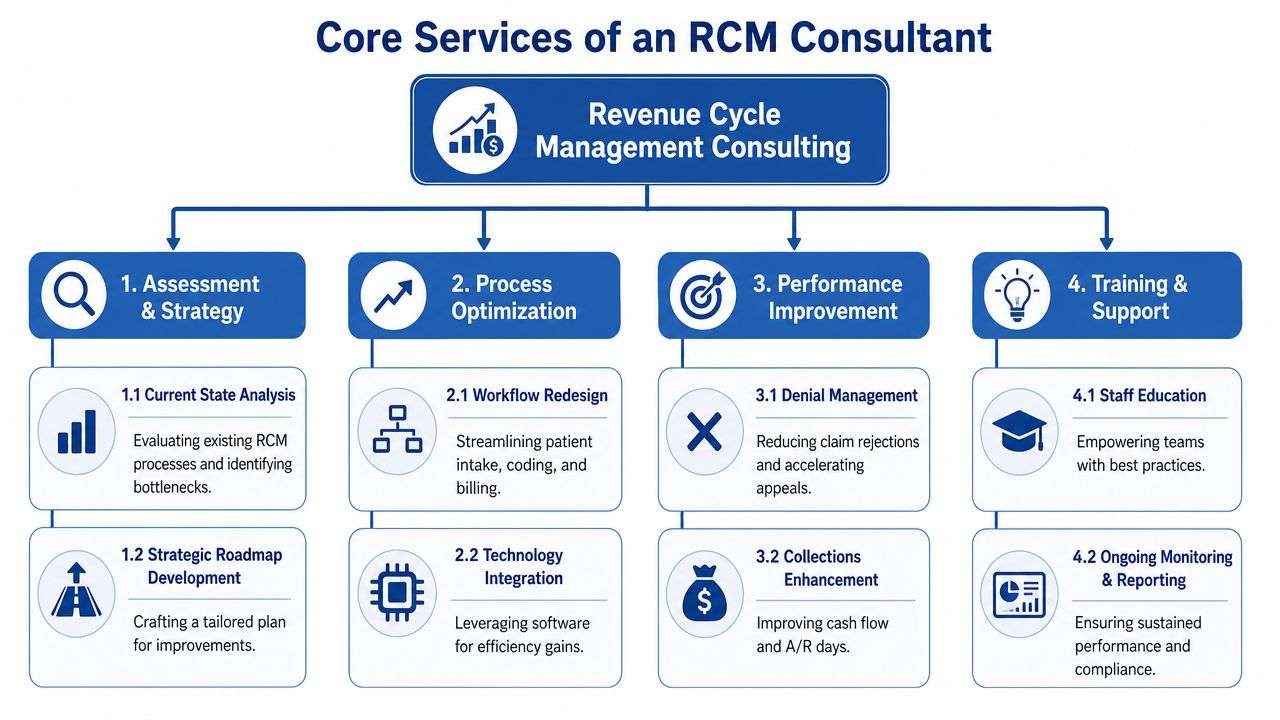
Assessment And Root Cause Analysis
This is where the work should begin. If a consultant jumps straight to recommendations without understanding your intake process, payer mix, denial categories, coding patterns, and work queues, they're guessing.
Expect a proper engagement to include:
- Workflow mapping across the full cycle: Scheduling, preregistration, eligibility, authorization, charge entry, coding, claim submission, payment posting, denials, and patient collections.
- Data review by friction point: Not broad “revenue trends,” but where claims stall, where edits repeat, where handoffs break, and where staff are using manual workarounds.
- Payer rule analysis: Commercial plans, Medicare, Medicaid, managed care, and specialty-specific authorization behavior all create different failure modes.
Process Redesign And Technology Fit
A consultant should tell you whether the issue is people, process, system configuration, or some combination.
That often means reviewing your PM system, EHR workflows, claim scrubber edits, work queue design, and reporting logic. The same thinking shows up in broader operational consulting. If you want a useful comparison point for how infrastructure and process strategy should support execution, CloudOrbis's strategic IT guidance is worth reading because the principle is the same. Don't bolt tools onto broken workflows.
Practical rule: If the proposed fix is “buy new software” before anyone audits your current workflows, stop the conversation.
A qualified RCM consultant should also be able to distinguish what belongs in-house, what should be automated, and what can be outsourced. If you're weighing that decision, this overview of the benefits of outsourcing medical billing is useful because it clarifies where outside support helps and where it can mask process defects.
Deliverables You Should Actually Expect
Don't settle for vague advice. The deliverables should be concrete.
Look for outputs like these:
- A current-state findings report that names the operational bottlenecks, not just the symptoms.
- A prioritized improvement roadmap that sequences fixes by financial impact and implementation difficulty.
- Workflow redesign documentation for front desk, billing, coding, and follow-up teams.
- Denial prevention plans organized by reason code, payer, and process owner.
- Training guides and accountability structures so the changes survive after the consultant leaves.
What RCM Consulting Is Not
It's not routine claim submission. It's not generic outsourced billing dressed up with strategy language. And it's not a one-time audit that sits untouched in a shared drive.
Real RCM consulting changes operating behavior. It should make your front desk register patients better, your coders document and code cleaner, your billers work smarter queues, and your leaders review the right data at the right cadence.
If it doesn't alter decisions and cash movement, it wasn't consulting. It was commentary.
The KPIs That Truly Define RCM Consulting Success
If a consultant talks mostly about “increasing revenue,” push back. That phrase is too vague to manage. Strong engagements measure success through days in accounts receivable, denial rate, clean claim rate, and net collection rate, because those indicators show where friction lives in the cycle according to RCM performance guidance on core KPIs.
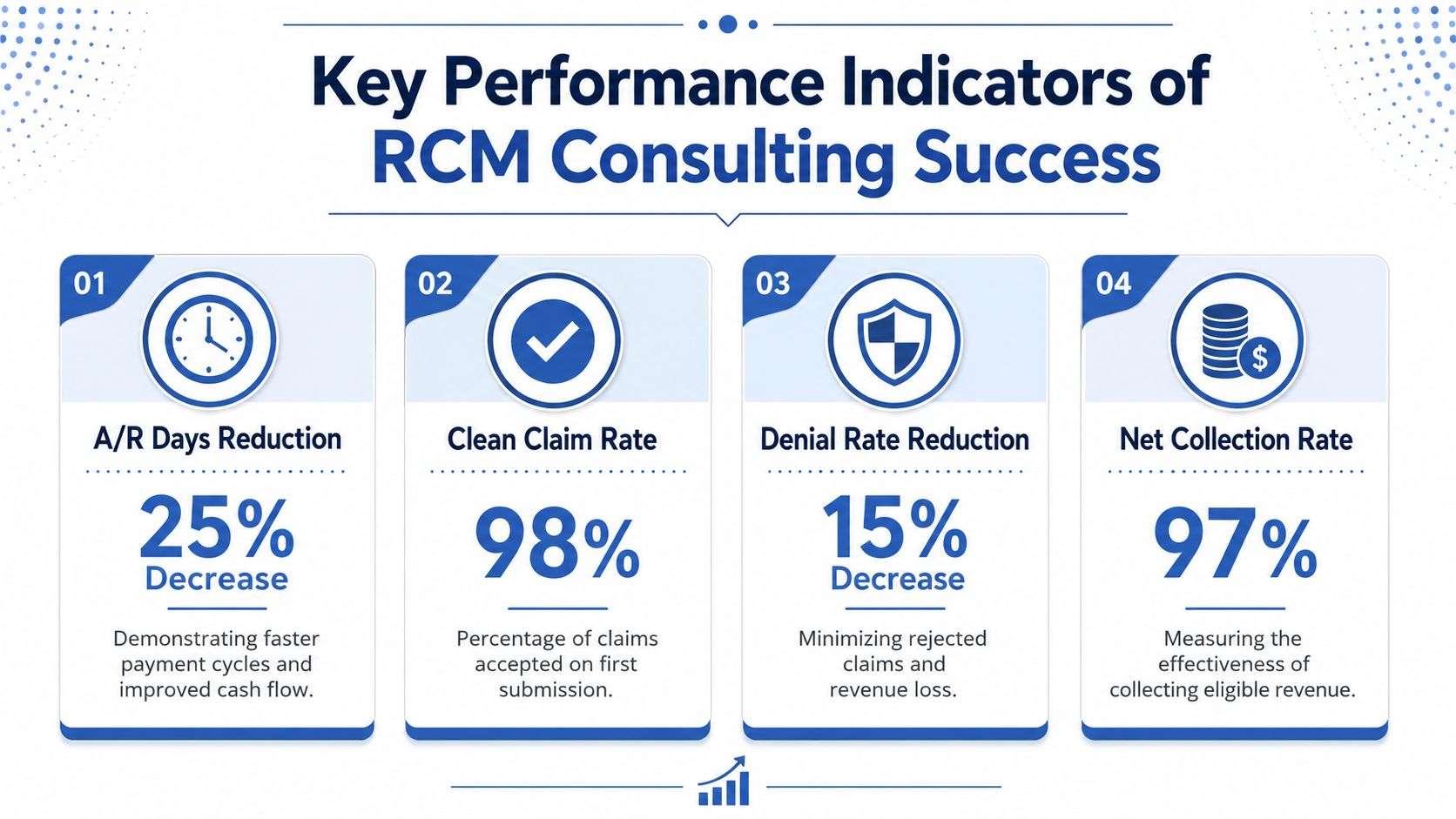
Four Metrics That Matter More Than General Revenue Talk
Each KPI answers a different management question.
- Days In A/R: How long cash sits before your practice collects it. If this drifts up, you have a speed problem somewhere in claims, posting, follow-up, or payer response handling.
- Denial Rate: How often claims get rejected or denied. This is the most useful signal for process quality because it often traces directly to registration, authorization, coding, or documentation failure.
- Clean Claim Rate: How many claims go through correctly the first time. This tells you whether your front-end data and billing rules are strong enough to avoid rework.
- Net Collection Rate: How much collectible reimbursement you bring in. It indicates whether operational execution is converting entitled revenue into cash.
How Administrators Should Use These KPIs
Don't review these in isolation. Look at the pattern.
If clean claim rate looks acceptable but A/R days remain stubborn, your issue may sit in payment posting or payer follow-up. If denial rate climbs while providers insist productivity is strong, the bottleneck is likely upstream. If net collection looks weak but denial patterns seem stable, investigate underpayments, contract variance, or patient balance workflow.
That's why dashboard design matters. A good KPI stack lets leadership connect movement across the cycle instead of reacting to one metric at a time. For a practical example of what that oversight should look like, review this revenue cycle management dashboard guide.
Metrics are only useful when someone owns the action behind them.
There's a useful parallel in broader finance and workforce strategy. Discussions around understanding PEO cost savings make the same point in another setting. Financial improvement should be measured through operating KPIs that leadership can connect to decisions, not through vague promises.
Questions To Ask When Reviewing KPI Reports
Use these in every consultant meeting:
- Which KPI moved because of a front-end workflow change, not just more back-end labor?
- Which payer categories create the most rework?
- Which denial reasons are preventable, and who owns prevention?
- What process changed at the point of service, not just after claim submission?
If a consultant can't answer those clearly, they're reporting activity, not improvement.
Building The Business Case And Proving ROI
Many RCM consulting pitches typically fall apart at this stage. They promise “cash acceleration,” “process improvement,” and “better visibility,” but they don't build a financial case sturdy enough for a practice administrator, CFO, or executive team to approve.
That gap is well recognized. Public coverage often talks about consulting value in broad terms without showing which interventions create the biggest dollar impact or how long it takes to recover consulting costs, as discussed in analysis of ROI challenges in revenue cycle management consulting.
Start With Leakage, Not Optimism
Don't approve a consulting engagement because someone says your revenue cycle has “room for improvement.” Every practice has room for improvement. That's not a business case.
Build the case around avoidable leakage. Ask for a baseline in four areas:
- Preventable denials: Which denial categories come from registration, eligibility, authorization, coding, or documentation failures?
- A/R drag: Where do balances stall, and which work queues carry the oldest unresolved claims?
- Under-collection patterns: Where does entitled reimbursement fail to convert into posted cash?
- Labor-heavy rework: Which tasks consume staff time because the process failed upstream?
A good consultant should tie each problem to a named intervention, a process owner, and a monitoring method.
Model ROI By Intervention Type
This is the practical way to think about return. Not all fixes pay back the same way.
Front-end redesign usually produces the clearest operational lift because it prevents bad claims from entering the system. Denial workflow redesign helps too, but that's often recovery work. Contract analysis can matter a great deal in some settings, but only if underpayment or payer behavior is a real issue in your practice. Training can be valuable, but only when it's tied to a redesigned workflow and measured afterward.
If you need a disciplined way to prepare baseline comparisons before an engagement starts, this resource on benchmarking in healthcare operations is useful. It helps administrators frame performance gaps without relying on guesswork.
The strongest ROI case is never “the consultant will help.” It's “this process defect is costing us money, and this intervention should stop it.”
What A Good ROI Proposal Looks Like
You should expect the proposal to answer these questions in plain language:
- What is broken
- Why it is broken
- Which change is proposed
- Who must change behavior
- How success will be measured
- How often results will be reviewed
What you should reject is just as important.
Reject proposals built around generic software demos, broad efficiency language, or recommendations that don't assign accountability. Reject any plan that measures success only by gross collections without separating operational causes. And reject consultants who can't explain why one intervention should come before another.
The point isn't to buy “improvement.” The point is to buy measurable financial lift tied to specific operational change.
Your RCM Consulting Implementation Roadmap
A proper engagement follows a sequence. If the consultant has no roadmap, you'll end up with a pile of findings and a frustrated staff.
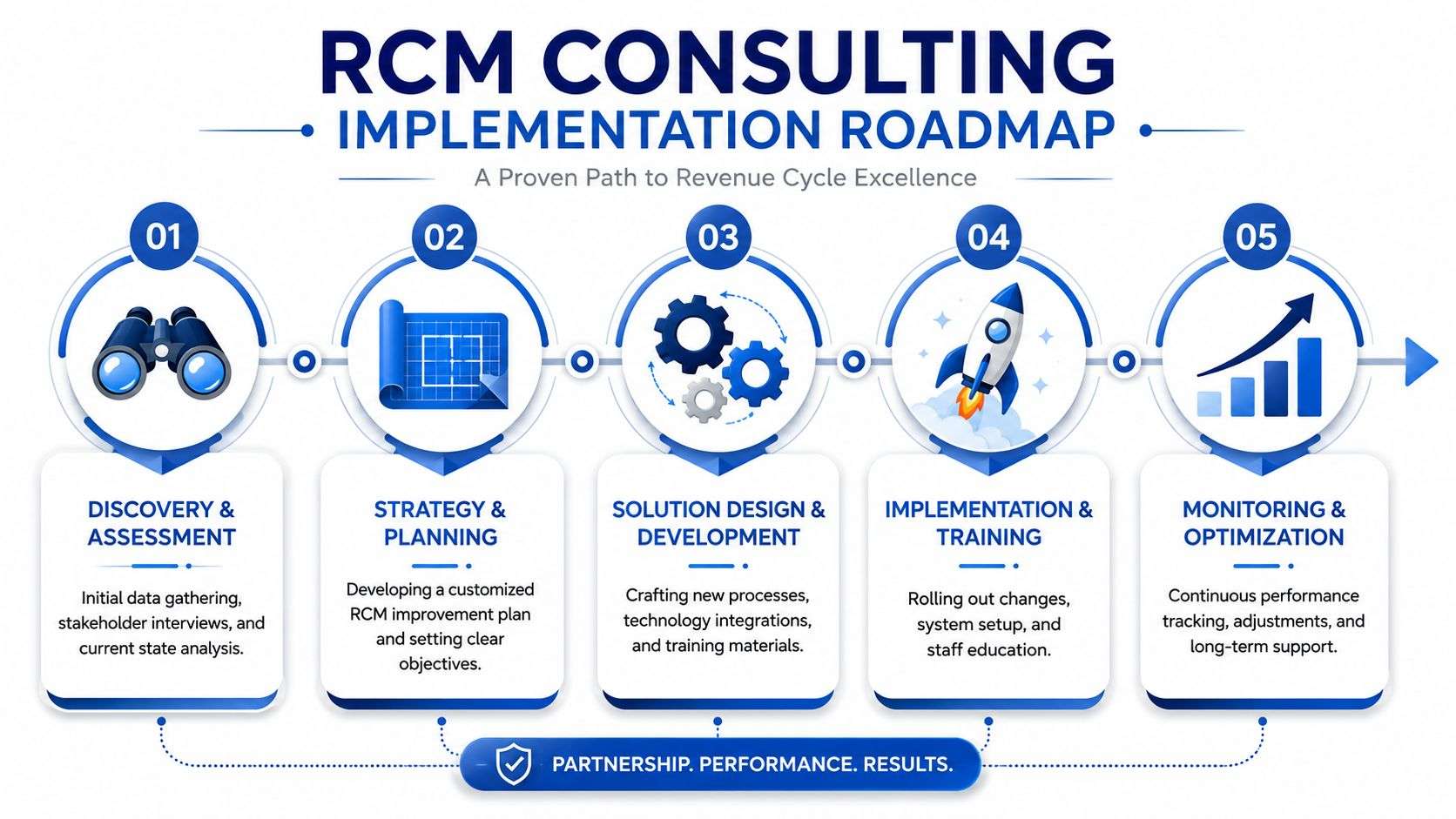
Discovery And Diagnosis
The first phase is fact-finding. That means data pulls, interviews, workflow observation, and queue review. You want the consultant talking to schedulers, front-desk staff, billers, coders, and leadership, because each group sees different failure points.
This phase should expose where work is breaking across handoffs. It should also reveal whether reported KPI problems are caused by front-end intake, coding variance, system edits, payer behavior, or weak follow-up discipline.
Fix The Front End First
In many practices, the highest-impact technical lever is workflow redesign around front-end eligibility and authorization. Preregistration, real-time insurance verification, and prior-authorization checks reduce downstream rework when they happen before the visit, as outlined in AMA guidance on eligibility and workflow redesign.
That's where I'd start unless the data clearly shows a different bottleneck.
Why? Because fixing bad claims after submission is always slower and more expensive than preventing them. Front-end discipline protects coding, billing, and collections from avoidable contamination.
Implementation And Change Control
Many engagements stall at this stage. The consultant identifies the right fixes, but managers don't operationalize them.
Use a structured rollout:
- Assign process owners: Registration lead, coding lead, billing lead, and an executive sponsor.
- Document the new workflow: Not broad policy language. Actual steps staff will follow.
- Train by role: Front desk needs different training than A/R follow-up.
- Monitor weekly at first: Early drift is common, especially when staff revert to old habits.
The best redesign on paper is worthless if the front desk still skips insurance verification when the waiting room gets busy.
Optimization That Sticks
After rollout, the consultant should monitor the impact, identify resistance points, and tighten the process. Some fixes need system changes. Others need scripts, checklists, queue redesign, or stronger manager review.
The mistake practices make here is declaring victory too early. If leaders stop checking compliance after launch, old behaviors return fast. Durable performance comes from reinforcement, not announcement.
That's the roadmap that works. Diagnose carefully, fix upstream first, assign ownership, train hard, and monitor until the new process becomes normal.
How To Select The Right RCM Consulting Partner
Most firms sound competent in a sales call. That's not the standard. You need a partner who can diagnose operational failure, prove financial impact, and work effectively with real staff in a busy clinical environment.
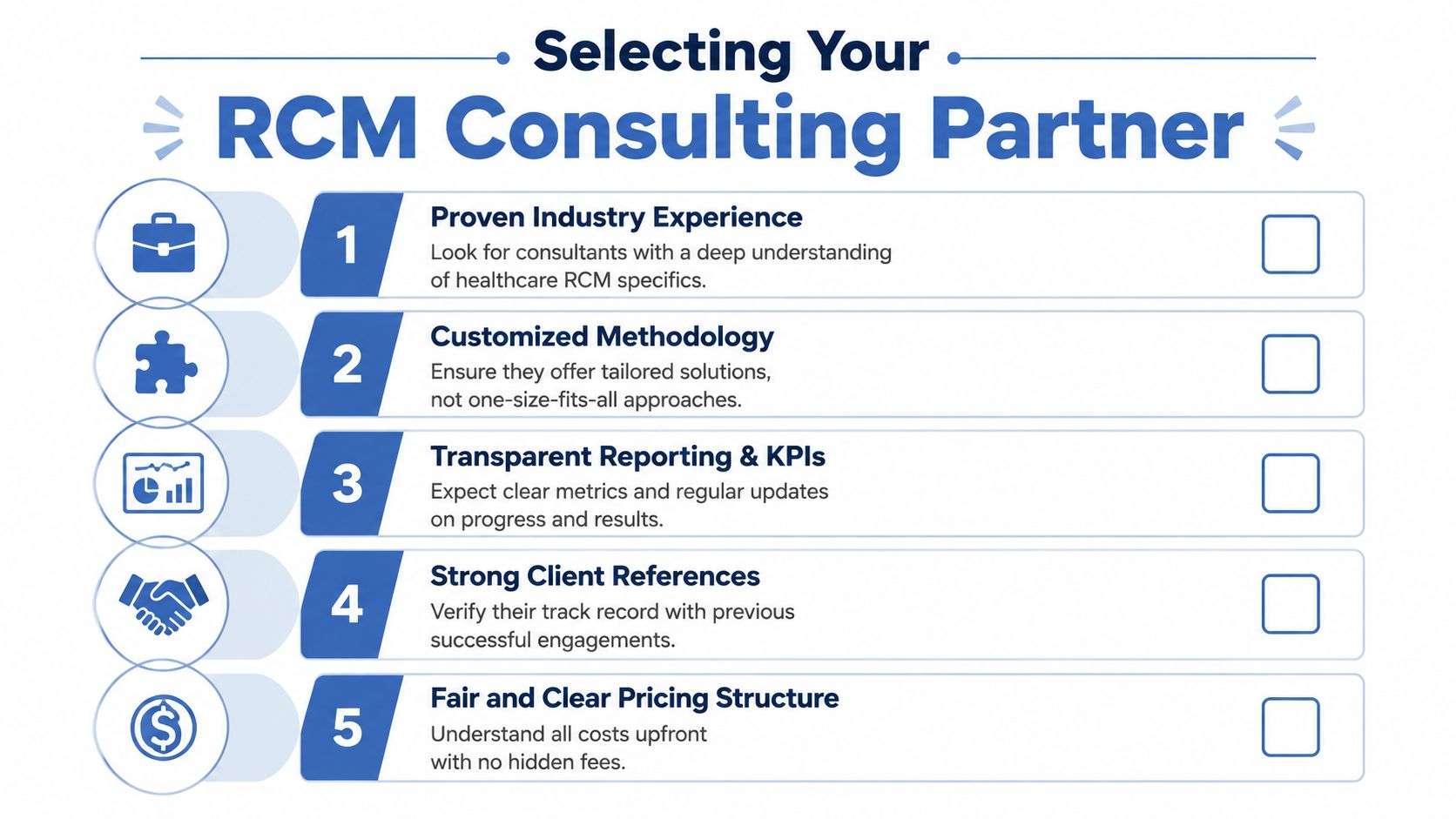
What To Ask Before You Sign
The right questions expose whether you're talking to strategists or slide-makers.
Ask these:
- What types of practices do you work with most often? Specialty complexity matters. Urgent care, multisite primary care, behavioral health, surgical specialties, and infusion models don't break in the same places.
- How do you identify root causes? If the answer is mostly dashboards and high-level reporting, keep digging. They should talk about workflow observation, payer patterns, queue analysis, and staff interviews.
- What changes do you typically recommend first? You want prioritization logic, not a menu of services.
- How do you measure success? If they can't speak clearly about operational KPIs and accountability by function, they're not ready.
- Who does the work after assessment? Some firms sell senior expertise and deliver junior labor. Get clarity.
Compare Pricing Models By Risk And Control
Different pricing structures fit different situations.
A project-based model works when you need a defined assessment, redesign plan, and implementation support. It's best when scope is clear.
A retainer model makes sense when your practice needs ongoing oversight, repeated optimization, or leadership support across multiple sites.
A performance-based model sounds attractive, but read the terms carefully. It can align incentives, or it can reward short-term collection moves that don't fix process quality. If the model pushes the consultant to chase easy wins while ignoring workflow defects, you'll feel the pain later.
Red Flags That Should End The Conversation
Some warning signs aren't subtle.
- Guaranteed outcomes: Any consultant who guarantees specific financial results before deep diagnosis is selling confidence, not discipline.
- Black-box reporting: If they won't show methodology, assumptions, and process findings, you won't know what changed or whether it will last.
- Software-first selling: Tools matter. But if every problem leads to the same platform recommendation, the diagnosis is probably biased.
- Weak implementation ownership: Findings without change management won't hold.
- No meaningful references: You don't need celebrity logos. You do need proof they've solved similar problems in environments like yours.
If you're comparing service providers more broadly, this roundup of revenue cycle management company selection factors can help sharpen your screening criteria.
The Partner You Want
The best partner is boring in the right ways. They ask detailed questions, insist on baseline data, challenge assumptions, and refuse to promise miracles before diagnosis. They can sit with your front desk, talk with coders, review payer patterns, and explain financial implications to executives without changing language every five minutes.
That's what competence looks like in RCM consulting.
Not charisma. Not jargon. Not a polished deck.
A partner who can find where your operation leaks money and help your team close the gaps.
Taking Control Of Your Practice's Financial Health
You don't need more noise around the revenue cycle. You need clarity. That starts with naming the bottlenecks, measuring them with the right KPIs, and forcing every proposed fix to prove its financial value.
The smartest practices treat Revenue Cycle Management Consulting as a business decision, not a rescue mission. They baseline performance, prioritize high-impact workflow changes, and choose partners who can connect operational redesign to measurable cash improvement.
That same discipline applies in other advisory categories too. If you've ever evaluated specialized outside expertise in another area, this guide on hiring an AI consultant is a good reminder that the right advisor should bring method, transparency, and accountability, not just ideas.
If your practice is stuck in denial cleanup, delayed payments, and unreliable forecasting, stop accepting that as normal. Fix the front end. Track the right metrics. Demand an ROI case before you sign anything. And choose a consulting partner who's willing to be judged by results, not presentations.
If you want a partner that helps providers get paid faster with fewer denials and less operational stress, One For All Medical Billing is worth a close look. Their team supports practices with billing, coding, eligibility verification, denial follow-up, reporting, and scalable revenue cycle support built for real-world healthcare operations.

