

table of contents
The patient collections process is the end-to-end workflow that converts patient-responsibility balances into cash, and the single most important thing you can do right now is move collection activity earlier. Verify eligibility before the visit, present a clear cost estimate at check-in, and send a digital statement within seven days of adjudication. These three steps alone compress your patient accounts receivable (A/R) cycle and cut bad debt before it accumulates.
Three immediate actions to take this week:
- Run real-time eligibility checks on every scheduled patient at least 48 hours before the appointment to surface deductibles, copays, and coverage gaps.
- Collect known patient-responsibility balances at the point of service, including copays, outstanding balances, and estimated cost-sharing based on the verified benefit.
- Launch a digital post-service follow-up within seven days of adjudication, using a patient portal message or email with a direct payment link.
Each of these actions targets the highest-leverage moments in the revenue cycle. The longer a patient balance ages, the harder and more expensive it becomes to recover. Getting ahead of it is not just good operations; it is the difference between a healthy A/R and a write-off problem.
How does patient collections fit into the revenue cycle?
Patient collections does not stand alone. It sits at the downstream end of a chain of operational decisions that begins the moment a patient schedules an appointment. Understanding where it fits helps you see which upstream failures create downstream collection problems.
The high-level process map:
- Pre-service: Insurance eligibility verification, prior authorization, and patient cost estimates. Failures here cause claim denials and surprise balances that patients resist paying.
- Point of service: Copay and known-balance collection at check-in or check-out. This is the highest-yield collection moment in the entire cycle.
- Claims submission and adjudication: Clean claim submission, clearinghouse edits, payer adjudication, and remittance posting. Denial rates directly inflate patient balances when claims are partially or fully rejected.
- Patient-responsibility identification: After the explanation of benefits (EOB) posts, the billing team calculates the true patient balance and generates a statement.
- Post-service collections: Outreach via portal, email, SMS, and phone using a graduated cadence. This is where most practices lose ground by moving too slowly.
- Escalation and write-off: Internal final notice, early-out partner placement, third-party agency referral, or financial hardship write-off.
Three ways this map affects your practice:
- Cash flow: Delays at any stage push patient balances past 90 days, where recovery rates drop sharply and cost-to-collect rises.
- Denial rate interaction: A clean-claim program reduces the volume of balances that land on patients unexpectedly. Fewer denials mean fewer disputed balances and faster patient payment.
- Patient experience and retention: Patients who receive clear, timely, empathetic billing communications are more likely to pay and return. Confusing or aggressive outreach damages both.
Who owns which handoff:
- Front desk: Eligibility checks, estimate presentation, point-of-service collection, and signed financial agreements.
- Clinical staff: Accurate charge capture, diagnosis documentation, and prior authorization compliance.
- Billing specialists: Claim submission, denial management, payment posting, and statement generation.
- A/R collectors: Outreach cadence management, payment plan setup, and escalation decisions.
- RCM partner (when engaged): End-to-end process oversight, reporting, compliance monitoring, and vendor coordination.
What does the step-by-step patient collections workflow look like?

A well-designed workflow removes ambiguity about who acts, when, and with what documentation. The steps below map the full cycle from pre-visit to account closure.
Ordered operational steps:
- Pre-visit eligibility verification (48–72 hours before appointment): Confirm active coverage, deductible status, copay amounts, and any authorization requirements. Use a real-time eligibility tool integrated with your practice management (PM) system. Document results in the patient account.
- Pre-visit cost estimate: Generate a good-faith estimate based on scheduled services and verified benefits. Present it to the patient in writing. For practices subject to the No Surprises Act, this is also a compliance requirement.
- Point-of-service collection (day 0): Collect the copay, any outstanding balance, and a deposit toward the estimated patient responsibility. Obtain a signed financial responsibility agreement and, where appropriate, a card-on-file consent.
- Claim submission (day 1–3): Submit a clean claim through your clearinghouse with all required codes, modifiers, and authorization numbers. Run claim scrubbing edits before transmission.
- Adjudication and remittance posting (day 7–30, payer-dependent): Post the EOB or electronic remittance advice (ERA) promptly. Identify the patient balance and flag any denials for appeal.
- First digital patient notice (within 7 days of adjudication): Send a portal message or email with the balance, a plain-language explanation, and a direct payment link. Industry guidance confirms this is the highest-yield post-service collection moment.
- Payment plan offer (day 30): For balances that have not been paid, present a structured payment plan option with automated card-on-file enrollment.
- Phone outreach (day 45): A billing specialist or A/R collector makes a personal call using an empathetic, compliant script.
- Final notice (day 60): Send a written final notice via portal and mail, clearly stating the next step if payment is not received.
- Escalation decision (day 90): Evaluate for early-out partner placement, third-party agency referral, or financial hardship write-off based on balance size, patient history, and cost-to-collect math.
Roles and responsibilities:
- Front desk: Steps 1–3 (eligibility, estimate, POS collection, financial agreement)
- Financial counselor: Estimate counseling, hardship screening, payment plan enrollment
- Billing specialists: Steps 4–5 (claim submission, denial management, payment posting)
- A/R collectors: Steps 6–10 (outreach cadence, escalation decisions)
- RCM partner: Oversight of the full cycle, reporting, and compliance monitoring
Required documents per account:
- Insurance card (front and back, verified at each visit)
- Signed assignment of benefits and financial responsibility agreement
- Pre-visit cost estimate with patient acknowledgment
- Prior authorization number (where applicable)
- Card-on-file consent form with documented patient authorization
- Signed HIPAA consent
Pro Tip: Set a hard rule that no account moves past day 30 without a documented outreach attempt. Accounts that fall between teams, with no owner and no logged contact, are the primary driver of preventable write-offs.
Which KPIs actually measure patient collections success?
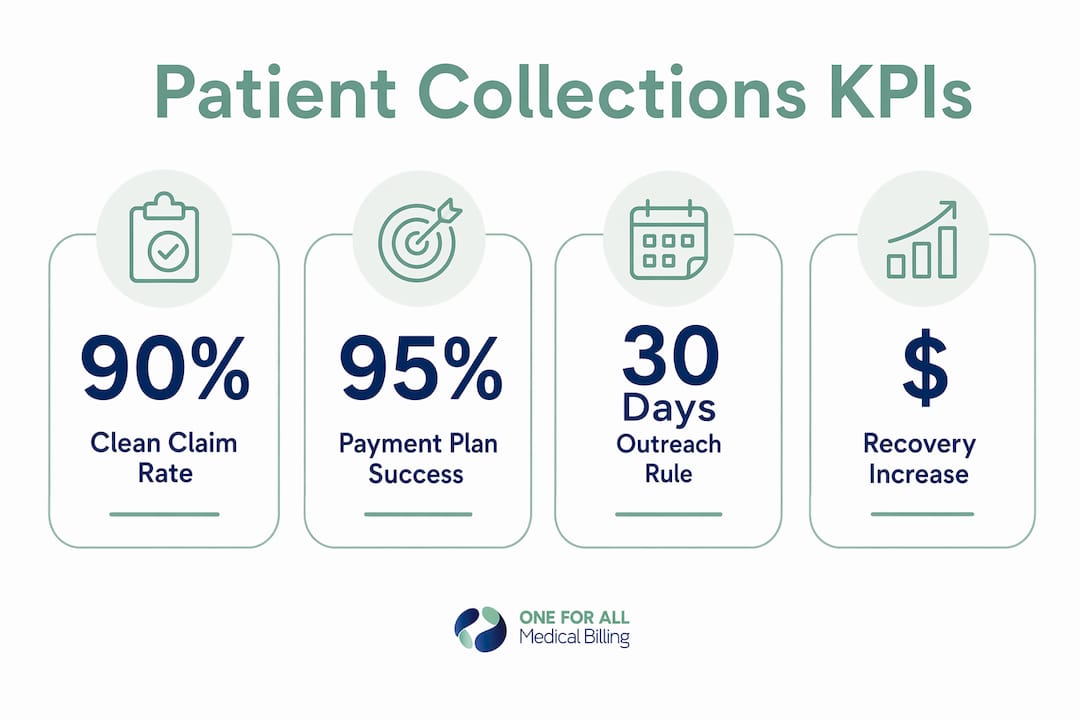
Metrics without benchmarks are just numbers. The six KPIs below give you both the formula and a target range so you can spot problems before they compound.
Core metrics with formulas:
- Patient days in A/R: (Total patient A/R balance ÷ Average daily patient charges). Target: under 35 days. Higher values signal slow outreach or billing delays.
- Patient collection rate: (Patient payments collected ÷ Net patient charges). Tracks how much of your patient-responsibility revenue you actually recover.
- Net collection rate: (Payments received ÷ Net charges after contractual adjustments). HFMA guidance suggests targeting 95% or higher where feasible, though specialty and payer mix affect achievable rates.
- Bad debt rate: (Bad debt write-offs ÷ Gross charges). A rising bad debt rate is usually a lagging indicator of upstream failures in eligibility, estimates, or outreach timing.
- Point-of-service collection rate: (POS collections ÷ Total POS collectible amount). Practices with consistent point-of-service collections see a 40–60% reduction in patient A/R balances.
- Patient contact rate: (Accounts with documented outreach ÷ Total accounts in collections). Low contact rates reveal workflow gaps, not patient unwillingness to pay.
Benchmark targets:
- Patient days in A/R: under 35 days
- Net collection rate: 95%+ (varies by specialty and payer mix)
- Bad debt rate: under 5% for most ambulatory practices
- POS collection rate: 70%+ for copays; 40%+ for estimated balances
A/R aging buckets mapped to actions:
- 0–30 days: Monitor only; confirm statements were sent within 7 days of adjudication.
- 31–60 days: Trigger automated follow-up; offer payment plan enrollment.
- 61–90 days: Escalate to personal phone outreach; document all contacts.
- 91–120+ days: Run cost-to-collect analysis; evaluate for early-out placement or write-off.
Standardizing these reports in an automated billing analytics dashboard is what separates practices that react to A/R problems from those that prevent them. A weekly aging report reviewed by a billing manager is the minimum viable cadence for a practice with meaningful patient volume.
What causes unpaid patient balances, and how do you prevent them?
Most unpaid balances trace back to a small number of root causes. Fixing them upstream is far cheaper than chasing them downstream.
Cause-and-fix pairs:
- Eligibility failures: A patient’s coverage has lapsed or their deductible is higher than expected, and no one caught it before the visit. Fix: run real-time eligibility checks at least 48 hours pre-visit and again at check-in. Verifying insurance coverage before every encounter eliminates the most common source of surprise balances.
- Poor or absent estimates: Patients who do not know what they owe are far less likely to pay promptly. Fix: generate a written good-faith estimate for every scheduled service and review it with the patient at check-in.
- Claim denials: A denied claim shifts the full balance to the patient or creates a disputed account. Fix: a clean-claim program with pre-submission scrubbing edits catches coding errors, missing modifiers, and authorization gaps before they reach the payer.
- Billing delays: Statements sent 30–45 days after service feel disconnected from the visit. Fix: automate statement generation to trigger within seven days of remittance posting.
- Confusing statements: Patients who cannot understand their bill call to dispute it rather than pay it. Fix: use plain-language statements that show the original charge, the insurance payment, and the patient balance in three clear lines.
- Limited payment options: Patients who cannot pay online, by phone, or in installments simply do not pay. Fix: offer a patient portal with a direct payment link, card-on-file enrollment, and automated payment plans.
Front-desk scripting for point-of-service collections:
The conversation at check-in sets the tone for everything that follows. A script that normalizes payment as part of the visit works better than one that sounds like a demand.
Pro Tip: Train front-desk staff to say: “Based on your insurance, your estimated responsibility today is $[amount]. We collect that at the time of service. Would you like to pay by card, or would you prefer to set up a payment plan?” The offer of a plan removes the binary of “pay now or don’t,” and most patients choose one or the other.
Financial counselors play a parallel role for larger balances. Screening patients for financial hardship eligibility before they leave the building, and enrolling them in a plan or charity care program on the spot, prevents the account from aging into collections at all.
Which technology features actually move the needle on collections?
The right technology does not just automate tasks; it closes the gaps where accounts fall through. When evaluating vendors or auditing your current stack, focus on these capabilities.
Feature checklist for vendor selection:
- Patient portal with a direct, mobile-friendly payment link
- Card-on-file with documented, HIPAA-compliant patient consent
- Automated payment plan enrollment with card-on-file execution (not patient-initiated manual plans)
- Omnichannel outreach: SMS, email, portal message, and phone, with documented consent per channel
- Real-time eligibility integration with your EHR or PM system
- Claim scrubbing and edit rules before clearinghouse submission
- Secure messaging that keeps PHI off unencrypted channels
- Audit trails and business associate agreement (BAA) support for all third-party integrations
The card-on-file capability deserves special attention. Automated card-on-file payment plans achieve completion rates over 94%, while patient-initiated manual payment plans have completion rates of about 50–60%. That gap is not marginal; it is the difference between a payment plan that works and one that stalls after the first installment.
Integration and technical requirements:
- Bidirectional EHR/PM integration for real-time balance and demographic data
- Clearinghouse connectivity for ERA/EOB posting and claim status
- PCI-DSS compliance for stored card data; HIPAA compliance for all PHI in transit and at rest
- Reporting and analytics APIs that feed your billing dashboard
Capability tiers by platform type:
Entry-level tools typically cover online payment acceptance and basic statement generation, but lack automated outreach sequencing or real-time eligibility. They work for very small practices with low patient volume and dedicated billing staff to manage follow-up manually.
Mid-market platforms add automated outreach cadences, payment plan automation, and EHR integration. They are the right fit for most independent practices and small health systems that want to reduce manual A/R work without a full outsourced RCM engagement.
Enterprise RCM platforms include advanced analytics, multi-site reporting, denial management workflows, and full clearinghouse integration. They are built for multi-site health systems and specialty groups with complex payer mixes and high claim volume.
Implementation sequencing:
Pilot new technology on a single provider or location before rolling out practice-wide. Train front-desk and billing staff together so the workflow changes are understood end-to-end. Build a QA checkpoint at 30 days to catch configuration errors before they affect a full month of claims.
What are the compliance rules for patient collections?
Compliance in collections is not optional, and it is not just about HIPAA. Three separate regulatory frameworks govern how, when, and what you can communicate to patients about their balances.
Compliance checklist:
- HIPAA: Minimize PHI in all collection communications. Never include diagnosis codes, procedure descriptions, or service dates in unencrypted texts or voicemails. Use secure portals for balance details. Any third-party collection partner must sign a BAA before receiving patient data.
- Regulation F (FDCPA): Limits debt collectors to seven calls per week per debt, prohibits contact before 8 AM or after 9 PM local time, and requires a validation notice within five days of first contact. If you use an external agency, confirm they operate within these boundaries.
- FDCPA disclosures: First written communication must include the amount of the debt, the creditor’s name, and the patient’s right to dispute. Internal billing staff are generally not covered by the FDCPA, but third-party collectors are.
- PCI-DSS: Card-on-file data must be stored by a PCI-compliant processor. Never store raw card numbers in your PM system or EHR.
- State-level rules: Several states have enacted additional protections on medical debt reporting and collection practices. The CFPB has proposed rules that would prohibit medical bills from appearing on credit reports; monitor this space, as the regulatory environment is actively shifting.
For a deeper look at HIPAA obligations in billing communications, the HIPAA Enforcement Rule guidance from One For All Medical Billing covers the practical compliance steps practices need to follow.
Compliant SMS example: “You have a balance with [Practice Name]. Visit [secure link] to view and pay your bill. Reply STOP to opt out.” This message contains no PHI, no service details, and includes an opt-out mechanism as required. A non-compliant version would include the patient’s name, the service date, or the diagnosis in the message body.
A note on outsourcing: The moment patient data leaves your organization for a third-party collector, HIPAA requires a signed BAA. No exceptions. Build BAA execution into your vendor onboarding checklist, not as an afterthought after the contract is signed.
How should you design patient outreach sequences and communication templates?
Timing and channel selection are as important as the message itself. A well-designed outreach cadence collects most balances before they ever need to be escalated.
Recommended timing cadence:
- Day 0–7 (post-adjudication): Send a portal message or email with the balance and a payment link. This is the highest-yield moment; patients still remember the visit and feel the connection between the service and the bill.
- Day 30: Send a payment plan offer. For patients who have not paid, a structured installment option removes the barrier of a lump-sum payment.
- Day 45: Make a personal phone call. A human voice at this stage recovers accounts that digital outreach missed.
- Day 60: Send a final written notice via portal and mail. State clearly what happens next if payment is not received.
- Day 90: Escalate to an early-out partner or third-party agency, or write off per your financial hardship policy.
Practices that use this graduated digital sequence collect a substantially higher share of patient balances compared to monthly paper statement cycles. The gap is driven almost entirely by timing: faster first contact and more frequent touchpoints.
Channel guidance:
- SMS requires documented patient consent and must contain no PHI.
- Email is appropriate for balance notifications with a secure portal link; never embed PHI in the email body.
- Phone is the right channel for complex accounts, large balances, or patients who have not responded to digital outreach.
- Portal messages are the most secure channel and should be the default for any communication that includes balance details.
For practical guidance on ethical, effective billing communications, the patient communication guide from One For All Medical Billing covers scripting and channel best practices in detail.
Three short template snippets:
Phone prompt (empathetic):
“Hi, this is [Name] calling from [Practice Name] regarding your account. We have a balance of $[amount] on file. I’d like to help you take care of that today, or set up a payment plan that works for your budget. Is now a good time to talk?”
Portal/email message:
“You have a balance of $[amount] with [Practice Name] for services on [date]. You can view your statement and pay securely at [portal link]. If you have questions or need a payment plan, call us at [phone number].”
Compliant SMS (no PHI):
“[Practice Name]: You have a balance due. View and pay securely at [link]. Reply STOP to opt out.”
Pro Tip: Log every outreach attempt, the channel used, the date, and the outcome in the patient account. This documentation protects you in a dispute, satisfies Regulation F contact-frequency tracking, and gives your A/R team a clear picture of what has already been tried.
When should you escalate from internal collections to an agency or write-off?
Escalation is a financial decision, not a failure. The question is not whether to escalate, but when the math makes it the right call.
Escalation timeline with decision triggers:
- Day 0–60: Internal collections. You have the relationship, the data, and the lowest cost-to-collect. Work the account internally through your full outreach cadence.
- Day 60–90: Evaluate for early-out placement. If your internal team has made multiple documented contacts without resolution, an early-out partner (a contingency-fee agency that works accounts before they are formally “in collections”) can recover balances at a lower cost than a traditional third-party agency.
- Day 90+: Third-party agency placement or write-off. Run a cost-to-collect analysis before placing small balances. A $75 balance placed with an agency at a 30% contingency fee nets you $52.50 before the agency’s administrative costs. For very small balances, a financial hardship write-off may be more economical.
Checklist for placing with an agency or early-out partner:
- Confirmed signed BAA before any data transfer
- Verified FDCPA compliance posture and documented complaint history
- Transparent reporting: you should receive account-level status updates, not just aggregate recovery summaries
- Pricing model clearly defined (contingency percentage, flat fee, or hybrid)
- Omnichannel outreach capability (not phone-only)
- Healthcare A/R experience, specifically with your payer mix and patient demographics
Accounting guidance:
When an account is placed with a third-party agency, record it as a transfer out of your A/R and into a contingency receivable. Do not recognize revenue until the agency remits payment. Write-offs should be recorded against your allowance for doubtful accounts, not directly against revenue, to maintain clean revenue recognition. For practices using accrual accounting, the timing of write-off decisions affects both your bad debt rate and your reported net revenue.
How an RCM partner executes the patient collections process
Working with a specialist RCM partner changes the operational model. Instead of managing every workflow internally, your team focuses on patient care while the partner owns the billing cycle end-to-end.
Onboarding checklist for a partner engagement:
- Data handoff: demographic files, payer contracts, fee schedules, and current A/R aging report
- EHR/PM integration: bidirectional data feed for charges, demographics, and payment posting
- Rule-set mapping: payer-specific billing rules, authorization requirements, and denial reason codes
- Staff role definition: who on your team handles patient-facing financial conversations vs. what the partner manages
- Communication template review: outreach scripts, statement formats, and escalation thresholds
One For All Medical Billing’s accounts receivable best practices framework illustrates how a structured onboarding process reduces the time-to-first-clean-claim and prevents the common early-engagement errors that delay cash flow.
What improved outcomes look like:
Practices that transition from an internal-only billing model to a managed RCM engagement typically see measurable improvements in patient days in A/R, clean claim rates, and denial resolution speed. The specific gains depend on the baseline, but the pattern is consistent: faster first-pass claim acceptance reduces the volume of patient balances that require post-adjudication outreach, and a structured outreach cadence recovers more of those balances before they age past 60 days.
Questions to ask any RCM vendor:
- What is your clean claim rate on first submission, and how do you measure it?
- How do you handle denial appeals, and what is your average resolution time?
- What reporting do you provide, and at what cadence?
- Do you have a signed BAA template, and what security certifications do you hold?
- Is your pricing contingency-based, flat-fee, or a hybrid, and what is included vs. billed separately?
- What are your SLA definitions for claim submission, denial response, and patient outreach initiation?
- How do you handle specialty-specific billing rules for our practice type?
Pro Tip: Before signing any RCM contract, request a sample monthly report and a sample denial appeal letter. These two documents tell you more about a vendor’s actual capabilities than any sales presentation. A vendor who cannot produce them quickly is not operationally ready.
Key Takeaways
A structured, front-loaded patient collections process recovers significantly more revenue than reactive, paper-based billing cycles, and the difference compounds over every month you delay fixing the workflow.
| Point | Details |
|---|---|
| Front-load collection activity | Verify eligibility pre-visit, collect at point of service, and send a digital notice within 7 days of adjudication. |
| Use graduated digital outreach | A digital cadence (day 7, 30, 45, 60, 90) yields significantly higher collection rates than paper-only cycles. |
| Card-on-file plans outperform manual ones | Automated card-on-file payment plans complete at over 94%, while patient-initiated manual payment plans complete at about 50–60%. |
| Track six core KPIs | Monitor patient days in A/R (target under 35), net collection rate (target 95%+), and bad debt rate (target under 5%). |
| One For All Medical Billing | Brings 20+ years of RCM expertise and a 90% clean claim rate to help practices recover more revenue with less internal burden. |
What most billing teams get wrong about patient collections
The conventional wisdom says the hardest part of patient collections is getting patients to pay. After two decades of watching billing operations across specialties and practice sizes, the real problem is almost always upstream: the practice waited too long, sent a confusing statement, and then expected the patient to figure out how to pay.
Patients are not inherently resistant to paying their medical bills. They are resistant to paying bills they do not understand, did not expect, and received weeks after they had mentally closed the chapter on that visit. The practices that collect the most are not the most aggressive; they are the most organized. They verify eligibility before the visit, have a real conversation about cost at check-in, and send a clear, actionable statement within a week of adjudication. By the time a balance reaches 45 days, the best practices have already had three touchpoints with the patient.
The other thing teams underestimate is the compliance dimension. Regulation F, HIPAA, and evolving CFPB guidance on medical debt reporting are not bureaucratic obstacles; they are the framework that protects both the patient and the practice. Building compliance into your outreach automation from the start is far less painful than retrofitting it after a complaint or audit. A BAA with every third-party partner, PHI-free SMS messages, and documented consent for every communication channel are not nice-to-haves. They are the operational baseline.
One For All Medical Billing’s 90% clean claim rate and 20+ years of specialty billing experience reflect a simple operating philosophy: fewer denials mean fewer patient balances, and fewer patient balances mean less collections pressure on everyone. Fix the front end, and the back end takes care of itself.
One For All Medical Billing: a faster path to recovered revenue
Practices that try to manage the full patient collections cycle internally often find that the process works until it does not, and by the time the A/R aging report signals a problem, months of recoverable revenue have already aged past the point of easy collection.

One For All Medical Billing delivers full-service revenue cycle management built around the operational discipline this article describes: real-time eligibility verification, clean-claim submission at a 90% first-pass rate, compliant automated patient outreach, card-on-file payment plan enrollment, and denial management with documented appeal workflows. The result is a measurable reduction in patient days in A/R and a higher net collection rate, without adding headcount to your billing team.
What to prepare before a consultation:
- Your current A/R aging report (90-day and 120+ buckets)
- Your most recent clean claim rate and denial rate by payer
- A description of your current patient outreach cadence and tools
- Your top three billing pain points (denials, slow payments, staff capacity)
To get started, visit the medical billing services page and request a consultation. A specialist will review your current workflow and identify the highest-leverage changes for your practice.
Useful sources and primary references
- CFPB: Proposed Rule to Ban Medical Bills from Credit Reports: The primary regulatory source for understanding how federal policy on medical debt reporting is evolving. Most useful for the compliance section and FAQ.
- CMS: Explanation of Benefits Guide: Official CMS guidance on patient rights related to EOBs. Useful for patient communication and statement design sections.
- HFMA: 7 KPIs Providers Should Be Tracking: Industry benchmark guidance for net collection rate, POS collection, and A/R days. Primary source for the KPI section.
- AccessOne: 5 Ways to Measure Patient Collections in Revenue Cycle: Practical definitions and benchmark targets for patient-specific KPIs including patient days in A/R and bad debt rate.
- Clear Receivables: Medical Collections HIPAA-Compliant AR Guide: Source for card-on-file completion rate data, digital outreach recovery rates, and compliant messaging examples.
- First Credit: Patient Balance Collections Practical RCM Guide: Operational guidance on best-practice timelines and cost-to-collect escalation logic.
- DFPI: Medical Debt Collection Know Your Rights: Consumer-facing guidance on medical debt collection rights; useful for understanding the patient perspective and state-level rule context.
- KFF Health System Tracker: The Burden of Medical Debt in the United States: Research context on the scale of medical debt; useful for framing the patient experience dimension of collections.
FAQ
What happens if a $1,000 medical bill goes to collections?
Once a medical bill is placed with a third-party collection agency, the agency may report the debt to credit bureaus, though federal and state policy on medical debt credit reporting is actively changing. The patient retains the right to dispute the debt and request validation within 30 days of first contact under the FDCPA.
Who is responsible for managing patient collections?
Responsibility is shared across the revenue cycle: the front desk owns eligibility verification and point-of-service collection, billing specialists own claim submission and statement generation, and A/R collectors own the post-adjudication outreach cadence. When a practice uses an RCM partner like One For All Medical Billing, the partner typically manages billing, outreach, and escalation while the practice retains patient-facing financial conversations.
What happens if a patient never pays their medical bill?
Unpaid balances that exhaust the internal collections cadence are typically placed with an early-out partner or third-party agency, or written off under a financial hardship policy. Write-offs are recorded against the allowance for doubtful accounts and affect the practice’s reported bad debt rate; they do not eliminate the patient’s legal obligation to pay.
Does medical debt in collections ever go away?
Medical debt has a statute of limitations that varies by state, typically three to six years, after which the debt becomes legally uncollectible through the courts. Separately, recent CFPB rulemaking has proposed removing medical debt from credit reports entirely, which would change how long collections activity affects a patient’s credit profile.
How do automated payment plans improve collection rates?
Card-on-file payment plans complete at rates over 94% because the payment executes automatically on the agreed schedule without requiring the patient to initiate each installment. Patient-driven manual payment plans, by contrast, complete at about 50–60%, because they depend on the patient remembering and acting each month.
This article is general informational guidance for healthcare billing professionals and does not constitute legal, financial, or compliance advice. Confirm current regulatory requirements with the relevant primary sources or a qualified compliance professional for your specific situation.
Recommended
- Revenue Cycle Management Billing: A Complete Guide – One For All Medical Billing
- RCM For Healthcare Providers: Your 2026 Financial Guide – One For All Medical Billing
- Medical Billing For Pain Management: A Complete Playbook – One For All Medical Billing
- Protect Your Practice: Internal Controls to Prevent Fraud – One For All Medical Billing

