

table of contents
Modifier 59 identifies a distinct procedural service, one performed at a different session, site, lesion, incision, or timed block than another code billed the same day. It functions as a modifier of last resort. That means CMS wants XE, XS, XP, or XU applied whenever one fits the clinical facts, and it means modifier 59 never belongs on an evaluation and management line.
TL;DR:
- Modifier 59 should only be used with documentation that clearly proves services occurred at different times, sites, lesions, incisions, or timed blocks, not solely based on diagnosis codes.
- CMS prefers to assign more specific modifiers—XE, XS, XP, or XU—over 59 whenever the clinical facts support a distinct service, and these should be checked first.
- Overusing modifier 59 without proper documentation or on evaluation and management codes triggers audits, denials, and potential recoupments, especially if used habitually or inappropriately.
- Proper documentation must include explicit timestamps, specific anatomical descriptors, or separate encounter notes to justify the distinctness of procedures billed with 59 or the X modifiers.
- Incorporating workflow checks for CCMI values, matching correct modifiers to codes, and verifying documentation standards can significantly reduce the risk of errors and audit exposure.
Modifier 59 Billing: Appropriate Uses That Hold Up
Modifier 59 earns its place on a claim when documentation shows the two services genuinely did not overlap. CMS built the rule around a short list of qualifying circumstances, and understanding each one is the difference between a clean claim and a takeback letter six months later.
A separate session means the second procedure happened at a distinct time from the first, not layered into the same encounter. A separate site or organ system covers cases like a biopsy on the left breast and a different procedure on the right. A separate lesion applies when a provider treats two distinct lesions during the same visit, each requiring its own clinical decision. A separate incision or excision covers surgical scenarios where the operative note documents two distinct entry points. A separate injury, or separate area of injury in extensive trauma cases, justifies distinct treatment. Finally, different timed code blocks in therapy or behavioral health let a coder distinguish 15-minute units that did not run concurrently.
Each of these circumstances usually has a better-fitting X modifier. Separate structure situations point to XS. Separate encounters point to XE. Unusual non-overlapping service point to XU. Separate practitioner scenarios point to XP. CMS guidance on modifier 59 and the X{EPSU} family states plainly that these four are more specific and should be selected first whenever the clinical picture supports one of them.
- Different session or patient encounter on the same date
- Different procedure or surgery on the same date
- Different anatomic site or organ system
- Different lesion, even within the same organ
- Separate injury requiring distinct treatment
Medicare Administrative Contractors do not apply this preference uniformly. Some MACs accept 59 on legacy claims processing systems that have not fully adopted X modifier logic, while others flag any 59 use where an X modifier was available and reject the claim outright.
Pro Tip: Build your claim scrubber to flag every 59 modifier automatically and prompt the coder to check whether XE, XS, XP, or XU fits before the claim leaves the building.
Where Modifier 59 Billing Goes Wrong
The single most common mistake in modifier 59 billing is treating a different diagnosis code as sufficient justification on its own. It is not. CMS article A53399 states that modifier 59 identifies procedures not normally reported together, and a differing ICD-10 code alone does not prove the services were clinically or temporally distinct. Auditors know this pattern well, and it is one of the first things a prepayment review checks.
Modifier 59 also never belongs on an evaluation and management code. If a provider performed a significant, separately identifiable E/M service alongside a procedure, the correct tool is modifier 25, or modifier 24 or 57 depending on the global period context. Appending 59 to an E/M line is an automatic red flag on most payer edit systems.
Other traps that invite scrutiny:
- Using 59 to override a National Correct Coding Initiative edit carrying a modifier indicator of 0, which cannot be bypassed under any circumstance
- Stacking 59 alongside an X modifier on the same code pair, which signals confusion rather than precision
- Applying 59 by habit on recurring code combinations without checking whether the day’s documentation actually supports distinctness
- Letting an EHR template auto-populate 59 based on code pairing history rather than the specific encounter
One data point worth internalizing: CMS’s own guidance frames overuse of modifier 59 as a known driver of improper payment findings, which is precisely why the agency pushed the X modifier family into wider use in the first place. Practices that treat 59 as a default workaround, rather than an exception, tend to show up disproportionately in post-payment audits.
NCCI Edits, CCMI Indicators, and the X-Modifier Preference
Every code pair on the National Correct Coding Initiative Procedure-to-Procedure edit table carries a Correct Coding Modifier Indicator, and that single digit determines whether modifier 59 has any legal function at all.
- CCMI = 0 means the edit cannot be bypassed by any modifier. No amount of documentation changes this. If NCCI flags a pair as mutually exclusive with indicator 0, one of the two codes simply is not billable that day.
- CCMI = 1 means a modifier can override the edit when the clinical circumstances support distinctness. This is where 59 or an X modifier actually does its job.
- CCMI = 9 means the edit does not apply, usually because CMS deleted or never activated the pair.
On any code pair carrying indicator 1, the column-2 code (the one CMS considers the lesser-valued or bundled service) gets the modifier, not the column-1 code. CMS’s NCCI tools guidance walks through this column logic in detail, and getting it backward is a quiet way to trigger a denial that looks like a coding error rather than a policy dispute.
A workable decision flow for any coder facing this fork:
- Check the CCMI value first. If it is 0, stop. No modifier applies.
- If it is 1, ask whether XE, XS, XP, or XU describes the clinical circumstance more precisely than 59.
- If none of the four fits but the encounter is genuinely distinct, 59 remains valid.
- Confirm the documentation actually supports whichever modifier gets selected before the claim goes out.
What Documentation Has to Show for Modifier 59 Billing
Modifier 59 shifts the burden of proof onto the medical record, not the claim form. An auditor reviewing a 59-modified line is looking for evidence that the two services were genuinely distinct, and vague or duplicate-sounding notes are the fastest way to lose an appeal before it starts.
Documentation that holds up under review typically includes explicit time stamps for timed codes, showing start and stop for each unit billed. Operative notes should describe each incision or lesion by specific anatomic location rather than generic terms. Separate encounter notes, each with its own assessment and plan, support session-based distinctness far better than a single combined note covering two procedures. Practitioner identifiers matter too, particularly when the justification for 59 rests on a different provider performing part of the service.
- Time in and time out for every timed CPT code, logged independently
- Anatomic descriptors specific enough to distinguish one lesion or site from another
- Separate consent forms when two distinct procedures occurred
- Distinct assessment and plan language for each encounter, not a copied paragraph
Insufficient documentation often looks like this: “Patient also had a second procedure performed.” Acceptable documentation looks like this: “A 1.2 cm lesion was excised from the left forearm at 10:15 a.m.; a separate 0.8 cm lesion was excised from the right forearm at 10:40 a.m., following a new prep and drape.”
Pro Tip: Standardize a documentation template that forces providers to fill in anatomic site and time fields before the note can be finalized. Retroactively fixing vague notes after a denial is far harder than building the habit up front.

Modifier 59 Examples That Show the Logic in Practice
Working through real claim-line scenarios makes the abstract rules concrete, and it is usually where coders finally see why the column-1 versus column-2 distinction matters.
- Surgical example. A dermatologist excises two separate lesions during one visit, one on the scalp and one on the forearm. The NCCI pair carries CCMI 1. Because the distinction is anatomic site, XS is the sharper choice than 59. The operative note needs two clearly separated excision descriptions to back it up.
- Timed therapy example. A physical therapist bills two 15 minute units of manual therapy and therapeutic exercise that ran in genuinely separate time blocks rather than concurrently. If the blocks occurred in the same treatment session, 59 still applies since none of the four X modifiers describe a timed-block distinction as precisely; the flow sheet needs independent start and stop times for each.
- Clinic encounter example. A patient sees a provider for a scheduled follow-up in the morning and returns that afternoon for an unrelated acute complaint. Two separate encounters, two separate notes, and XE fits better than 59 because the defining feature is the distinct encounter itself.
- Column 1 code: the higher-valued or “parent” service in the NCCI pair
- Column 2 code: the code that receives the modifier when distinctness is documented
- Documentation snippet to attach: anatomic site, time stamp, or encounter identifier matching the modifier chosen
Radiology groups run into a version of this constantly when a single imaging center reads studies at different sites or under different orders the same day; teleradiology arrangements built for overflow reading often surface these distinct-site scenarios at volume, which makes consistent modifier logic even more important for that specialty.
Common Denials Tied to Modifier 59 Billing
Denial language around modifier 59 tends to follow a few predictable patterns, and recognizing them speeds up the appeal decision.
- “Modifier inconsistent with procedure code” usually signals the CCMI was 0 and no modifier should have been attempted at all
- “Insufficient documentation to support distinct service” points straight to the medical record, not the claim
- Payer policy requiring an X modifier where 59 was submitted, common among commercial plans that adopted the AmeriHealth Caritas approach%20.pdf.coredownload.inline.pdf) of treating 59 strictly as a fallback
An appeal packet needs the original operative or encounter notes with time stamps and anatomic descriptors highlighted, a brief cover letter mapping each documentation element to the specific NCCI criterion claimed, and a copy of the CCMI lookup showing the edit was bypassable. Track your practice’s 59 usage rate as a percentage of total claims, denial rate specific to 59-modified lines, and total takeback dollars tied to modifier reviews. A rising usage rate paired with a flat or rising denial rate is the earliest warning sign of a training gap, not a coding fluke.
Building a Workflow That Keeps Modifier 59 Billing Clean
The safest operational pattern is a presubmission checklist that runs the same three questions on every claim carrying modifier 59: what is the CCMI value, does a more specific X modifier apply, and does the chart actually document distinctness.
- Pull the CCMI value for the code pair before selecting any modifier.
- If the indicator allows a modifier, test XE, XS, XP, and XU against the encounter facts first.
- Confirm the documentation contains the specific elements, time stamps, anatomic descriptors, or separate notes, that match the chosen modifier.
- Require a coder and provider sign-off on any claim where 59 is the final selection, not an X modifier.
- Log the claim in a monthly usage report broken out by provider and code pair.
Recurring coding errors around modifier 59 almost always trace back to a missing step in this sequence, usually the skipped CCMI check.
Pro Tip: Set an internal threshold, such as flagging any provider whose 59 usage rate climbs more than two standard deviations above the practice average, for a documentation spot check before the next billing cycle closes.
Why Modifier 59 Billing Still Trips Up Experienced Coders
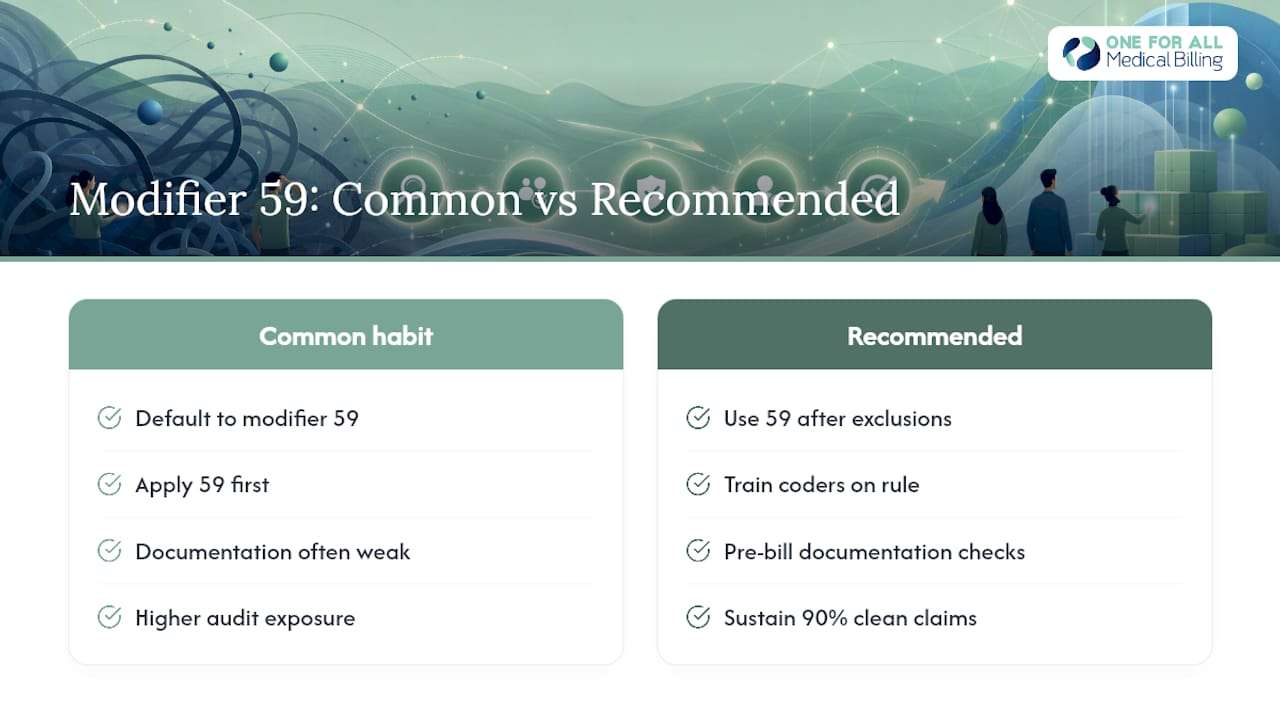
Modifier 59 has been part of CPT since long before the X modifier family existed, and that history is exactly why so many practices default to it out of habit rather than precision. The rule hasn’t changed as much as the expectation around it has.
At One For All Medical Billing, we train coders to treat 59 as the answer they reach after ruling out something more specific, not the answer they reach first. That discipline, paired with the documentation standards our teams build into pre-bill review, is a meaningful part of how we sustain a 90% clean claim rate across more than 20 years of specialty billing work. The gap between compliant use and audit exposure is almost always a documentation gap, not a coding one.
— One For All Medical Billing
Reduce Modifier 59 Risk With Specialty-Focused Billing Support
Getting modifier 59 wrong costs more than one denied line. It invites a broader payer review, and that review can pull dozens of claims into scrutiny at once. One For All Medical Billing built its pre-bill review process specifically to catch CCMI conflicts, missing documentation, and X modifier opportunities before a claim ever leaves the office, which is a very different posture than fixing denials after the fact.

Our services cover full claims submission and coding, denial management, and compliance consulting tailored to how your specialty actually documents distinct procedures. We build documentation templates that match your EHR workflow, train coders on the X modifier decision flow, and support appeal packets when a 59-related denial does land. Practices working with us see fewer prepayment reviews and stronger audit defense because the documentation habits get fixed at the source, not patched after a takeback letter arrives. If your practice is ready for a pre-bill review of its current modifier 59 usage, visit One For All Medical Billing to start the conversation.
FAQ
When Should You Use Modifier 59 in Medical Billing?
Use modifier 59 only when a different session, site, lesion, incision, or timed block makes two services genuinely distinct, and only after confirming no X modifier fits better.
Does Medicare Still Accept Modifier 59?
Yes, Medicare still accepts modifier 59, but CMS guidance directs coders to use XE, XS, XP, or XU first whenever one of those more specific modifiers applies.
What Are the CMS Guidelines for Using Modifier 59?
CMS requires that modifier 59 attach to the column-2 code in an NCCI pair with a modifier indicator of 1, that documentation prove distinctness, and that it never be appended to an evaluation and management code.
Does Modifier 59 Reduce Payment?
Modifier 59 itself does not reduce the fee schedule payment for the code it modifies; it simply allows a bundled pair to bypass an NCCI edit so both services can be paid when documentation supports distinctness.
What Is the Difference Between Modifier 59 and the X Modifiers?
Modifier 59 is a general distinct-service modifier, while XE, XS, XP, and XU each describe one specific type of distinctness, separate encounter, structure, practitioner, or unusual service, and CMS prefers the more specific option whenever it applies.

