

table of contents
CPT code 99214 is more than just a number on a claim form—it’s the code for a level 4 office visit for an established patient, and it represents a moderate level of medical decision-making. As one of the most common codes in outpatient care, getting it right is absolutely vital to the financial health of your practice.
What Every Practice Manager Should Know About CPT Code 99214

In the world of medical billing, CPT code 99214 is a true workhorse, particularly in primary care and specialties that manage chronic conditions. Think of it this way: it’s the code for a visit that’s more involved than a simple, stable follow-up but doesn't quite rise to the level of a high-stakes, complex crisis.
This code signals that a provider had to tackle moderately complex problems, like managing a chronic illness that’s acting up or juggling several stable conditions at once.
Using 99214 correctly isn’t just about ticking compliance boxes; it's a core component of a healthy revenue cycle. Because it reflects a significant amount of provider work and mental effort, it naturally comes with a higher reimbursement value than lower-level codes. When your team consistently and accurately bills for 99214, you’re making sure the practice is paid fairly for the care being delivered. Mastering this code is a key step to discover more about effective revenue cycle management and strengthen your financial strategy.
The Financial Cornerstone Of Outpatient Visits
It's hard to overstate just how important 99214 is. For countless practices across the country, it's a cornerstone of their billing revenue. Data from the Centers for Medicare & Medicaid Services (CMS) backs this up. Years ago, in 2013, it was already a top code with $9.1 billion in total allowed charges.
Fast forward to 2022, and its importance has only grown. Medicare approved a staggering 98.5 million claims for 99214, making it the most frequently used outpatient E/M code.
This consistently high volume is exactly why understanding its nuances is so critical. A practice that under-codes these visits—billing a 99213 when a 99214 is fully supported—is leaving a significant amount of money on the table. Over time, those small misses add up to a major revenue gap.
Core Criteria For Using CPT Code 99214
To bill a 99214, the visit has to meet specific criteria. The choice comes down to either the complexity of the medical decision-making (MDM) or the total time the provider spent on the encounter that day.
Here's a quick look at the main criteria for billing CPT code 99214.
CPT Code 99214 At A Glance
- Patient Status: The patient must be established, meaning they've been seen by a provider in your practice (or the same specialty) within the last three years.
- Medical Decision Making (MDM): The visit must meet a moderate level of MDM. This is based on the number and complexity of problems, the amount of data reviewed, and the risk of complications from patient management.
- Time-Based Billing: The provider must spend a total of 30-39 minutes on patient care activities on the day of the encounter. This includes all face-to-face and non-face-to-face time, like reviewing records, documenting, and coordinating care.
A common example of a 99214 visit is a patient with two stable chronic illnesses, like hypertension and hyperlipidemia. During the visit, the provider reviews recent lab results and actively manages their prescription medications.
Now that we've covered the basics, the next sections will dive deeper into the documentation needed, common billing mistakes to avoid, and strategies to ensure your practice can confidently and correctly use this essential code.
Building An Audit-Proof Case For Every 99214 Claim
When it comes to audits and claim denials, your clinical documentation is your single best line of defense. Think of it as the evidence that proves a CPT code 99214 wasn't just randomly chosen, but was medically necessary for that specific encounter. Every claim needs to tell a clear, compelling story, whether you're billing based on the visit's complexity or the total time spent.
Creating this audit-proof case doesn’t mean adding hours of extra work. It’s about precision and focusing on the details that matter to payers. This is your practical playbook for creating medical records that are defensible, compliant, and ready to stand up to scrutiny. A strong documentation foundation is also the first step toward significant improvements in clinical documentation integrity across your entire practice.
Justifying 99214 With Medical Decision Making
If you're billing based on Medical Decision Making (MDM), your documentation must clearly support a "moderate" level of complexity. To get there, you have to meet the requirements for two out of three key elements: Problems, Data, and Risk. Forget the dry, textbook definitions—let's break down what auditors are actually looking for.
The real goal here is to paint a clear picture of your provider's thought process. Simply listing diagnoses on a chart won't cut it. The note has to show how the provider is actively managing these conditions and what they were thinking.
The narrative of your medical record must answer the "why" behind every decision. Why was this test ordered? Why was this medication adjusted? Answering these questions is the key to demonstrating moderate complexity and securing proper reimbursement for CPT code 99214.
To build a solid case for moderate MDM, your documentation should reflect one of these common scenarios:
- One chronic illness with exacerbation: Think of a patient with well-controlled asthma who comes in with a severe flare-up. The visit involves a new treatment plan and close monitoring.
- Two or more stable chronic illnesses: This could be a patient with both stable hypertension and type 2 diabetes. The provider has to consider how managing one condition might affect the other, especially when adjusting medications.
- One undiagnosed new problem with an uncertain prognosis: A patient presents with unexplained weight loss and fatigue. This requires the provider to develop a differential diagnosis and map out a workup to figure out what's going on.
Documenting Time-Based 99214 Billing
Alternatively, you can justify a 99214 claim based on the total time your provider spent on the patient's care on the date of the encounter. For this code, the magic number is 30 to 39 minutes. This method is a lifesaver for visits that involve a ton of counseling or care coordination but might not hit that moderate MDM complexity threshold.
But be careful—just writing down "35 minutes" is a rookie mistake that can easily trigger an audit. Your documentation has to be specific and include a breakdown of the activities that made up that total time.
What Activities Count Toward Total Time?
The clock starts ticking the moment the provider begins working on that patient's case for the day and stops when they’re done. This includes both face-to-face and behind-the-scenes work.
- Pre-Visit Work: Reviewing the patient’s chart, recent lab results, or imaging studies before even walking into the exam room.
- During the Visit: Taking a history, performing the exam, counseling the patient and their family, and documenting in the EHR in real-time.
- Post-Visit Work: Ordering medications or tests, referring the patient to a specialist, communicating with other healthcare providers, and finishing up the clinical note after the patient has left.
It's critical to remember that time spent by clinical staff—like a medical assistant taking vitals or rooming the patient—does not count toward the provider's total time.
A compliant time statement in the EHR should look something like this: "I spent a total of 35 minutes on this patient's care today. This included 15 minutes of pre-visit chart review, 15 minutes of face-to-face evaluation and counseling, and 5 minutes of post-visit care coordination and documentation." That level of detail creates a clear, defensible record that leaves no doubt about your 99214 claim.
Navigating The Nuances Of Medical Decision Making
This is where the rubber meets the road for CPT code 99214: mastering the "moderate" level of Medical Decision Making (MDM). So many practices struggle here because it’s not always obvious what separates a simple follow-up from a more complex, involved patient encounter.
Let’s use an analogy to clear things up.
Think of a straightforward, low-complexity visit (what you’d bill as a 99213) as a routine tune-up. It's like refilling a prescription for a stable, chronic condition where the patient has no new complaints. It’s predictable and linear.
A moderate MDM visit that justifies a 99214, on the other hand, is more like being an air traffic controller. The provider is managing multiple interacting factors at once. The classic example? A patient with stable diabetes who now shows up with newly diagnosed hypertension. The provider can’t just write a new script; they have to carefully manage the new prescription, considering how it will interact with the patient’s existing condition and medications.
This flowchart breaks down the two primary pathways—MDM and Total Time—that you can use to justify billing for a 99214.
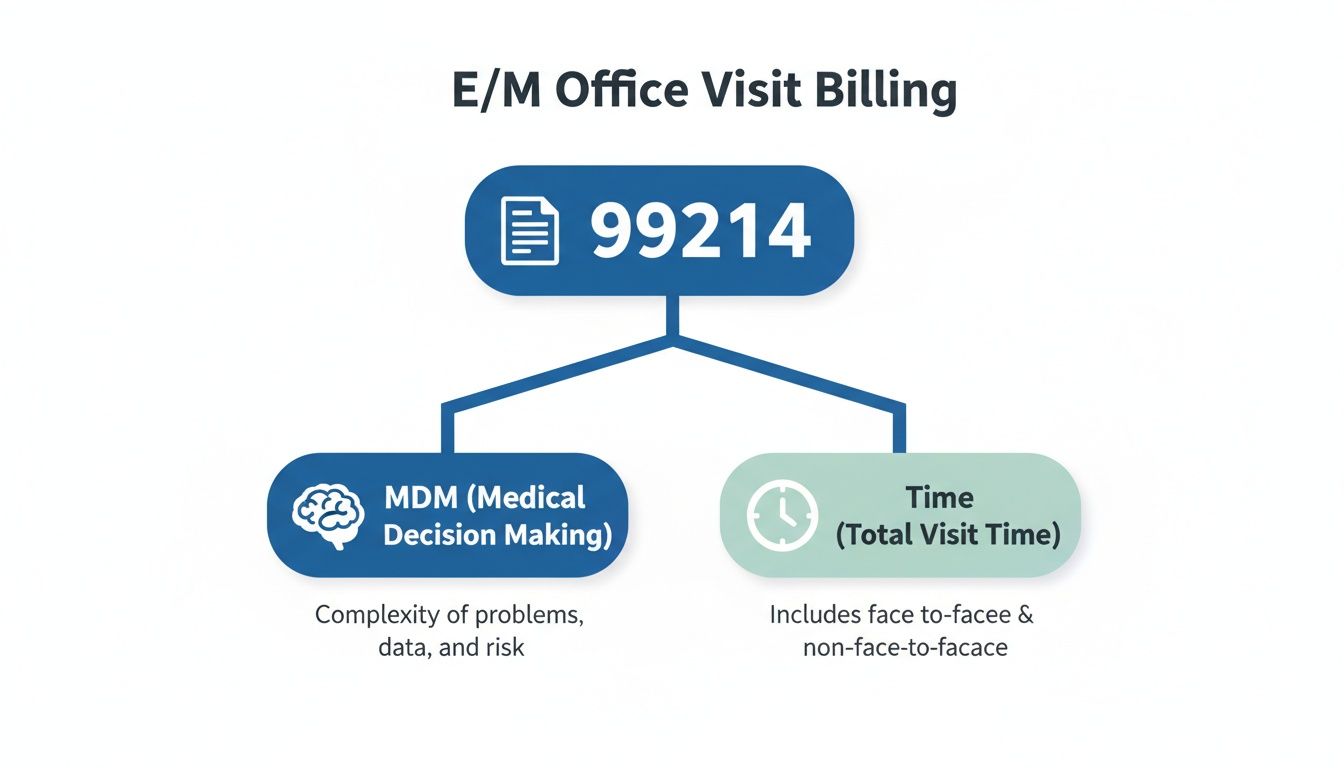
As you can see, both are perfectly valid options, but they each demand different documentation to back up the claim.
What Constitutes Moderate Complexity?
To bill 99214 based on MDM, the documentation has to show a moderate level of complexity in at least two of the three core elements:
- The number and complexity of problems addressed.
- The amount and/or complexity of data reviewed and analyzed.
- The risk of complications or morbidity/mortality of patient management.
Let's see how this actually plays out in the real world with a few examples from different specialties.
Primary Care: A 65-year-old patient with stable type 2 diabetes and hyperlipidemia comes in for a regular check-up. But this time, they mention new symptoms of persistent heartburn. Now, the provider has to manage the stable chronic issues, investigate a new problem with an uncertain prognosis (is it GERD or something more serious?), and review recent lab work before deciding on a new prescription. That's moderate complexity.
Cardiology: An established patient with a history of atrial fibrillation, who is on anticoagulants, presents with worsening shortness of breath. The cardiologist must figure out if this is a flare-up of their cardiac condition or an entirely new problem. This means reviewing recent ECGs, possibly ordering new imaging, and managing prescription drugs that carry a high risk of morbidity.
Endocrinology: A patient with hypothyroidism is doing fine on their current medication, but they have a strong family history of osteoporosis. The endocrinologist discusses the risks, orders a bone density scan for the first time, and then has to analyze those results to create a future management plan. The decision to kick off a workup for a new potential problem is what elevates the complexity here.
All these scenarios have one thing in common: they go beyond simple, routine management. The provider is actively digging into new information, juggling multiple conditions, or addressing an exacerbation that bumps up the patient's risk.
MDM Level Comparison 99213 Vs 99214 Vs 99215
Seeing the MDM requirements side-by-side really helps clarify the differences between the most common E/M codes. It gives billing teams and providers a quick visual checklist to make sure the documentation lines up with the code being billed.
Low (99213)
- Problems Addressed: 2+ self-limited/minor problems; or 1 stable chronic illness; or 1 acute, uncomplicated illness/injury
- Data Reviewed: Limited (Meets 1 of 2 categories)
- Risk of Patient Management: Low risk of morbidity from additional testing or treatment
Moderate (99214)
- Problems Addressed: 1+ chronic illness with exacerbation; or 2+ stable chronic illnesses; or 1 undiagnosed new problem with uncertain prognosis; or 1 acute illness with systemic symptoms
- Data Reviewed: Moderate (Meets 1 of 3 categories)
- Risk of Patient Management: Moderate risk of morbidity from additional testing or treatment
High (99215)
- Problems Addressed: 1+ chronic illness with severe exacerbation; or 1 acute or chronic illness/injury that poses a threat to life or bodily function
- Data Reviewed: Extensive (Meets 2 of 3 categories)
- Risk of Patient Management: High risk of morbidity from additional testing or treatment
This breakdown is a great reference for ensuring your documentation hits all the right marks. A quick check against this list can be a powerful tool for preventing downcoding and defending your claims during an audit.
Common Billing Mistakes That Cost Your Practice Money
Even the sharpest practices can get tripped up by simple billing errors, especially with a code as common as 99214. These aren’t just minor clerical slip-ups; they're costly mistakes that can invite denials, trigger audits, and put a serious dent in your bottom line. The key is to turn these common missteps into lessons that strengthen your entire billing process.
Most of these errors come down to one thing: documentation that doesn't tell the whole story. Payers need to see a clear narrative that justifies a moderate level of complexity. Any gaps or ambiguity can easily lead to a denial, and these issues are a huge source of lost revenue for practices everywhere.
The financial stakes are massive. In 2023, CPT code 99214 was the single biggest source of Medicare improper payments, adding up to a staggering $564,563,132. A closer look shows that 63% of these errors were due to incorrect coding, 20.1% came from missing documentation, and 16.5% were from insufficient details in the medical record.
Insufficient Documentation To Prove Complexity
This is, hands down, the number one reason a 99214 claim gets denied or downcoded. The provider might have done all the work, but if it’s not in the medical record, it didn't happen in the eyes of an auditor.
What Went Wrong: A provider sees an established patient for hypertension and type 2 diabetes. The note is short, listing the diagnoses and stating, "Continue current medications. Follow up in 3 months." While true, this note doesn’t show any real thought process. It looks more like a low-complexity visit.
How to Fix It: The note has to show the work. It needs to detail the management decisions—mentioning the review of recent A1C and blood pressure logs (Data), the assessment of how well the meds are working and any side effects (Risk), and the reasoning for sticking with the current plan for two stable chronic illnesses (Problems). This paints a clear picture of moderate complexity.
Think of a well-documented claim as a story. It needs a beginning (the patient's status), a middle (the provider's assessment), and an end (the plan). Anything less leaves your claim wide open for a denial.
The Dangers Of Cloning Previous Notes
In the daily clinic rush, it’s tempting to use your EHR’s copy-and-paste function to save time. But this habit, often called "cloning" or "carrying forward," is a huge red flag for auditors and a major compliance risk. You can get more information by reading our guide to avoiding common medical coding errors that often stem from this practice.
What Went Wrong: A provider copies the note from a visit three months ago, changes the date, and calls it a day. The problem is, the note is now full of outdated information and doesn’t reflect the actual conversation, exam findings, or decisions made during today's visit. An auditor will spot this instantly, and the claim's legitimacy goes right out the window.
How to Fix It: Use your EHR templates as a starting point, not a shortcut. Every single note must be unique to the date of service, documenting what was specifically addressed and managed during that encounter. Make sure the history, exam, and medical decision-making sections are updated to reflect the patient's current status and the provider's real-time thinking.
Using Modifiers Correctly With CPT Code 99214
Modifiers can feel like a complex puzzle, but they’re actually one of the most powerful tools in your billing arsenal. When you use them correctly with CPT code 99214, you ensure you get paid for all the work you do. They stop simple misunderstandings from turning into costly denials.
Think of a modifier as a special instruction you attach to your 99214 claim. It’s your way of telling the payer, “Hey, there’s more to the story here.” Getting these instructions right is the key to a healthy revenue cycle.
The All-Important Modifier 25
If there’s one modifier you’ll see again and again with 99214, it’s Modifier 25. This is the one you’ll append when a significant, separately identifiable E/M service happens on the same day as another procedure.
Its whole purpose is to show the payer that the E/M service went above and beyond the usual work that’s bundled into another service.
Here’s a classic real-world scenario where Modifier 25 is essential:
- The Situation: A patient comes in for a scheduled follow-up for their hypertension—a clear-cut 99214 visit. During the exam, the patient brings up severe knee pain that’s been bothering them for weeks. After a separate evaluation of the knee, the provider decides to perform a joint injection (which has its own procedure code).
- Correct Billing: You would bill CPT code 99214-25 for the E/M service covering both the hypertension management and the new knee problem. You’d also bill the separate CPT code for the joint injection. That “-25” is the signal that the E/M portion of the visit was a distinct and necessary service, not just a precursor to the injection.
Without Modifier 25, the payer would likely bundle the E/M service into the payment for the injection, assuming the visit's only purpose was the procedure. This oversight would result in lost revenue for the significant cognitive work performed by the provider.
Other Key Modifiers To Know
While Modifier 25 gets most of the attention, a few others play a critical role in painting an accurate picture for payers. Knowing when to use them can clear up complex billing situations and protect your practice from denials. The right modifier is often tied to where the service was provided, a detail you can explore further as you learn more about CMS place of service codes.
Here are a couple of others to keep on your radar:
- Modifier 59 (Distinct Procedural Service): This modifier is your go-to when you need to identify procedures or services that aren’t normally reported together but were appropriate under the circumstances. It basically says, "This procedure was distinct or independent from the other services we did today." Think of it for procedures performed on different anatomical sites during the same encounter.
- Modifier 24 (Unrelated E/M Service): You’ll use this one when an E/M service is performed during the postoperative period of a previous surgery, but for a reason completely unrelated to that original procedure. It tells the payer that this new E/M visit is not part of the standard global surgical package and should be paid separately.
How Accurate 99214 Coding Impacts Your Bottom Line

Beyond the clinical chart, CPT code 99214 is a powerful lever for your practice’s financial performance. For administrators and billing managers, getting this code right isn’t just about compliance—it's about capturing the true value of the care your providers deliver every single day.
Every CPT code translates directly to a reimbursement rate. This means even small, consistent coding errors can carve out significant revenue gaps over the long haul. Understanding these financial stakes is the first step toward building a billing strategy that protects your bottom line.
The Real Cost Of Downcoding
One of the most common—and expensive—habits in medical billing is downcoding a 99214 visit to a 99213. This often happens out of an overabundance of caution or because the documentation feels just shy of the mark. While it might seem like a safe bet to avoid audits, it's a costly mistake that leaves hard-earned revenue on the table.
The reimbursement difference between these two codes isn't trivial. While exact figures vary by payer and location, a CPT code 99214 can reimburse $40 to $50 more per visit than a 99213.
Think about that for a moment. If your practice downcodes just two of these visits per day, you could be losing over $20,000 a year. That’s not a rounding error; it’s a major financial hit that can affect everything from staff bonuses to new equipment purchases.
RVUs And Provider Productivity
The story of 99214’s financial impact goes deeper than just direct reimbursement. It also shapes how provider productivity is measured and, in many cases, compensated. Each CPT code is assigned a specific number of Relative Value Units (RVUs), which quantify the value of a service. Unsurprisingly, CPT code 99214 carries a higher RVU value than lower-level E/M codes to reflect the greater clinical work involved.
This matters immensely because many provider compensation models are tied directly to the total RVUs they generate.
When a provider’s work clearly supports a 99214 but the visit is billed as a 99213, their documented productivity takes a hit. This not only affects their potential earnings but also skews the practice-wide data you rely on for financial forecasting, staffing decisions, and performance benchmarks.
Ensuring every visit is coded to the highest, most accurate level supported by the documentation is essential for a few key reasons:
- Fair Compensation: It ensures providers are properly rewarded for the complexity of care they provide.
- Accurate Data: It gives leadership a clear, precise picture of productivity for smarter business planning.
- Financial Stability: It strengthens the practice’s entire revenue cycle by accurately reflecting the intensity of services being delivered.
Ultimately, mastering 99214 coding isn't just a billing task—it's a core strategy for financial stability and growth. That makes it a top priority for any successful practice administration team.
Frequently Asked Questions About CPT Code 99214
Even seasoned providers and billers run into the same questions time and again when it comes to CPT code 99214. Getting clear, practical answers is the key to keeping your practice both compliant and financially healthy. Here are some quick solutions to the most common coding challenges we see.
Can I Bill 99214 Based On Time If MDM Doesn't Meet The Criteria?
Yes, absolutely. The E/M guideline updates a few years back changed the game here. You now have the choice to select the code level based on either the total time spent on the day of the encounter or the level of Medical Decision Making (MDM).
So, if the MDM for a visit only points to a 99213, but the provider spent 33 minutes on qualifying activities, you can and should bill a 99214 based on time. This includes both face-to-face and non-face-to-face work like reviewing charts, ordering tests, or coordinating care. The key is to document the total time and add a brief summary of how that time was spent to back up your choice.
What Is The Biggest Mistake Practices Make When Billing 99214?
The most common—and most costly—mistake is simply not documenting enough to support the "moderate" complexity that 99214 requires. This usually happens when providers are rushed, and their notes don't fully capture the thought process behind their decisions.
For example, a note might list two chronic conditions but fail to explain how they're being actively managed, what specific data was reviewed (like recent labs), or the risks involved with a new prescription. This lack of detail is a red flag for auditors and a common reason for downcoding or outright denials. Consistently documenting the "why" behind your treatment plan is the best defense against this pitfall.
How Often Should Our Practice Audit Our 99214 Claims?
Regular internal audits are non-negotiable for compliance and revenue integrity. A great rule of thumb is to conduct quarterly internal audits on a small sample of charts—say, 10-15 charts per provider—with a specific focus on your high-volume codes like 99214.
This proactive approach helps you spot patterns of under-coding or thin documentation early. You can then provide targeted feedback to your providers before small habits turn into big, expensive problems.
We also highly recommend an annual external audit performed by a certified professional. It provides an unbiased look at your practice's coding accuracy, helps you identify potential risks, and ensures you’re ready for any payer reviews that come your way.
At One For All Medical Billing, we help practices cut through the complexity of coding and billing so you get paid accurately for the incredible work you do. Schedule a free consultation today and see how our team of experts can drive down your denials and strengthen your entire revenue cycle.

