

table of contents
Cash flow problems in a medical practice rarely start where people think they start. The schedule looks full. Providers are seeing patients. Clinical care is strong. Yet deposits arrive unevenly, denied claims pile up, patient balances age, and nobody can say with confidence where the slowdown began.
That's usually the moment a practice manager starts trying to define revenue cycle in practical terms, not textbook terms. You're not asking for a theory. You're asking why work performed today isn't reliably turning into cash tomorrow, next week, or next month.
The answer is that your practice runs on a financial system with its own intake points, pressure points, and blockages. When data enters cleanly, documentation supports the service, claims go out correctly, and follow-up happens fast, revenue moves. When any of those steps break, money stalls. That's why revenue cycle management matters so much. It isn't just an office function. It's the operating system behind the financial health of the practice.
Your Practice Has A Financial Pulse And Its Called The Revenue Cycle
A common scenario looks like this. Monday's clinic was packed, but by Friday the billing team is chasing eligibility issues from earlier in the week, coders are waiting on missing documentation, and front-desk staff are fielding calls from patients who didn't understand what they owed. The practice delivered care, but the revenue attached to that care didn't move cleanly through the system.
That system is the revenue cycle. I think of it as the financial circulatory system of a practice. It carries the value of patient care from the first contact through the final payment. If there's a blockage anywhere, the whole organization feels it.
Many explanations reduce the topic to insurance billing, but that's too narrow. The HFMA revenue cycle overview treats it as an end-to-end process that starts at registration and includes clinical documentation, coding, claim submission, reimbursement, and denial follow-up. That broader view is what practice leaders need, because most payment problems begin long before a claim is sent.
A denied claim is often the final symptom of an earlier operational mistake.
That's also why staffing decisions, workflow design, and vendor support matter. If your team is stretched thin, it helps to understand the key benefits of outsourcing medical billing for your practice, especially when internal bottlenecks are slowing collections and increasing rework.
When you define revenue cycle the right way, you stop treating billing as a back-office afterthought. You start managing it like a core business function.
What Exactly Is The Healthcare Revenue Cycle
The simplest way to define revenue cycle is this. It's the full process a practice uses to turn patient care into collected payment.
That process is called a cycle because each step depends on the step before it. A scheduling mistake becomes a registration error. A registration error becomes an eligibility problem. An eligibility problem becomes a denial. A denial becomes delayed cash and extra labor. Nothing in revenue cycle management stands alone.
The Formal Definition That Actually Helps
The Healthcare Financial Management Association defines revenue cycle management as “all administrative and clinical functions that contribute to the capture, management, and collection of patient service revenue”, and it treats RCM as a full lifecycle process that starts when a patient account is created and continues through payment, as summarized in this HFMA definition of revenue cycle management.
“All administrative and clinical functions that contribute to the capture, management, and collection of patient service revenue”
That definition matters because it fixes a common misunderstanding. Revenue cycle management isn't only about claims. It includes the front office, clinicians, coders, billers, and anyone touching the patient account before and after the visit.
Why Practices Struggle To See It Clearly
Often, teams experience RCM in fragments:
- Front Desk Sees Intake Problems: Wrong subscriber data, incomplete forms, or outdated insurance.
- Clinical Staff See Documentation Pressure: Missing details that make coding harder or weaken claim support.
- Billing Staff See Payer Friction: Rejections, denials, underpayments, and follow-up work.
- Leadership Sees Cash Flow Symptoms: Slow collections, unpredictable receipts, and rising accounts receivable.
Those aren't separate issues. They're all the same cycle viewed from different desks.
A strong practice management stack helps connect those desks. If your workflows feel disconnected, it's worth reviewing what practice management software is supposed to coordinate, especially around scheduling, intake, claim status, and payment tracking.
What A Good Definition Should Include
When I explain RCM to practice managers, I include three ideas:
- It starts early. Revenue risk begins at scheduling and registration, not at billing.
- It crosses departments. Clinical and administrative work both affect reimbursement.
- It ends late. The cycle isn't complete until the expected payment is collected and reconciled.
That's the practical answer when someone asks you to define revenue cycle. It's the complete system that captures, protects, and collects the financial value of care.
The Seven Key Stages Of Revenue Cycle Management
A healthy revenue cycle keeps cash moving through the practice the way blood moves through the body. Every handoff either supports that flow or creates a blockage. The seven stages below show where revenue is captured, where it stalls, and where it leaks away.
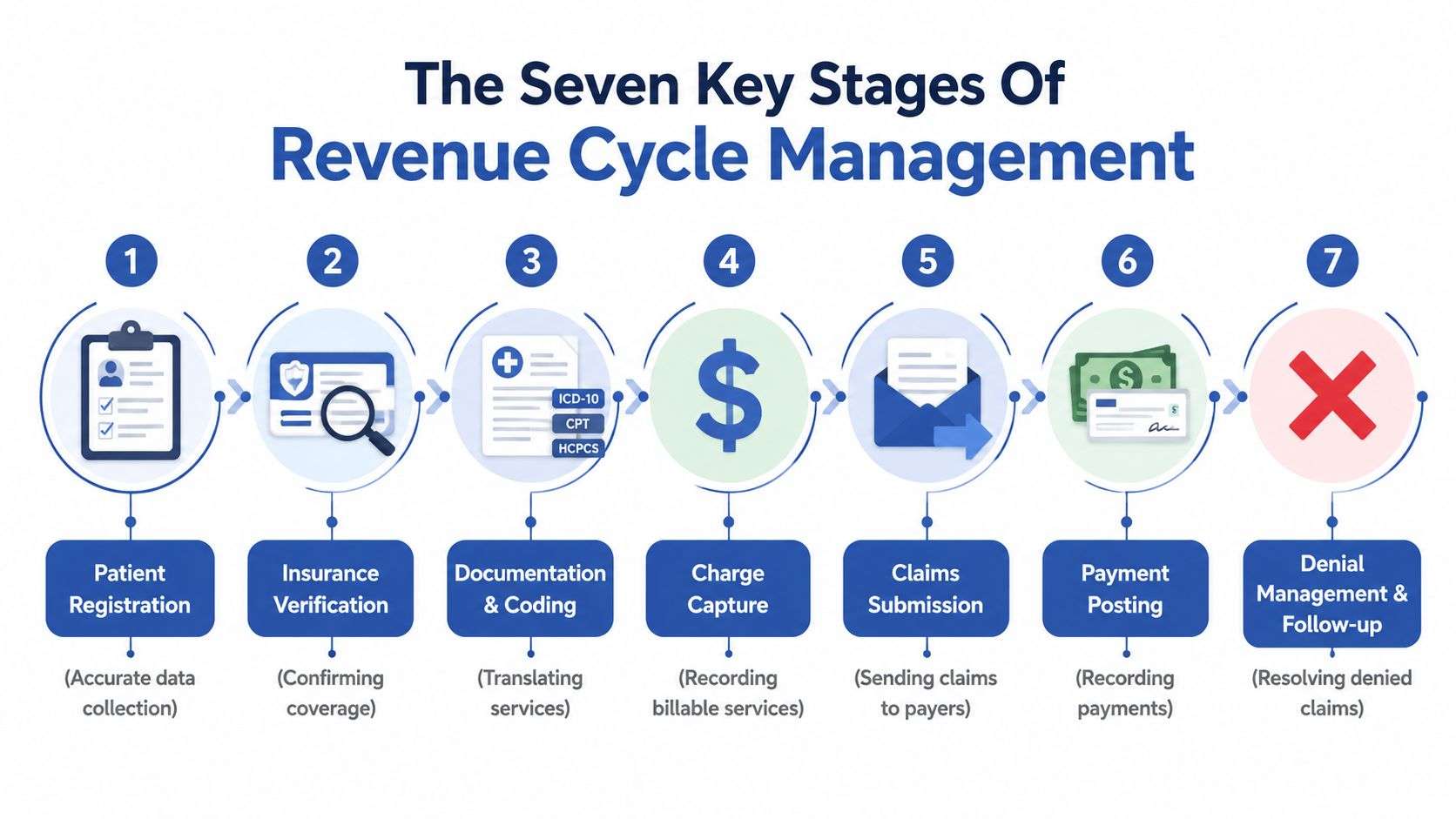
Stage One Patient Registration
The first stage sets the baseline for everything that follows. Patient demographics, insurance details, subscriber information, guarantor data, and contact information need to be accurate before the account moves any further.
Small front-desk errors create expensive downstream work. A wrong member ID can turn into an eligibility rejection. An outdated address can delay patient statements. A missing guarantor can leave a balance sitting in A/R with nowhere to go.
Registration is clerical work, but it has direct financial consequences.
Stage Two Insurance Verification And Authorization
Once the patient is in the system, the practice needs to confirm active coverage, identify the patient's financial responsibility, and check whether the visit or procedure needs prior authorization. The Medical Group Management Association advises practices to verify eligibility before the date of service because front-end verification helps reduce preventable denials and missed collections at check-in, as noted in MGMA guidance on improving patient registration and insurance verification.
This stage affects both cash flow and patient experience. If staff verify benefits early, they can collect the right copay, flag authorization needs, and set expectations before care is delivered. If they skip it, the practice often finds the problem after the claim is denied, when recovery is slower and less certain.
Practical rule: Confirm coverage and authorization before the visit, while the account is still easy to correct.
Stage Three Documentation And Coding
After the visit, the medical record has to support the services billed and explain why they were medically necessary. Coding then converts that clinical story into the code set the payer will evaluate.
This is one of the most common choke points in the cycle. Providers may document late. Notes may support the visit clinically but miss details needed for code selection. Coders may know coding rules well but still struggle if specialty-specific documentation is thin.
Good coding protects revenue, but only when documentation gives it something solid to work with.
Stage Four Charge Capture
Charge capture records every billable service, supply, procedure, and encounter component that should appear on the claim. Many practices fold this into coding, but separating it as an operational checkpoint is useful because missed charges often go unnoticed.
That is a different problem from a denial. A denied claim at least leaves a trail. A missed charge often disappears unnoticed unless someone reconciles schedules, clinical activity, and posted charges.
Practices with high visit volume feel this quickly. A few missed injections, supplies, or ancillary services each day can drain margin without showing up as a clean claim issue.
Stage Five Claims Submission
Once the account is documented, coded, and charged, the claim goes out. The goal is to send it correctly the first time, with the right diagnoses, modifiers, payer rules, provider identifiers, and filing details already in place.
A rushed submission process usually creates more rework than speed. Teams may push claims out fast, then spend days correcting rejects, appealing denials, and answering payer edits. A disciplined claim review process slows the front end slightly, but it usually improves cash flow because fewer claims boomerang back.
For a closer operational breakdown, this guide to the medical billing process steps shows where claim prep and submission often fail.
Stage Six Payment Posting
Payment posting closes the loop between what the practice expected and what the payer did. Staff post payments, contractual adjustments, denials, and patient responsibility, then compare the remittance to the original claim.
This stage gives leadership visibility into payer behavior. Underpayments, unusual adjustment codes, and recurring reimbursement variances often surface here first. If posting is delayed or inaccurate, the practice loses that visibility and may miss appeal deadlines or fail to bill the patient correctly.
Payment posting is accounting work, but it is also a control point.
Stage Seven Denial Management And Follow Up
Denied and underpaid claims need active follow-up. Staff have to identify the reason, correct the claim if possible, appeal when warranted, and track the account until the balance is resolved.
Strong denial management does two things:
- Recovers money already earned
- Exposes the upstream process failure that caused the denial
That second job matters just as much as the first. If the same denial codes keep appearing, the practice usually has a repeated breakdown in registration, authorization, coding, or claim edits. Follow-up alone will not fix that pattern.
Where Patient Billing Fits
Patient billing runs alongside the later part of the cycle rather than sitting neatly in a single box. After payer adjudication, balances have to move to the patient accurately, statements need to go out on time, and payment plans or collection workflows need to be handled consistently.
For many practices, patient responsibility is now large enough to act like its own pressure point in cash flow. The account is not closed until both payer and patient balances are resolved.
Measuring Success With Key RCM Performance Indicators
You can't manage the revenue cycle on instinct alone. Practices need a short list of indicators that show whether cash is moving well or getting trapped in the system.
The most useful metrics are the ones that expose speed, accuracy, and leakage.
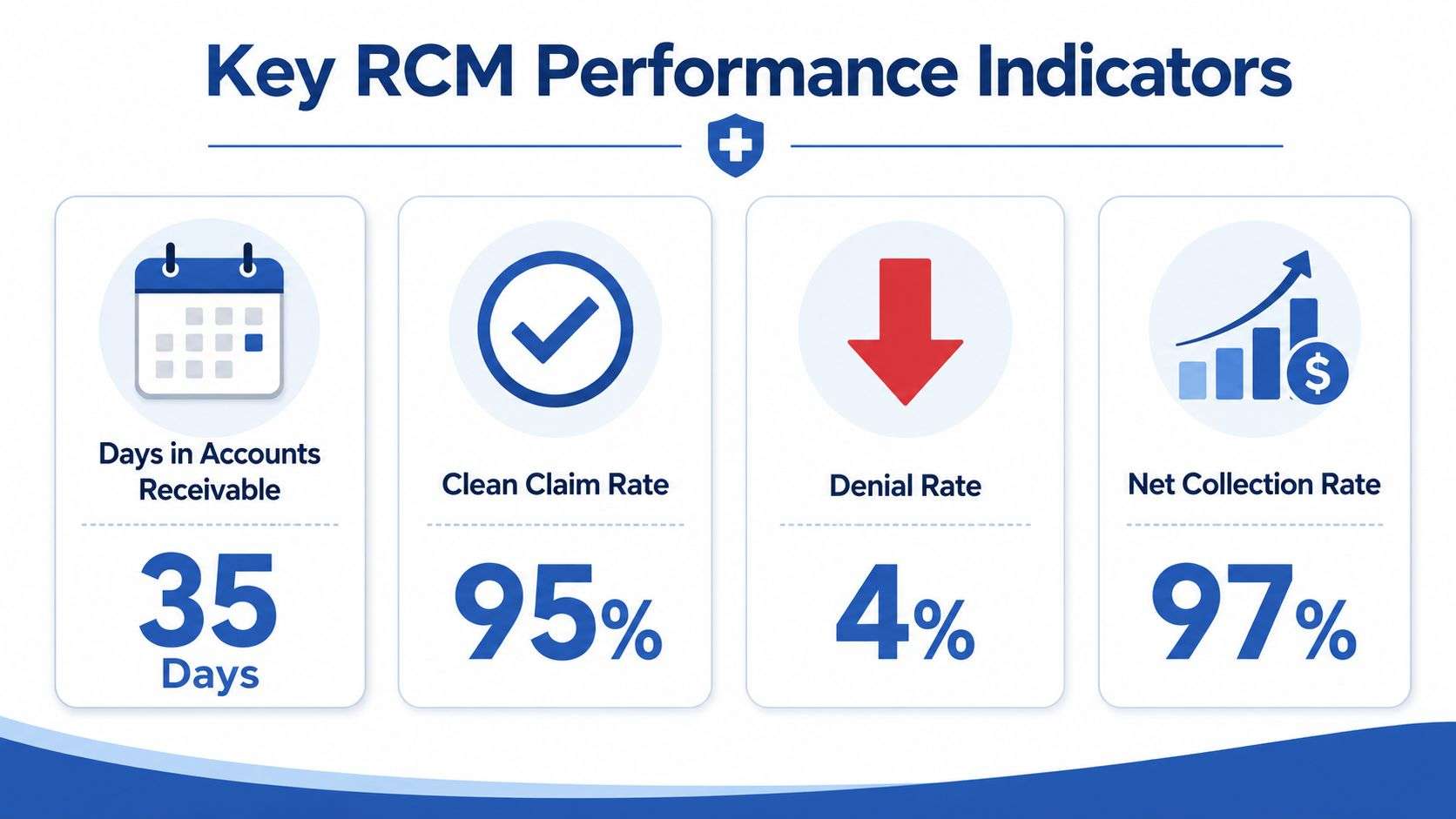
The Four Metrics That Matter Most
- Clean Claim Rate: This measures how often claims go out correctly and pass initial edits without preventable errors. A low clean claim rate usually signals front-end data issues, coding gaps, or weak claim scrubbing.
- Days In Accounts Receivable: This shows how long it takes to convert billed charges into cash. According to this peer-reviewed review of healthcare revenue cycle benchmarks, Days in A/R should be kept under 45 days and ideally fall in the 30 to 40 day range.
- Denial Rate: This tracks how often claims are denied. The same benchmark source notes that a claim denial rate above 10% indicates an unhealthy revenue cycle.
- Net Collection Rate: This tells you how much of expected reimbursement the practice is collecting. That same source states that a healthy net collection rate is commonly 98.5% to 99%.
How To Read The Numbers Operationally
A metric only matters if it changes behavior.
A low denial rate with slow A/R can mean claims are being accepted but not followed through to final payment quickly enough.
For example, if Days in A/R is high but clean claim performance looks decent, the practice may not have a submission problem. It may have a posting lag, a follow-up backlog, or weak patient balance collection. If denial rate is high, the best next question isn't “Who is working denials?” It's “Which denial categories repeat, and where are they originating?”
A Simple Dashboard Mindset
Practice managers don't need dozens of reports. They need a dashboard that answers four questions:
- Are claims leaving cleanly?
- Is cash arriving quickly enough?
- Are denials staying under control?
- Are we collecting what we should collect?
If your current reporting doesn't answer those questions clearly, a dedicated revenue cycle management dashboard can help organize the data into something leadership can use.
Common Causes Of Revenue Leakage And How To Find Them
Revenue leakage rarely comes from one dramatic failure. More often, it comes from routine misses that nobody owns end to end. A wrong insurance ID at check-in. A prior authorization that wasn't confirmed. A note that doesn't support the code. A denied claim that sits too long. A patient statement that goes out late or confuses the balance.
Each issue looks small in isolation. Together, they choke cash flow.
The Most Common Leak Points
The first leak is usually at the front end. Registration errors and weak eligibility checks create downstream denials that the billing office inherits later. The second leak is in the handoff from clinical care to billing, where incomplete documentation or coding mismatches create claims that are technically billable but financially vulnerable.
The third leak is follow-up discipline. Some teams work denials hard but never sort them by root cause, so the same preventable errors keep recurring. Others let aged accounts sit because staff are reacting to daily fires instead of managing queues intentionally.
The Patient Balance Problem
A modern revenue cycle can't be judged only by how fast insurers pay. The patient side now matters much more than many older workflows were built to handle. AMA guidance emphasizes that a good revenue cycle is no longer defined only by insurer reimbursement speed, and that higher deductibles and co-pays make patient collections, real-time insurance verification, and clear statement cycles more important, as described in this AMA STEPS Forward resource on revenue cycle improvement.
If patients don't understand what they owe, collection problems start long before the first statement goes out.
How To Diagnose Leakage In A Real Practice
Start with pattern recognition, not blame. Review denial reasons by category. Compare registration error trends by location. Look at where accounts are aging. Check whether patient statements are timely and understandable. Audit a handful of paid claims, denied claims, and slow-pay accounts from beginning to end.
A focused accounts receivable management review is often where hidden leakage becomes visible, especially in older balances that staff have stopped questioning.
The core question is simple. Where does revenue stop flowing smoothly, and what upstream process allowed that blockage to form?
Best Practices For A High Performing Revenue Cycle
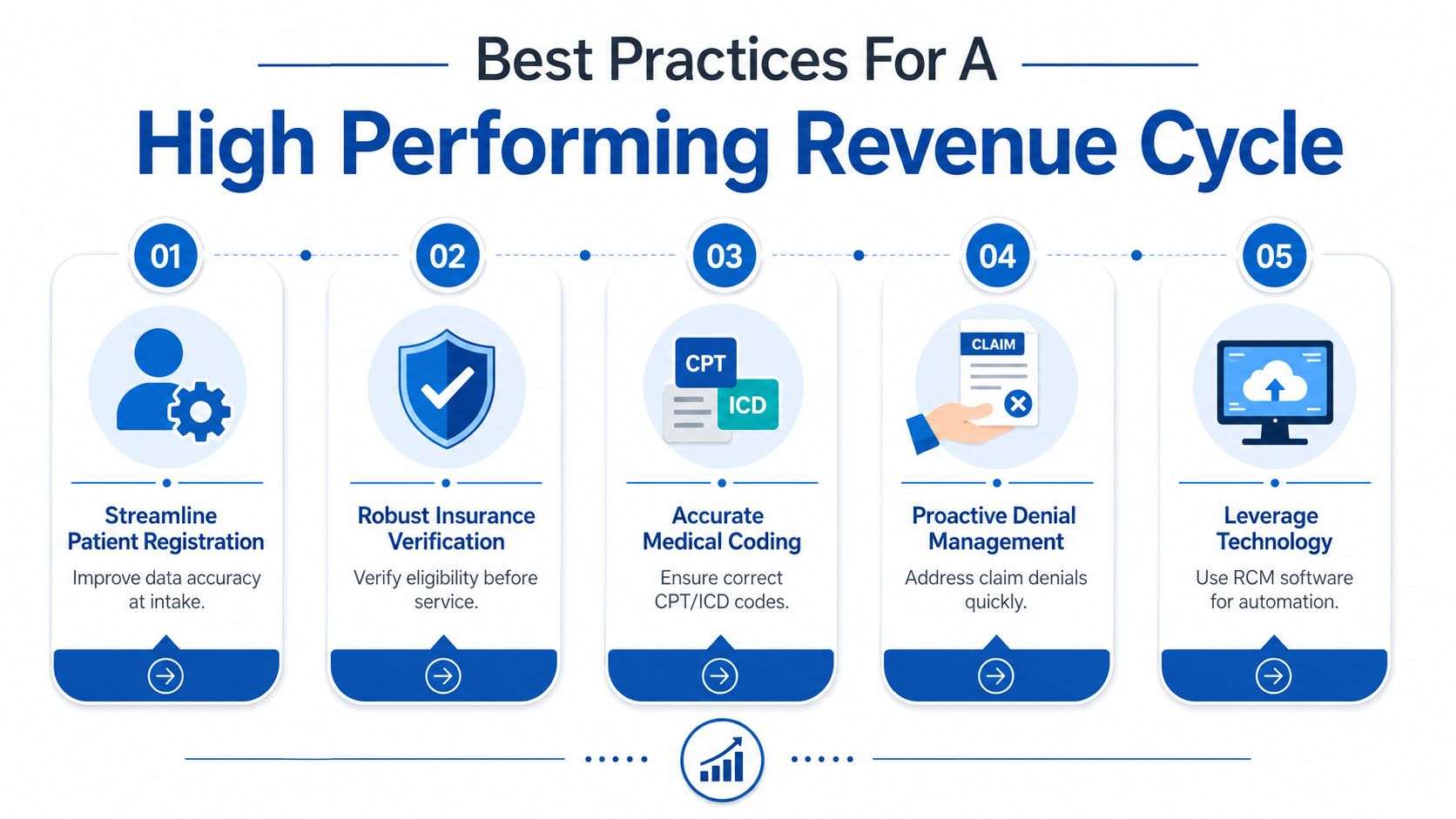
A healthy revenue cycle keeps cash moving with as little friction as possible. In practice, that means building a workflow that keeps preventable errors from reaching the claim stage, where every correction costs more staff time and delays payment.
Start Before The Visit
The strongest practices protect revenue before the patient is seen. Eligibility should be verified before every appointment, benefits should be reviewed against the scheduled service, and staff should confirm demographic details while there is still time to correct problems. HFMA notes that front-end financial clearance, including insurance verification and patient financial communication, has a direct effect on downstream denials and collections in its patient access best practices guidance.
This is one of the clearest trade-offs in RCM. A few extra minutes before the visit can prevent weeks of rework after the claim is filed.
Build A Process That Keeps Revenue Flowing
High-performing teams usually rely on the same operating habits:
- Standardized Intake: Registration staff use required fields, consistent scripts, and payer-specific checks so bad data does not enter the system in the first place.
- Documentation And Coding Review: Providers and coders look for repeat patterns, such as weak visit notes or frequent modifier errors, and correct them upstream.
- Denial Categorization: Teams track why claims fail, then fix the source of the blockage instead of treating every denial as a one-off problem.
- Clear Patient Financial Conversations: Estimates, payment policies, and statements should be easy to understand so balances do not stall on the patient side.
- Targeted Automation: Eligibility tools, claim edits, and work queues should remove manual work. If the software creates more clicks without reducing errors, it is not helping cash flow.
The goal is simple. Keep revenue moving steadily from scheduling to final payment.
Use Outside Support When Capacity Or Expertise Is Limited
Some practices have the staff and systems to manage every part of the cycle internally. Others hit predictable limits. Coding complexity grows, denial follow-up slips, or reporting becomes too shallow to show where money is getting stuck. In those cases, outside support can close operational gaps without adding permanent headcount.
One option is One For All Medical Billing, which provides support across eligibility verification, coding, claims submission, payment posting, denial follow-up, reporting, and related RCM workflows for healthcare practices.
If your collections are improving and you are also planning for higher patient volume, this guide for healthcare practice growth is a useful companion read because growth only helps when the financial flow behind it can absorb the demand.
More visits do not solve revenue leakage. A cleaner revenue cycle gives growth a chance to produce cash instead of more backlog.
How One For All Medical Billing Optimizes Your Revenue Cycle
A practice doesn't need more theory once revenue starts stalling. It needs cleaner intake, stronger coding support, faster claim movement, accurate posting, disciplined follow-up, and reporting that shows where cash is getting stuck.
That's the operational problem One For All Medical Billing is built to address.

The company supports the full billing lifecycle for healthcare practices, including patient eligibility verification, ICD-10, CPT, and HCPCS coding, claims submission and management, payment posting and reconciliation, denial and A/R follow-up, reporting and analytics, credentialing assistance, and compliance consulting. For practice managers, that means fewer disconnected handoffs between front-end intake, coding, billing, and collections.
Where The Workflow Usually Improves
The biggest gains typically come from process control.
- Front-End Accuracy: Eligibility verification and cleaner patient data reduce downstream claim issues.
- Coding Support: Certified, U.S.-based coders help align documentation with payer-ready claims.
- Back-End Discipline: Denial and A/R follow-up keeps accounts from sitting untouched.
- Reporting Visibility: Analytics make it easier to see whether the problem is denials, aging, underpayments, or patient balances.
The company serves practices nationwide and can support multi-site groups, which matters when standardizing workflows across locations is part of the challenge.
The Outcome Practices Care About
Operational consistency is what ultimately improves collections. According to the publisher information provided, One For All Medical Billing delivers a 90% clean claim rate and supports practices with specialty-specific billing processes, HIPAA-compliant workflows, and onboarding that starts with a consultation and system connection.
That combination matters because the revenue cycle only performs well when every handoff is managed. Clean registration without follow-up won't solve aging A/R. Strong coding without accurate posting won't reveal underpayments. Fast claim submission without patient collection discipline still leaves balances behind.
If you need to define revenue cycle for your team, define it this way. It's the system that determines whether your work gets paid fully, correctly, and on time. If that system isn't performing, it needs redesign, tighter oversight, or a partner that can run the process with fewer leaks.
If you want a practical review of where your revenue cycle is slowing down, One For All Medical Billing offers a straightforward place to start. A consultation can help identify intake errors, coding gaps, denial patterns, and A/R bottlenecks so your practice can move from reactive billing to a healthier, more predictable flow of revenue.

