

table of contents
When you need to get paid for giving a patient a shot, one question matters more than any other: what’s the right CPT code for injection administration?
For a routine therapeutic, prophylactic, or diagnostic injection given under the skin or into a muscle, the code you’ll almost always reach for is 96372. Think of it as the workhorse code for most common injections your practice performs day in and day out.
Decoding The Go-To CPT Code For Injections
In medical billing, CPT codes are how you tell a payer what you did. Using the right one isn't just about following the rules—it's about making sure your practice actually gets paid for the services you provide. The wrong code can trigger denials, stall payments, and drain your revenue over time.
The main code for this job, CPT 96372, is officially defined as a "therapeutic, prophylactic, or diagnostic injection (specify substance or drug); subcutaneous or intramuscular." So, what does that really mean in practice?
When To Use CPT 96372
Let’s say a patient comes in for a standard antibiotic shot or a vitamin B12 injection. The work your clinical staff performs—their time, the syringe, the alcohol wipe, and their expertise—is all wrapped up in CPT 96372.
It specifically covers the two most common types of injections:
- Subcutaneous (SQ): The shot goes into the fatty tissue right below the skin.
- Intramuscular (IM): The shot is delivered directly into a muscle.
This code is a staple in just about every outpatient clinic. Just how common is it? According to 2023 CMS data, CPT 96372 is billed over 50 million times a year in U.S. outpatient settings. It accounts for about 15% of all procedures performed alongside an E/M service. You can get a better sense of how procedural codes are used by reviewing industry overviews.
Key Takeaway: CPT 96372 is for the service of giving the shot, not the drug itself. The medication has its own HCPCS code (usually a J-code) that you must bill separately. Forgetting to bill for both is a classic mistake that guarantees you’ll be underpaid.
Getting this one CPT code right is the first step to cleaning up your claims process. It ensures your practice is properly paid for the essential work your team does every day.
To help you navigate the broader landscape of injection and infusion codes, we've put together a quick summary. Think of it as your cheat sheet for the most common codes you'll encounter.
Quick Guide To Common Injection Administration Codes
Here are the most common injection and infusion codes and their typical uses:
- CPT 96372: Therapeutic, prophylactic, or diagnostic injection; subcutaneous or intramuscular.
- Common Use Case: A standard antibiotic shot, vitamin B12 injection, or hormone shot.
- CPT 96365: IV infusion, for therapy, prophylaxis, or diagnosis; initial, up to 1 hour.
- Common Use Case: The first hour of a standard intravenous drip for hydration or medication.
- CPT 96366: IV infusion, for therapy, prophylaxis, or diagnosis; each additional hour.
- Common Use Case: Each additional hour of the same IV drip after the first hour (add-on code to 96365).
- CPT 96374: Therapeutic, prophylactic, or diagnostic injection; intravenous push, single or initial substance/drug.
- Common Use Case: Administering medication directly into a vein over a short period (15 minutes or less).
- CPT 90471: Immunization administration (any route); one vaccine.
- Common Use Case: Giving a single vaccine, like the flu shot, when counseling is not performed.
- CPT 90460: Immunization administration through 18 years of age via any route, with counseling; first or only component.
- Common Use Case: Administering the first component of a vaccine to a child/teen, including parent counseling.
While this list covers the basics, remember that each code has specific rules for sequencing, modifiers, and documentation. Always refer to the latest CPT guidelines and payer policies to ensure you're billing correctly.
Choosing Between 96372 And Other Injection Codes
While CPT 96372 is the workhorse for most basic injections, it’s not the only code in your toolkit. Picking the right CPT code for an injection means you have to look past the drug itself and focus entirely on how it was given. This is where so many practices trip up, leading to quick denials and lost money.
Think of it like this: the drug is the package, but the administration is the delivery service. Are you paying for a standard ground shipment, an express push, or a scheduled freight infusion? The service dictates the price—and in billing, it dictates the code.
It’s The Method, Not The Medication
Here’s the golden rule for injection and infusion coding: the administration method determines the code, not the substance being delivered. A simple antibiotic can be given in several ways, and from a billing standpoint, each method is a completely different service. A quick intramuscular shot is worlds apart from a complex IV infusion.
To get it right, you have to read the clinical notes like a detective, looking for specific verbs that describe what the provider did. Did they "inject," "push," or "infuse"? The answer points you directly to the correct code.
Let's walk through a few real-world examples to see how this plays out.
Scenario 1: The Simple Shot
A patient comes in for their scheduled Vitamin B12 shot. The nurse administers it intramuscularly (IM).
- Correct Code: 96372 (Therapeutic, prophylactic, or diagnostic injection; subcutaneous or intramuscular)
- Why: This is the textbook definition of a 96372 service. It's a straightforward SQ or IM injection of one substance, with no other services performed.
Scenario 2: The IV Push
A patient arrives at an urgent care clinic with a nasty infection and needs antibiotics fast. The provider administers the drug directly into the vein over 10 minutes.
- Correct Code: 96374 (Therapeutic, prophylactic, or diagnostic injection; intravenous push, single or initial substance/drug)
- Why: The key phrase here is "intravenous push." The drug went straight into the vein in 15 minutes or less. It’s a more involved service than an IM shot, so it gets its own code.
Scenario 3: The IV Infusion
A dehydrated patient at an outpatient clinic needs fluids. A nurse starts an IV and infuses a liter of saline over the next hour.
- Correct Code: 96365 (Intravenous infusion, for therapy, prophylaxis, or diagnosis; initial, up to 1 hour)
- Why: The service was an "infusion," which means it was delivered over a longer period (more than 15 minutes). This is a completely different service from a push or a simple injection.
A frequent point of confusion is the line between an IV push (96374) and an IV infusion (96365). The difference comes down to time. If the administration takes 15 minutes or less, it’s a push. If it takes 16 minutes or more, it’s an infusion.
This decision-making process is the foundation of accurate injection coding.
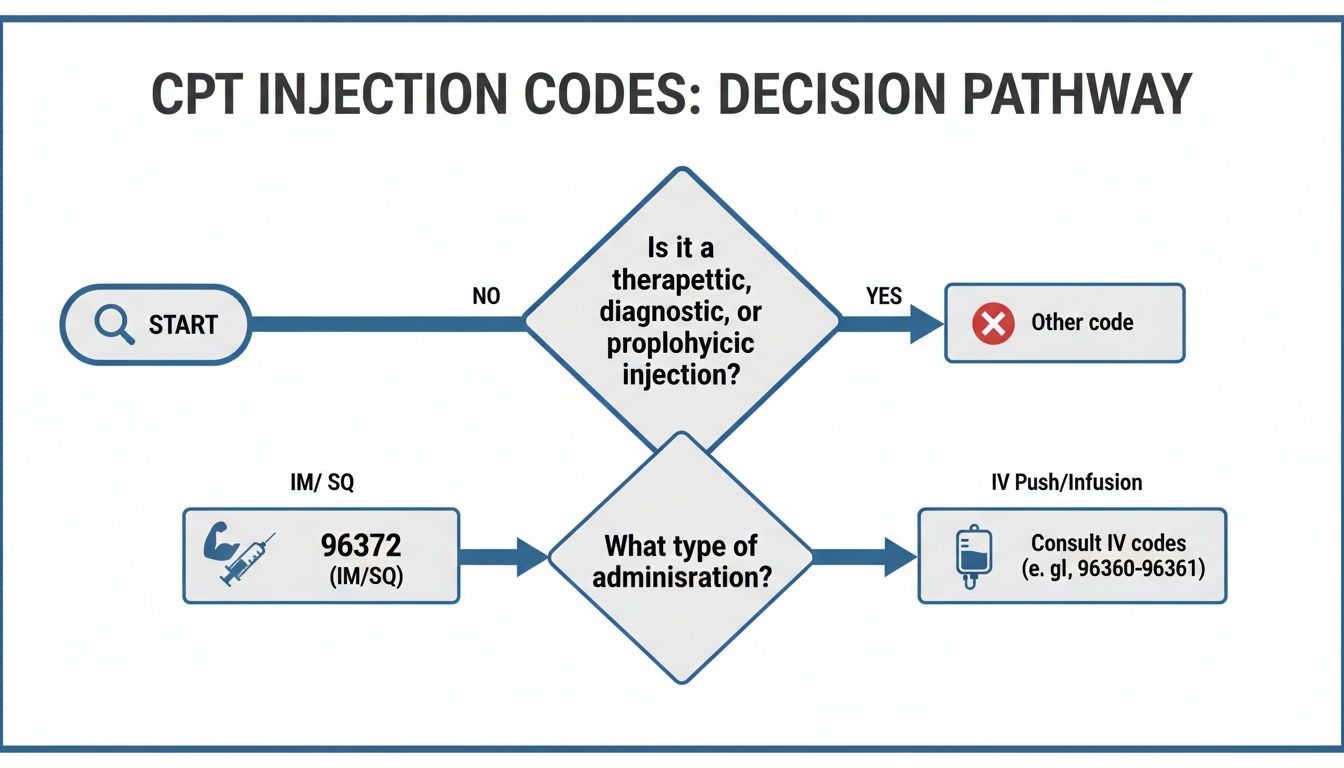
As you can see, the path to the right code always starts with identifying the service type: was it a simple injection, a push, or an infusion?
The High Cost Of Getting It Wrong
Mixing up these codes isn't just a minor mistake—it has a major financial impact. The numbers are revealing: 16% of all claims for CPT code 96374 are rejected because the documentation doesn't clearly prove it was a "push" instead of an "infusion." This simple confusion adds up to an estimated $1.2 billion in lost revenue for providers every year.
Unfortunately, many practices make the same billing mistakes over and over, all of which are easily avoidable. You can learn more by checking out our guide on the 9 common medical coding errors. Getting this right stops denials before they happen and protects your practice’s bottom line.
Mastering Modifiers For Injection Services

Think of modifiers as special instructions you attach to a claim. They provide critical context, telling the payer a more complete story about why a service was performed in a particular way. When it comes to the CPT code for injection administration, getting these modifiers right is often what separates a paid claim from a denied one.
It’s no secret that incorrect modifier use is a massive headache for practices. In fact, a shocking 14% of claims for injection administration get rejected. The top culprits? Payers citing 'not medically necessary' (9%) or flagging a supposedly duplicate Evaluation and Management (E/M) service (5%).
These denials add up, costing providers an estimated $3 billion every year—and many are directly tied to missing or misused modifiers. You can dig deeper into denial data with reports from organizations like The Joint Commission.
Getting a handle on these two-digit codes is essential for clean claims and a healthy revenue cycle. Let's break down the ones you'll use most often.
The Power Of Modifier 25
Modifier 25 is hands-down the most important—and most misunderstood—modifier in outpatient billing. It signals that a "Significant, Separately Identifiable Evaluation and Management Service" was performed by the same provider on the same day as a procedure, like an injection.
The key to using it correctly is to ask a simple question. Did the patient's visit involve a significant E/M service that went beyond the normal prep work for an injection? IF the answer is yes, THEN you add Modifier 25 to the E/M code.
Let’s look at two common scenarios to see how this plays out.
Scenario A (No Modifier Needed): A patient comes in for a scheduled B12 shot. The nurse verifies their identity, administers the injection, and observes them for a few minutes. This is a routine visit, and all that work is already baked into the CPT code for injection administration, 96372. No separate E/M service is billable here.
Scenario B (Modifier 25 Required): A patient presents with sudden, sharp back pain and muscle spasms. The doctor performs a detailed exam, reviews their medical history, diagnoses them with lumbago, and determines a steroid injection is medically necessary. They then administer the shot during that same visit.
In Scenario B, the exam and decision-making process are substantial and completely separate from the simple act of giving the injection. This is where you would bill for both the E/M code (e.g., 99213) with Modifier 25 appended, and the injection administration code (96372).
Our guide on how to use CPT Modifier 25 dives into even more real-world examples and best practices.
Key Insight: Modifier 25 essentially tells the payer, "This wasn't just a quick shot." It justifies getting paid for both the cognitive work (the E/M service) and the procedural work (the injection), preventing the E/M from being bundled and denied.
Other Essential Modifiers For Injections
While Modifier 25 gets most of the spotlight, a few other modifiers are just as crucial for painting a clear picture for payers.
Modifier 59: Distinct Procedural Service
This modifier is your go-to when you need to show that a procedure was separate and independent from other services performed on the same day. For injections, you might use it when:
- Giving two different types of non-vaccine injections at completely different anatomical sites.
- Performing an injection that isn’t normally reported with another procedure but was necessary under the circumstances.
For example, a patient receives a steroid injection in their right knee for arthritis and a separate antibiotic shot in their left arm for an infection. You would report 96372 for the first shot and 96372-59 for the second to show they were unrelated procedures.
Modifiers RT and LT: Right and Left Side
These anatomical modifiers are simple but absolutely vital for accuracy. They specify which side of the body a procedure took place on.
- RT: Indicates the right side of the body.
- LT: Indicates the left side of the body.
Using these is especially critical in specialties like orthopedics and pain management, where bilateral joint injections are common. They stop payers from incorrectly assuming a second injection is a duplicate. Forgetting to add them is an open invitation for a denial.
Essential Documentation For Clean Injection Claims

In medical billing, there's a timeless rule that everyone knows but too many forget: "if it wasn't documented, it wasn't done." When it comes to injection claims, this isn't just a saying—it's the absolute truth. You can code everything perfectly, but without clear, detailed notes, that claim is going straight to the denial pile.
Think of your documentation as your only defense when a payer decides to audit your claims. If your notes are ambiguous, incomplete, or missing key details, you’ve left your claim defenseless. It's an easy win for the payer and a frustrating loss for your practice.
This is where the clinical staff and the billing team have to be in perfect sync. Meticulous charting isn't just a compliance chore; it's what keeps the revenue cycle moving and ensures your practice gets paid for the work it does.
Your Indisputable Documentation Checklist
To build an audit-proof medical record for an injection, every single note has to paint a complete picture. Vague entries like "gave shot" are a guaranteed recipe for denials and follow-up headaches.
Here’s the essential information that must be included for every injection you bill:
- A Clear Provider's Order: The record needs a signed and dated order from the physician or qualified healthcare professional. This is ground zero—it proves the service was intentional and authorized.
- The Drug Name and NDC Number: Be specific. Document "Rocephin," not just "antibiotic." Including the 11-digit National Drug Code (NDC) is a non-negotiable best practice and often a payer requirement.
- Dosage and Strength: How much was given? The note must specify the exact amount, like "1g," "40mg," or "250mg/mL." No guesswork allowed.
- Route of Administration: Clearly state how the injection was administered. Was it intramuscular (IM) or subcutaneous (SQ)? This is what directly justifies your use of CPT code 96372.
- Anatomical Site: Document the exact spot, such as "left deltoid muscle" or "right gluteus medius." This detail is especially critical for proving that multiple injections were truly separate procedures.
- Lot Number and Expiration Date: This is vital for patient safety, tracking, and compliance. Don't skip it.
Crucial Insight: The single most scrutinized part of your documentation is medical necessity. Your notes must explicitly answer why the injection was necessary and connect it directly to the patient's diagnosis. This justification is your primary defense against those frustrating "not medically necessary" denials.
Connecting Documentation To Financial Health
Every missing detail creates a weak link in your billing chain. A claim without a documented order can be denied as unauthorized. One missing the dosage can be rejected for incomplete information. These small documentation gaps cause big friction, leading to payment delays, extra work, and lost revenue.
Good documentation habits do more than just stop denials—they speed up your entire revenue cycle. For practices looking to boost their bottom line, focusing on clinical documentation improvement delivers one of the highest returns on investment.
When your clinical and billing teams are aligned on documentation, claims fly out the door cleanly, and payments come back faster. It’s that simple.
Navigating Payer Policies And Common Denials
If you've mastered the universal rules for CPT codes, you’re already halfway there. But the real challenge often lies in the wild west of individual payer policies. While the CPT manual gives you the "what," it's the insurance companies that dictate the "how" and "when"—and their rules for the CPT code for injection administration can be worlds apart.
This means a claim coded perfectly for one payer might get an instant denial from another. One insurer might demand a specific modifier for multiple injections, while the next has completely different documentation requirements. To stay on top of it, you have to stop reacting to problems and start getting ahead of them.
Cracking The Code Of Common Denials
When an injection claim gets denied, it usually arrives with a reason code that feels like it’s written in another language. The good news is that most of these denials fall into a few predictable buckets. Figuring out what they mean is the first step toward fixing them—and making sure they don't happen again.
Here are the most common denial reasons and what to do next:
Bundled with E/M Service
- What It Means: The payer decided the injection administration was included in the E/M service billed on the same day.
- How To Fix It: Review the documentation. If a separate E/M service was performed, resubmit the claim with Modifier 25 on the E/M code and include the relevant chart notes.
Missing Prior Authorization
- What It Means: The drug required pre-approval from the insurance company before it was administered, and that step was missed.
- How To Fix It: Immediately check if a retro-authorization is possible. If not, this often becomes a write-off and a crucial learning opportunity for your front-desk workflow.
Medical Necessity Not Met
- What It Means: Your documentation didn't clearly justify why the injection was the right treatment for the patient's diagnosis.
- How To Fix It: Appeal the claim with a corrected claim or letter of medical necessity. Make sure to reference the specific clinical notes that support the treatment decision.
Incorrect Place of Service
- What It Means: The claim was filed with a code for a location (e.g., inpatient hospital) that doesn't align with the payer’s rules for that injection.
- How To Fix It: Verify the correct POS code for your practice setting (e.g., 11 for Office). Submit a corrected claim with the right code.
Learning to spot these patterns turns your billing team into detectives. Each denial provides a clue about a payer’s specific rulebook, helping you refine your process and stop denials before they start.
Key Takeaway: Think of denial management as business intelligence. Every denial you analyze is a lesson learned, giving you the insight to sharpen your billing processes and prevent the same mistake from happening twice.
Your Playbook For Reversing Denials
Once a denial hits your desk, your team needs a clear game plan. Let's walk through the "what to do next" steps for two of the most frequent injection-related denials you'll face.
If the denial is "Service Bundled with E/M":
- Go Back to the Documentation: Pull the patient’s chart. Look for proof of a significant, separately identifiable E/M service. Did the doctor perform a detailed exam, make a new diagnosis, or spend significant time on counseling that went way beyond the simple act of giving a shot?
- Hunt for Modifier 25: Check the original claim to see if Modifier 25 was appended to the E/M code. If it’s missing, you’ve probably found your culprit.
- Appeal with Your Evidence: File an appeal or a corrected claim. This time, add Modifier 25 to the E/M code and point the reviewer directly to the parts of the medical record that document the separate work. Make it impossible for them to miss.
If the denial is "Missing Prior Authorization":
- Confirm the Requirement: First things first, double-check that the payer’s policy actually required a prior auth for that specific drug and diagnosis. Payers make mistakes, and sometimes a denial is sent in error.
- Try for a Retro-Authorization: Some payers will let you request a retroactive authorization after the service is done, especially if there were urgent clinical reasons. It’s a long shot, but it’s always worth asking.
- Analyze and Adapt: If the denial sticks, treat it as a critical lesson. Your front-desk or clinical team needs a new workflow to ensure authorizations are locked in before the patient ever gets the injection. To get a better handle on this, you can learn more about what prior authorization in healthcare involves and how to manage it effectively.
Real-World Injection Billing Scenarios
Theory is great, but seeing how the rules play out in a real clinic is where it all clicks. To bring injection coding to life, let's walk through three common scenarios you’ll likely encounter.
These examples show you how to build a clean claim from start to finish, combining the right CPT codes, modifiers, and documentation to get paid correctly on the first try.
Scenario 1: The Routine Vaccine
A 68-year-old established patient comes to your family practice for a scheduled RSV vaccine. The nurse confirms the patient’s details, administers the shot intramuscularly in the left deltoid, and the patient heads out after a brief observation. The provider didn’t perform any other evaluation during the visit.
This is as straightforward as it gets—a simple immunization visit. The billing focuses only on the administration and the vaccine itself.
- Administration Code: 90471 (Immunization administration; 1 vaccine). We use this code because no separate E/M counseling was provided.
- Vaccine Product Code: 90679 (Respiratory syncytial virus vaccine, preF, recombinant, subunit, adjuvanted, for intramuscular use). This HCPCS code identifies the specific vaccine product.
- Diagnosis Code: Z23 (Encounter for immunization).
The Claim:
- 90471
- 90679
- DX: Z23
No modifiers are needed here. It was a single-purpose visit. Your documentation just needs to note the vaccine name, lot number, injection site (left deltoid), and that it was given per standing order.
Scenario 2: The Pain Management Consultation
A new patient is referred to a pain management clinic with severe right knee pain. The physician performs a comprehensive history and exam, reviews the patient's imaging, and diagnoses them with advanced osteoarthritis. After discussing the treatment options, the physician decides a steroid injection is the best course for immediate relief.
This visit involves two distinct services: a significant evaluation and a procedure. You have to bill for both.
- E/M Code: 99204-25 (Office or other outpatient visit for the evaluation and management of a new patient). That -25 modifier is absolutely critical. It signals to the payer that the E/M service was significant and separate from the injection procedure.
- Injection Administration Code: 96372 (Therapeutic injection; subcutaneous or intramuscular). This is the correct CPT code for injection administration in this therapeutic context.
- Drug Supply Code: The J-code for the specific steroid used (e.g., J3301 for Kenalog).
- Anatomical Modifier: Add -RT to 96372 to specify the right side.
The Claim:
- 99204-25
- 96372-RT
- J3301
- DX: M17.11 (Unilateral primary osteoarthritis, right knee)
Key Takeaway: Forgetting Modifier 25 is one of the top reasons claims like this get denied. Without it, the payer will assume the evaluation was part of the standard injection service and bundle the payment, leaving you significantly underpaid.
Scenario 3: The Urgent Care Antibiotic Shot
An established patient walks into your urgent care clinic complaining of a sore throat and fever. The provider examines them, runs a rapid strep test (which is positive), and diagnoses them with strep throat. To treat it, the provider gives a single dose of a long-acting antibiotic via an intramuscular injection.
This is another classic example where an E/M service and an injection happen in the same visit. Every component must be captured correctly on a superbill. To make sure you list every service properly, it helps to understand what a superbill is in medical billing and how it anchors a clean claim.
- E/M Code: 99213-25 (Office or other outpatient visit for an established patient). Once again, that -25 modifier is non-negotiable.
- Lab Code: 87880 (Rapid strep test).
- Injection Administration Code: 96372.
- Drug Supply Code: The J-code for the antibiotic (e.g., J0561 for Penicillin G Benzathine).
The Claim:
- 99213-25
- 87880
- 96372
- J0561
- DX: J02.0 (Streptococcal pharyngitis)
Frequently Asked Questions About Injection Coding
Even when you feel you've got a handle on the rules, some questions about the CPT code for injection administration seem to come up time and time again. Let's tackle some of the most common ones head-on, giving you clear, practical answers you can use right away.
Can I Bill A Nurse Visit And An Injection On The Same Day?
This is a big one, and the short answer is usually no. You can't bill a separate nurse-only visit (like CPT code 99211) just for the work of giving a planned injection. Why? Because the reimbursement for the administration code itself—like 96372—already accounts for the effort of giving the shot.
The only time a nurse visit would be appropriate is if the nurse performs a separate, distinct E/M service that goes well beyond the standard injection process. For instance, if a nurse spends significant time providing detailed, documented education about a brand-new diagnosis, that might qualify. Your documentation must paint a crystal-clear picture of this separate service.
The work of administering a pre-planned injection is already captured by the injection administration code. Billing a separate nurse visit without a distinct E/M service is a common cause for denials.
What Is The Difference Between A J-Code And CPT 96372?
Getting this right is absolutely crucial for proper reimbursement. Think of it like buying a new tire for your car and then paying someone to install it—they are two separate charges for one complete service.
It’s the same logic for injections:
- J-Codes (or other HCPCS codes): This is the "product." It represents the actual drug or substance that was injected.
- CPT 96372: This is the "labor." It represents the service of physically administering that injection.
To get paid what you're owed, you have to bill for both the substance and the service. Forgetting to include both on a claim is an incredibly common—and costly—mistake that guarantees you’ll be underpaid for the visit.
How Do I Bill For Multiple Injections On The Same Day?
The rule here is pretty straightforward: you report CPT 96372 once for each injection given. So, if a patient gets three separate shots in three different anatomical sites, you would report 96372 three times. Depending on the payer, this might mean listing the code on three separate lines or using units (e.g., 96372 x 3).
There's a catch, though. If you mix multiple drugs into a single syringe and give it as one shot, you can only report 96372 once. Always double-check specific payer policies, as some may require you to add Modifier 59 to the second and third injections to show they were distinct procedures.
Navigating all these nuances is essential for a healthy revenue cycle. At One For All Medical Billing, we specialize in managing the entire billing process—from verifying eligibility to fighting denials—so your practice can focus on patients, not paperwork. Schedule a free consultation today and see how our expert team can help you get paid faster with fewer headaches.

