

table of contents
For medical coders and billing professionals, getting EGD with dilation claims paid cleanly comes down to one thing: knowing which primary CPT code to use. Get it right, and the claim sails through. Get it wrong, and you’re looking at a denial. The two codes you’ll see most often are CPT 43249 for balloon dilation and CPT 43245 for all other methods.
Knowing the difference isn't just good practice—it's essential for accurate billing.
Your Quick Guide To Primary EGD Dilation Codes
When it comes to esophagogastroduodenoscopy (EGD) with therapeutic dilation, the devil is in the details. The specific instrument the physician uses to widen an esophageal or gastric stricture is what dictates your code choice. If that crucial detail isn't captured correctly in your claim, you can expect payment delays or outright denials.
These two foundational codes are not interchangeable. Each one has a very specific job based on the technique documented in the procedure notes.
Balloon Dilation CPT Code 43249
If the procedural notes say a balloon was used to perform the dilation, CPT 43249 is your code. Simple as that. This code specifically describes an EGD where a balloon is passed through the endoscope to dilate the esophagus, usually for strictures less than 30 mm in diameter.
CPT 43249 has been a staple in gastroenterology billing for a long time. It accounts for the skill involved in using a balloon to widen strictures, a common issue for patients with conditions like GERD-induced Barrett's esophagus. While the code’s reimbursement reflects this detailed work, bundling it incorrectly with other procedures—like a stent placement—is a classic mistake that leads to denials. For more on utilization trends for CPT 43249, the PRS Network is a great resource.
Dilation By Other Methods CPT Code 43245
What if the dilation was done with something other than a balloon passed through the scope? That's where CPT 43245 comes in. This code covers techniques using a Savary-Gilliard dilator or a Maloney bougie guided through the endoscope.
Key Takeaway: The single most important factor for choosing between 43245 and 43249 is the tool used for dilation. Your documentation must clearly state whether a balloon or another type of dilator was employed to support your code selection.
For a quick reference, here's a breakdown of the primary codes and their core uses.
Primary EGD Dilation CPT Code Reference
Here is a summary of the most common CPT codes for EGD with dilation, their specific use cases, and key documentation tips to ensure accurate billing.
CPT Code 43249
- Description: Esophagogastroduodenoscopy, flexible, transoral; with transendoscopic balloon dilation of esophagus
- Key Use Case: Used exclusively when a balloon is passed through the endoscope to dilate an esophageal stricture.
CPT Code 43245
- Description: Esophagogastroduodenoscopy, flexible, transoral; with dilation of esophagus with passage of a guidewire
- Key Use Case: Used for any other method of dilation through the scope, like a bougie or Savary-Gilliard dilator.
Remember, the physician’s notes are your source of truth. The method described in the op report is what ultimately guides your coding and protects your claim during an audit.
For both codes, proving medical necessity is non-negotiable. Make sure the documentation clearly shows:
- The patient’s diagnosis (e.g., dysphagia, esophageal stricture)
- The location of the stricture
- Confirmation that the dilation was successfully performed
How To Select The Correct EGD Dilation CPT Code
Choosing the right CPT code for EGD with dilation is more than a clerical task—it's essential for compliance and getting paid properly. While we've touched on the two main codes, picking the correct one means digging deeper into the specific clinical details of each procedure.
This isn't just about whether a balloon was used. You have to consider the condition being treated and the exact part of the anatomy targeted. Getting it wrong can lead to some of the most common medical coding errors, putting your revenue cycle at risk.
Breaking Down The Dilation Code Family
The CPT code family for EGD with dilation is incredibly precise. Think of each code as telling a different story about what happened in the procedure room. The main codes you need to master are CPT 43245, CPT 43249, and CPT 43274.
- CPT 43249 (Balloon Dilation < 30mm): As we've covered, this is your go-to for transendoscopic balloon dilation of the esophagus. Use this when a balloon is inflated to stretch a standard esophageal stricture.
- CPT 43245 (Dilation by Any Method): Report this code when the physician uses something other than a balloon—like a bougie or a Savary-Gilliard dilator—passed through the scope to open a stricture in the esophagus or stomach.
- CPT 43274 (Balloon Dilation for Achalasia): This code is reserved for a very specific and more complex procedure: balloon dilation of the esophagogastric junction specifically to treat achalasia. It should never be used for typical esophageal strictures.
This decision tree gives you a quick visual for choosing between the two most common dilation methods.
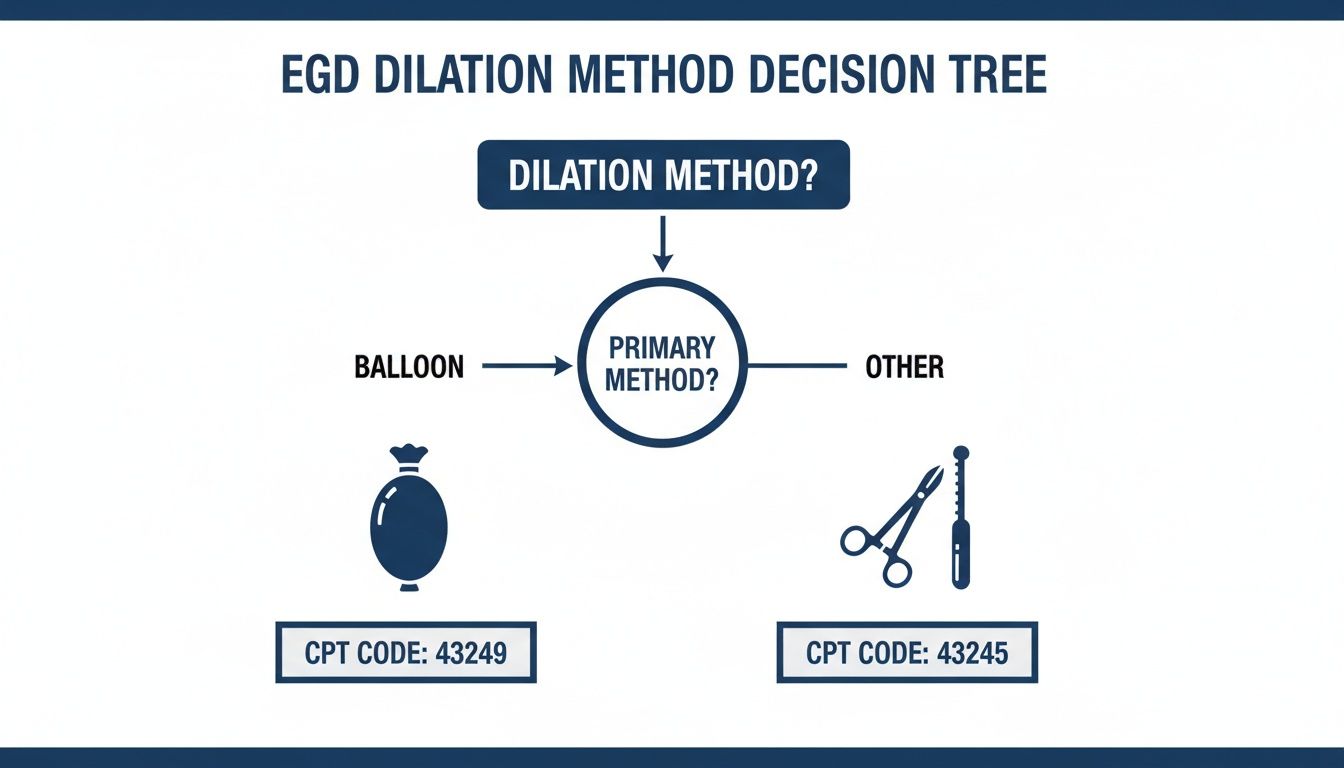
As you can see, the first question is always, "What method was used?" That single detail points you directly to either the balloon code (43249) or the code for "other methods" (43245).
A Closer Look At CPT Code 43245
CPT code 43245 is specifically for an EGD with dilation of an esophageal or gastric stricture using a non-balloon method. This makes it a workhorse code for gastroenterologists treating upper GI narrowing from conditions like GERD or eosinophilic esophagitis.
To bill it correctly, the documentation has to be rock-solid. You'll need the stricture's location, confirmation that the dilation was performed through the endoscope, and the specific method used.
In 2026, Medicare data showed that EGD procedures, including dilations like 43245, accounted for over 1.2 million claims nationwide. That’s about 15% of all GI endoscopic services reimbursed under the physician fee schedule.
This high volume highlights just how important it is to get the coding right every single time. The financial impact of coding changes is significant, a fact you can confirm by exploring proposed Medicare rules each year.
To ensure accuracy, the operative report must clearly state that a guidewire was used to pass a dilator (like a bougie) through the endoscope to the point of narrowing. Any ambiguity forces a coder to either query the physician—slowing down the entire billing cycle—or pick a less-specific code, which often leads to underpayment. Physician training on documentation specifics is the best way to prevent these bottlenecks.
Applying CPT Modifiers For EGD Dilation Claims

Getting the primary CPT code for EGD with dilation right is only half the battle. To secure full and fair payment, especially in complex cases, your billing team has to master the art of applying CPT modifiers. These two-digit codes are essential for telling the complete story of a patient encounter.
Think of modifiers as the crucial footnotes on your claim. They clarify unique circumstances, help prevent automatic denials, and ensure your claims accurately reflect the work performed. Without them, you risk leaving significant revenue on the table.
Modifier 59: Distinct Procedural Service
Modifier 59 is arguably one of the most important—and frequently misused—modifiers in medical billing. It’s used to identify a procedure or service that was distinct or independent from other non-E/M services performed on the same day.
For an EGD with dilation, you’d append Modifier 59 to a secondary procedure if it was performed in a separate anatomical site or during a completely separate patient encounter.
- Example Scenario: A patient undergoes an EGD with balloon dilation of an esophageal stricture (coded with 43249). During the same session, the physician also performs a biopsy of a suspicious lesion found in the duodenum.
- Correct Coding: The biopsy code would be billed with Modifier 59 attached. This signals to the payer that it was a separate service from the dilation, which was performed in a different anatomical location (the esophagus).
Solid documentation is absolutely critical to support using Modifier 59. The operative report must clearly describe the distinct nature of each service, highlighting the different anatomical locations to justify the separation.
Modifier 53: Discontinued Procedure
Sometimes, things don't go as planned. A procedure may need to be stopped early for the patient's safety. When a physician elects to terminate an EGD with dilation after it has already started, Modifier 53 comes into play.
This modifier tells the payer that the procedure was initiated but not completed. The documentation must explain exactly why the procedure was stopped—for instance, due to patient instability or an unexpected anatomical issue that made continuing unsafe. Using Modifier 53 allows for partial reimbursement for the work and resources that were used.
Modifier 22: Increased Procedural Services
What happens when a procedure is far more difficult or time-consuming than usual? That's where Modifier 22 is used. It can be appended to an EGD with dilation if the physician encounters severe, fibrotic, or tortuous strictures that demand significantly more time and effort to dilate successfully.
To justify Modifier 22, the physician’s documentation must paint a vivid picture of the complexity. It should detail the extra time, intense effort, and technical difficulty involved compared to a typical case. A simple note like "difficult procedure" won't cut it.
By the way, another common modifier in this context is Modifier 25.
Mastering Documentation To Prove Medical Necessity

Audit-proof documentation is the backbone of successful billing for any procedure, and it's absolutely critical when you submit a claim using a CPT code for EGD with dilation. Payers simply won't reimburse for a procedure unless the medical record clearly and convincingly shows it was medically necessary. Think of it this way: vague or incomplete notes are a direct invitation for denials.
Your procedural report has to tell a complete and logical story. It should connect the patient's symptoms to the diagnostic findings and, ultimately, to the therapeutic intervention performed. Without this clear narrative, payers are left wondering why the dilation was necessary in the first place. That uncertainty increases audit risks and threatens your entire revenue cycle.
Essential Documentation Elements
Think of the operative report as your primary evidence in the case for reimbursement. It must contain specific, undeniable facts that leave no room for a claims adjudicator to misinterpret anything. Missing just one key element can be the difference between a paid claim and a lengthy, frustrating appeals process.
To create documentation that stands up to scrutiny, make sure every EGD with dilation report includes these core components:
- A Clear Patient Diagnosis: State the primary reason for the procedure using specific ICD-10 codes. Common examples include dysphagia (difficulty swallowing), esophageal stricture, or Schatzki ring.
- Detailed Pre-Procedure Findings: Describe the symptoms and clinical indications that led to the EGD. This is your chance to detail the patient's history, the severity of their symptoms, and the failure of any previous conservative treatments.
- Specific Location of the Stricture: Document precisely where the narrowing was found. For example, "a 2 cm stricture located in the distal esophagus at 35 cm from the incisors." Vague descriptions like "esophageal narrowing" just won't cut it.
These details provide the "why" behind the procedure, setting the stage for the therapeutic intervention that follows.
Documenting The Dilation Itself
Once you've established the reason for the procedure, the report must meticulously detail the therapeutic action you took. This part of the documentation is what justifies using a therapeutic CPT code (like 43245 or 43249) instead of a purely diagnostic one.
Key Takeaway: The goal of your documentation is to paint a picture so clear that an auditor can understand the entire patient encounter without needing to ask for more information. Every detail strengthens your claim and reduces the likelihood of a denial.
Here’s what you absolutely must include about the dilation:
- Type and Size of Dilator: Specify the exact instrument used. Was it a balloon dilator, a Savary-Gilliard dilator, or a Maloney bougie? Document the size it was dilated to (e.g., "dilated to 15 mm" or "up to a 54 French bougie").
- Confirmation of Completion: The report must include a clear statement confirming that the dilation was successfully performed and that the endoscope could pass through the previously narrowed area.
- Post-Dilation Assessment: Briefly note the appearance of the esophagus after dilation and whether there were any immediate complications, such as mucosal tearing.
Building these habits is a key part of any successful clinical documentation improvement strategy. By providing this level of detail, you create a complete record that fully supports the chosen CPT code for EGD with dilation and proves medical necessity beyond a doubt. For a deeper dive, you might be interested in our guide on how to enhance your practice's clinical documentation improvement.
How To Avoid Common EGD Dilation Denials
Understanding payer-specific rules is the real key to getting EGD with dilation claims paid and reducing denials. Even with flawless documentation, a claim can get kicked back if it doesn’t line up with a payer’s unique policies. These rejections mess with your cash flow and eat up valuable staff time, but the good news is that most of them are preventable with a solid, proactive strategy.
The most common denials boil down to three pitfalls: bundling edits, missing pre-authorizations, and payer policies that flag a procedure as experimental or not medically necessary for certain conditions. By getting ahead of these issues, your billing team can build tougher, cleaner claims right from the start.
Interpreting Payer Rules And LCDs
Payers lay out their rules in documents like Local Coverage Determinations (LCDs) and other national policies. Let’s be clear: these aren't suggestions. They're the rulebooks your claims will be judged against. For example, an LCD for the CPT code for EGD with dilation might spell out exactly which diagnosis codes prove medical necessity. It might also state that a biopsy taken from the same site as the dilation is considered part of the main procedure and isn’t separately payable.
Ignoring these documents is one of the fastest ways to get a denial. Your team should make it a habit to:
- Regularly check the LCDs for your specific MAC (Medicare Administrative Contractor).
- Scour commercial payer websites for their EGD with dilation policies.
- Build claim edits into your practice management system to flag potential conflicts before a claim ever goes out the door.
This forward-thinking approach helps you submit claims that meet payer expectations from day one. Many practices find it drastically cuts down on rework and boosts their clean claim rate.
Proactive Strategies For Denial Prevention
Preventing a denial is always better—and more cost-effective—than appealing one. Beyond just reading the LCDs, a few operational habits can protect your revenue and make your billing process much smoother.
A denial isn't just a lost payment; it's a data point showing a weakness in your revenue cycle. Analyzing denial trends is crucial for finding the root cause, whether it’s a documentation gap, a coding error, or a front-desk mistake.
Here are a few actionable strategies you can implement right away:
- Verify Pre-Authorization Requirements: Never, ever assume. Always check if pre-authorization is needed for both the EGD and the dilation. Some payers might greenlight a diagnostic EGD but require a separate auth for the therapeutic dilation component.
- Challenge Bundling Edits (When Appropriate): If a biopsy is performed on a separate, distinct lesion far from the dilation site, you can often bill it separately using Modifier 59. Just make sure the documentation clearly describes the separate locations to justify unbundling the services.
- Audit-Proof Your Documentation: The procedural report has to explicitly back up the codes you bill. For instance, if you're billing for balloon dilation, the note absolutely must mention the use of a balloon. This reinforces the documentation principles we covered earlier and gives you the evidence needed to overturn an incorrect denial.
Putting these steps into practice shifts your billing function from reactive to proactive. For more in-depth techniques on handling denials when they do happen, our guide to effective medical billing denial management offers additional strategies.
Denials can feel random, but they often fall into predictable categories. Understanding these patterns is the first step toward preventing them. Below is a list of the most frequent denial reasons for EGD dilation claims and, more importantly, how to fix them.
Common Denial Reasons For EGD Dilation And How To Fix Them
Denial Reason: Bundled Service
- Explanation: The payer considers the dilation (43249) inclusive of another service performed, like a diagnostic EGD (43235) or a biopsy at the same site.
- Prevention & Correction Strategy: For prevention, review NCCI edits and payer policies before billing. To correct, if the services were distinct (e.g., biopsy at a separate site), appeal with Modifier 59 and clear documentation supporting the separate locations and medical necessity.
Denial Reason: Missing/Invalid Pre-Authorization
- Explanation: The payer required prior approval for the therapeutic dilation, but none was obtained, or the auth on file was only for a diagnostic EGD.
- Prevention & Correction Strategy: For prevention, verify authorization requirements for all potential CPT codes. Train front-desk and scheduling staff to confirm this for every scheduled procedure. To correct, submit a retroactive authorization request if the payer allows it. Otherwise, this often requires a time-consuming appeal focused on medical necessity.
Denial Reason: Lack of Medical Necessity
- Explanation: The diagnosis code (ICD-10) submitted does not support the need for dilation according to the payer's policy (LCD/NCD).
- Prevention & Correction Strategy: For prevention, ensure the primary diagnosis code is one of the approved codes listed in the payer’s policy. Use secondary diagnoses to paint a full clinical picture. To correct, review the patient’s chart for a more specific or appropriate diagnosis. If the billed diagnosis is correct, appeal with a letter of medical necessity from the provider explaining the clinical rationale.
Denial Reason: Incorrect Modifier Usage
- Explanation: A required modifier (like 59, XU, or 51) was missing, or an incorrect one was used, leading to an automatic rejection.
- Prevention & Correction Strategy: For prevention, train coders on proper modifier application based on NCCI and payer-specific guidelines. Use automated claim scrubbing software to catch these errors pre-submission. To correct, fix the modifier on the claim and resubmit. If unsure, check the payer's modifier policy or call the provider representative.
Denial Reason: Documentation Does Not Support Service
- Explanation: The procedure note is vague or fails to mention key details, such as the type of dilation (e.g., balloon, guidewire) or the location of a separate procedure.
- Prevention & Correction Strategy: For prevention, work with providers to ensure procedure notes are detailed and specific. Use EHR templates that prompt for required information. To correct, submit an addendum to the medical record (if permissible and timely) clarifying the service. Use the corrected documentation to support an appeal.
By treating each denial as a learning opportunity, you can systematically strengthen your billing process. This list serves as a great starting point for troubleshooting your most common EGD dilation denials and building a strategy to keep them from happening again.
Practical Coding Scenarios And Claim Examples
Theory is one thing; applying it under pressure is another. To help your team move from understanding the rules to mastering their application, let's walk through several real-world coding scenarios for EGD with dilation.
These examples are designed to show exactly how the primary CPT code, ICD-10 diagnoses, and necessary modifiers come together to form a clean, payable claim. Think of them as training exercises that build the confidence and critical thinking skills needed to handle the variety of situations you'll see every day.
Scenario 1: GERD-Induced Stricture With Balloon Dilation
This is a classic, straightforward case that every GI coder will see frequently. It’s the perfect baseline for a therapeutic EGD claim.
- Patient: 62-year-old male with a long history of GERD.
- Symptoms: Presents with progressive dysphagia (difficulty swallowing) for solid foods over the past three months.
- Procedure: An EGD is performed, revealing a tight, 1.5 cm ring-like stricture in the distal esophagus. A through-the-scope balloon dilator is used, successfully dilating the stricture to 15 mm. The scope is then easily passed through the previously strictured area.
- Claim Breakdown:
- Primary CPT Code: 43249 (EGD with transendoscopic balloon dilation of esophagus) is the correct code because the physician's notes specify a balloon was the method of dilation.
- Diagnosis Codes (ICD-10):
- K22.2 (Esophageal obstruction) is the primary diagnosis directly tied to the therapeutic intervention.
- R13.12 (Dysphagia, oropharyngeal phase) supports the patient's presenting symptom.
- K21.9 (Gastro-esophageal reflux disease without esophagitis) provides essential clinical context for the underlying cause.
- Modifiers: None are needed in this straightforward case.
Scenario 2: Complex Dilation Plus A Separate Biopsy
This next case introduces a common complexity: performing an additional procedure during the same session. Correctly coding this requires knowing when and how to use modifiers to signal distinct services.
- Patient: 55-year-old female with a history of radiation therapy for chest cancer.
- Symptoms: Complains of food getting "stuck" and regurgitation.
- Procedure: An EGD reveals a long, fibrotic stricture in the mid-esophagus. A guidewire is passed, and bougie dilators are used repeatedly to stretch the stricture up to a 48 French diameter. Separately, in the stomach's antrum, a small, suspicious-looking ulcer is noted, and two biopsies are taken from it.
- Claim Breakdown:
- CPT Codes:
- 43245 (EGD with dilation using a guidewire) is the primary procedure, as a bougie (not a balloon) was used.
- 43239 (EGD with biopsy, single or multiple) is the secondary procedure.
- Modifiers: Modifier 59 (Distinct Procedural Service) absolutely must be appended to CPT code 43239. This tells the payer that the biopsy was a separate service performed in a different anatomical area (stomach) than the dilation (esophagus). Without it, the claim will almost certainly be denied.
- Diagnosis Codes (ICD-10):
- K22.2 (Esophageal obstruction) linked to 43245.
- K25.9 (Gastric ulcer, unspecified) linked to 43239.
- Z92.3 (Personal history of irradiation) provides crucial history supporting the stricture's likely cause.
- CPT Codes:
Among EGD dilation-related codes, 43274 stands out for complex upper GI balloon dilations involving multiple, sequential, or repeated inflations, distinguishing it from simpler codes by its higher work intensity, as updated in 2026 GI coding guides. This code captures advanced interventions for refractory strictures, prevalent in 10-15% of post-radiation or caustic injury cases, with US incidence rising 7% annually per ASGE data since 2020. In 2026, it featured in over 250,000 Medicare claims, part of the 43235-43259 family billed 5 million times yearly, generating $2.5 billion in reimbursements but facing 25% audit scrutiny due to documentation lapses on inflation counts.
Scenario 3: Planned Dilation That Was Discontinued
Finally, let's look at what to do when a procedure doesn't go as planned. This situation requires a specific modifier to ensure you are reimbursed for the work that was performed, even if the primary goal wasn't achieved.
It’s also a good reminder of how payer policies, like the need for pre-approval, can impact these situations. For more details on that topic, check out our guide on what is prior authorization in healthcare.
- Patient: 78-year-old male with multiple comorbidities.
- Symptoms: Severe dysphagia.
- Procedure: An EGD with balloon dilation is planned. The endoscope is inserted, and the esophageal stricture is identified. However, before dilation can be initiated, the patient becomes hypotensive and tachycardic. For patient safety, the physician terminates the procedure immediately.
- Claim Breakdown:
- Primary CPT Code: 43249 (The code for the procedure that was planned).
- Modifiers: Modifier 53 (Discontinued Procedure) is appended to 43249. This is the critical step that informs the payer the procedure was started but was terminated by the physician for safety reasons before completion.
- Diagnosis Codes (ICD-10): The diagnosis codes would be the same as if the procedure were completed, such as K22.2 and R13.12, since they represent the medical necessity for the attempted procedure.
- Documentation: The operative report must clearly state why the procedure was stopped. Justifying the use of Modifier 53 is essential for receiving partial payment and avoiding a denial.
Frequently Asked Questions About EGD Dilation Coding
When it comes to billing for an EGD with dilation, certain questions pop up time and time again. Getting the answers right is crucial for accurate claims and consistent cash flow. This quick-reference guide tackles the most common uncertainties your billing team will face, offering clear, actionable advice to keep your claims compliant.
Can A Diagnostic EGD And An EGD With Dilation Be Billed On The Same Day?
No, this is a common billing mistake. You cannot report a diagnostic EGD (like CPT 43235) alongside a therapeutic EGD with dilation (such as 43249 or 43245) for the same session. Payers, including Medicare via its National Correct Coding Initiative (NCCI) edits, bundle the diagnostic scope into the therapeutic procedure.
Think of it this way: the diagnostic look-around is an inherent part of the decision to perform the dilation. When a physician starts with a diagnostic scope and then proceeds with dilation in the same encounter, you only bill for the more comprehensive therapeutic service. Billing for both is considered unbundling and is a guaranteed denial.
What Is The Correct Way To Code For Moderate Sedation?
The answer depends entirely on who administers the sedation. The CPT codes for EGD with dilation (43245, 43249) do not include the work of providing moderate sedation, so it's a separately reportable service under the right circumstances.
Here’s the breakdown:
- If the Gastroenterologist Administers Sedation: When the same physician performing the EGD also personally handles the moderate sedation, you can report the appropriate moderate sedation codes (99151–99153) in addition to the EGD code. The documentation is key here—it must clearly show the physician's active role in managing the sedation.
- If An Anesthesia Professional Administers Sedation: If an anesthesiologist or CRNA is brought in, they will bill for their services separately using anesthesia CPT codes. The gastroenterologist, in this scenario, should not report the moderate sedation codes.
How Do I Code For Dilating Multiple Strictures In One Session?
This is a very specific rule that often trips up coders. If a physician dilates multiple strictures within the same part of the upper GI tract—for example, two different strictures in the esophagus—you report the cpt code for egd with dilation only once. If two esophageal strictures were dilated with a balloon, you would bill CPT 43249 just one time.
CPT guidelines are clear: codes like 43249 and 43245 are billed once per session, no matter how many strictures are treated in that anatomical area. Don't try to bill the code multiple times with modifiers for each stricture; it’s incorrect and will only lead to denials.
The reimbursement for that single code is designed to cover all the work involved in dilating every stricture found during that single operative session.
Stop losing revenue to coding errors and persistent denials. The experts at One For All Medical Billing provide specialty-specific RCM support to ensure your practice gets paid correctly and on time. Schedule your free consultation today!

