

table of contents
When it comes to documenting patient care, the specific chronic pain ICD 10 code you choose is the difference between a clean claim and a frustrating denial. For coders and billers, getting to know the G89 series—the primary category for chronic pain not otherwise specified—is non-negotiable.
Core Chronic Pain ICD 10 Codes At A Glance

To really get a handle on chronic pain coding, you have to start with the G89 category. This series, officially titled "Pain, not elsewhere classifiable," is your home base for reporting pain that has stuck around for longer than three months. With new cases of chronic pain occurring at a rate of 52.4 per 1,000 persons annually, getting this right has never been more important.
Simply using a vague code like G89.2 on its own is a recipe for a denied claim. Payers are looking for specificity. To get claims paid, you need to use more detailed codes that paint a clear picture of the patient's condition. Think of this section as your quick-start guide to the most common G89 codes, helping you nail the documentation every time.
Quick Reference For Primary G89 Chronic Pain Codes
To help you choose the right code quickly, here's a breakdown of the most common G89 subcategories. This summary explains what they are and when to use them.
- Code Series G89.21 – Chronic Pain Due To Trauma: Use this when documentation clearly links the pain's onset to a past injury, even if the original trauma has since healed.
- Code Series G89.22 – Chronic Postprocedural Pain: Apply this for pain that persists long after a surgical or medical procedure.
- Code Series G89.3 – Neoplasm Related Pain (Acute) (Chronic): This is for pain directly caused by a tumor, its metastasis, or cancer-related treatments like chemotherapy or radiation.
- Code Series G89.4 – Chronic Pain Syndrome: This is a more complex diagnosis for when chronic pain is tied to significant psychosocial issues like depression, anxiety, or major disruption to daily life.
Using the right code ensures your claims meet payer requirements for specificity, which is a big step toward reducing denials.
A Closer Look At The Codes
G89.21 (Chronic Pain Due To Trauma)
This code is your go-to when the provider’s notes show a clear line from a past injury or traumatic event to the patient’s current, persistent pain. It’s appropriate even if the initial injury has fully healed.G89.3 (Neoplasm-Related Pain)
You'll apply this code for pain—whether it’s acute or chronic—that is directly associated with cancer. This includes pain caused by the tumor itself, its spread (metastasis), or as a side effect of treatments like chemotherapy or radiation.G89.4 (Chronic Pain Syndrome)
This is a more comprehensive diagnosis. It's the right choice when the provider's documentation details how the pain has caused significant psychosocial problems, such as depression, anxiety, or a major negative impact on the patient's social life and daily functioning. For related back conditions, you might also find our guide on low back pain ICD coding helpful.
How To Correctly Use The G89 Pain Management Category
The G89 category, “Pain, not elsewhere classifiable,” is one of the trickiest areas in ICD-10 coding. When used correctly, these codes are essential for justifying medical necessity for pain management services. But misuse them, and you’re looking at a near-certain claim denial.
The key to getting it right comes down to one thing: mastering the sequencing rules and knowing exactly what each subcategory means. Let’s break it down.
A common point of confusion is whether to list a G89 code as the principal diagnosis. The official guidelines actually give us a clear rule here. If the encounter is specifically for pain control or management, a G89 code should be sequenced first. This is especially true when the underlying condition causing the pain is unknown or when the entire visit is focused on managing something like neoplasm-related pain.
However, if a patient comes in for a definitive, diagnosed condition that is also causing their pain, you must code that condition first. The G89 code then becomes a secondary diagnosis, adding important context about the patient's symptoms without taking the primary spot.
Distinguishing Key G89 Subcategories
Applying G89 codes correctly means you have to understand the nuances between the major subcategories. Each one tells a different story about the patient’s condition, and picking the most specific option available isn't just a good idea—it's a requirement for compliant billing.
Here’s a look at the primary distinctions:
- G89.2 (Chronic Pain): This series is your go-to for pain that has lasted for more than three months. But be careful—just slapping an unspecified code like G89.29 on a claim is a major red flag for payers. You need to drill down to a more detailed code whenever the documentation supports it.
- G89.3 (Neoplasm-Related Pain): Use this code for pain, whether it's acute or chronic, that is a direct result of cancer (primary or metastatic) or its treatment. This code can often be used as the primary diagnosis if the visit's main purpose is pain management.
- G89.1 (Postprocedural and Post-thoracotomy Pain): This group includes codes like G89.11 (Acute pain due to trauma) and G89.12 (Post-thoracotomy pain), which pinpoint pain that follows a medical procedure.
A frequent mistake we see is coders using a general chronic pain code when a more specific postprocedural code fits better. If the documentation clearly links persistent pain to a past surgery, a code like G89.22 (Chronic postprocedural pain) is far more accurate and defensible.
Clinical Scenarios For G89 Codes
Let’s walk through a couple of real-world examples to see these rules in action.
Scenario 1: Primary Diagnosis
A patient with metastatic bone cancer is admitted to the hospital specifically for the management of severe, uncontrolled pain. The entire focus of the encounter is getting their pain under control.
- Primary Code: G89.3 (Neoplasm-related pain)
- Secondary Code: The appropriate code for the specific cancer.
Scenario 2: Secondary Diagnosis
A patient visits their doctor for a routine follow-up on their established Type 2 diabetes. During the appointment, they mention they’ve been dealing with ongoing, chronic generalized pain that’s affecting their daily activities. The pain isn't the main reason for the visit.
- Primary Code: The appropriate code for Type 2 diabetes (e.g., E11.9).
- Secondary Code: G89.29 (Other chronic pain).
Mastering these sequencing rules and subcategory definitions helps you build denial-proof claims from the ground up. This knowledge not only helps you justify your coding choices but also significantly reduces your practice's denial risk. For an even deeper dive into these guidelines, you can learn more about ICD-10 education on our comprehensive resource page.
Coding For Symptoms Versus A Definitive Diagnosis
One of the biggest questions we see in chronic pain coding is whether to report a symptom or a definitive diagnosis. Your choice comes down to the provider's documentation and the primary reason for that specific patient visit. The core principle never changes: always code to the highest level of specificity supported by the medical record.
When the provider has clearly identified an underlying cause for the pain, that condition gets coded first. For example, if a patient’s chronic pain is definitively tied to a musculoskeletal problem, you’d use a code from the M chapter, like M54.5 for chronic low back pain. In that case, the G89 code becomes secondary, adding important context but not driving the diagnosis.
This decision is critical for claim accuracy and avoiding denials. This visual guide breaks down the choice of whether to use a G89 code as the primary diagnosis or to code the definitive condition first.
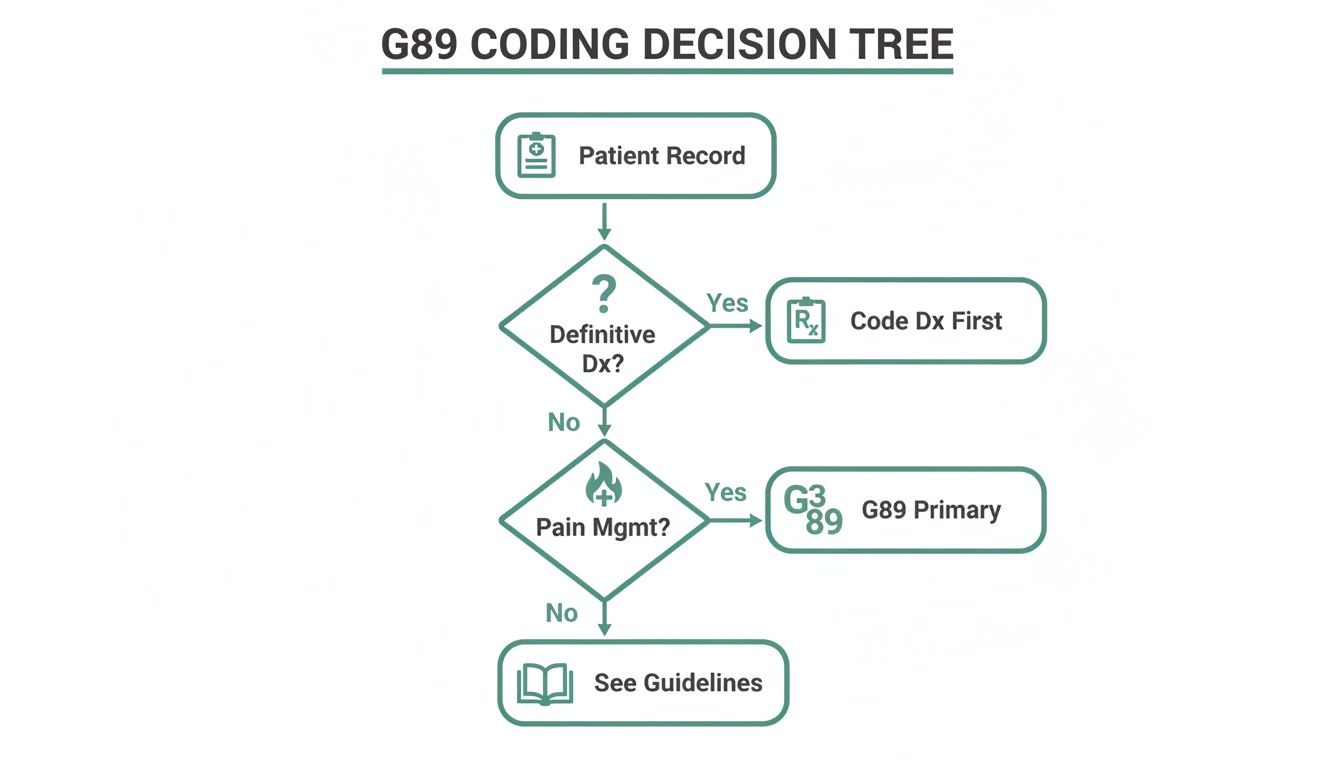
As the flowchart shows, if a definitive diagnosis exists and is the focus of the encounter, it must be coded first to establish medical necessity.
Navigating "Code First" And "Use Additional Code" Conventions
ICD-10-CM provides instructional notes like "Code First" and "Use Additional Code" to direct the proper sequencing of codes. These aren't suggestions—they are mandatory rules that ensure the complete clinical picture is painted accurately for payers.
- "Code First" Note: If you see this note under a pain code (like many G89 codes), you are required to list the underlying condition that's causing the pain first.
- "Use Additional Code" Note: On the other hand, if you see this note under a disease code, it’s an instruction to add a second code to identify a specific manifestation, such as pain.
For example, a patient has chronic pain due to postherpetic neuralgia (G53). You must code G53 first, then add G89.29 (Other chronic pain) to specify the related chronic pain symptom. This sequence is not optional.
Contrasting G89 With Other Code Chapters
Knowing when to use G89 codes versus codes from other chapters is essential for clean claims. Codes from the R chapter (Symptoms, signs, and abnormal clinical and laboratory findings) are generally for when a definitive diagnosis hasn't been established yet.
However, G89 codes are much more appropriate when the encounter itself is specifically for pain management. This distinction is key.
Let's compare two common scenarios:
Scenario: Established Diagnosis
- Documentation: "Patient seen for management of chronic low back pain. Condition has persisted for 6 months."
- Correct Code: M54.5 (Low back pain). This is far more specific and is the definitive diagnosis being treated, making it the correct primary code.
Scenario: Complex Pain Condition
- Documentation: "Patient has chronic, widespread pain with significant psychosocial distress and functional impairment. Diagnosed with chronic pain syndrome."
- Correct Code: G89.4 (Chronic pain syndrome). In this situation, the syndrome is the diagnosis being managed, not just a symptom of something else. The G89 code is rightfully the primary diagnosis.
Essential Documentation To Support Chronic Pain Codes

Accurate chronic pain ICD 10 coding is flat-out impossible without detailed clinical documentation to back it up. Payers scrutinize claims with G89 codes more than most, and a weak medical record is the quickest route to a denial. For providers and practice managers, creating audit-proof documentation isn't just good practice—it's your best defense.
Think of strong documentation as the evidence that justifies the code you've chosen. It needs to paint a clear, specific picture of the patient's condition, leaving zero room for a payer to question medical necessity. This level of detail is what turns a billable service into a paid claim.
Key Elements Of Strong Pain Documentation
To hold up under payer review, every patient note needs to include a few core components. Simply writing "chronic pain" won't cut it and will almost guarantee a denial. Instead, clinicians must capture the full story behind the patient's experience.
A complete record should always specify:
- Pain Onset and Duration: State exactly when the pain started and confirm it has lasted for more than three months. This detail is crucial for meeting the clinical definition of chronic.
- Anatomical Location: Be as precise as you can. "Right lower back pain radiating to the posterior thigh" is always better than "back pain."
- Severity and Quality: Use a consistent pain scale (like 1-10) and include descriptive words to characterize the pain, such as "burning," "aching," "stabbing," or "sharp."
- Relationship to an Underlying Condition: You have to connect the dots for the payer. Documenting "chronic pain secondary to postherpetic neuralgia," for example, creates a clean diagnostic link that's hard to dispute.
This structured approach not only gets your claims paid but also improves the continuity of care for the patient.
One of the most common reasons we see for denials is the failure to link pain to its functional impact. If your documentation shows that chronic pain severely disrupts a patient’s ability to work, sleep, or perform daily activities, you have a solid justification for a more complex code like G89.4 (Chronic pain syndrome).
A Practical Documentation Checklist For Your Clinical Team
To help your team consistently hit all the right notes, consider implementing a documentation checklist. A simple tool like this can standardize your charting process and ensure every claim is built on a rock-solid foundation.
Clinical Documentation Checklist:
- Timing: Is the onset date noted? Is the pain clearly documented as chronic (persisting >3 months)?
- Location: Is the specific anatomical site of the pain recorded?
- Severity: Has a pain score been documented for the current visit?
- Context: Is the pain explicitly linked to a definitive diagnosis, past trauma, or surgical procedure?
- Functional Impact: Are the effects on the patient's daily life, mood, or physical activities described?
- Treatment Plan: Is the current plan for managing the pain clearly laid out in the note?
Integrating these points into your daily workflow creates a powerful defense against audits and denials. For more strategies on tightening up your record-keeping, check out our guide on clinical documentation improvement. Taking this proactive approach is fundamental to maintaining a healthy revenue cycle.
How To Reduce Denials And Navigate Payer Policies

Turning accurate coding into steady revenue means getting familiar with payer-specific rules for chronic pain ICD 10 codes. Claims using G89 codes almost always face extra scrutiny because payers need proof that the services were medically necessary. The first step to building a denial-proof billing process is understanding exactly what auditors are looking for.
Payers will often flag G89 codes to make sure the documentation truly supports a chronic diagnosis, not just a more specific or localized problem. If there isn't a clear line connecting the diagnosis to the treatment, the claim is an easy target for rejection. This is especially true for procedures and therapies billed alongside a chronic pain diagnosis.
Justifying Medical Necessity For Procedures And Therapies
To protect your revenue, you have to draw a clear, compliant line from the chronic pain ICD-10 diagnosis to the CPT codes for the services you provided. It doesn't matter if it's a nerve block, physical therapy, or medication management—the diagnosis has to fully support the treatment.
For instance, when billing for physical therapy, a generic G89.29 (Other chronic pain) code on its own is pretty weak. A much stronger claim would pair the therapy CPT code with a diagnosis that clearly documents functional impairment.
Auditors want to see that the treatment directly addresses the limitations caused by the pain. Your documentation should spell out how chronic pain impacts the patient's mobility or daily activities, making physical therapy a necessary step to restore function.
Strategies For Overturning Denials
Even with perfect coding, denials will happen. That's why having an effective appeals process is so important. When a claim gets denied for medical necessity, a well-written appeal letter backed by solid documentation can often get the decision overturned.
Your appeal letter should include:
- A clear summary of the patient’s history of chronic pain.
- Direct quotes from the medical record highlighting the pain’s duration, severity, and functional impact.
- A brief explanation of why the chosen chronic pain ICD 10 code is the most specific and appropriate one.
- Any relevant clinical guidelines that support your treatment plan.
On top of that, many payers have local coverage determinations (LCDs) that spell out exactly which diagnoses support which procedures. You should always check these policies before submitting a claim. Getting a handle on payer requirements, including knowing when a service needs pre-approval, is critical. If you want to learn more, our guide on what prior authorization is in healthcare is a great resource, as this is often required for high-cost pain management treatments. Staying on top of these rules is your best bet for improving clean claim rates and protecting your practice’s financial health.
Standardizing Your Chronic Pain Coding Workflow
For any practice managing patients with chronic conditions, inconsistent coding can quietly chip away at your bottom line. When it comes to chronic pain ICD-10 codes, that inconsistency can lead to a storm of denials and audits. For RCM leaders and practice administrators, building a standardized workflow isn't just a best practice—it's essential for financial survival.
The aim is to create a system that makes accurate coding the path of least resistance. It starts with clear, internal policies that become your team’s go-to guide for how to apply G89 codes, when to sequence them, and what specific documentation is non-negotiable. From there, you can develop quick-reference sheets and job aids that turn those complex rules into simple, actionable steps.
Implementing A Quality Assurance Process
Your next move should be establishing a quality assurance (QA) process to put high-risk claims under a microscope before they ever reach a payer. Claims with complex diagnoses like G89.4 (Chronic pain syndrome) are perfect candidates for this second look, as they require detailed documentation supporting the code’s psychological and social aspects.
A proactive review system is your best defense against denials. A simple QA checklist for your team could include:
- Verifying that the provider’s note explicitly states pain duration of over three months.
- Confirming a clear link between the pain and an underlying diagnosis or specific event.
- Checking that functional impairments caused by the pain are clearly described.
Catching these potential red flags early saves you from the costly and time-consuming work of appeals. You can find more strategies for preventing claim issues in our guide on common medical coding errors.
Optimizing EHRs And Analyzing Data
Finally, make your technology do the heavy lifting. Optimize your Electronic Health Record (EHR) templates to prompt providers for the exact details needed at the point of care. Adding mandatory fields for pain severity, location, and its impact on daily life helps build a rock-solid medical record from the very beginning.
Use your billing software's analytics to spot recurring denial trends tied to specific pain diagnoses. If you see a particular payer is frequently denying G89.29, you can dig into the root cause and give your team targeted training to fix it.
This data-first approach transforms your revenue cycle from a reactive, fire-fighting function into a proactive, strategic one. It's how you create a more efficient, predictable, and profitable billing operation.
Your Chronic Pain ICD 10 Coding Questions Answered
When it comes to chronic pain coding, the ICD-10 rules can be a real headache. Even experienced coders and clinicians run into confusing scenarios that leave them second-guessing their choices. We get it.
Here, we're answering some of the most common and tricky questions we hear from practices every day. These are direct, real-world answers to help you clear up the confusion and code with more confidence.
Can I Use A G89 Code As A Primary Diagnosis?
Yes, but you have to be careful. A G89 code should only be listed as the primary diagnosis when the pain itself is the main reason for the visit, and the underlying cause is either unknown or isn't the focus of the appointment.
A classic example is a patient coming in specifically for pain control therapy. The pain management is the service being provided. For instance, G89.3 (Neoplasm-related pain) is frequently used as the primary diagnosis for an appointment focused solely on managing a patient's cancer pain. In that case, the cancer code would be listed second.
But if a definitive diagnosis is known and it’s the main reason for the treatment, that condition code always comes first.
What Is The Difference Between G89.29 And G89.4?
The line between G89.29 (Other chronic pain) and G89.4 (Chronic pain syndrome) all comes down to what the provider has documented. Making the right choice here has a big impact on reimbursement and showing medical necessity.
- G89.29 is your go-to general code. You’ll use it when the physician's notes confirm the pain is chronic but don't mention any related psychosocial issues.
- G89.4 is much more specific and tells a more complete story. This code should only be used when the documentation clearly describes major psychological or social problems stemming from the pain, like depression, anxiety, or disabling changes to the patient's ability to function.
Don't even think about using G89.4 unless it's backed up by notes detailing the syndrome's complexity. Without that specific documentation, the code is a magnet for denials.
How Do I Code Acute On Chronic Pain?
ICD-10-CM actually gives us specific combination codes for "acute on chronic" pain, and these should always be your first choice when they're available. A great example is G89.12 (Acute on chronic post-thoracotomy pain), which captures both the sudden flare-up and the existing chronic condition in one code.
What if there isn't a specific combination code for the patient's condition? In that case, you have to report two separate codes: one for the acute pain and another for the chronic pain. The sequencing depends entirely on why the patient came in—if the acute flare-up is what prompted the visit, its code should be listed first.
When Should I Use A Site Specific Pain Code Instead Of A G89 Code?
You should always reach for a site-specific pain code over a general G89 code if you can. If the provider's notes point to a clear anatomical spot and don't tie the pain to a more complex, system-wide condition, the specific code isn't just an option—it's required.
For example, use codes like M54.5 for low back pain or M25.511 for right shoulder pain when the visit is focused on that localized problem. A G89 code is better suited for situations where the pain is widespread, linked to a condition like cancer, or when the entire appointment is about managing the pain itself, not treating the localized cause.
At One For All Medical Billing, we specialize in navigating these complex coding rules to ensure your practice gets paid accurately and on time. Let our certified, U.S.-based experts handle the billing so you can focus on your patients. Schedule a free consultation to see how we can boost your clean claim rate.

