

table of contents
There’s no single “A1C diagnosis code”—and that’s a common point of confusion for many practices. The term actually refers to the critical process of connecting a patient’s A1C lab result to the specific ICD-10 diagnosis code that justifies the test for medical billing. Getting this right depends entirely on the lab value and the patient's documented clinical picture.
Your A1C Diagnosis Code Reference Guide
When it comes to medical billing, especially for a common lab like the Hemoglobin A1C, precision is everything. The A1C test gives you a clear snapshot of a patient's average blood sugar over the past two to three months, making it a cornerstone for diagnosing and managing diabetes. But just running the test doesn't mean you'll get paid.
To get paid, your claim has to prove medical necessity by linking the lab procedure to a valid diagnosis. This is where the correct A1C diagnosis code comes in. The code you select tells the payer why you performed the test. For instance, a routine screening for a low-risk patient uses a completely different code than a diagnostic test for someone showing symptoms of hyperglycemia.
Key Codes To Know
While we'll cover a wide range of codes in this guide, a few are fundamental to A1C billing. You'll use these ones again and again:
- R73.03 (Prediabetes): This is your go-to when a patient’s A1C is elevated (5.7% to 6.4%) but hasn't crossed the line into a full diabetes diagnosis.
- E11.9 (Type 2 diabetes mellitus without complications): Use this for a new diagnosis of Type 2 diabetes, which is typically confirmed with an A1C of 6.5% or higher.
- Z00.00 (Encounter for general adult medical examination without abnormal findings): This code is often used for preventive screenings. Just be aware that payers usually require a secondary diagnosis to cover the A1C test.
This decision tree gives you a quick visual guide on how to pick a primary diagnosis code based on a patient's A1C results.
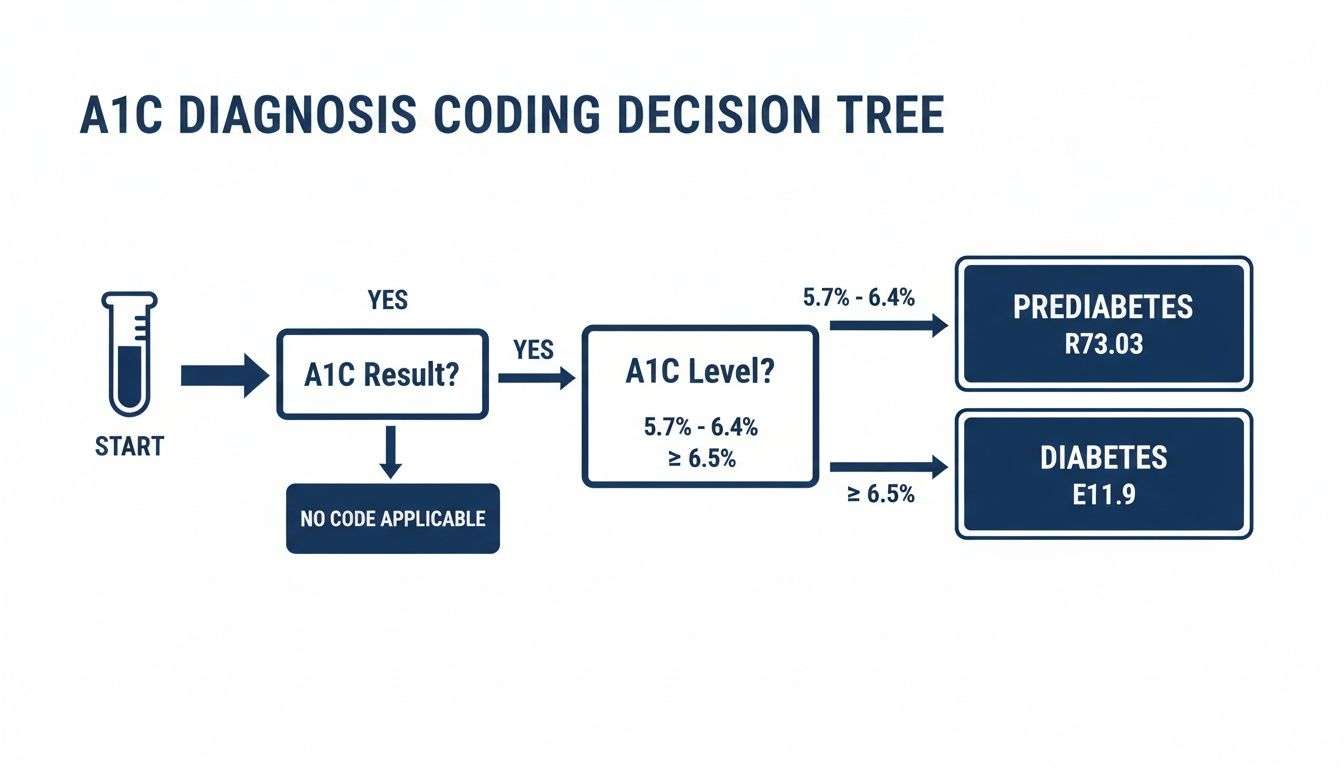
As the flowchart shows, the A1C lab value is what points you toward either the prediabetes code (R73.03) or a diabetes code like E11.9.
Choosing the right code from the start is one of the most important steps in building a claim that gets paid on the first try. You can dig deeper into how this choice affects your revenue by reading our guide on what is a clean claim in medical billing.
Common A1C Scenarios And Corresponding ICD-10 Codes
To make things even easier, here is a quick-reference list matching common A1C lab result scenarios with the most appropriate primary ICD-10 diagnosis code.
- Scenario: A1C is between 5.7% and 6.4%
- Primary ICD-10 Code: R73.03
- Description: Prediabetes
- Billing Context: For patients with elevated glucose who do not yet meet the criteria for diabetes.
- Scenario: A1C is 6.5% or higher
- Primary ICD-10 Code: E11.9
- Description: Type 2 diabetes mellitus without complications
- Billing Context: Used for a new diagnosis of uncomplicated Type 2 diabetes.
- Scenario: Screening for low-risk patient
- Primary ICD-10 Code: Z13.1
- Description: Encounter for screening for diabetes mellitus
- Billing Context: For asymptomatic patients without known risk factors. Payer coverage varies.
- Scenario: Monitoring established diabetes
- Primary ICD-10 Code: E11.—
- Description: Type 2 diabetes mellitus (with or without complications)
- Billing Context: Use the appropriate E11 code that reflects the patient’s current status.
- Scenario: A1C is normal (<5.7%) but patient has risk factors
- Primary ICD-10 Code: Z72.89
- Description: Other problems related to lifestyle
- Billing Context: Can be used as a secondary code to justify screening (e.g., obesity, family history).
This list serves as a great starting point for your coders and billers. Remember, always consult the full patient record to ensure the selected code accurately reflects the provider’s documentation and the reason for the encounter.
Understanding The Role Of A1C In Diabetes Diagnosis

As a medical biller or coder, justifying claims for an a1c diagnosis code is much easier when you understand the clinical story behind it. The Hemoglobin A1C (HbA1c) test isn't just another lab value; it has become the gold standard for diagnosing and monitoring diabetes for one simple reason: it tells a long-term story.
Unlike a standard glucose test that only captures a patient's blood sugar in a single moment, the A1C test gives us a much bigger picture. It measures the percentage of hemoglobin proteins in the blood that have become coated with sugar, providing a reliable average of blood glucose levels over the past two to three months.
This extended timeframe is exactly what gives the A1C test its power. It smooths out the daily ups and downs of blood sugar, offering providers and payers a stable metric to assess a patient's real-world glycemic control.
Official Diagnostic Thresholds
The American Diabetes Association (ADA) has established clear, widely accepted thresholds for A1C results. Knowing these values is the first step to choosing the right ICD-10 code, as each range points to a completely different clinical status and coding pathway.
- Normal: An A1C level below 5.7% is considered normal.
- Prediabetes: An A1C level between 5.7% and 6.4% points to prediabetes, signaling a high risk for developing type 2 diabetes.
- Diabetes: An A1C level of 6.5% or higher on two separate tests confirms a diabetes diagnosis.
This tiered system is fundamental to accurate billing and coding. For instance, an A1C of 6.2% supports a prediabetes code, while a result of 6.8% provides the clear medical necessity for a diabetes diagnosis code. Getting these thresholds wrong is a very common reason for coding errors and claim denials.
When you have a firm grasp of this clinical reasoning, you can build much stronger, more defensible claims. Knowing why a specific A1C value leads to a certain diagnosis helps you prove medical necessity to any payer. For anyone looking to sharpen their skills, you can learn more about ICD-10 education in our article. This foundation is absolutely key to making sure your coding is both accurate and reimbursable.
Mastering Core ICD-10 Codes For A1C Diagnoses
Getting the ICD-10 code right for an A1C test is the cornerstone of successful diabetes and prediabetes billing. The code you pick has to tell the payer exactly what the provider documented in the patient’s chart. Think of this section as your quick-reference guide for the most common A1C codes to make sure your claims are specific and compliant from the get-go.
Diabetes is a massive public health concern, affecting over 37 million Americans as of 2019 and ranking as the seventh leading cause of death. Because of this, payers scrutinize these claims closely. They need to see clear documentation supporting A1C levels above 6.5% for a diabetes diagnosis or between 5.7% and 6.4% for prediabetes.
Coding For An Abnormal Result Without A Diagnosis
One of the most frequent situations you'll encounter is an elevated A1C lab result that doesn't quite cross the threshold for a full diabetes diagnosis. This is exactly what the "Symptoms, signs and abnormal clinical and laboratory findings" chapter is for.
- R73.03 (Prediabetes): This is your go-to code when a patient's A1C is between 5.7% and 6.4%. It signals that the patient has impaired glucose regulation and is at high risk for developing diabetes, but they don't meet the official diagnostic criteria yet.
It’s critical to use R73.03 here, not a definitive diabetes code like E11.9. Jumping the gun and using a diabetes code for a prediabetic A1C value is a common mistake that will get your claim denied because the lab value simply doesn’t support the diagnosis.
Making this distinction is about more than just getting paid—it’s about maintaining accurate patient records. The R73.03 code properly flags the patient for necessary monitoring and preventive care without incorrectly saddling them with a chronic condition diagnosis.
Coding For A New Diabetes Diagnosis
When an A1C test comes back at 6.5% or higher and confirms a new diabetes diagnosis, you'll turn to the "Endocrine, nutritional and metabolic diseases" chapter (the E codes) in your ICD-10-CM codebook. The code you choose depends entirely on the type of diabetes the provider has documented.
Type 2 Diabetes (E11 Series)
Most new diabetes diagnoses will fall into this category.
- E11.9 (Type 2 diabetes mellitus without complications): This is the code for a newly diagnosed patient with an A1C of 6.5% or more, where the provider hasn’t documented any related complications yet. It’s the most common code used for an initial A1C-based diagnosis.
Type 1 Diabetes (E10 Series)
While less common for an initial diagnosis in adults, it's essential to code it correctly when it's documented.
- E10.9 (Type 1 diabetes mellitus without complications): Use this code only when a provider specifically diagnoses Type 1 diabetes, which is an autoimmune condition. This diagnosis is usually supported by more than just an A1C level.
Nailing these foundational codes is a huge step, but plenty of other things can go wrong. You can learn more by checking out our guide on how to avoid common medical coding errors.
Navigating CPT Codes And Payer Rules For A1C Testing
While your ICD-10 codes tell the story of why an A1C test was necessary, the CPT code defines what service you performed. For any A1C lab test, the procedure code you'll use is CPT code 83036 (Hemoglobin; glycosylated (A1c)). Getting this CPT code paid hinges on pairing it with a supportive a1c diagnosis code—that’s the secret to a clean claim.
But successful billing for CPT 83036 goes beyond just knowing the code. You have to navigate a maze of payer-specific rules, especially when it comes to testing frequency. Payers like Medicare have strict limits on how often they’ll reimburse for an A1C test, and those limits are tied directly to the patient's documented clinical picture.
For instance, a patient whose diabetes is well-controlled might only be approved for A1C testing twice a year. But if that same patient's condition becomes unstable or their treatment plan changes, payers will often cover up to four tests annually. Pushing past these frequency limits without rock-solid documentation is a fast track to a denial.
Linking CPT And ICD-10 Codes Correctly
The most important step in billing for A1C is making sure the CPT code and the ICD-10 code tell a consistent story. The diagnosis has to be a logical reason for the procedure. It’s that simple.
Valid Pairing Example: CPT 83036 is billed with ICD-10 E11.9 (Type 2 diabetes without complications) for routine monitoring. This diagnosis clearly justifies the test.
Invalid Pairing Example: CPT 83036 is billed with an unrelated diagnosis like M54.5 (Low back pain). This claim will be denied for lack of medical necessity almost instantly.
The complexity of A1C diagnosis coding has only grown, especially since the switch to ICD-10. During the COVID-19 pandemic from 2019-2024, for example, testing was disrupted and data showed A1C control worsened in certain populations. For billing managers, this is just another reminder of how external factors can shift patient needs and why precise coding is your best defense against denials.
Understanding Payer Policies And Bundling
Payers often have their own unique policies that can impact reimbursement for CPT 83036. One common issue to watch for is bundling, where the payment for one service gets rolled into another service performed on the same day. While A1C tests aren't usually bundled with office visits, it’s always smart to check each payer’s specific guidelines.
A frequent error we see is submitting a claim for CPT 83036 with a vague or weak diagnosis. Payers are using increasingly sophisticated automated edits, and any claim that doesn't scream "medical necessity" will be flagged.
On top of that, some services might need prior approval before they can be performed. Getting a handle on these requirements can feel like a full-time job, but it’s essential for getting paid. You can learn more by checking out our detailed guide on what is prior authorization in healthcare. Staying on top of payer rules is the best way to make sure your A1C claims are processed smoothly and without delay.
Best Practices For A1C Documentation And Compliance

A claim’s real strength is found in its documentation. Even when you’ve selected the perfect a1c diagnosis code, a weak or incomplete medical record can sink your reimbursement efforts and trigger an audit. To get paid without a fight, every claim for an A1C test needs to be backed by clear, detailed provider notes that justify the service.
This means your documentation must tell the payer the full story. Simply dropping a diagnosis code into the claim isn’t enough—the record has to reveal the provider's clinical thought process. Why was the test ordered? What did the results show? And what's the plan now?
Essential Documentation Elements
To build an audit-proof A1C claim, every provider note has to contain a few key ingredients. If you miss one, you’re creating a weak link that payers can easily use to issue a denial.
These elements work together to establish undeniable medical necessity for the test.
- The Specific A1C Lab Value: Always document the exact numerical result, like 6.8%.
- A Clinical Assessment: The provider needs to write down their interpretation of the value. For instance, “A1C of 6.8% confirms a new diagnosis of Type 2 diabetes.”
- The Treatment Plan: The note must outline the next steps, such as prescribing metformin, advising on lifestyle changes, or scheduling a follow-up visit.
For example, a rock-solid note might say, "Patient's A1C is 7.2%, confirming uncontrolled Type 2 diabetes. Will adjust insulin dosage and recheck in 3 months." This simple entry provides a complete, defensible record. For more strategies on getting your notes up to par, check out our resources on clinical documentation improvement.
Having a quick reference can make all the difference. This checklist helps ensure every A1C claim is complete, compliant, and ready for a smooth submission process.
A1C Coding And Documentation Checklist
- Checklist Item: Correct ICD-10 Code Used
- Why It Matters: The diagnosis code must match the reason for the test (e.g., monitoring, screening, abnormal finding).
- Example: Use E11.9 for an established Type 2 patient, not Z13.1 for screening.
- Checklist Item: A1C Value Documented
- Why It Matters: Payers need to see the specific numerical result to validate the clinical context.
- Example: "A1C result is 8.1%."
- Checklist Item: Clinical Interpretation Included
- Why It Matters: The provider’s assessment links the lab value to the patient's condition, proving medical necessity.
- Example: "Result indicates uncontrolled diabetes."
- Checklist Item: Actionable Treatment Plan
- Why It Matters: This shows the A1C test was used to guide patient care, not just for data collection.
- Example: "Start Metformin 500 mg daily. Recheck A1C in 3 months."
- Checklist Item: Payer Frequency Limits Checked
- Why It Matters: Submitting claims more often than allowed by the payer’s policy will lead to automatic denials.
- Example: Verify if the patient is eligible for a quarterly test (uncontrolled) or semi-annual (stable).
- Checklist Item: HIPAA Compliance Maintained
- Why It Matters: All documentation and transmission of patient data must adhere to strict privacy and security rules.
- Example: Ensure all patient data is handled through a secure, HIPAA compliance-ready system.
Running through this checklist before submitting a claim can help you catch common errors, reduce denials, and strengthen your revenue cycle.
Navigating Common Payer Policies
Beyond the individual claim, staying compliant means knowing the specific rules for each payer. Major payers like Medicare have set clear frequency limits for A1C testing, and these limits are tied directly to the patient's clinical status.
One of the most common pitfalls we see is billing for A1C tests more often than a payer’s policy allows. For a patient with stable, well-controlled diabetes, Medicare might only cover the test twice a year. But for someone whose diabetes is uncontrolled or who is undergoing a major treatment change, coverage often extends to four times per year.
If you exceed these limits without clearly documenting why more frequent monitoring is needed, you’re practically asking for a denial. And of course, protecting this sensitive health data is non-negotiable. Strict adherence to HIPAA compliance is essential for safeguarding patient information and avoiding steep penalties. Building a solid foundation in both documentation and compliance helps you meet payer expectations and defend your claims if an appeal is ever needed.
Of course. Here is the rewritten section, crafted to sound like it was written by an experienced human expert and matching the provided examples.
How To Prevent Common A1C Coding Denials
Getting paid for an A1C test should be straightforward, but denials are all too common. It takes more than just picking the right A1C diagnosis code; it requires a proactive strategy to avoid the same frustrating pitfalls that sink revenue for so many practices. With a bit of foresight, you can stop these issues before they ever leave your office.
A huge number of A1C denials come down to one thing: a perceived lack of medical necessity. This is just a technical way of saying the diagnosis code on the claim didn’t properly justify why the test was performed. Simply put, the payer's automated system saw a mismatch between the "why" (the diagnosis) and the "what" (the lab test).
For example, submitting CPT code 83036 with a vague or unrelated diagnosis is a guaranteed denial. To prevent this, your first step should always be to ensure the primary diagnosis code directly and clearly supports the A1C test.
Tackling Diagnosis And Frequency Denials
Two of the most frequent denial reasons we see are "missing or invalid diagnosis" and "exceeds frequency limits." The good news is both are entirely preventable with careful attention to detail and a solid understanding of payer rules.
A "missing or invalid diagnosis" denial often pops up when a claim is sent with an outdated code or one that isn't specific enough. Another common mistake is using a screening code like Z00.00 as the only diagnosis for a lab test, which Medicare simply will not cover.
To fix this:
- Always Verify Your Codes: Before submitting, double-check that all ICD-10 codes are current and valid for the date of service.
- Establish Medical Necessity: For screening, you must include a secondary diagnosis code that points to a specific risk factor. Good examples include obesity (E66.9) or a family history of diabetes (Z83.3).
- Link It Up: Make sure the provider’s documentation clearly connects the patient's condition or risk factors to the order for the A1C test.
Frequency-based denials happen when you bill for A1C tests more often than a payer’s policy allows. For instance, Medicare will typically cover up to four tests per year for a patient with uncontrolled diabetes but only two per year if their condition is stable and well-managed.
The key is to justify the need for more frequent testing directly in the patient’s medical record. If a patient's treatment plan changes or their A1C levels are unstable, that clinical reasoning must be clearly documented to support the claim.
Proactive Strategies For Cleaner Claims
Billing for an A1C diagnosis code has evolved, and it directly impacts your revenue cycle. With a large portion of the U.S. population having prediabetes—diagnosed with A1C values from 5.7% to 6.4%—proactive coding is essential for capturing reimbursement for these important preventive services.
On top of that, quality programs like MIPS use these codes to track outcomes, such as MIPS measure #001, which monitors patients with HbA1c levels greater than 9%. You can review the details on how these measures impact reimbursements and discover more insights about 2026 quality measure specifications from CMS. This just highlights the need for precision, as your coding directly influences both payments and quality scores.
Adopting a denial prevention mindset isn't just about fixing mistakes; it's about improving your clean claim rate and slashing the administrative burden of managing accounts receivable.
Common Questions About A1C Coding
Coding for A1C tests seems straightforward, but it’s an area where small mistakes can lead to big headaches. Getting the diagnosis code right for prediabetes versus diabetes, or knowing how often Medicare will pay, is critical for clean claims.
Here are quick answers to the A1C coding questions we hear most often from practices, designed to help you get it right the first time.
What Is The A1C Diagnosis Code For Prediabetes?
When a patient’s A1C falls between 5.7% and 6.4% without a formal diabetes diagnosis, the correct ICD-10 code is R73.03 (Prediabetes). This code tells the payer that you’ve found an abnormal glucose level that doesn't yet meet the threshold for diabetes.
It’s crucial to avoid using a diabetes code like E11.9 here. That would misrepresent the patient's clinical picture and is a surefire way to get a claim denied for a lack of medical necessity.
How Often Can We Bill An A1C Test For A Medicare Patient?
For Medicare patients, how often you can bill CPT code 83036 comes down to one thing: documented stability. If your patient's diabetes is stable and well-controlled, Medicare will generally cover the A1C test twice per year.
However, you can justify more frequent testing—up to four times per year—if the patient's diabetes is documented as uncontrolled or if their treatment plan has recently changed. Just make sure the medical necessity for the extra tests is clearly spelled out in the patient’s chart.
Can I Use An A1C Diagnosis Code For Gestational Diabetes?
No, the A1C test isn’t the right tool for diagnosing gestational diabetes. While a provider might use it early in pregnancy to screen for pre-existing, undiagnosed diabetes, the official diagnosis of gestational diabetes relies on glucose tolerance testing.
The correct ICD-10 codes are found in the O24.- category (Diabetes mellitus in pregnancy). Using a general code like E11.9 as the primary diagnosis for a patient with gestational diabetes is incorrect and will cause claim issues.
How Do I Code For Diabetes With Complications?
When a patient has diabetes along with documented complications, you need to use more specific ICD-10 codes to paint the full clinical picture. It’s a two-step process that’s essential for accurate coding and proper payment.
- Start with the primary diabetes code that names the complication. A great example is E11.22 (Type 2 diabetes mellitus with chronic kidney disease).
- Next, look for the "use additional code" note in your coding manual and add the code for the specific manifestation, such as N18.3 (Chronic kidney disease, stage 3).
At One For All Medical Billing, we specialize in helping practices navigate complex coding scenarios just like these to improve clean claim rates and reduce denials. Learn how our dedicated, U.S.-based team can help you get paid faster by visiting us at https://oneforallmed.com.

