
table of contents
Yes, telehealth visits are billable in the United States, and Medicare, most state Medicaid programs, and the majority of private payers will reimburse them when you code them correctly. Bill with the correct CPT or HCPCS code, attach the right modifier (95, GT, or GQ), and select the accurate place-of-service code (02 or 10). Congress has extended major Medicare telehealth flexibilities through December 31, 2027, but the fine print on coding, documentation, and payer acceptance still changes year to year, so billing teams need to stay current on CMS updates rather than assume last year’s rules still apply.
TL;DR:
- Accurate billing requires confirming codes are on the current Medicare telehealth list each year, as they frequently change.
- Using the incorrect place-of-service code or modifier can instantly lead to claim denials, especially for POS 02 versus POS 10.
- RHC and FQHC providers must switch from HCPCS G2025 to individual CPT or HCPCS codes for telehealth services starting October 1, 2026, to avoid denials.
- Payers other than Medicare, such as state Medicaid and private insurers, often have different coverage rules and reimbursement standards that require ongoing tracking.
- Implementing standardized documentation, pre-claim scrubs, and payer-specific updates helps prevent common telehealth billing errors and revenue delays.
Telehealth Billing Guidelines: A Quick Checklist Before You Submit
Before a telehealth claim leaves your building, run it through a short gut check.
- Confirm the CPT or HCPCS code is on the payer’s current telehealth services list for that date of service.
- Attach the correct modifier (95, GT, or GQ) based on payer and service type, and pair it with POS 02 or POS 10.
- Decide whether Q3014 applies for an originating site facility fee, and confirm the payment amount for the current calendar year.
- Document modality, session start and end times, informed consent, and medical necessity in the chart note.
Pro Tip: Build these four checks into your EHR’s claim-scrub rule set rather than relying on staff memory. A hardcoded scrub catches errors before they cost you a resubmission cycle.
Medicare Telehealth Billing Rules You Need to Know
Start with the list itself. CMS maintains a running list of services payable under Medicare via telehealth, and it updates that list through the annual Medicare Physician Fee Schedule rule. Before billing any CPT or HCPCS code as a telehealth service, confirm it appears on that current list for the date of service. A code that qualified last year isn’t guaranteed to qualify this year.
Most Medicare telehealth claims use standard E/M or behavioral health CPT codes with a modifier attached. Modifier 95 signals a synchronous audio-video visit, while GT and GQ apply in narrower contexts tied to specific programs. Pair the modifier with the correct place-of-service code:
- POS 02 indicates the patient received care at a telehealth location other than their home.
- POS 10 indicates the patient was in their home when the service occurred.
Getting POS wrong is one of the fastest ways to trigger an automatic denial, since the code drives payment rate calculations behind the scenes.
Originating site facilities can also bill HCPCS code Q3014 for the facility fee tied to hosting the originating end of a telehealth encounter. The CY 2026 Medicare Physician Fee Schedule final rule set the Q3014 payment amount at $31.85, and standard Part B deductible and coinsurance rules apply on top of that base payment. Beneficiaries generally pay the same amount for a telehealth visit that they would for the equivalent in-person visit, which is worth explaining to patients who assume a video visit costs less.
Where State Medicaid and Private Payers Diverge From Medicare
Medicare gives you one rulebook. State Medicaid and commercial payers give you dozens, and none of them are obligated to match CMS exactly.
- State Medicaid programs set their own rules on covered telehealth services, accepted modalities (audio-only versus audio-video), and place-of-service requirements, so check your specific state’s Medicaid telehealth page before assuming Medicare rules carry over.
- Private payer parity laws vary widely from state to state, and even where parity laws exist, reimbursement rates and accepted coding conventions can still differ from Medicare’s approach.
- Build and maintain a payer-policy matrix that tracks modifier preferences, POS requirements, and pre-authorization triggers by payer, and update it whenever a payer publishes a policy bulletin.
Treat this matrix as a living document. A payer that accepted modifier 95 last quarter can shift its preferred coding overnight, usually with a one-line update buried in a provider bulletin nobody reads until a batch of claims bounces back.
Building a Telehealth Billing Workflow That Actually Holds Up
Good telehealth billing isn’t a single decision at the coding step. It’s a chain of operational decisions that starts at check-in and ends with a paid claim, and a weak link anywhere along that chain shows up as a denial weeks later.
- Standardize documentation templates so every chart note captures modality, platform used, exact start and end times, informed consent, and a clear statement of medical necessity.
- Run pre-claim scrubs that check CPT or HCPCS code accuracy, modifier selection, and POS assignment against current payer rules before the claim ever transmits.
- Train front desk and billing staff on payer-specific quirks, and update your EHR or billing software templates to force capture of the fields your scrubs depend on.
- Set up post-submission tracking with automated denial alerts and a standing appeals queue, complete with template language for the most common rejection reasons.
Pro Tip: Assign one staff member to review payer bulletins weekly. That single habit catches more coding changes than any quarterly audit.
This is the same discipline our guide on medical billing compliance walks through in more depth, and it applies just as directly to telehealth claims as it does to in-person visits.
Why Telehealth Claims Get Denied and How to Fix Them
Most telehealth denials trace back to one of four patterns, and each has a specific fix rather than a vague “resubmit and hope” approach.
- Incorrect modifier or POS code: Resubmit with the corrected value and attach documentation confirming the modality and location of care.
- Service not covered or documentation gaps: Confirm the code sits on the payer’s current telehealth list, then add explicit medical necessity language to the claim notes.
- Same-day in-person and telehealth conflicts: Clarify the service timeline in your notes, show distinct clinical content for each encounter, and correct the coding if the visits actually overlapped.
- RHC or FQHC denials tied to code transitions: Update your billing logic to reflect the correct CPT or HCPCS codes and revenue codes rather than continuing to bill the old code set.
Reference our place of service codes breakdown when your team needs a fast POS 02 versus POS 10 refresher during a denial review.
RHC and FQHC Telehealth Billing Changes for 2026
Rural health clinics and federally qualified health centers face a hard deadline. For dates of service on or after October 1, 2026, RHCs and FQHCs must bill individual CPT or HCPCS codes for distant-site telehealth instead of HCPCS code G2025. Systems that still map claims to G2025 after that date will generate denials at scale.
- Update billing systems now to emit individual codes and correct revenue codes rather than the old bundled G2025 approach.
- Report modifier 93 or 95 as CMS instructs, depending on the specific service and visit type.
- Run a test batch of claims before the deadline, then watch denial trends closely for the first 60 days after the switch.
A failure to update system mappings ahead of the transition is the single most common cause of RHC and FQHC telehealth denials once a coding rule like this takes effect.
Getting Ready for CY2026 and CY2027 Telehealth Changes
Treat the coming rule changes as a project with a deadline, not a background update your software vendor will quietly handle.
- Inventory every telehealth code your practice currently bills, map each one to payer-specific acceptance rules, and update claim-scrub logic before new effective dates hit.
- Train billing and front desk staff on the changes, update EHR templates accordingly, and run sample claims through your Medicare Administrative Contractor and top private payers before full volume goes live.
- Reconcile expected payment changes, including the Q3014 facility fee update, against actual remittances, and run weekly denial trend reports during the transition window.
Pro Tip: After any CMS rule change, pull a denial report every Friday for the first six weeks. Early trend spotting saves far more revenue than a monthly review ever will.
Why Billing Accuracy Protects Your Cash Flow
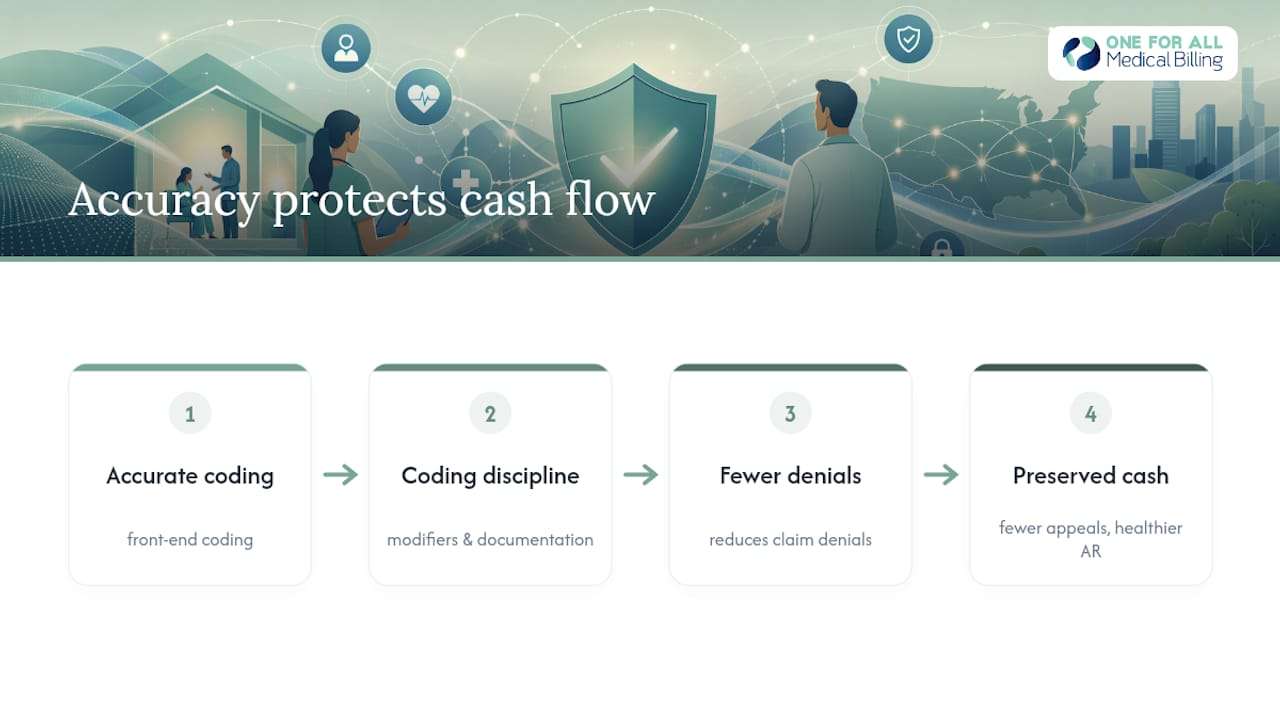
Denied telehealth claims don’t just delay payment. They compound, tying up staff hours on appeals while accounts receivable ages past the point where recovery gets harder. Accurate coding on the front end is what keeps that cycle from starting.
One For All Medical Billing built its specialty-focused approach around this exact principle. It’s what disciplined coding, modifier accuracy, and documentation habits produce when applied consistently across telehealth and in-person claims alike.
— One For All Medical Billing
Let One For All Medical Billing Handle Your Telehealth Claims
The firm offers specialty-specific telehealth expertise built on extensive revenue cycle management experience.
A compliance review can check your current telehealth coding, modifier usage, and RHC or FQHC readiness against the latest CMS updates to help prevent revenue loss from denials. A clean claim rate reflects discipline in using correct modifiers, accurate place-of-service codes, and thorough documentation that holds up under payer scrutiny. For behavioral health practices navigating similar coding shifts, our operational fixes for behavioral health billing covers related workflow changes worth reviewing alongside your telehealth updates. Practices coordinating patient outreach around new telehealth offerings may also find value in healthcare marketing support from our partners at 121 Group.
Reach out through the One For All Medical Billing contact page to schedule a telehealth billing audit before the October 2026 RHC and FQHC transition takes effect.
Sources
This article is general information, not a substitute for advice from a qualified financial advisor. Consult a qualified financial professional about your own circumstances before acting on anything here.
FAQ
What are the CMS guidelines for telehealth billing in 2026?
CMS requires providers to bill telehealth services using approved CPT or HCPCS codes from the current telehealth services list, paired with the correct modifier and place-of-service code, and the CY 2026 fee schedule set the Q3014 originating site facility fee at $31.85.
Are telehealth visits still billable?
Yes, telehealth visits remain billable to Medicare, most state Medicaid programs, and the majority of private payers, and major Medicare telehealth flexibilities are extended through December 31, 2027.
What are the current CMS telehealth guidelines?
Current guidelines require confirming the service appears on the Medicare telehealth services list, applying modifier 95, GT, or GQ as appropriate, and selecting POS 02 or POS 10 based on where the patient received care.
How do I bill telehealth in 2026?
Bill the correct CPT or HCPCS code with the applicable modifier and POS code, document modality and medical necessity thoroughly, and confirm RHC or FQHC clients are prepared for the shift away from G2025 ahead of the October 1, 2026 deadline. Practices that want this handled without building the process from scratch can work with One For All Medical Billing directly.

