

table of contents
TL;DR:
- Gastroenterology billing requires precise CPT and ICD coding, disciplined documentation, and payer-aware modifiers to avoid denials.
- A pre-procedure coding huddle can catch conversion errors and ensure correct billing before the patient enters the room.
Gastroenterology billing requires precise CPT/ICD-10-CM alignment, disciplined documentation, and payer-aware modifier use to protect revenue. Get any one of those three wrong and you are looking at denials, delayed payments, or compliance exposure. The good news: most GI billing failures trace back to a short list of fixable process gaps.
Here is the immediate checklist for any GI practice:
- Confirm screening vs. diagnostic intent before the procedure, not after
- Apply modifier 33 for preventive screening, PT when a polyp is removed during a screening colonoscopy
- Use modifier 59 or XS for separate-site interventions (different colonic segments)
- Capture site-by-site anatomic detail, polyp size, morphology, and withdrawal time in the op note
- Verify anesthesia billing responsibility: the GI physician bills moderate sedation (99152/99153) only when no separate anesthesiologist is present
- Log prior-authorization requirements for capsule endoscopy, ERCP, and advanced bariatric endoscopy before scheduling
Pro Tip: Run a two-minute pre-procedure coding huddle between the endoscopist and the charge-capture team. Confirm the scheduled procedure intent, the likely therapeutic upgrade path (e.g., screening to polypectomy), and the correct modifier chain before the patient enters the room. This single step catches the majority of screening-to-diagnostic conversion errors before they become denials.
How GI procedure CPT codes drive revenue and where billing goes wrong
Most outpatient GI revenue comes from upper and lower endoscopy, and mastering the code groups that govern those procedures is the foundation of clean-claim performance. Here are the procedure groups that matter most, with the pitfalls that most commonly cost practices money.
Lower GI (Colonoscopy) Codes
- 45378 — Diagnostic colonoscopy, no intervention. This is the baseline code; bill it only when no biopsy or polypectomy is performed.
- 45380 — Colonoscopy with biopsy. Work RVU is higher than 45378; requires documentation of biopsy site and specimen sent to pathology.
- 45384/45385 — Colonoscopy with polypectomy (hot biopsy forceps/45384, snare/45385). These are among the highest-volume therapeutic codes in GI. Billing 45378 alongside 45380 or 45385 when a biopsy or polypectomy occurs at the same site is an NCCI violation.
- Additional-site polypectomies — When polyps are removed from distinct colonic segments, bill the additional-site code with modifier 59 or XS. Documentation must name each segment and link to the corresponding pathology accession number.
Upper GI (EGD) Codes
- 43235 — Diagnostic EGD, no intervention.
- 43239 — EGD with biopsy. Pair with the EGD CPT coding guide for documentation expectations.
- When EGD and colonoscopy are performed in the same session, bill both with modifier 51 on the secondary procedure; some payers require modifier 59 instead — verify by payer contract.
ERCP and EUS
ERCP codes (43260 series) and endoscopic ultrasound codes (43237, 43238, 43242) carry high work RVUs and almost always require prior authorization. Incomplete documentation of the clinical indication is the leading cause of ERCP denials.

Capsule Endoscopy
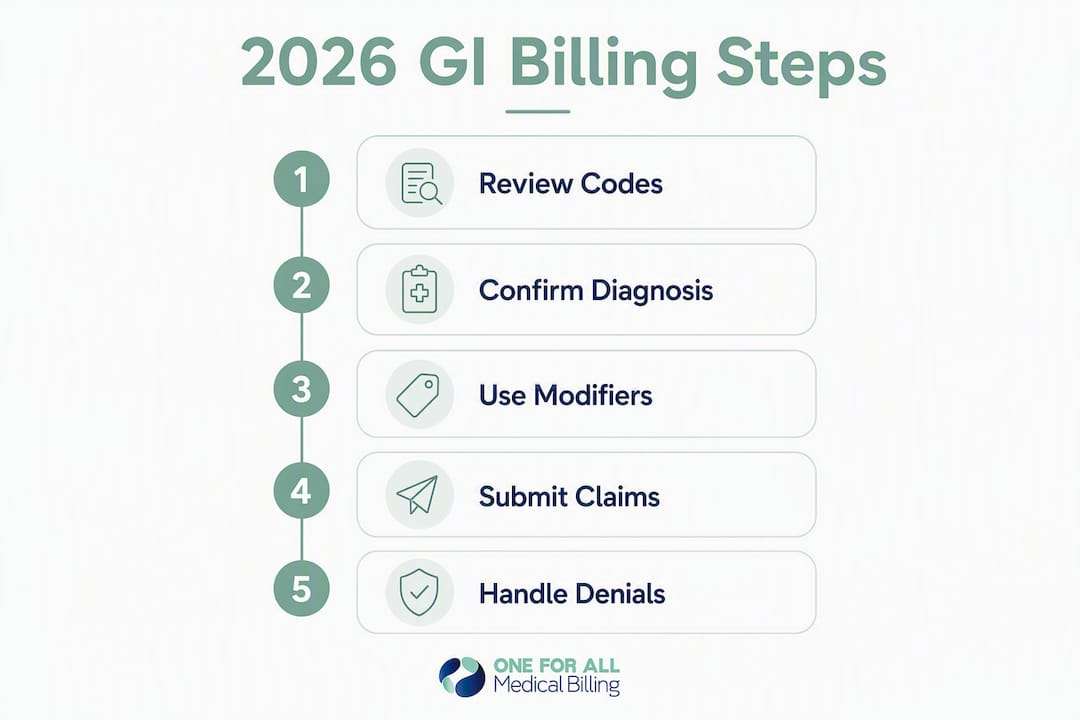
CPT 91110 (GI tract) and 91111 (esophagus) require documented failure or contraindication of conventional endoscopy for most payers to approve the claim.
New in 2026: ESG Code 43889
The Tri-GI Society 2026 CPT update introduced CPT 43889 for endoscopic sleeve gastroplasty. This code carries a global period and has specific bundling exclusions with certain EGD codes — review the Tri-GI guidance before billing it alongside upper endoscopy on the same date.
Anesthesia and Sedation
When a separate anesthesiologist provides monitored anesthesia care, that provider bills the anesthesia CPT. When the GI physician provides moderate sedation without a separate anesthesia provider, the physician bills 99152 (first 15 minutes) and 99153 (each additional 15 minutes), per RVUDoc’s 2026 GI billing guide. Billing both the procedure and moderate sedation is appropriate in that scenario; billing moderate sedation when a separate anesthesiologist is present is not.
Pro Tip: When a screening colonoscopy converts to a therapeutic procedure, the correct modifier chain is: bill 45385 (or the applicable therapeutic code) with modifier PT appended. Modifier PT signals that the service began as a preventive screening, which preserves the patient’s $0 cost-share under ACA rules while correctly reflecting the therapeutic upgrade. Never bill 45378 with modifier 33 when a polypectomy was actually performed — that combination understates the work and misrepresents the service.
ICD-10-CM diagnosis coding in GI: which codes to use and why linkage matters
Diagnosis selection in GI billing does more than satisfy a payer’s medical-necessity requirement. It directly determines whether a patient owes a cost-share and whether a claim passes first-pass review.
Common GI Diagnosis Categories
- Screening — Z12.11 (encounter for screening for malignant neoplasm of colon). Use this when the procedure is preventive with no prior symptoms or findings.
- GI bleeding — K92.1 (melena), K92.0 (hematemesis), K57.30 (diverticulosis with bleeding). These symptom codes convert a screening to a diagnostic encounter.
- Surveillance — Z12.11 with history codes (Z80.0 personal history of colon polyps, Z85.038 personal history of colon cancer). Surveillance intervals must be documented and match society guidelines to support medical necessity.
- Inflammatory bowel disease — K50.x (Crohn’s disease), K51.x (ulcerative colitis). Specificity matters: code to the site and severity level documented.
- GERD and motility disorders — K21.0 (GERD with esophagitis), K22.0 (achalasia), K59.00 (constipation, unspecified). Use the most specific code the documentation supports.
- Functional disorders — K58.0 (IBS with diarrhea), K58.9 (IBS without diarrhea). These codes require documented clinical criteria; vague functional complaints without workup documentation invite denials.
How Diagnosis Choice Changes Patient Cost-Share
When a colonoscopy begins as a screening (Z12.11) and no polyp is found, the patient typically owes nothing under ACA preventive care rules. The moment a symptom code or a finding code becomes the primary diagnosis, the encounter is diagnostic and cost-share applies. PayerReady’s screening conversion guidance notes that front-office confirmation of the procedure’s preventive intent, documented before the visit, prevents improper balance billing when the procedure remains purely diagnostic.
CPT + ICD Linkage Examples
- Screening colonoscopy, no findings: 45378 + Z12.11 + modifier 33. Patient owes $0 under most commercial plans.
- Screening colonoscopy, polyp removed by snare: 45385 + Z12.11 + modifier PT. Patient still owes $0 for the preventive intent; the PT modifier signals the therapeutic upgrade.
- Colonoscopy for rectal bleeding: 45378 or 45380 + K92.1. This is a diagnostic encounter; standard cost-share applies.
- Surveillance colonoscopy, history of polyps: 45378 + Z12.11 + Z80.0. Document the surveillance interval in the clinical note to support medical necessity.
What your op notes must contain to support clean claims
Documentation is where GI billing either holds up or falls apart under payer scrutiny. A technically correct CPT code attached to a thin op note is a denial waiting to happen.
Must-Have Elements in Every Endoscopy Note
- Clinical indication and procedure intent (screening, diagnostic, or therapeutic)
- Anatomic segment detail: name every segment examined and every site where a finding was noted or an intervention performed
- Polyp characteristics: size in millimeters, location by segment, morphology (pedunculated, sessile, flat), and removal technique
- Withdrawal time: document 6 or more minutes for colonoscopy; RVUDoc’s documentation guidance identifies withdrawal time as a key element that reduces medical-necessity challenges
- Boston Bowel Prep Scale score for each colonic segment
- Photographic documentation of cecal landmarks (ileocecal valve, appendiceal orifice)
- Specimens sent to pathology: note the accession number or pending status for each specimen
- Post-procedure instructions and follow-up plan
E/M on the Same Date as a Procedure
When a physician bills an E/M service on the same date as an endoscopy, time-based E/M selection must exclude time spent on the separately reported procedure. Per AGA’s 2026 CPT coding update, only the time related to E/M activities — history, exam, counseling, care coordination — counts toward the E/M level. Modifier 25 is required on the E/M code to signal a separately identifiable service.
Pro Tip: Build a structured endoscopy note template in your EHR that includes mandatory fields for withdrawal time, Boston Bowel Prep Scale, and pathology accession number. Make those fields required before the note can be signed. Coders should not have to hunt for these elements — if they are not in a predictable location, they get missed, and the claim goes out incomplete.
Prior authorizations, payer rules, and what 2026 Medicare updates mean for GI
Authorization requirements in GI have expanded as payers scrutinize high-cost procedures more closely. Missing a prior-auth step is one of the fastest ways to generate a denial that is difficult to appeal retroactively.
Procedures That Commonly Require Prior Authorization
- Capsule endoscopy (91110, 91111): most commercial payers require documented failure or contraindication of conventional endoscopy
- ERCP (43260 series): clinical indication, prior imaging, and failed conservative management are typically required
- Endoscopic sleeve gastroplasty (43889): new in 2026, this code will face heightened payer scrutiny; the Tri-GI Society guidance on global periods and bundling is the starting point for building your auth checklist
- EUS with fine needle aspiration (43242): requires documented clinical rationale for tissue sampling
- Repeat surveillance colonoscopies outside standard intervals: document the clinical reason for shortened interval
2026 CPT Updates from AGA and the Tri-GI Societies
The AGA’s March 2026 CPT update summarizes new codes affecting endoscopic and motility procedures, along with E/M documentation reminders that practices should map to their EHR templates. The Tri-GI 2026 update introduced 43889 with a defined global period — procedures bundled within that global window cannot be billed separately without documentation of a distinct clinical indication.
Medicare Considerations
The CY 2027 Medicare Physician Fee Schedule proposed rule signals continued CMS focus on value-based care and accountable care models, which affects how GI practices document and report quality measures. Medicare’s preventive colonoscopy benefit covers screening colonoscopies for beneficiaries at average risk every 10 years, or every 2 years for high-risk patients — and the ACA cost-share waiver for screening applies to Medicare Advantage plans as well, though traditional Medicare has its own cost-share rules that vary by finding.
Prior-Auth Integration Checklist
- Front desk confirms procedure type and payer at scheduling
- Clinical staff pulls payer-specific auth requirements from your payer matrix
- Coder reviews the scheduled CPT and flags auth-required codes
- Auth request submitted with clinical documentation at least 5 business days before the procedure
- Auth number logged in the scheduling system and attached to the claim before submission
Pro Tip: Build a payer-specific authorization matrix in your practice management system, updated quarterly. Map each high-risk CPT code to its payer-specific auth requirement, the clinical documentation needed, and the typical turnaround time. Practices that treat auth as a scheduling function rather than a billing function catch far more gaps before the procedure date.
Denial reasons in GI and a step-by-step appeal checklist
GI denials cluster around a predictable set of root causes. Knowing the pattern lets you triage faster and appeal smarter.
Top Denial Reasons in GI
- Incorrect screening-to-diagnostic conversion: billing a symptom code as primary when the procedure was scheduled as preventive, or vice versa
- Missing modifier 59 or XS for separate-site interventions at different colonic segments
- Lack of medical-necessity documentation for repeat surveillance outside standard intervals
- NCCI bundling violations: billing 45378 alongside 45385 at the same site
- Missing prior authorization for capsule endoscopy, ERCP, or advanced endoscopic procedures
- Incomplete op note: missing withdrawal time, bowel prep score, or pathology linkage
Step-by-Step Remediation Checklist
- Triage the denial — Identify the denial reason code (CO-4, CO-97, CO-167, etc.) and map it to the root cause category above
- Pull the original claim and op note — Compare the billed CPT/ICD pair against the documentation; identify the specific gap
- Request a clinical addendum if needed — The physician adds missing documentation (withdrawal time, segment names, polyp morphology) as a dated addendum, not a replacement note
- Build the appeal letter — Reference the specific CPT code, the denial reason, the corrected documentation, and the applicable payer policy or CMS guideline
- Submit within the payer’s appeal window — Most commercial payers allow 60–180 days from the denial date; Medicare has a defined appeals ladder (redetermination, reconsideration, ALJ)
- Track the appeal — Log submission date, expected response date, and outcome in your denial management system
- Escalate unresolved denials — If a first-level appeal fails, escalate to peer-to-peer review or the second appeal level with additional clinical support
Metrics to Track
- Denial rate by reason code (target: under 5% overall denial rate)
- Days from denial to appeal submission (target: under 10 business days)
- Appeal overturn rate by denial category
Pro Tip: Site-specific endoscopy photos and pathology accession numbers are the two most underused appeal tools in GI. When a payer denies a multi-site polypectomy claim for “insufficient documentation of separate sites,” submitting the photo log with segment labels and the corresponding pathology report with accession numbers overturns the denial at a high rate. Build the habit of attaching these to every appeal involving modifier 59 or XS.
How to build a GI billing workflow that keeps AR days low
A GI practice running high procedure volumes needs a charge-capture and claims management process that closes the loop the same day procedures are performed. Delayed charge entry is one of the most common and most preventable sources of revenue leakage.
Charge Capture Workflow Steps
- Pre-procedure: verify insurance eligibility, confirm prior-auth status, and flag any payer-specific coding rules for the scheduled CPT
- Intra-procedure: the endoscopist documents findings in real time using structured EHR templates
- Same-day reconciliation: a coder or charge-capture specialist reviews the op note, assigns CPT and ICD codes, and reconciles against the procedure schedule before end of day. RVUDoc’s workflow guidance identifies same-day charge reconciliation as a material driver of first-pass clean-claim rates
- Pathology coordination: when specimens are sent, flag the claim for pathology charge follow-up; the pathology CPT (88305 or similar) is billed separately and must be linked to the correct encounter
- Payer assignment: confirm the correct payer and plan type before submission; Medicare Advantage plans often have different rules than traditional Medicare
RCM KPIs for GI Practices
- Clean-claim rate: target 90% or above on first submission. One For All Medical Billing’s RCM solutions are built around this benchmark.
- Days in AR: target under 35 days for most GI practices; over 50 days signals a systemic workflow problem
- Denial rate: track by reason code, not just overall; a low overall rate can mask a high rate in one CPT category
- Net collection rate: target 95–98% of adjusted net charges
- First-pass acceptance rate: track separately from clean-claim rate; a claim can be clean but still rejected for eligibility or enrollment issues
Given the documented shortage of gastroenterologists driving higher per-physician procedure volumes, efficient charge capture is not optional — it is a capacity issue as much as a revenue issue.
Pro Tip: Build a weekly GI leadership dashboard with one primary KPI highlighted each week, rotating through key metrics such as clean-claim rate, AR days, denial rate by reason, and appeal overturn rate. A single focused metric per week keeps the team from drowning in data and surfaces the one lever that needs attention right now.

Modifiers in GI billing: when to use them and where audits focus
Modifiers are the most audit-prone element of GI coding. Used correctly, they protect revenue and reflect clinical reality. Used incorrectly, they invite recoupment.
The Modifiers GI Billers Use Most
- Modifier 33 — Preventive service. Appended to the procedure code when a colonoscopy is performed as a screening with no findings and no therapeutic intervention. Signals $0 patient cost-share under ACA preventive care rules.
- Modifier PT — Colorectal cancer screening converted to diagnostic/therapeutic. Use when a polyp is removed during a screening colonoscopy. Per PayerReady’s modifier guidance, PT preserves the patient’s preventive cost-share while correctly reflecting the therapeutic work performed.
- Modifier 59 / XS — Distinct procedural service / separate structure. Use when billing additional-site polypectomies or biopsies at anatomically distinct colonic segments. CMS’s modifier 59 guidance requires that the documentation clearly support a separate anatomic site or a distinct encounter.
- Modifier 52 — Reduced services. Use when a colonoscopy is incomplete due to patient tolerance or prep quality, and the physician did not reach the cecum.
- Modifier 53 — Discontinued procedure. Use when the procedure is stopped after initiation due to a medical complication or patient safety concern.
- Modifier 73/74 — Discontinued ambulatory surgical procedure before/after anesthesia administration. Used in the ASC setting.
- Modifier 25 — Separately identifiable E/M on the same date as a procedure. Required when billing an E/M alongside an endoscopy; the E/M must be documented as distinct from the pre-procedure assessment.
- Modifier 22 — Increased procedural services. Use when the work required was substantially greater than typical; requires a cover letter explaining the additional complexity.
Usage Examples
- Screening colonoscopy, no findings: 45378 + modifier 33
- Screening colonoscopy, snare polypectomy performed: 45385 + modifier PT
- Colonoscopy with polypectomies at ascending colon and sigmoid: 45385 (primary) + 45385-59 or 45385-XS (additional site) with segment names documented
- Same-session EGD and colonoscopy: 43235 (EGD) + 45378-51 (colonoscopy, multiple procedures)
- Incomplete colonoscopy due to poor prep: 45378 + modifier 52
Audit-Risk Red Flags
- Modifier 59 applied without distinct segment documentation
- Modifier 22 without a supporting cover letter
- Modifier 25 on an E/M that duplicates the pre-procedure note
- Modifier PT applied to a diagnostic colonoscopy that was never scheduled as a screening
Pro Tip: For every claim using modifier 59, XS, or PT, the op note must contain: (1) the specific anatomic segment name for each intervention site, (2) the removal technique for each polyp, and (3) the pathology accession number or pending status for each specimen. If any of those three elements is missing, the modifier will not survive an audit.
How One For All Medical Billing addresses gastroenterology billing challenges
GI billing is one of the most documentation-intensive specialties in outpatient medicine. The combination of high procedure volume, complex modifier rules, and payer-specific screening conversion policies creates a billing environment where generalist RCM teams consistently underperform.
One For All Medical Billing approaches GI revenue cycle management with specialty-specific processes built around the code groups, documentation standards, and payer rules that actually drive GI revenue and denials.
Service Scope for GI Practices
- Specialty-specific CPT and ICD-10-CM coding for endoscopy, ERCP, EUS, capsule endoscopy, and motility procedures
- Claims submission with payer-specific modifier and bundling rules applied at the claim level
- Denial management: triage by reason code, clinical addendum coordination, and appeal submission within payer windows
- Prior-authorization handling: payer matrix management, auth request submission, and status tracking integrated into the scheduling workflow
- Pathology charge coordination: flagging and reconciling pathology CPTs against the originating endoscopy encounter
- Reporting and analytics: clean-claim rate, AR days, denial rate by CPT, and appeal overturn rate reported on a defined cadence
Performance Proof Points
One For All Medical Billing brings over 20 years of specialty billing experience and a high clean-claim rate benchmark to GI practices. That clean-claim benchmark directly reduces the administrative cost of denial management and accelerates cash flow.
Getting Started: Implementation Checklist
- Discovery call: review current CPT mix, denial patterns, and EHR platform
- Workflow mapping: document the charge-capture path from procedure to claim submission
- EHR integration: configure charge-capture templates and code-mapping rules
- Pilot period: run a defined volume of claims through the new workflow with side-by-side reporting
- Reporting cadence: establish weekly KPI dashboard delivery and monthly coder–clinician review sessions
For claims management guidance on selecting the right RCM partner for a GI practice, the implementation checklist above is the starting framework.
Key Takeaways
Accurate gastroenterology billing requires correct CPT/ICD linkage, disciplined modifier use, and a same-day charge-capture workflow to protect revenue and minimize denials.
| Point | Details |
|---|---|
| Screening vs. diagnostic intent | Confirm procedure intent before the visit; use modifier PT when a screening converts to polypectomy to preserve patient cost-share. |
| Op-note documentation | Every endoscopy note must include withdrawal time, Boston Bowel Prep Scale, segment-level findings, and pathology accession numbers. |
| Prior-auth gating | Capsule endoscopy, ERCP, and ESG (43889) require authorization before the procedure date; build auth checks into scheduling. |
| RCM KPIs to track | Target a 90% clean-claim rate and under 35 days in AR; track denial rate by CPT code, not just overall. |
| One For All Medical Billing | Specialty GI billing with 20+ years of experience and a 90% clean-claim rate benchmark supports faster reimbursement and fewer denials. |
The friction points GI practices consistently underestimate
The most expensive billing problems in gastroenterology are rarely the complex ones. They are the predictable ones that repeat month after month because no one has built a process to catch them.
Screening-to-diagnostic conversion errors are the clearest example. The clinical team knows the procedure was scheduled as a screening. The billing team sees a polypectomy code and no modifier. The claim goes out wrong, the patient gets an unexpected bill, and the practice spends time on a complaint that a two-minute pre-procedure huddle would have prevented.
Documentation gaps are the second pattern. Withdrawal time and the Boston Bowel Prep Scale score are not optional elements — they are the clinical evidence that supports the claim’s completeness and medical necessity. When those fields are missing from the op note, the coder either holds the claim or submits it without the supporting detail. Both outcomes cost the practice money.
The cultural fix is straightforward but requires consistent reinforcement: monthly coder–clinician calibration sessions where the team reviews the prior month’s denial patterns, traces each denial back to its documentation or coding root cause, and updates the EHR template or pre-procedure workflow accordingly. Practices that run these sessions regularly see their denial rates drop and their clean-claim rates climb. The ones that skip them keep making the same mistakes.
Your GI practice deserves specialty-level billing support
GI practices face a billing environment that rewards specificity: the right modifier, the right diagnosis, the right documentation, submitted on time with the right prior authorization attached. Generic billing services miss the nuances that cost GI practices real revenue every month.
One For All Medical Billing provides full-service GI revenue cycle management, from specialty CPT coding and modifier application through denial management, prior-auth handling, and pathology charge coordination. With over 20 years of specialty billing experience and a 90% clean-claim rate, the team is built for the documentation intensity and payer complexity that GI practices deal with daily. The next step is a discovery call to review your current denial patterns and charge-capture workflow. Contact One For All Medical Billing to schedule that conversation and see where your revenue cycle has room to improve.
Authoritative resources and further reading
Use these primary sources when verifying coding rules, payer policies, and society guidance for GI billing:
- CMS Modifier 59 Guidance — The primary CMS source for modifier 59 and X-modifier application rules; required reading before building any multi-site polypectomy billing workflow.
- One For All Medical Billing — Specialty GI billing services, RCM solutions, and implementation support for practices seeking to improve clean-claim rates and reduce denials.
FAQ
What CPT codes are used most often in gastroenterology?
The highest-volume GI CPT codes are 45378 (diagnostic colonoscopy), 45380 (colonoscopy with biopsy), 45385 (colonoscopy with snare polypectomy), 43235 (diagnostic EGD), and 43239 (EGD with biopsy). Advanced procedures like ERCP (43260 series) and EUS (43237, 43242) carry higher work RVUs but require prior authorization from most payers.
What is the difference between CPT 45380 and 45385?
CPT 45380 is a colonoscopy with biopsy using cold forceps, while 45385 is a colonoscopy with polypectomy using a snare technique. Bill the code that reflects the actual removal method documented in the op note; billing 45378 alongside either code at the same site is an NCCI bundling violation.
How does screening-to-diagnostic conversion work in GI billing?
When a screening colonoscopy results in a polyp removal, the correct approach is to bill the therapeutic code (e.g., 45385) with modifier PT rather than the screening code 45378 with modifier 33. Modifier PT signals that the procedure began as a preventive screening, which preserves the patient’s $0 cost-share under ACA rules while accurately reflecting the therapeutic work performed.
How does medical billing work for GI practices in the U.S.?
GI practices submit claims to commercial payers and Medicare using CPT procedure codes paired with ICD-10-CM diagnosis codes. The claim must include the correct modifiers, prior-authorization numbers for applicable procedures, and documentation that supports medical necessity. Denied claims can be appealed through payer-specific processes, with Medicare offering a formal multi-level appeals ladder.

