

table of contents
A timely filing limit is the payer-set deadline by which a claim must be received and accepted — miss it, and the denial is usually final. Here are the windows you need to know right now:
- Medicare (Part A and Part B): 12 months from date of service, enforced by CMS and Medicare Administrative Contractors (MACs); narrow statutory exceptions only.
- Medicaid: State-dependent, commonly ranging from 90 to 365 days; Texas often enforces 95 days, New York often 90 days, and Florida allows up to 365 days for some services.
- Commercial payers: Typically 90–180 days, with many plans and Medicare Advantage contracts now trending toward 90-day windows.
- Blue Cross Blue Shield (BCBS): Varies by affiliate; some allow 180 days, others enforce 90 days. Always check the local BCBS affiliate’s provider manual.
Your immediate action: pull the filing window from every active payer contract and provider manual today. Aim to submit claims within 24–48 hours of the date of service whenever possible. The shortest window in your payer mix sets the operational pace for your entire billing team.
Why this matters: Timely filing denials are among the most costly and least recoverable in revenue cycle management. Unlike a coding error, a missed filing deadline rarely gives you a second chance.
What does “timely filing” actually mean in a payer contract?
Timely filing is not a vague industry norm. It is a contractual obligation written into every payer agreement you sign, and the payer’s own language controls — not a third-party reference table, not a colleague’s recollection from a prior contract cycle.
A typical timely filing clause reads something like this: “Claims must be received by the payer no later than [X] days from the date of service (or date of discharge for inpatient stays) to be considered for reimbursement.” The operative word is received. The payer’s receipt of a processable claim governs the deadline, not the date your practice management system marked the claim as sent, and not the clearinghouse 999 acknowledgment. A payer-side 277CA (claim acceptance transaction) is the standard proof of receipt most payers recognize.
The distinction that trips up billing teams: A clearinghouse 999 confirms the file was syntactically accepted by the clearinghouse. A payer 277CA confirms the payer received and accepted the claim for adjudication. Only the latter protects you against a timely filing denial.
Payer contracts also draw a line between three separate windows that must be tracked independently:
- Initial claim window: The primary filing deadline measured from the trigger event (usually date of service or discharge).
- Corrected/adjusted claim window: Many payers require corrected claims within 60 days of the denial or rejection date — a shorter, separate clock.
- Appeal and reopening window: Also limited; for Medicare, reopening requests follow specific regulatory timelines distinct from the standard redetermination process.
Pro Tip: When you onboard a new payer contract, extract all three windows — initial, corrected, and appeal — and log them in your payer tracker the same day. Treating them as one deadline is one of the most common process failures in billing departments.
Common trigger events that start the clock vary by claim type:
- Date of service (DOS): Standard for most outpatient and professional claims.
- Discharge date (through date): Applies to inpatient claims; the clock starts on the last day of the stay, not admission.
- Final date of service for span-of-service claims: Some payers measure from the last date in a date range, not the first.
- Date of primary EOB for secondary/COB claims: Secondary payers often measure from when the primary paid or denied, not from the original DOS.
Timely filing limits by payer type: Medicare, Medicaid, commercial, and BCBS
Getting the deadline right starts with knowing which payer you are dealing with and where to find the authoritative rule. Here is what the primary sources say.
Medicare
Federal regulation at 42 C.F.R. § 424.44 sets the Medicare timely filing window at one calendar year from the date of service for services furnished on or after January 1, 2010. CMS and MACs enforce this uniformly for Part A and Part B claims. Per Medicare.gov, if a doctor sees a patient on March 22, 2025, the claim must be filed by March 22, 2026. No exceptions apply unless a narrow statutory condition is met (see the exceptions section below).
One critical nuance: Medicare Advantage (MA) plans are private contracts. They are not bound by Original Medicare’s 12-month rule and can require filing windows as short as 90 days. Never apply the Original Medicare standard to an MA plan without verifying the specific plan’s contract.
Medicaid
Medicaid timely filing limits are set at the state level, and the variation is significant. Industry sources cite windows commonly ranging from 90 to 365 days, with examples including Texas at approximately 95 days, New York at approximately 90 days, and Florida allowing up to 365 days for certain services. The controlling document is your state’s Medicaid provider manual, available through the state Medicaid agency’s website. Check Medicaid.gov for state plan amendments that may affect filing requirements.
Commercial payers
Commercial payers typically set filing windows between 90 and 180 days, and the trend since 2024 has been toward tighter 90-day enforcement, particularly for Medicare Advantage and managed care contracts. Your signed contract controls. A payer’s website or provider manual may list a general policy, but if your contract specifies a different window, that language governs.
Blue Cross Blue Shield affiliates
BCBS is a federation of independent affiliates, and filing windows vary meaningfully from one affiliate to the next. Some affiliates allow 180 days; others enforce 90 days. There is no single BCBS national rule you can rely on. The only reliable source is the provider manual for the specific BCBS affiliate serving your market. Check the affiliate’s provider portal or contact provider relations directly when you cannot locate the policy in writing.
Where to find authoritative limits:
- Your signed payer contract (the controlling document)
- The payer’s provider manual or policy page on the provider portal
- Your MAC’s website for Medicare guidance
- Your state Medicaid agency’s provider manual
- Clearinghouse payer reference guides (starting point only — always verify against the contract)
Third-party reference tables, including widely circulated “cheat sheets,” are useful starting points. They are not authoritative. Your contract and the payer’s provider manual are.
When does the timely filing clock actually start?
The trigger event is where billing teams most often lose track of the deadline, particularly for inpatient and secondary claims. Getting this right is not a detail — it is the difference between a payable claim and a permanent write-off.
For most outpatient and professional claims, the clock starts on the date of service. Straightforward enough. But several claim types carry different triggers, and missing the distinction is costly.

Inpatient claims: The filing window starts on the discharge date (the “through” date on the claim), not the admission date. A patient admitted on January 5 and discharged on January 12 gives you a filing window that begins January 12. Billing teams that start the clock on admission date are working with a shorter effective window than they realize.
Span-of-service claims: For services billed across a date range (common in home health, skilled nursing, and some therapy claims), many payers measure from the last date of service in the span. Confirm this with each payer’s manual, because some measure from the first date.
Secondary and coordination of benefits (COB) claims: Secondary payers frequently measure the filing window from the date of the primary payer’s explanation of benefits (EOB), not from the original date of service. This means a slow primary payer can compress your secondary filing window significantly. Track payment posting dates and EOB receipt dates as part of your secondary routing workflow.
Rejected claims and clearinghouse errors: A claim rejected by the clearinghouse or returned as unprocessable by the payer does not stop the clock. The original filing deadline continues to run. If a claim is rejected on day 45 of a 90-day window, you have 45 days left to correct and resubmit — not a fresh 90 days from the rejection date.
Pro Tip: Store the payer-side 277CA transaction for every claim as your proof of receipt. A clearinghouse 999 acknowledgment confirms file delivery to the clearinghouse, not payer acceptance. Only the 277CA or an equivalent payer acceptance document protects you if the payer later claims the claim was never received within the window.
Exceptions and extensions that can reset a filing deadline
The exceptions are narrow. Billing teams that treat them as a safety net will be disappointed. That said, knowing the specific conditions that qualify can recover revenue that would otherwise be written off.
Medicare statutory exceptions under 42 C.F.R. § 424.44
The federal regulation lists a small set of recognized exceptions that can extend the filing window:
- Administrative error by Medicare or a contractor: If CMS or a Medicare contractor (including a MAC, intermediary, or carrier) made an error or misrepresentation that caused the late filing, the window extends through the last day of the sixth calendar month following the month in which the error was corrected and notification was received. Requests must be made within four years of the date of service.
- Retroactive Medicare entitlement: If a beneficiary’s Medicare coverage was established retroactively to or before the date of service, the window extends through the last day of the sixth calendar month following the month in which the provider received notification of that retroactive entitlement.
- Retroactive entitlement involving a state Medicaid agency: When a state Medicaid agency recovers a Medicaid payment from the provider because Medicare was the primary payer, the window extends through the last day of the sixth calendar month following the month of that Medicaid recovery.
- Retroactive disenrollment from a Medicare Advantage plan or PACE organization: If a beneficiary was retroactively disenrolled from an MA plan or PACE organization, the extension runs through the last day of the sixth calendar month following the month in which the MA plan or PACE organization recovered its payment from the provider.
Commercial payer exceptions
Commercial exceptions are contract-dependent and less standardized. Situations that sometimes qualify include:
- Documented payer system failures that prevented claim receipt
- Retroactive eligibility established after the service date
- Federally declared disaster declarations affecting operations
- Documented payer-side processing errors with a clear paper trail
These are rare. When you believe one applies, the burden of proof is entirely on your practice. Collect every piece of documentation before you submit the exception request.
How to request an exception or reopening
- Identify the specific exception category that applies and confirm it is supported by your documentation.
- Gather supporting documents: the payer-side 277CA or equivalent acceptance record, the primary EOB for COB cases, retroactive eligibility letters, correspondence showing payer-side error, and any disaster declaration notices.
- For Medicare, submit a reopening request to the MAC with a written explanation citing the specific statutory exception under 42 C.F.R. § 424.44. A reopening is distinct from a standard redetermination and applies in limited circumstances.
- For commercial payers, submit through the payer’s formal appeal or reconsideration process, attaching all supporting documentation and citing the specific contract language or payer policy that supports the exception.
- Note the appeal or reopening window in your tracker immediately and assign an owner to monitor it.
The difference between a reopening and a standard appeal matters for Medicare. A reopening corrects a processed claim; a redetermination is the first level of the formal appeals process. Timely filing denials on Medicare claims typically require a reopening request citing a statutory exception, not a standard redetermination, because the claim was never paid in the first place.
What happens when you miss the deadline: denial codes and financial impact
Missing a timely filing deadline produces a specific, recognizable denial. Knowing the code and what it means helps your team triage quickly and decide whether to appeal or write off.
CO-29 is the Claim Adjustment Reason Code (CARC) that denotes “the time limit for filing has expired.” When you see CO-29 on a remittance advice, the payer is telling you the claim was received outside the filing window. Associated Remittance Advice Remark Codes (RARCs) may provide additional context, but CO-29 is the primary signal.
The hard truth about CO-29: Timely filing denials are frequently final. Unlike a coding error or an authorization issue, a CO-29 denial cannot usually be corrected and resubmitted — the window has closed. The only path to reversal is proof that the claim was received within the window, or that a recognized exception applies. If neither is true, the claim is a write-off.
The financial impact compounds quickly. The lost reimbursement is the obvious cost. The less visible cost is the administrative burden: staff time spent investigating, documenting, and submitting appeals that are unlikely to succeed, plus the cash-flow disruption of claims that age past collectability. Industry analyses consistently identify timely filing denials as among the most costly and least recoverable in revenue cycle management.
Quick decision guide when you receive a CO-29:
- Appeal if: You have a payer-side 277CA or equivalent acceptance document dated within the filing window. This is your strongest evidence and the most common path to reversal.
- Appeal if: You have documented proof of a recognized exception (retroactive eligibility letter, evidence of payer-side error, disaster declaration).
- Write off if: No proof of timely receipt exists and no exception applies. Spending staff time on an unwinnable appeal costs more than the write-off.
- Investigate payer error if: The claim was submitted well within the window but the payer is claiming otherwise. Pull your 277CA, check clearinghouse logs, and contact provider relations before accepting the denial.
On patient billing: Do not balance-bill patients for timely filing denials. The failure to file within the payer’s window is an administrative error on the provider’s side, not the patient’s. Most payer contracts and state regulations prohibit balance-billing patients for this reason, and doing so creates compliance and patient-relations problems that far outweigh any potential recovery.
How to build a payer-deadline tracker and weekly workflow
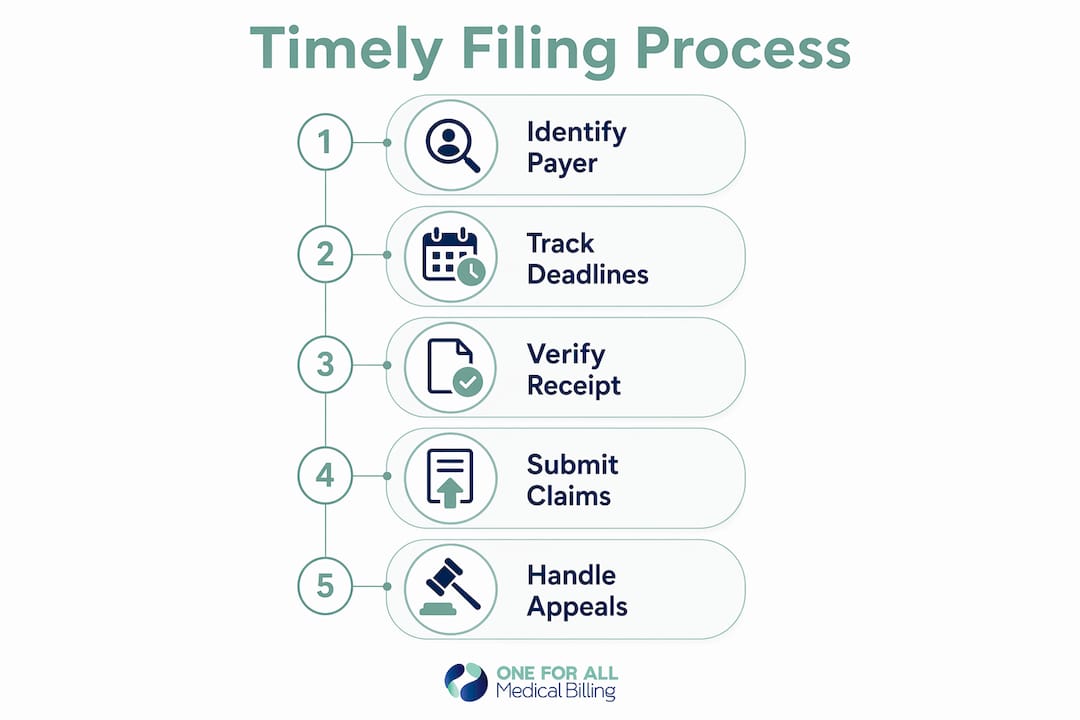
Prevention is the highest-return activity in timely filing management. A well-maintained payer-deadline tracker, combined with a consistent weekly workflow, eliminates most timely filing denials before they happen.

What your payer-deadline tracker should include
Build a tracker — whether in a spreadsheet, your practice management system, or a dedicated RCM platform — with at least these fields for every active payer:
- Payer name and plan type (Original Medicare, Medicare Advantage, Medicaid, commercial, BCBS affiliate)
- Contract filing window (days from trigger event)
- Trigger event type (DOS, discharge date, primary EOB date)
- EDI/acceptance evidence field (277CA received: yes/no, date)
- Secondary/COB timing rules
- Corrected claim window (days from denial/rejection)
- Appeal and reopening window
- Last verification date and next scheduled review
Treating this tracker as a living contract document — updated whenever a contract renews or a provider manual changes — is what separates billing teams that prevent denials from those that chase them.
Daily and weekly operational workflow
Daily:
- Verify 277CA receipt for all claims submitted the prior day; flag any missing acceptances for same-day follow-up.
- Triage clearinghouse rejections (999 errors) and correct and resubmit before the end of the business day.
- Route secondary claims as soon as primary EOBs are posted; do not let secondary claims sit in a queue.
Weekly:
- Run an accounts receivable aging sweep across the 0–30, 31–60, and 61–90 day buckets.
- Flag any claim in the 31–60 bucket that has not received a 277CA or payer acknowledgment and escalate immediately.
- Review all claims approaching 75% of their filing window and confirm submission status.
- Check for corrected-claim deadlines on any claims denied or rejected in the prior week.
Automation and integration points
Modern clearinghouse and RCM platforms offer several automation options that reduce manual tracking burden:
- Eligibility verification at scheduling and again at check-in to catch retroactive coverage changes early.
- Claim scrubbing before submission to catch errors that would produce rejections and compress your effective filing window.
- Automated deadline alerts when a claim approaches a configurable percentage of its filing window (e.g., 50% and 75% thresholds).
- 277CA and 999 acknowledgment integration so acceptance status is visible in your workflow without manual log review.
Pro Tip: Assign a named owner for payer-rule updates — one person whose job it is to review provider manual changes and contract renewals and update the tracker within five business days. Diffuse ownership means no one owns it, and filing windows slip through unnoticed.
How to appeal a timely filing denial: checklist and template
Before you invest staff time in an appeal, confirm that you have a viable basis. An appeal without proof of timely receipt or a recognized exception is unlikely to succeed and costs more in labor than the write-off.
Step-by-step appeal checklist
- Pull the payer-side 277CA or equivalent acceptance document and confirm the date. If the date falls within the filing window, you have a strong appeal.
- For COB/secondary claims, pull the primary payer’s EOB and confirm the date the secondary filing window opened.
- For retroactive eligibility cases, obtain the eligibility confirmation letter showing the effective date of coverage.
- For payer-error cases, document the error with screenshots of the payer portal, correspondence, or clearinghouse logs showing the claim was submitted on time.
- For Medicare reopening requests, identify the specific statutory exception under 42 C.F.R. § 424.44 that applies and prepare a written explanation citing that section.
- Compile all documents into a single organized packet before submitting. Incomplete appeals are denied on procedural grounds.
- Note the appeal or reopening deadline in your tracker and assign an owner to monitor the response.
Pro Tip: For denied insurance claims, your appeal documentation should lead with the 277CA date, state the filing window from the contract, and present the evidence in a single paragraph before listing attachments. Payer reviewers process high volumes; a clear, front-loaded summary gets read.
Sample appeal summary structure
Subject line: Timely Filing Appeal — [Patient Name], [Claim Number], DOS [Date]
Opening sentence: This appeal requests reconsideration of claim [number] denied under CO-29, as payer acceptance of this claim is documented within the [X]-day filing window per our provider agreement dated [date].
Evidence list:
- 277CA transaction dated [date] (within filing window)
- Copy of provider agreement section [X] confirming [X]-day filing window
- [Any additional supporting documents]
Requested outcome: Reversal of the CO-29 denial and processing of the claim for reimbursement per the terms of the provider agreement.
Appeal and reopening timing
Most commercial payers require appeals within 60–180 days of the denial date; check your contract for the specific window. Medicare redetermination requests must be filed within 120 days of the claim determination date. Mark these deadlines in your tracker the same day the denial is received — an expired appeal window on top of a timely filing denial means the revenue is gone.
Where to verify the exact filing limit for any payer
No reference table, including this one, replaces the primary source. Here is the verification checklist your team should run for every active payer, and for any new payer before the first claim is submitted.
Verification checklist:
- Provider contract: Pull the signed agreement and locate the timely filing clause. This is the controlling document. Note the exact number of days, the trigger event, and any exceptions listed.
- Payer provider manual: Download the current version from the payer’s provider portal. Provider manuals are updated more frequently than contracts and may contain clarifications or policy changes that affect your effective window.
- Clearinghouse payer reference: Your clearinghouse may publish payer-specific filing windows. Treat these as a cross-reference, not an authority.
- State Medicaid provider manual: For Medicaid claims, download the current manual from your state Medicaid agency’s website. Check Medicaid.gov for state plan amendments.
- MAC guidance for Medicare: Your MAC’s provider education pages publish timely filing guidance, FAQs, and exception procedures specific to your jurisdiction.
- Payer portal acceptance evidence: Confirm that your clearinghouse or practice management system captures and stores 277CA transactions as part of the standard claims workflow.
Re-verify every payer’s filing window at contract renewal and at least annually for payers without fixed renewal dates. When a provider manual is updated mid-cycle, update your tracker within five business days. The due diligence checklist for evaluating billing partners covers this verification process in detail and is worth reviewing as a model for your internal audit.
Real-world lessons from 20+ years of billing
The most expensive timely filing denial we see in practice is not the one caused by a forgotten claim. It is the one caused by a process assumption — a billing team that applied Original Medicare’s 12-month rule to a Medicare Advantage plan, or that counted a clearinghouse 999 as proof of payer receipt.
Consider a common scenario: a claim is submitted electronically on day 45 of a 90-day commercial window. The clearinghouse returns a 999 acknowledgment, and the claim is marked “sent” in the practice management system. On day 92, the payer denies with CO-29. The billing team pulls the clearinghouse log and discovers the claim was rejected by the payer’s front-end edits on day 46 — a missing modifier — and was never accepted for adjudication. No 277CA was ever generated. The corrected claim was resubmitted on day 93. The denial is final. The corrective step: build 277CA verification into the daily workflow so rejected claims surface within 24 hours, not 47 days later.
The lesson that sticks: Prevention is higher ROI than appeals. A timely filing denial is not just lost reimbursement — it is the administrative cost of the appeal, the cash-flow disruption, and the staff time spent on a claim that was never going to pay. The billing teams that keep timely filing denials near zero are the ones that treat the payer-deadline tracker as a living operational document, not a reference they check when something goes wrong.
One For All Medical Billing brings over 20 years of billing experience and a 90% clean claim rate to this work. The practices that achieve that rate share a few common disciplines: they verify 277CA receipt daily, they maintain payer-specific filing windows in a tracked document updated at every contract renewal, and they run a monthly denial post-mortem that flags any CO-29 denial for root-cause analysis.
Internal checklist used by high-performing billing teams:
- Daily: confirm 277CA receipt for prior-day submissions; triage and correct all rejections before end of day.
- Weekly: run aging sweep across 0–30, 31–60, and 61–90 buckets; escalate any claim past 50% of its filing window without a 277CA.
- Monthly: pull all CO-29 denials and conduct a root-cause review; identify whether the miss was a submission error, a tracker gap, or a payer-side issue.
- Quarterly: audit the top 10 payers’ provider manuals for policy changes; update the tracker and brief the billing team on any window changes.
Key Takeaways
Timely filing denials are preventable with the right payer-specific tracker, daily 277CA verification, and a clear understanding of which trigger event starts each payer’s clock.
| Point | Details |
|---|---|
| Medicare’s window is fixed | CMS enforces a 12-month filing window for Part A and Part B claims; Medicare Advantage plans can require as few as 90 days. |
| Commercial windows are tightening | Most commercial payers set 90–180 day windows; the trend since 2024 has moved toward 90-day enforcement for many plans. |
| The 277CA is your proof | Payer receipt is what the deadline measures — a clearinghouse 999 does not prove payer acceptance; only a 277CA or equivalent does. |
| CO-29 denials are often final | Timely filing denials are among the least recoverable in revenue cycle management; prevention outperforms appeals in every cost analysis. |
| One For All Medical Billing | With 20+ years of experience and a 90% clean claim rate, One For All Medical Billing helps providers build the payer-deadline workflows that prevent CO-29 denials before they happen. |
The real cost of treating timely filing as a back-office detail
Most billing teams know timely filing matters. Fewer treat it with the operational rigor it deserves, and the gap between those two groups shows up directly in write-offs.
The conventional wisdom is that timely filing denials are a training problem — staff just need to know the deadlines. That framing misses the structural issue. The deadlines are not the problem. The problem is the chain of operational decisions between the date of service and the payer’s receipt of a processable claim: eligibility verification, charge capture, coding review, claim scrubbing, submission, and 277CA confirmation. Any break in that chain can push a claim past its window, and by the time CO-29 appears on the remittance, the opportunity to fix it is gone.
What actually works is treating timely filing as a process-control problem, not a knowledge problem. That means building the 277CA check into the daily workflow so rejected claims surface within 24 hours. It means maintaining a payer-deadline tracker that is updated at contract renewal, not when a denial appears. It means running a monthly CO-29 post-mortem so the same process failure does not repeat. And it means training staff on the Medicare Advantage distinction specifically — because the assumption that Original Medicare’s 12-month rule applies to MA plans is one of the most common and expensive errors in billing departments today.
The billing teams that keep timely filing denials near zero are not necessarily the ones with the most sophisticated technology. They are the ones with the most consistent process discipline. That discipline is teachable, auditable, and worth building before the next contract renewal brings a shorter filing window.
One For All Medical Billing: payer-deadline audits and denial prevention
Timely filing denials are preventable, and the fastest path to prevention is knowing exactly where your current process breaks down.

One For All Medical Billing offers payer-deadline audits, full-service claims submission with 277CA tracking, and denial management for healthcare providers across Oklahoma and nationwide. With over 20 years of billing experience and a 90% clean claim rate, the team works with individual providers and multi-site health systems to build the payer-specific workflows that keep claims payable. Services include identifying filing window gaps in your current payer mix, correcting tracker deficiencies before they produce CO-29 denials, managing appeals when proof of timely receipt exists, and training billing staff on payer-specific rules including the Medicare Advantage distinction.
If you want to know where your practice stands on timely filing risk, the right next step is a payer-deadline audit. Contact One For All Medical Billing or review the full-service billing and RCM options to get started with a team that treats your filing windows as seriously as you do.
Useful sources and where to verify payer rules
Your contract and the payer’s provider manual are the controlling documents. These primary sources are where to go when you need an authoritative answer.
- 42 C.F.R. § 424.44 (eCFR): The federal regulation that sets Medicare’s 12-month filing window and lists the statutory exceptions. Read the actual regulatory text, not a summary, when preparing a reopening request.
- Medicare.gov — Filing a Claim: CMS’s beneficiary-facing explanation of the 12-month rule, with a plain-language example. Useful for training materials and for confirming the basic rule with a primary-source citation.
- CMS Medicare Claims Processing Manual (Chapter 1): The authoritative operational manual covering timely filing periods, start-date determination, receipt-date rules, and exception procedures. Sections 70 through 70.8 cover timely filing in detail.
- Noridian — Timely Filing (JF Part A): MAC-specific guidance for providers in Noridian’s jurisdiction. Find your own MAC’s equivalent page for jurisdiction-specific rules and exception procedures.
- Medicaid.gov — State Plan Amendments: The federal repository for state Medicaid plan amendments, including changes that affect filing requirements. Use alongside your state Medicaid agency’s provider manual.
- Your state Medicaid agency’s provider manual: The single most authoritative source for your state’s Medicaid filing window. Download the current version directly from the state agency’s website; do not rely on a cached or third-party copy.
- Your payer’s provider portal and provider manual: Every major commercial payer and BCBS affiliate publishes a provider manual on its provider portal. This is where filing window policies, corrected-claim rules, and appeal procedures are documented. Download and date-stamp the version you rely on.
- Your signed provider contract: The timely filing clause in your contract controls over any general policy published by the payer. When the contract and the provider manual conflict, the contract governs.
Verification principle: Use third-party reference tables and industry guides as a starting point for awareness. Always confirm the specific window against your contract and the payer’s current provider manual before relying on it operationally. Payer policies change, and a filing window that was 180 days at your last contract renewal may now be 90 days.
FAQ
What is the timely filing limit for Medicare?
Medicare requires claims to be filed no later than 12 months (one calendar year) from the date of service for Part A and Part B claims, per 42 C.F.R. § 424.44. Medicare Advantage plans are private contracts and can require shorter windows, sometimes as few as 90 days.
What is the timely filing rule in medical billing?
A timely filing rule is the payer-set deadline by which a claim must be received and accepted for adjudication. Missing the deadline typically produces a CO-29 denial, which is frequently final and not correctable by resubmission.
What is a TFL limit and how is it different from an appeal window?
A TFL (timely filing limit) is the initial deadline for submitting a new claim, measured from a trigger event such as the date of service. An appeal window is a separate, often shorter deadline for contesting a denial after the claim has already been processed.
What is the timely filing limit for Medicaid?
Medicaid timely filing limits are set by each state and commonly range from 90 to 365 days. Texas often enforces approximately 95 days, New York approximately 90 days, and Florida allows up to 365 days for some services. Always check your state Medicaid agency’s current provider manual for the authoritative window.
Can a timely filing denial be appealed?
Yes, but only when you have proof that the claim was received by the payer within the filing window, or that a recognized exception applies. A payer-side 277CA acceptance document dated within the window is the strongest evidence. Without that proof or a qualifying exception, the denial is typically final.
Recommended
- Choose Top Medical Coding and Billing Companies – One For All Medical Billing
- Medical Billing Payment Posting: Strategic Guide 2026 – One For All Medical Billing
- Choose a Top Mental Health Billing Company in 2026 – One For All Medical Billing
- Mastering Prior Authorization Requirements: Your 2026 Guide – One For All Medical Billing

