

table of contents
A provider starts next Monday. Their schedule is full. Front desk staff have confirmed benefits, clinical leaders have built templates, and operations expects a smooth launch. Then billing asks the question that changes the mood in the room: is the provider fully credentialed and enrolled with every payer that matters?
If the answer is no, the clinic has a real revenue problem, not just an admin problem. The provider may be ready to treat patients, but the practice may not be ready to bill in network. For multi-site groups, that gap gets wider fast because each new location, payer mix, and provider type adds another layer of follow-up, status tracking, and documentation control.
The provider credentialing process works best when practice managers treat it like revenue cycle infrastructure. It needs ownership, timelines, escalation rules, and a system that holds up during hiring surges, acquisitions, and location expansion.
Why The Provider Credentialing Process Is A Revenue Cycle Pillar
The cleanest way to understand the provider credentialing process is to stop viewing it as back-office paperwork. It is a gatekeeper for claims, payment timing, and network access.

A common scenario proves the point. A provider joins your group, starts seeing patients, and quickly becomes productive. But if payer enrollment isn't complete, the practice may be unable to bill in network while those applications are still pending. That lag isn't unusual. Medallion's review of credentialing and revenue cycle impact notes that over half of medical practices saw an increase in denials tied to provider credentialing in 2021, and industry sources estimate an average credentialing timeline of 60 to 180 days.
That changes how an RCM team should prioritize the work. Credentialing affects charge capture value, denial volume, AR timing, and provider ramp-up planning. It also shapes patient access because scheduling teams often need to know when a clinician can be booked for specific plan types.
Why Multi Site Groups Feel The Pressure First
Single-location practices feel credentialing pain. Multi-site groups feel it everywhere at once.
A growing organization doesn't just credential one provider one time. It manages provider records across locations, specialties, supervisory relationships, and payer rosters. Every operational handoff matters. Recruiting has to communicate realistic start dates. Credentialing has to submit early. Billing has to know effective dates. Scheduling has to avoid placing in-network patients with a provider who can't yet bill their plan.
When those teams work from different spreadsheets or stale email threads, delays become expensive. That's why many organizations fold credentialing into broader revenue cycle management workflows instead of leaving it isolated with HR or medical staff administration.
Practical rule: If a provider can't bill, the credentialing file is still open from an RCM standpoint, even if hiring is complete.
Compliance Matters, But Cash Flow Is What Gets Attention
Credentialing absolutely supports compliance and patient safety. But in day-to-day operations, the issue that forces action is cash flow. Practices can absorb only so many preventable denials, retroactive corrections, and delayed effective dates before leadership starts asking harder questions about process ownership.
What works is simple, even if execution isn't. Start earlier than feels necessary. Tie credentialing milestones to onboarding milestones. Treat payer follow-up like AR follow-up. And don't assume a clinically ready provider is financially ready to launch.
Assembling Your Credentialing Toolkit For Success
Strong credentialing teams don't start with forms. They start with a controlled source file. If your documentation package is messy, inconsistent, or incomplete, every payer application turns into rework.
The core file should include the provider's education, licensure, training, work history, malpractice history, and references, because that's where the credentialing workflow begins according to this provider credentialing guide. The same source also notes that records must be verified from primary sources and that recredentialing is generally required every 2 to 3 years, which means the file you build now has to stay usable later.
Build A Credentialing Go Bag
I tell practice managers to create one master packet for each provider and maintain it like a controlled record set, not a loose folder of PDFs.
Include items such as:
- Current CV: Make sure dates are consistent with every other document and explain any employment changes clearly.
- State licenses: Keep active copies organized by state if the provider works across regions.
- Training records: Residency, fellowship, and other formal training documents should match the CV exactly.
- Malpractice history details: If there was an issue in the past, document it cleanly and consistently the first time.
- References and contact details: Missing or outdated contacts slow verification.
- Board certifications and supporting records: Store the current status and any renewal dates in the same place.
- Practice information: Tax ID, service location details, group identifiers, and supervisory information should be standardized before you start payer work.
For teams managing multiple locations, standardization matters more than perfection. Every provider packet should look the same, live in the same place, and follow the same naming rules.
Treat CAQH As Your Operational Source Of Truth
For many payer workflows, your CAQH profile becomes the center of gravity. If it contains old addresses, mismatched work history, or incomplete disclosures, those mistakes spread across applications.
That is why the best internal process is to update the master packet first, then update CAQH, then submit payer applications. Not the other way around.
A practical review checklist helps:
- Match all dates: CV, licenses, training, and employment history should align.
- Use one version of every name and address: Inconsistency creates avoidable payer questions.
- Document disclosures consistently: If a payer asks again later, your answer should not change.
- Set calendar reminders for re-attestation and renewals: Recredentialing is recurring work, not cleanup work.
- Assign one owner for final review: Shared responsibility often means no responsibility.
Teams that want a broader view of how verification systems work beyond healthcare can also learn from identity-proofing practices used in other regulated workflows. This 2026 identity verification guide is useful context for understanding why clean records and repeatable verification standards matter.
A payer application should never be the first place your team notices a gap, mismatch, or expired document.
Connect Credentialing Prep To Front End Revenue Work
Credentialing prep shouldn't sit in a silo. Once provider records are accurate, downstream teams can set better expectations for scheduling, plan acceptance, and front-desk communication. That coordination becomes much easier when credentialing and eligibility and benefits verification are managed with the same discipline around payer rules, effective dates, and documentation accuracy.
What doesn't work is chasing missing records after a start date is already on the calendar. By then, the clinic is operating under pressure, and every correction takes longer than it should.
Navigating The Credentialing Workflow From Start To Finish
The provider credentialing process feels opaque because most of the waiting happens outside your office. A file is submitted, then it disappears into verification queues, committee calendars, and payer enrollment workflows. Practice managers need a mental model for what is happening during that silence.
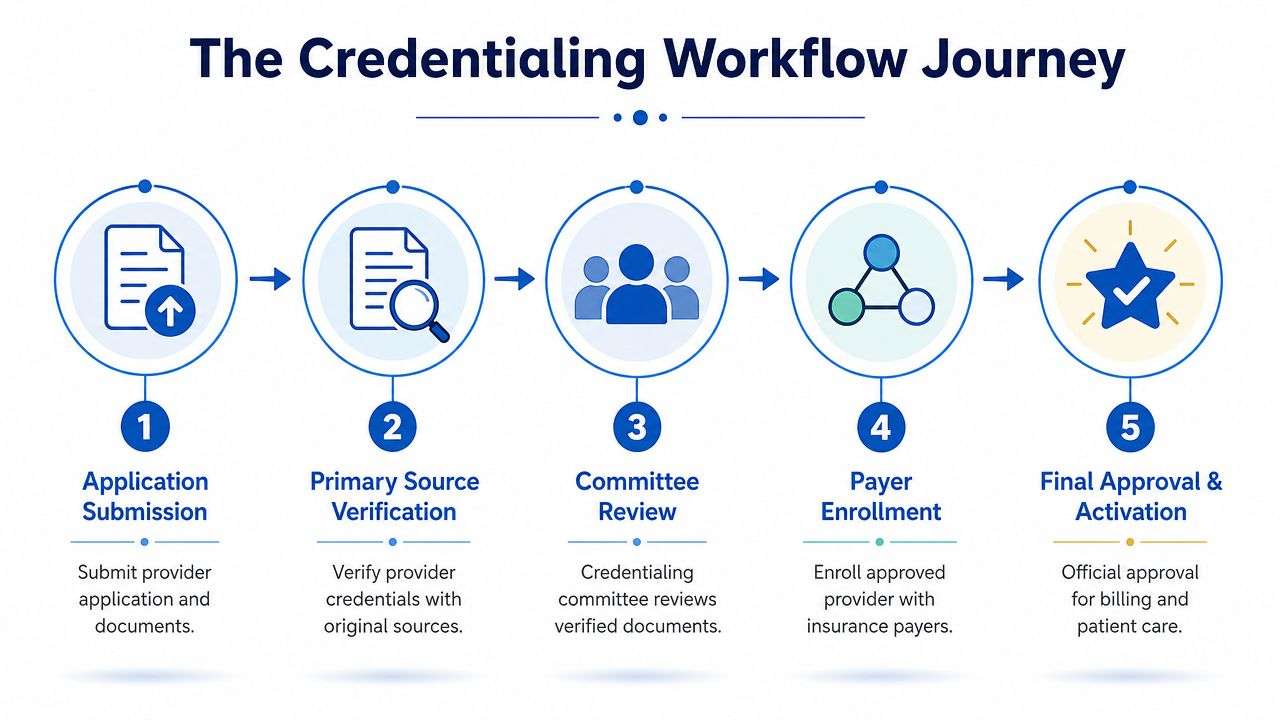
According to CAQH's explanation of provider credentialing, the process can take 30 days to six months or more, and a major checkpoint is committee review, which may occur only every 1 to 3 months before an application moves forward for final approval by the governing board. That timing explains why a file can appear “complete” internally and still sit in limbo externally.
What The Happy Path Actually Looks Like
A clean application usually moves through five stages.
Application submission
The provider file goes out with required documents and disclosures. If anything is missing, the delay starts here.Primary source verification
The payer or delegated entity verifies licenses, education, training, and other credentials directly with original sources. During this process, mismatched dates and incomplete histories surface.Internal review of discrepancies
If the verifier finds a gap, conflicting employment date, or unclear disclosure, the file often pauses for clarification.Committee review and approval routing
Many practice managers underestimate this step. Even a clean file may wait for the next review cycle.Payer enrollment and activation
Approval alone isn't always the end of the work. The provider still needs to be loaded correctly so billing can proceed under the right group and location setup.
Track It Like A Production Workflow
The best credentialing teams don't ask, “Was this submitted?” They ask, “What stage is it in, who owns the next action, and what date triggers escalation?”
A useful tracker includes fields like:
- Provider name and specialty
- Payer name
- Submission date
- Primary source verification status
- Pending issue or discrepancy
- Committee review status
- Expected effective date
- Last payer contact
- Next follow-up date
- Billing activation confirmed
That level of detail sounds administrative, but it changes outcomes. It turns vague status meetings into action lists.
If your tracker can't tell scheduling whether a provider is billable for a specific plan at a specific site, the tracker isn't finished.
Where Delays Usually Hide
The delay usually isn't one dramatic event. It is a chain of small pauses. A missing explanation for a work history gap. A committee meeting that isn't until next month. A payer record that needs a manual correction after approval.
Process discipline matters. Build follow-up intervals. Keep documentation centralized. Escalate when a file sits too long without movement. And make sure your team understands the difference between credentialed, enrolled, and operationally active. For a closer look at the moving parts, this overview of the credentialing process for physicians is a useful companion for teams standardizing physician onboarding workflows.
Managing Payer Enrollment For Medicare And Medicaid
Commercial plans already demand patience. Government enrollment adds another operational layer because the workflow often involves different systems, different terminology, and different review expectations.
For practice managers, the main mistake is treating all payer enrollment as if it moves through the same channel. It doesn't. Medicare and Medicaid require their own attention, and multi-site groups can't afford to let those tasks wait behind commercial submissions.
Medicare Needs Its Own Lane
Medicare enrollment usually requires disciplined handling of provider and organizational records inside PECOS. The practical challenge isn't just submitting data. It's making sure the provider's individual information, reassignment relationships, practice locations, and supporting records line up correctly before the file enters review.
What works in the field is a separate internal checklist for Medicare. Teams should confirm naming conventions, addresses, group relationships, and who is responsible for monitoring portal activity after submission. If your organization assumes that “submitted” means “done,” Medicare applications can stall without anyone noticing until billing asks why claims aren't moving.
For multi-site groups, it's smart to keep Medicare enrollment status visible on the same launch dashboard used by finance and operations. That way, a new site opening doesn't move ahead based on incomplete assumptions about provider readiness.
Medicaid Requires State Specific Discipline
Medicaid is harder to standardize because state rules, portals, document requests, and revalidation expectations can differ significantly. A workflow that works in one state may not transfer cleanly to another.
That matters for expanding groups. If you add locations across state lines, don't let one centralized process flatten important differences. Build a state-specific playbook that answers a few practical questions:
- Which portal is used
- What supporting documents are commonly requested
- Whether site enrollment and provider enrollment move together or separately
- Who follows portal messages and deficiency notices
- How effective dates are communicated to billing and scheduling
Separate work queues prevent government enrollment from getting buried under commercial payer volume.
Keep Government Enrollment Parallel, Not Sequential
One of the most reliable ways to lose time is to wait for one payer category to finish before starting another. In real operations, Medicare, Medicaid, and commercial work should move in parallel whenever the documentation set is ready.
That doesn't mean every payer will finish together. It means your internal process shouldn't create avoidable sequencing delays. Groups that serve community-based populations know this especially well, because government plan participation often shapes access strategy, referral patterns, and site profitability. Teams working in those environments often benefit from aligning credentialing with broader payer planning, including how community health insurance programs affect patient mix and operational readiness.
Common Credentialing Pitfalls And How To Avoid Them
Most credentialing delays don't come from rare edge cases. They come from ordinary preventable errors that force manual review.
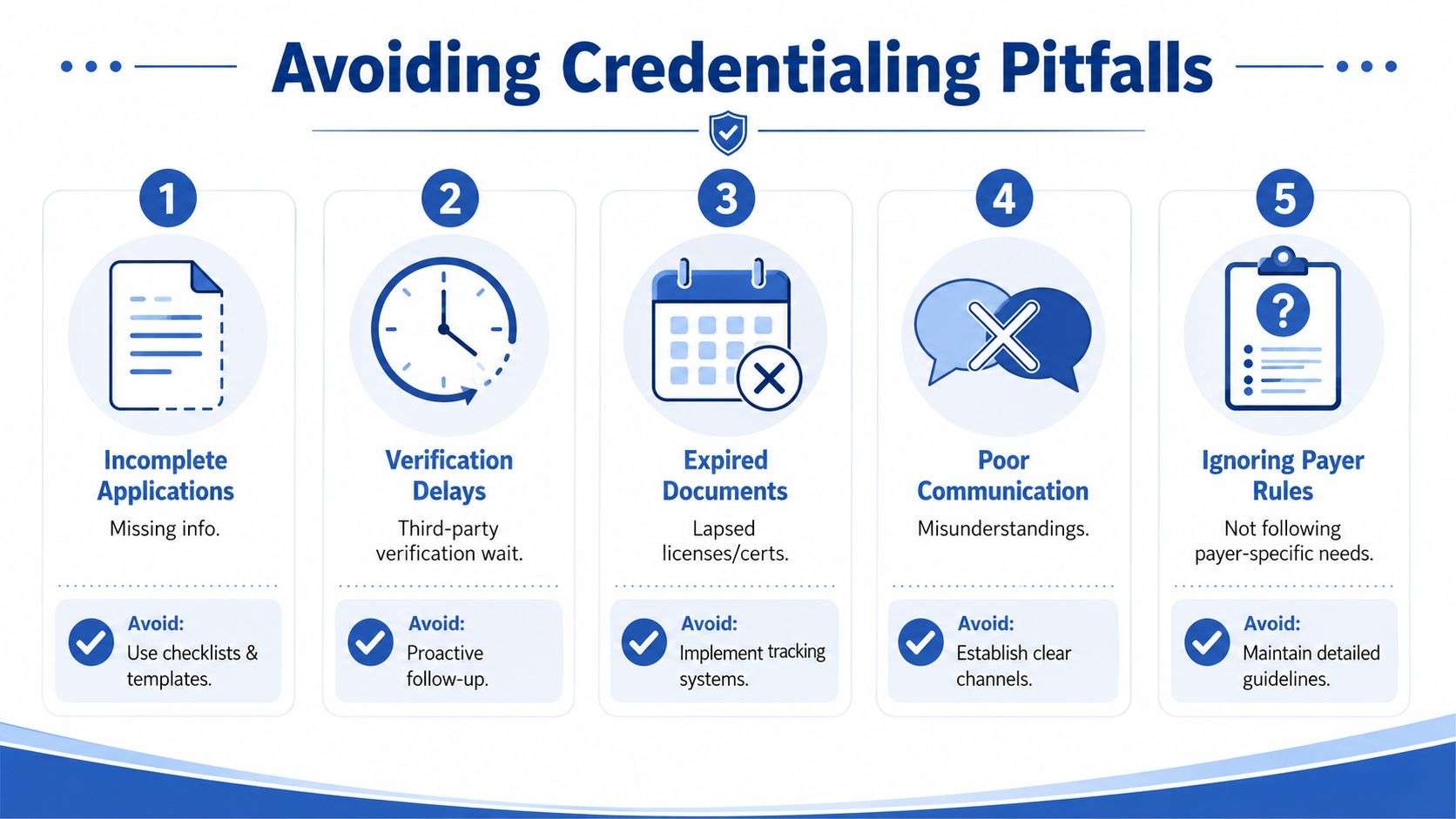
One important benchmark from StatPearls on provider credentialing is that provider groups usually enroll with an average of 5 to 10 payers. The same source highlights common failure points, including incomplete applications, inconsistent employment history, unreported disciplinary actions, and lapsed licenses. In practice, volume magnifies every small mistake because each issue has to be fixed payer by payer.
The Errors That Cause The Most Rework
Here are the problems I see most often and the fixes that help.
Incomplete applications
Missing fields seem minor until they trigger a stop-and-start review cycle. Use payer-specific submission checklists, not one generic checklist for all plans.Inconsistent work history
A CV that doesn't match the application creates immediate questions. Keep one master employment timeline and require staff to pull dates only from that record.Unreported disciplinary or malpractice history
The problem is often inconsistency, not the underlying event itself. If disclosure is required, answer fully and use the same wording everywhere it applies.Lapsed licenses or expiring documents
Expired records force avoidable follow-up. Maintain a renewal calendar visible to credentialing, HR, and compliance teams.Payer rule assumptions
Staff often reuse the last payer's workflow on the next payer. That leads to missing attachments, wrong submission paths, or incomplete location setup.
A Better Operating Model For Prevention
The easiest way to reduce errors is to create two review points instead of one.
First, do a document integrity review before any application is started. That review checks dates, disclosures, license status, and location data. Second, do a payer packaging review right before submission. That review confirms the application matches the payer's current requirements, including attachments and group details.
This two-step approach catches different kinds of mistakes. The first protects data quality. The second protects execution.
Field note: Every payer-specific correction should be added to your internal playbook immediately. If your team fixes the same issue twice, the process is leaking knowledge.
What To Standardize Across Sites
Multi-site groups should standardize the parts of credentialing that don't need local variation:
- Naming conventions for files
- One source of truth for employment history
- A shared renewal calendar
- Escalation rules for stuck applications
- Required documentation lists by provider type
What should stay flexible is anything tied to payer-specific or state-specific requirements. Strong credentialing operations know the difference between standardization and oversimplification.
Scaling Your Process When To Use Credentialing Services
There is a point where in-house credentialing stops being lean and starts being fragile. Often, this shift occurs unnoticed. One key employee owns all the payer logins. Expansion adds new providers faster than the team can submit. A delayed start date turns into delayed billing, then into claim cleanup and leadership escalations.

The business reason to act is straightforward. This analysis of provider credentialing delays describes the core problem as cash-flow delay. A provider may be clinically ready but unable to bill in network for 60 to 180 days because every health plan must approve enrollment separately.
Signs Your Internal Process Is At Capacity
You don't need a crisis to justify support. A few patterns usually tell the story:
- You are onboarding several providers at once: Submission volume rises faster than your follow-up capacity.
- You are opening or acquiring locations: Location setup, group relationships, and payer rosters become harder to control.
- You rely on one internal expert: If one person holds the process together, continuity risk is already high.
- Billing keeps discovering credentialing issues late: That means the process isn't integrated with revenue operations.
- Recredentialing sneaks up on the team: Recurring work is being managed reactively.
What Outsourcing Should Actually Solve
Credentialing services are useful when they improve process control, not just when they “take work off your plate.” The right support should give you structured document collection, payer application management, follow-up discipline, renewal tracking, and cleaner communication back to billing and operations.
For some groups, that means adding a specialized partner while keeping internal oversight. One example is medical billing and credentialing services, where support can include items such as CAQH renewals, payor enrollments, and revalidations alongside broader billing operations.
The trade-off is worth stating plainly. Outsourcing doesn't remove the need for internal ownership. Your practice still needs someone to approve data, respond to payer questions, and align provider start dates with actual enrollment status. What changes is that the administrative load becomes more scalable.
Choose Based On Complexity, Not Habit
Practices often keep credentialing in house because that's how they've always done it. That's not a strategy. The better question is whether your current setup can support growth without creating avoidable billing delays.
If the answer is no, getting help is not a surrender of control. It is a way to protect it.
If your team is juggling provider onboarding, payer enrollment, recredentialing, and billing readiness across multiple locations, One For All Medical Billing can support the operational side of that work with credentialing assistance as part of a broader revenue cycle workflow. The practical benefit is simple: fewer disconnected handoffs between credentialing and billing, clearer status visibility, and a process built to protect cash flow while your practice grows.

