

table of contents
You know the scenario. The claim was submitted correctly, the payer processed it, and then the money went to the patient instead of the practice. Now your staff is calling a patient who says they moved, lost the check, deposited it, or thought it was theirs to keep. What should have been a routine payment turns into rework, statements, follow-up calls, and avoidable aging.
That headache is why the Assignment of Benefits form matters far more than most new administrators expect. On paper, it looks like a standard registration document. In operations, it touches check-in, claim submission, denial prevention, payment posting, patient balance communication, and appeals. If the form is missing, vague, or handled casually, the problem shows up later in A/R.
A good Assignment of Benefits form doesn't fix every payment problem. It won't replace eligibility checks, prior authorization, or contract management. But when it's built correctly and used consistently, it removes one of the most common and preventable causes of payment confusion.
The Role of the Assignment of Benefits Form in RCM
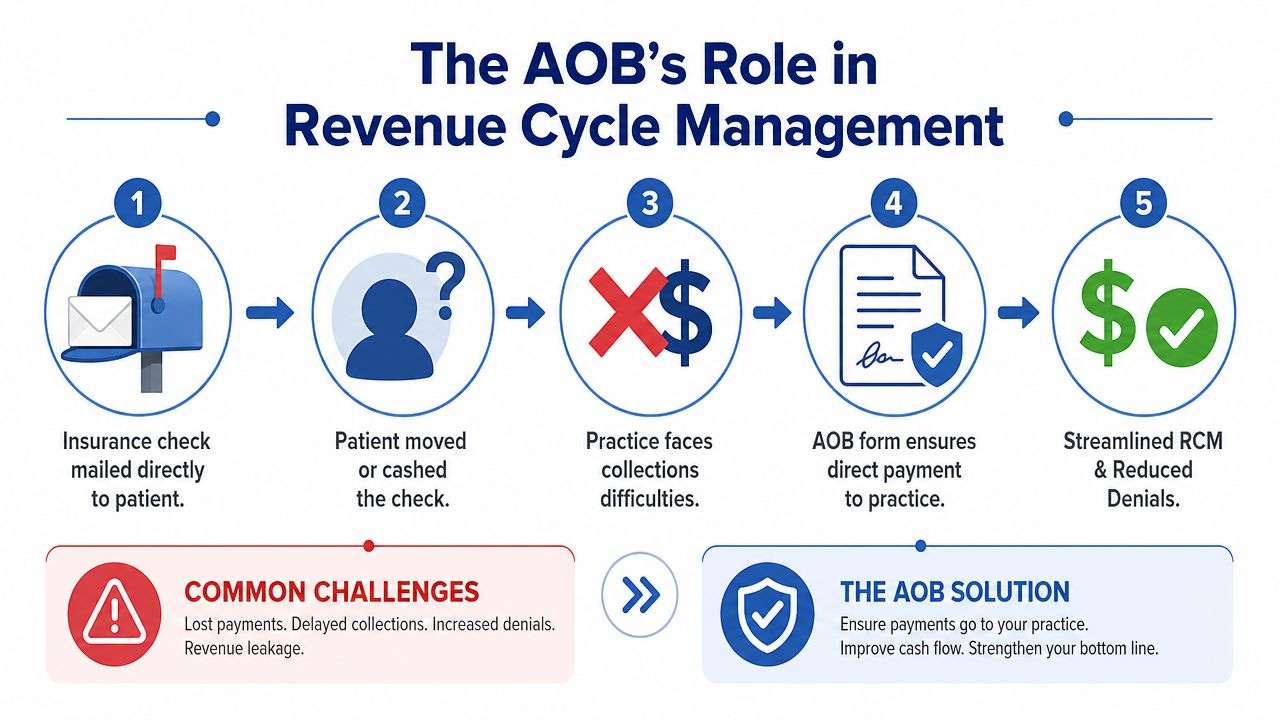
The cleanest way to understand an Assignment of Benefits form is this: it tells the insurer that the patient authorizes payment to go directly to the provider instead of to the patient. In healthcare, that written authorization is commonly collected at registration and attached to claims because it changes the payment path from patient reimbursement to direct provider reimbursement, as described by US Legal Forms' explanation of healthcare assignment of benefits.
Where It Changes The Revenue Cycle
Without a signed AOB, the practice may still provide care, submit the claim, and wait for adjudication. But if the payer sends reimbursement to the patient, your business office inherits a new collection problem that didn't need to exist.
With a valid AOB on file, the workflow is cleaner:
- The patient or guardian signs the form.
- Registration confirms the insurance information.
- Billing submits the claim with the proper documentation.
- The insurer can remit payment directly to the practice for covered services.
That one shift affects multiple downstream tasks. Payment posting is simpler. Reconciliation is more predictable. Staff spend less time chasing redirected checks and explaining to patients why insurance money isn't the same thing as a zero balance.
Why Administrators Should Treat It As A Control, Not A Form
New administrators sometimes see the AOB as passive paperwork. Strong billing teams treat it as a front-end financial control. It belongs in the same category as insurance verification, authorization tracking, and demographic accuracy.
Practical rule: If a form determines where money goes, it isn't just registration paperwork. It's part of cash control.
That mindset changes how teams manage it. Front desk staff stop treating signatures as box-checking. Billing teams stop discovering missing documentation after a denial. Managers build accountability around whether an AOB is present, legible, current, and retrievable.
If you're mapping the full financial workflow, it is then that broader medical practice revenue cycle management comes into focus. The AOB is only one document, but it sits at the intersection of patient intake, claim generation, and reimbursement routing.
What It Does And What It Doesn't Do
A signed Assignment of Benefits form helps direct payment. It doesn't guarantee payment. It doesn't override coverage limits, patient responsibility, or payer edits. If the patient has a deductible, copay, coinsurance, or non-covered service, the balance issue still exists. The AOB changes who gets paid first for covered services. It doesn't eliminate the rest of the collection cycle.
That's also why teams that submit Medicare claims effectively tend to do better overall. They don't rely on one document. They support it with clean intake, accurate data entry, and disciplined claim workflows.
Crafting a Bulletproof Assignment of Benefits Form
A weak AOB creates the same frustration as no AOB at all. If key fields are missing, if the language is too broad, or if the form can't be found when a payer asks for it, the practice still loses time and advantage.
A strong form starts at registration. Best-practice guidance describes the AOB as a front-end control: the patient or guardian signs it at check-in, staff verify demographic and insurance fields against the insurance card, and the executed document is stored in the EHR for audit and appeal retrieval. That same guidance also notes that claims-scrubbing should reject claims missing a signed AOB before submission, and it identifies the core components the form should capture, as outlined by CareCloud's AOB workflow guidance.
The Fields That Should Never Be Missing
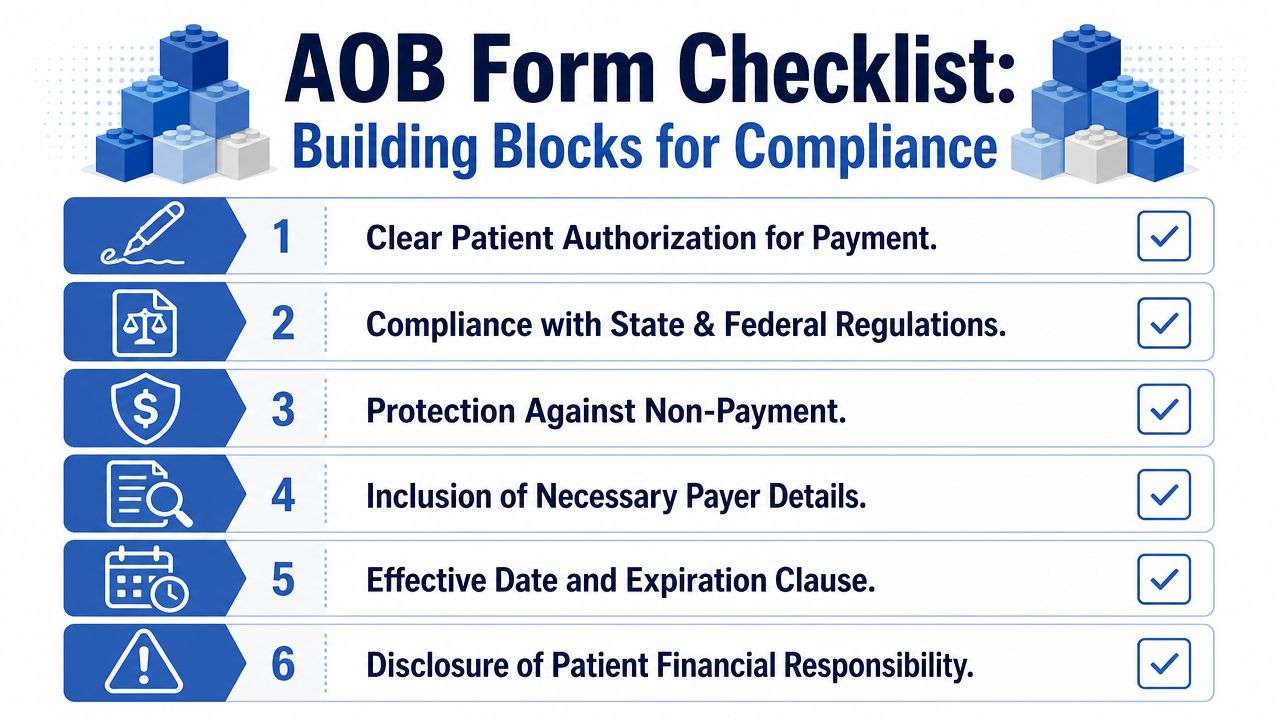
At minimum, your Assignment of Benefits form should include:
- Patient identification: Full patient name and the details your staff uses to match the document to the correct chart.
- Insurance information: Payer name, subscriber details, and policy information that matches the card on file.
- Scope of assignment: Clear language explaining what benefits are being assigned and for what services.
- Acknowledgment of responsibility: A statement confirming the patient still owes deductibles, copays, coinsurance, and non-covered amounts.
- Signature and date: The patient or authorized guardian must sign and date the form.
- HIPAA disclosure language: The payer needs lawful authority to disclose claim information and remit payment to the provider.
What fails in real life is rarely the concept. It's the execution. Staff skip fields because the lobby is busy. Someone uploads the form to the wrong chart. A scanned image is unreadable. The claim goes out anyway.
Sample Language That Works Better Than Vague Wording
Your legal counsel should approve final language, especially if you operate across states or specialties, but the assignment clause itself should be direct. A practical version usually reads something like this in substance:
I authorize payment of covered insurance benefits directly to the provider for services rendered. I understand that I remain financially responsible for any deductible, copayment, coinsurance, or non-covered amount. I also authorize release of information necessary to process this claim and support payment.
That wording does three jobs. It authorizes direct payment. It preserves patient balance responsibility. It supports necessary claim-related disclosure.
The form should also define whether the assignment is tied to a specific episode of care, date range, or class of services. Generic "everything forever" wording may create trouble later if the scope isn't what the practice intended.
Build The Form Into Your Systems
The best AOB isn't the prettiest PDF. It's the one your workflow can enforce.
Use your registration and practice systems so staff can see, at a glance, whether an executed form is on file. If you're tightening payment infrastructure more broadly, review how your team handles related forms such as an EFT authorization form. Practices that standardize document controls across intake and payment processes usually create fewer avoidable handoffs.
A practical audit checklist looks like this:
- At check-in: Confirm the signer has authority to sign.
- Before scan or upload: Check every required field for completeness and legibility.
- Before claim release: Use a scrubber edit or work queue hold if no signed AOB is attached or documented.
- During appeal prep: Make sure staff can retrieve the exact signed version quickly.
If your billers have to hunt for the AOB after a payer asks for it, your process is already too late.
Integrating AOBs Into Your Practice Workflow
The easiest way to see whether your process works is to follow one patient through the office.
A new patient arrives for an urgent visit. The front desk verifies identity, scans the insurance card, and hands over the registration packet. If the Assignment of Benefits form is buried in a stack of intake pages with no explanation, the patient signs half of it, skips a line, and hands it back. Nobody notices. The chart moves forward. The visit is coded, the claim is generated, and billing assumes intake did its job.
That's how small intake misses become back-end rework.

What Front Desk Staff Should Actually Say
Patients don't need a legal lecture. They need a plain explanation:
This form lets your insurance company send payment for covered services directly to the practice instead of mailing reimbursement to you.
That script reduces confusion and improves completion. It also lowers the chance that a patient later says they didn't understand why the insurer communicated with the provider about the claim.
For established patients, don't assume the old version is enough forever. Review the form when insurance changes, guardianship changes, or your organization updates language. The trigger doesn't have to be complicated. It just has to be consistent.
The Best Workflow Has Hard Stops
Most AOB failures happen because the process relies on memory. Someone is supposed to remember to check the form. Someone else is supposed to remember where it was stored. That's not a durable control.
A more reliable workflow uses the practice system to force action. If you're evaluating the broader role of practice management software, the key question is whether your platform can flag missing registration documents before claims are created.
Useful controls include:
- Required intake status fields: Staff can't finish registration until the AOB status is complete.
- Document naming standards: Every signed form uses the same naming convention in the chart.
- Claim hold logic: Claims stay in a queue if the AOB isn't present or is marked incomplete.
- Renewal prompts: Staff get a visible alert when the payer changed or the prior document needs review.
If your forms are digital, the integration matters as much as the form itself. A generic web form that dumps a PDF into email isn't enough. Teams that want cleaner intake should study how to integrate your online forms into downstream systems so signed documents land in the right workflow, not in someone's inbox.
Storage Has To Support Appeals, Not Just Intake
Scanning the form into the chart isn't the finish line. The business office has to retrieve it quickly when a payer asks for proof, when a denial needs appeal support, or when payment was misdirected. That means indexing by patient, date, and document type. It also means staff should know exactly where to find it without asking around.
The test is simple. If a payer questions payment direction today, can your team pull the signed AOB in minutes? If not, your workflow is incomplete.
Preventing Common AOB-Related Claim Denials
Most AOB-related payment problems don't start with a payer being difficult. They start with sloppy language or incomplete documentation. The most dangerous version is the form that looks finished but isn't enforceable enough to do what the practice expects.
Risk guidance on assignment of benefits points to two recurring problems: overbroad language and incomplete language. It also notes that only the relevant parts of the claim should be assigned because the rights named in the contract transfer to the assignee, and it highlights that sample statutory-style language often assigns “all medical, dental and surgical benefits” plus direct authorization to the payer, as discussed in ClaimSpot's guide to assignment of benefits risks.
The Denial Problems You Can Actually Prevent
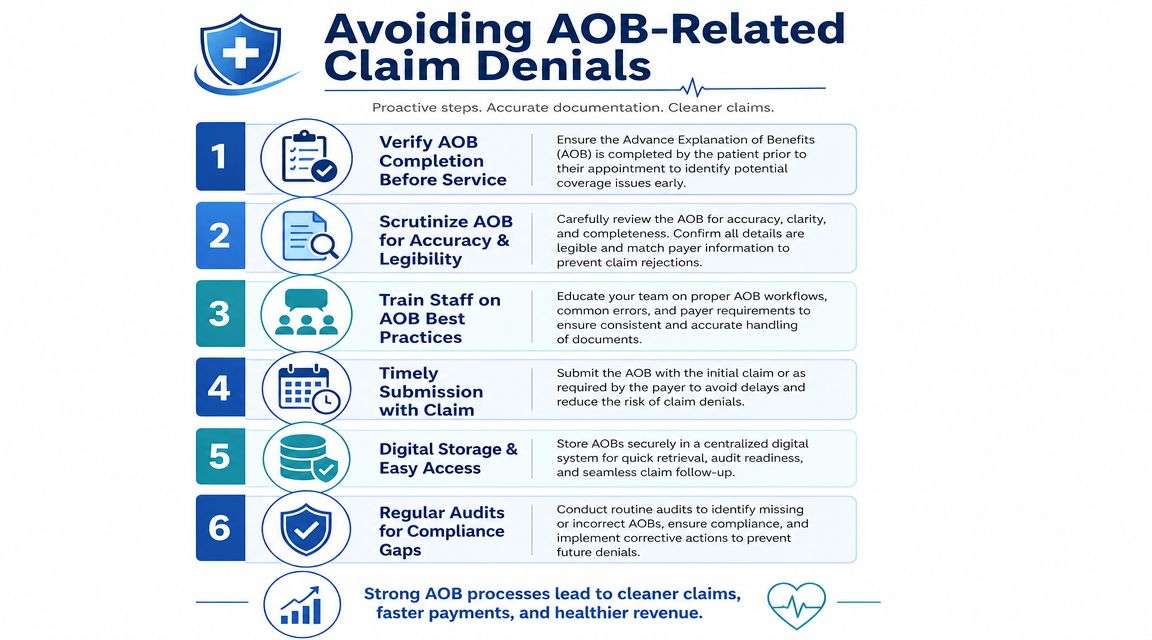
AOB-related denials and payment delays usually come from a short list of operational failures:
- Missing signature: The form exists, but the patient or guardian never completed the signature line.
- Unreadable document: The scan is cut off, faint, or stored so poorly that staff can't use it.
- Mismatched information: The patient or insurance details on the form don't match the current claim.
- Scope problems: The assignment language is vague, too broad, or not aligned to the services billed.
- No retrieval process: The payer asks for the signed form and the practice can't produce it quickly.
These are fixable. They aren't abstract compliance issues. They're process defects.
Why Broad Language Can Backfire
Many administrators assume broader language gives more protection. Sometimes it creates more room for dispute. If the form assigns more than the practice intends, you can end up with arguments about privacy authorization, appeal rights, or who has authority over parts of the claim.
That's why the safer benchmark is complete but controlled. The AOB should say enough to support direct payment and necessary claim communication, but it shouldn't wander into language your organization can't defend or operationalize.
The best AOB language is specific enough to be enforceable and narrow enough to be manageable.
This is also where billing and compliance need to work together. Denial teams see the practical fallout first. Compliance teams understand how state rules, payer contracts, and patient rights shape the language.
The Operational Fixes That Work
If you want fewer AOB-related denials, focus on controls before claim submission:
- Review the form for completion before the patient leaves.
- Train staff to compare the form against the insurance card, not against memory.
- Reject claims internally when the signed AOB isn't on file.
- Keep the document easy to retrieve for first-pass submissions, payer requests, and appeals.
- Audit a sample of claims regularly to catch patterns in missing or weak documentation.
Your denial workflow should also spell out what staff do when a payer still sends payment to the patient. The response should include confirming whether a valid AOB was on file, documenting the payer's action, and escalating the issue through your normal follow-up and appeal channels. Teams that already have a structured medical billing denial management process handle this more consistently because ownership is clear.
One more point matters. If the claim itself is wrong, the AOB won't save it. A clean AOB supports reimbursement. It doesn't cure coding errors, eligibility mistakes, missing authorization, or non-covered services.
Navigating Legal and State-Specific Nuances
An Assignment of Benefits form is a contract. That matters because contracts don't live in a vacuum. They sit inside state law, payer rules, patient rights, and whatever language your organization puts on paper.
A useful reminder comes from outside healthcare. Florida required insurers to collect detailed Assignment of Benefits experience reporting for property claims, with filings due by January 30, 2022, under a state reporting form. While that wasn't a medical billing rule, it shows how formally regulators treat AOB arrangements when they affect claims handling, payment direction, and disputes, as reflected in the Florida Office of Insurance Regulation AOB reporting form.
Why This Matters For Healthcare Practices
Healthcare leaders should take the same lesson: don't assume the AOB is casual because it's common. The signer is authorizing a third party to receive payment and act on the claim. That creates legal consequences around scope, disclosure, and enforcement.
Three variables usually need close review:
- State rules: State law can shape enforceability, required language, and how broadly rights can be assigned.
- Network status: In-network and out-of-network workflows don't always create the same operational risks, especially when patient balances remain.
- Service scope: A form meant for a narrow episode of care may not be appropriate as an evergreen document.
Broad Versus Service-Specific Forms
Some organizations prefer one broad AOB that stays on file. Others use language tied to a visit category, payer change, or date range. Neither choice is automatically right.
A broad form reduces repeat paperwork. It can also create avoidable ambiguity. A service-specific form is easier to defend operationally because staff know what it covers, but it requires stronger renewal discipline.
The right decision depends on your mix of specialties, payer behavior, and legal review. Multi-site groups need extra caution because one intake policy may play differently across locations and service lines.
When administrators get into trouble with AOBs, it's usually because they copied language before they understood the risk attached to it.
The Overlap With Other Financial Rights
AOB discussions often surface alongside other legal recovery tools, especially in accident-related care, out-of-network disputes, or contested payment situations. That's one reason administrators sometimes compare payment assignment processes with rights-preservation tools such as filing a lien. They aren't the same thing, and they shouldn't be treated as interchangeable, but both require clear documentation, timing discipline, and legal awareness.
The practical takeaway is simple. Review your AOB with counsel who understands healthcare reimbursement in the states where you operate. Then train your team to use that approved version consistently. The legal risk usually isn't in the concept. It's in variation, improvisation, and stale forms that stayed in circulation too long.
Answering Your Top AOB Questions
The biggest misunderstanding about the Assignment of Benefits form is that once it's signed, payment problems should disappear. In practice, the better question is narrower: when does the AOB help, and when does the problem lie elsewhere?
That distinction matters because assignment of benefits doesn't eliminate patient responsibility for deductibles, copays, or non-covered services, and operational guidance often notes that it mainly changes who gets paid first rather than who ultimately owes the remaining balance. It also raises a more practical issue for billing leaders, which is whether the form improves collections in specific workflows, as discussed in Operations Army's overview of AOB collection realities.
Do You Need A New AOB If Insurance Changes
Usually, you should review and often re-execute the form when the payer changes. The assignment is tied to payment rights and claim handling. If the insurance information changes, relying on an older document can invite unnecessary arguments about whether the authorization still matches the current coverage and services.
The safer operational rule is straightforward. When coverage changes, revisit all financial paperwork, not just the insurance card.
What About Minors Or Incapacitated Patients
The signer must have authority to sign. For minors, that generally means a parent or legal guardian. For incapacitated patients, the authorized representative must be identified according to your intake and compliance requirements.
The billing problem here isn't subtle. If the wrong person signs, the form may still look complete in the chart while failing when the practice needs to rely on it.
Are Digital Signatures Acceptable
They can be, if your workflow, document retention, and legal review support them. The practical issue isn't whether ink touched paper. It's whether the signature process is valid, attributable, stored properly, and retrievable later.
If your team adopts digital intake, make sure the AOB lands in the patient record with the same reliability as any other signed financial document. A digital process that loses auditability is worse than paper.
Why Payments Still Get Delayed Even With A Perfect AOB
Administrators need the most realism in this area. A complete Assignment of Benefits form helps with payment direction. It doesn't fix:
- Eligibility problems: The patient wasn't covered as expected on the date of service.
- Authorization gaps: The service needed prior authorization and didn't have it.
- Claim errors: Coding, modifiers, or demographic data were wrong.
- Coverage limits: The service wasn't payable under the patient's plan.
- Patient balance confusion: Covered payment went to the provider, but the patient still owes part of the account.
That's why strong collections don't come from the AOB alone. They come from a stack of controls that work together.
When Does The AOB Deliver The Most Value
It delivers the most value when the claim is otherwise clean and the practice wants to avoid reimbursement being routed through the patient. It delivers less value when the barrier is medical necessity, prior authorization, payer policy, or residual patient responsibility.
In other words, the AOB is most effective when it's treated as one link in the revenue cycle, not as a cure-all.
If your practice is dealing with misdirected payments, registration gaps, rising denials, or inconsistent follow-up across locations, One For All Medical Billing can help you tighten the full revenue cycle around forms like the Assignment of Benefits, not just the paperwork itself. Their team supports practices that need stronger front-end controls, cleaner claims, and more reliable collections without adding more stress to internal staff.

